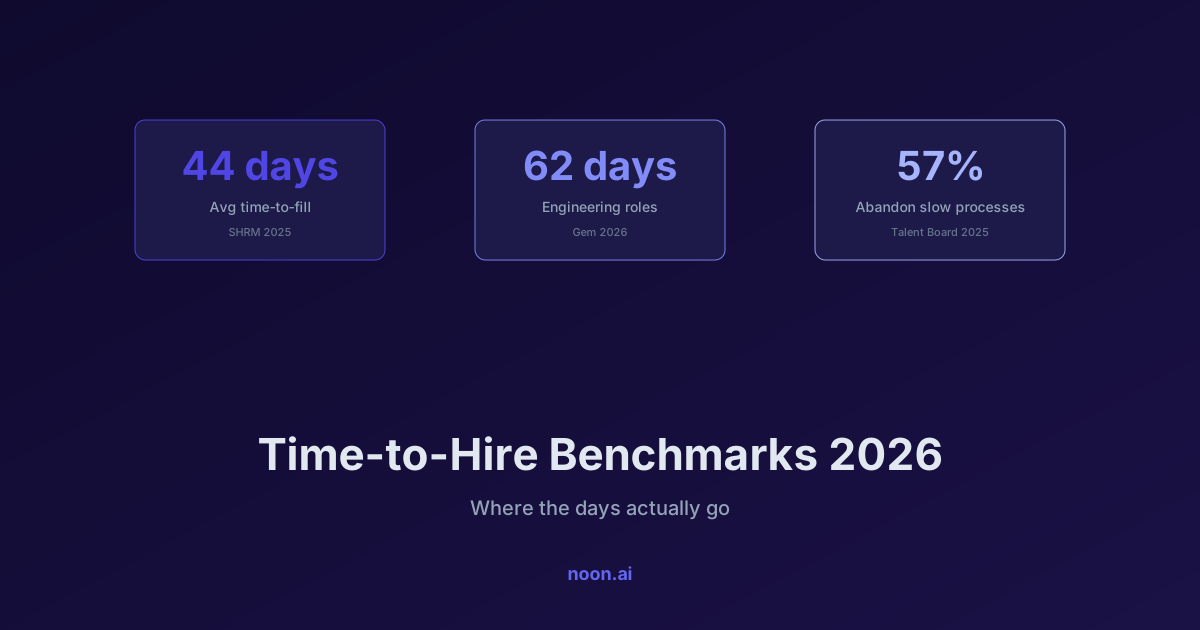
Key takeaway: Median time-to-fill for nonexecutive positions dropped to 39 calendar days in 2026, from 44 days in 2025 (SHRM 2026 recruiting benchmarking). Executive roles hold at 45 days. Engineering roles still average 62 days — the slowest function. Roles using AI-assisted sourcing move from first contact to accepted offer in 28 days versus 41 for manual sourcing, and 57% of candidates say they've dropped out of a process because it took too long.
Speed is the recruiting metric candidates feel. Every extra week in your process is a week your best candidate spends interviewing somewhere else.
The 2026 numbers finally moved in the right direction: after three years of processes getting slower, median time-to-fill for nonexecutive roles fell five days year over year. SHRM attributes the improvement partly to AI-assisted automation of repetitive recruiting work, noting that organisations with the most effective recruitment practices fill roles five days faster than the rest (SHRM, 2026).
Here are the current time-to-hire and time-to-fill benchmarks, with sources, plus the stage-level view of where the days actually go. For the full metric set, see our 50 recruitment statistics for 2026.
Time-to-fill vs. time-to-hire: which are you measuring?
The two get conflated constantly, and benchmarks differ:
- Time-to-fill: days from requisition opening to offer acceptance. Measures overall process and sourcing capacity.
- Time-to-hire: days from a candidate entering your pipeline to accepting the offer. Measures process speed as the candidate experiences it.
A 39-day time-to-fill with a 21-day time-to-hire means you spend more time finding candidates than evaluating them — a sourcing problem, not an interview problem. The fix differs accordingly.
What are the time-to-fill benchmarks for 2026?
| Benchmark | Days | Source |
|---|---|---|
| Median time-to-fill, nonexecutive positions | 39 | SHRM 2026 recruiting benchmarking |
| Median time-to-fill, nonexecutive positions (2025) | 44 | SHRM, 2025 |
| Median time-to-fill, executive positions | 45 | SHRM, 2026 (unchanged from 2025; 60 days in 2022) |
| Engineering / technical roles | 62 | Gem 2026 Recruiting Benchmarks |
| First contact → accepted offer, AI-assisted sourcing | 28 | Aptitude Research, 2025 AI in Talent Acquisition Report |
| First contact → accepted offer, manual sourcing | 41 | Aptitude Research, 2025 |
The headline improvement is real but narrow: it applies to nonexecutive roles. Executive time-to-fill has not moved since 2025, and executive median cost-per-hire jumped to $15,000 from $10,600 in the same period (SHRM, 2026) — senior searches got more expensive without getting faster. Our cost-per-hire benchmarks cover that side of the ledger.
Three structural notes on the averages:
Processes are getting heavier, not lighter. The average hiring process now involves 13 interviews per hire, up 42% from three years ago. Source: Gem 2026 Recruiting Benchmarks (165M applicants, 15M candidates, 1.2M hires)
Volume is up but so is noise. Applications per posting surged 93% in 2025 on AI-assisted apply tools, and LinkedIn recorded 14,200 applications per minute at the February 2025 peak — screening time balloons even when qualified candidates don't. Source: Gem 2026 Recruiting Benchmarks; LinkedIn Talent Solutions, 2025
Recruiter load is climbing fast at the top end. Extra-large organisations (5,000+ employees) saw a 67% increase in requisitions per recruiter in 2026, and more than two in three organisations reported struggling to fill open positions. Source: SHRM 2026 recruiting benchmarking
That combination — faster median fills alongside far heavier per-recruiter load — is the clearest signal in this year's data that the gains are coming from automation rather than from added headcount.
Where do the 39 days actually go?
For a typical professional role, the days cluster in four places (and note that a median hides a long tail — the roles that blow past 60 days are usually stuck in stage 1 or 2):
- Sourcing and top-of-funnel screening — usually the largest block for outbound-driven roles. TA teams are 14% leaner than in 2021 while managing 43% more reqs per recruiter (Gem 2026), so pipelines start slower.
- Interview scheduling — the silent killer. Coordinating 13 interviews across calendars adds days per round; every reschedule adds more.
- Interview loops themselves — more rounds = more elapsed weeks, with each round gated on the slowest interviewer's calendar.
- Offer approval and negotiation — internal comp approvals frequently add a final week.
If you only instrument one thing, instrument stage-by-stage elapsed time. Teams that can't see which stage eats the days default to blaming sourcing — see our guide to recruiting efficiency tools for the instrumentation stack.
Why speed wins offers
57% of candidates say they've dropped out of a hiring process because it took too long. Source: Talent Board 2025 Candidate Experience Report
76% of candidates say the hiring process directly influences their perception of the company — slow processes don't just lose candidates, they mark your employer brand. Source: Talent Board 2025 Candidate Experience Research
And offer acceptance rates average 82% (Gem 2026) — but acceptance correlates with momentum. Candidates who move through a tight, responsive process accept; candidates parked for two weeks between rounds arrive at the offer with competing options.
What actually shortens time-to-hire?
1. Fix sourcing latency first. The 13-day gap between AI-assisted (28 days) and manual (41 days) first-contact-to-offer timelines comes mostly from the front of the funnel: AI sourcing produces qualified pipeline in hours instead of weeks and re-engages the 46% of eventual hires who are already sitting in your ATS (Gem 2026).
2. Automate scheduling. Self-serve interview booking removes the multi-day email ping-pong per round — see AI scheduling for how the coordination step disappears. This is one of the 11 highest-yield automations we cover in recruitment process automation, and pricing models for standalone scheduling tools are compared in our interview scheduling software guide.
3. Cut interview rounds deliberately. If your loop grew 42% like the industry's did, audit which rounds changed a decision in the last 20 hires. Rounds that never flip outcomes are pure latency.
4. Personalize outreach so the funnel starts warmer. Across 844,234 candidate sequences on the Noon platform between August 2025 and July 2026, 16.6% of contacted candidates replied, and 65% of replies arrived only after a follow-up (Noon recruiting outreach benchmarks, 2026). Higher reply rates mean fewer sourcing cycles to build the same shortlist.
At Noon, the autonomous agent handles the first two levers end-to-end: continuous whole-web sourcing via the AI sourcer, evaluation against role-specific criteria, personalized multi-channel outreach, and an AI Coordinator that books interviews directly onto calendars — designed to compress the sourcing and scheduling blocks where most of the 39 days hide. If your team is managing 43% more reqs per recruiter and needs to shorten time-to-fill without adding headcount, book a demo to see how the autonomous agent compresses the 28-day gap between AI-assisted and manual sourcing timelines.
FAQ
What is the average time-to-fill in 2026? The median is 39 calendar days for nonexecutive positions and 45 days for executive positions (SHRM 2026 recruiting benchmarking). The nonexecutive figure fell from 44 days in 2025. Engineering and technical roles average 62 days (Gem 2026 Recruiting Benchmarks).
Did time-to-fill get faster in 2026? For nonexecutive roles, yes — the median dropped five days year over year, and SHRM links the improvement to AI automation of repetitive recruiting tasks, noting that organisations with the most effective recruiting practices fill roles five days faster than others. Executive time-to-fill did not move, and executive cost-per-hire rose to a median of $15,000 from $10,600 (SHRM, 2026).
What's a good time-to-hire? Roles using AI-assisted sourcing average 28 days from first contact to offer acceptance versus 41 days for manual sourcing (Aptitude Research, 2025). If your professional-role time-to-hire is under 30 days, you're outperforming the market; over 45, you're losing candidates to faster competitors.
How many interviews does the average hire take? 13 interviews per hire, up 42% from three years ago (Gem 2026 Recruiting Benchmarks).
Does a slow hiring process actually lose candidates? Yes — 57% of candidates report abandoning a process because it took too long (Talent Board 2025), and 76% say process speed and quality shape their perception of the employer. Delay in the shortlist-review step is the most expensive kind, because the candidates waiting on it are the ones already interviewing elsewhere; see our guide to what a hiring manager owns for how to set a feedback SLA.
What is the fastest way to reduce time-to-fill? For most teams: automate top-of-funnel sourcing and interview scheduling. Those two stages account for most elapsed days, and both are automatable without changing your interview bar. See 11 ways to automate the recruitment process for the stage-by-stage playbook.