
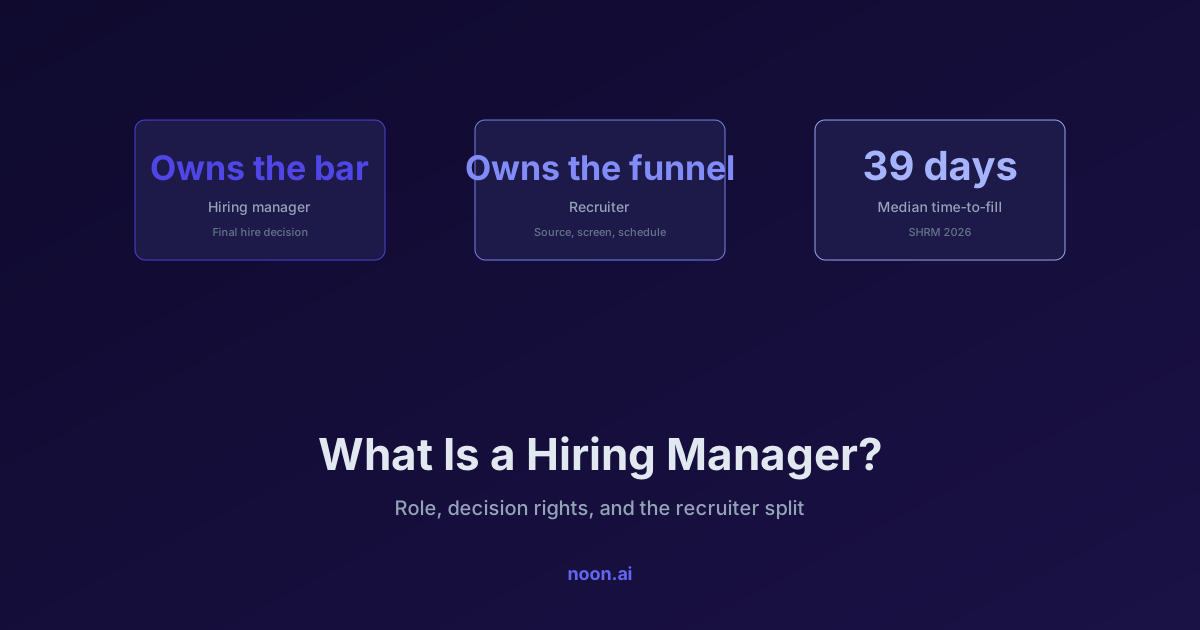
Key takeaway: A hiring manager is the person the new hire will report to — they own the requisition, define what "qualified" means for the role, run the substantive interviews, and make the final hire/no-hire call. The recruiter owns everything that gets a shortlist to that decision: sourcing, screening, scheduling, and offer logistics. The split matters because it is where hiring quietly breaks: the share of recruiting executives naming hiring manager or stakeholder engagement as a top focus area fell from 22% in 2025 to 16% in 2026 even as requisitions per recruiter rose 67% at the largest organisations (SHRM Recruiting Executives Priorities and Perspectives 2026; SHRM 2026 recruiting benchmarking).
The title causes confusion because it sounds like a job. It is not — it is a role someone takes on temporarily. An engineering director hiring two backend engineers is a hiring manager for those two requisitions and an engineering director for everything else.
That distinction has practical consequences. Hiring managers are, almost by definition, part-time at hiring: they carry a full workload alongside the requisition, they typically hire a handful of times a year, and they rarely receive training in it. Nearly everything that goes wrong in a hiring process traces back to that structural fact rather than to bad intent. For broader context on structuring the recruiting process around this reality, see our hiring best practices guide.
What does a hiring manager actually do?
Across a normal requisition, the hiring manager owns six things:
- Opens and justifies the requisition — headcount case, level, budget, start date.
- Defines the bar — the must-have criteria, the nice-to-haves, and what evidence counts as proof of each.
- Approves the shortlist — decides which sourced or applied candidates are worth interviewing.
- Runs the substantive interviews — the ones assessing whether the person can do the job.
- Makes the final decision — hire, no hire, or keep looking.
- Owns the outcome — onboarding, ramp, and performance of the person hired.
Item 6 is what separates a hiring manager from every other interviewer in the loop. They live with the decision. Everyone else in the process gives an opinion; the hiring manager absorbs the consequences, which is why they get the final call even when the recruiter has seen ten times more candidates.
Hiring manager vs. recruiter: who owns what?
| Stage | Hiring manager owns | Recruiter owns |
|---|---|---|
| Requisition | Business case, level, budget, target start date | Market reality check: supply, comp, realistic timeline |
| Role definition | Must-have criteria and how they will be evidenced | Turning that into a job description, search strategy, and screening rubric |
| Sourcing | Calibration feedback on early profiles | Finding and contacting candidates; pipeline volume and quality |
| Screening | Reviewing the shortlist | First-pass screens, scheduling, candidate communication |
| Interviews | Assessing capability; running the technical/functional loop | Loop design, interviewer training, keeping the process on schedule |
| Decision | Final hire/no-hire call | Debrief facilitation, bias checks, competitive context |
| Offer | Approving level and comp | Negotiation, closing, offer logistics |
| Post-hire | Onboarding and ramp | Feedback loop into the next requisition |
Two failure modes come straight out of this table. When the hiring manager skips the calibration column, the recruiter sources against a guess and the first shortlist is rejected wholesale — expensive, because sourcing is the largest block of elapsed time in most searches. When the recruiter skips the market reality check, the requisition launches with a bar the market cannot supply, and the search stalls at week six.
Note also who is not in the table: HR. In most organisations HR owns policy, compensation bands, and compliance — not the hire decision. And the "talent acquisition" function is the recruiter's column, not a third party. Our guide to full-cycle recruiting covers what changes when one person holds both columns.
Who makes the final hiring decision?
The hiring manager, in the overwhelming majority of organisations. Recruiters recommend, interviewers score, and panels debate — but the person accountable for the new hire's performance signs off.
Two common exceptions: executive hires, where the decision usually escalates to the hiring manager's leadership or the board; and consensus-model companies, where a hiring committee independent of the manager makes the call specifically to prevent individual managers from lowering the bar under pressure. Both trade speed for consistency. SHRM's 2026 benchmarking puts median time-to-fill at 45 days for executive positions versus 39 days for nonexecutive, and median cost-per-hire at $15,000 for executive roles, up from $10,600 in 2025 (SHRM 2026 recruiting benchmarking) — most of that gap is decision-making layers, not sourcing difficulty.
Why does the recruiter–hiring manager partnership break down?
Because the recruiter's capacity is shrinking while the hiring manager's attention is scarce.
Recruiter load is rising sharply. Extra-large organisations saw a 67% increase in requisitions per recruiter in 2026 (SHRM 2026 benchmarking). A recruiter carrying twice the reqs cannot chase a hiring manager for shortlist feedback the way they used to.
Hiring-manager engagement is being deprioritised. The share of recruiting executives naming hiring-manager or stakeholder engagement as a top focus area fell from 22% in 2025 to 16% in 2026, while recruiting function strategy jumped from 30% to 42% and recruiter talent development fell off the list entirely, from 10% to 0% (SHRM Recruiting Executives Priorities 2026). Leadership attention is moving up to strategy while the operational handoff gets thinner and the person running it gets less development.
The market is unforgiving of delay. More than two in three organisations reported struggling to fill open positions in 2026 (SHRM 2026 benchmarking), and 61% of job seekers say they have been ghosted after an interview (Greenhouse, December 2024) — much of which is a hiring manager who never returned a verdict.
The cheapest fix is a structured intake and a fixed feedback SLA. The expensive fix is discovering at week eight that the manager's actual bar was never written down. Our talent evaluation guide covers how to convert a manager's intuition into criteria a recruiter can screen against.
What should a recruiter ask in a hiring manager intake?
Seven questions that surface everything the search depends on:
- Who has done this job well before, here or elsewhere? Names and profiles beat adjectives. This gives the recruiter a search template.
- What are the true non-negotiables? Criteria you would reject an otherwise excellent candidate over. Usually two or three, never ten.
- What are you willing to trade? Years of experience for domain knowledge? Scale for speed? The tradeoff list is the search's degrees of freedom.
- What does this person do in their first 90 days? Converts a wish list into a job.
- Who else must say yes, and when do they get involved? Prevents a surprise veto in week seven.
- How fast can you give feedback on a shortlist? Agree a number — 48 hours is a normal SLA — and hold both sides to it.
- What would make you decline an offer-ready candidate? Surfaces the unstated bar.
Run this once at kickoff and again after the first five profiles, when the manager's stated criteria meet actual candidates. The second conversation is usually more informative than the first.
How does AI change the hiring manager's role?
It moves the manager's involvement earlier and makes it cheaper to give.
Traditionally, hiring-manager input arrived as a shortlist review — a batch verdict on candidates a recruiter had already spent days finding. With agentic sourcing, the same input becomes a continuous signal. At Noon, hiring managers give thumbs-up/down feedback on surfaced profiles and the AI sourcer recalibrates per role from that feedback; "unlearning" re-evaluates candidates already surfaced when criteria change, so a corrected bar updates the existing pipeline rather than only future searches. Non-negotiables sit outside that loop as strict criteria the AI never relaxes — the intake question 2 above, encoded.
The practical effect on the partnership is that the manager's five minutes of feedback compounds instead of evaporating, and the recruiter stops re-litigating the same criteria every batch. SHRM found that organisations with the most effective recruitment practices — which it associates with advanced technology use, including AI — fill roles five days faster than other organisations (SHRM 2026 benchmarking).
Interview load moves too: AI notetaking produces the transcript, summary, and coverage check on the questions the team agreed to ask, which is usually the part of the loop a busy hiring manager does worst. See our guide to interview notetaking for what to keep human. If you want to see how agentic sourcing calibrates from hiring manager feedback in your requisitions, you can book a demo to walk through a live search.
FAQ
What is the difference between a hiring manager and a recruiter? The hiring manager is the person the new hire will report to; they define the bar, run the substantive interviews, and make the final decision. The recruiter runs the process that produces the shortlist — sourcing, screening, scheduling, and closing. One owns the outcome, the other owns the funnel.
Is the hiring manager the same as HR? No. HR owns policy, compensation structure, and compliance. The hiring manager is a line manager in the business with an open role on their team. In smaller companies one person may wear both hats, but the roles are distinct.
Does the hiring manager make the final decision? Yes, in most organisations — they are accountable for the hire's performance. Exceptions are executive searches, which typically escalate to senior leadership or the board, and companies that use an independent hiring committee to hold a consistent bar.
How involved should a hiring manager be in sourcing? Enough to calibrate, not enough to search. The highest-leverage involvement is fast feedback on the first batch of profiles: it tells the recruiter (or the sourcing agent) what "qualified" actually means before the search scales. Beyond that, a hiring manager reviewing raw profiles is expensive time poorly spent.
How long should a hiring manager take to review a shortlist? Agree an explicit SLA at intake; 48 hours is a common standard. Delay at this step is the most expensive kind, because it stalls a pipeline of candidates who are actively interviewing elsewhere — median time-to-fill is 39 days for nonexecutive roles (SHRM, 2026), and candidates in play do not wait out a slow reviewer.
What makes someone a good hiring manager? Three habits: writing down the bar before seeing candidates, giving feedback within a fixed window, and interviewing for evidence rather than impressions. Our comparison of good and bad interviewers covers the interview half in detail.
What other titles mean "hiring manager"? It is a role, not a title — the person may be a director, team lead, VP, or founder. Job ads sometimes use "hiring team" or "people manager" for the same function. What stays constant is the definition: the person the new hire reports to and who owns the hire/no-hire decision. If a job description names a "hiring manager" who will not manage the person, it means "recruiter".