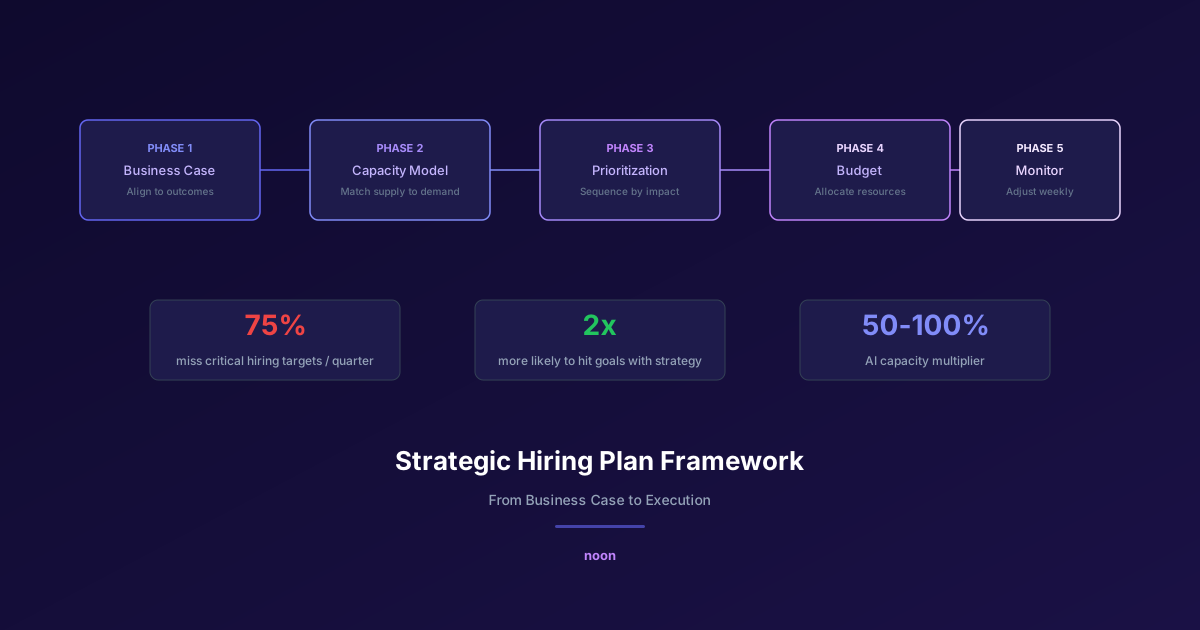
Key takeaway: A strategic hiring plan aligns headcount with business goals, maps talent needs 6-12 months ahead, and prioritizes roles by revenue impact. The five components are: business case connecting each hire to outcomes, a capacity model showing recruiting team's ability to execute, a prioritized and sequenced role list, budget allocation across tools, advertising, agencies, and team, and a monitoring cadence with specific KPIs and adjustment triggers. Companies with formal hiring plans fill roles 35% faster and reduce cost-per-hire by 20%.
Most hiring plans are spreadsheets. A list of roles, target start dates, and the names of hiring managers who requested them. The plan gets approved in January, starts falling behind by March, and is quietly abandoned by Q3 when priorities shift and budgets tighten.
The fundamental problem isn't the spreadsheet. It's that the plan disconnects headcount from business outcomes. "Hire 15 engineers in H1" is a target, not a strategy. A strategic hiring plan answers different questions: What business outcomes depend on these hires? What happens if we don't make them? What's our actual capacity to execute this plan? And how do we adjust when reality diverges from the forecast? This framework builds on principles covered in our broader hiring best practices guide, with specific focus on the planning and capacity modeling components.
According to Aptitude Research's 2025 Talent Acquisition study, companies with documented hiring strategies are 2x more likely to achieve their hiring goals. Yet most organizations treat workforce planning as an annual exercise rather than a continuous practice. The result: 75% of companies report missing at least one critical hiring target per quarter.
This guide covers the framework for building a hiring plan that actually works — from business case development through execution monitoring — with specific attention to how AI sourcing tools change the capacity math.
Why most hiring plans fail
The forecast problem
Hiring plans are built on forecasts. Forecasts are built on assumptions. Assumptions are frequently wrong.
The VP of Sales projects 40% revenue growth and requests 12 new AEs. By May, growth is tracking at 25% and the CFO freezes 4 of those headcount slots. But recruiting already invested 6 weeks sourcing for the now-frozen roles.
Meanwhile, the VP of Engineering didn't plan for turnover. Two senior engineers resign in February. Now there are 2 unplanned critical roles competing with the planned hiring for recruiter bandwidth.
The fix: Build flexibility into the plan. Separate "committed" hires (budgeted, approved, certain) from "projected" hires (likely but contingent on milestones). Allocate recruiting resources primarily to committed hires and begin early-stage sourcing for projected hires without full commitment.
The capacity problem
Most hiring plans are built by department heads requesting headcount without any understanding of recruiting capacity. The result: a plan that calls for 50 hires in H1 with a team of 3 recruiters managing 17 active reqs each — a pace that guarantees quality degradation.
The capacity math:
- Average recruiter manages 15-25 active reqs (Gem 2026)
- Average time-to-fill: 44 days (SHRM 2025)
- Average hires per recruiter per month: 3-5
If the plan calls for 30 hires in Q1, you need 3-4 full-time recruiters dedicated to that workload. If you have 2 recruiters who also support other departments, the plan is already dead.
The fix: Model recruiting capacity before finalizing the hiring plan. If capacity doesn't match demand, either add recruiters, extend timelines, or introduce AI sourcing to expand capacity without headcount.
The prioritization problem
When everything is priority one, nothing is. Most hiring plans list 30 roles without clear sequencing. When recruiters are overwhelmed, they default to working on the roles with the most persistent hiring managers — not the roles with the most business impact.
The fix: Force-rank every hire by business impact. Which roles, if left unfilled, would cause the most revenue impact, project delay, or customer risk? Those get sourcing resources first.
The strategic hiring plan framework
Phase 1: Business case alignment (Weeks 1-2)
Before any requisitions are opened, connect hiring to business outcomes:
Revenue-linked roles: "Hiring 6 AEs by March 1 enables $4.2M in additional pipeline by Q3, based on 9-month average ramp time and $700K average pipeline per rep."
Capacity-linked roles: "Hiring 3 customer success managers by April prevents churn in 45 accounts worth $2.1M ARR, where current CSM ratio has exceeded 1:80."
Risk-linked roles: "Hiring a second DevOps engineer reduces deployment risk. We currently have single-point-of-failure on infrastructure with no backup."
This exercise accomplishes two things: (1) It forces prioritization — roles with clear business cases rank higher than "nice to have" additions. (2) It creates executive alignment — when the CFO asks why recruiting spend increased 20%, the answer ties directly to revenue targets.
Phase 2: Capacity modeling (Weeks 2-3)
Model your team's actual ability to execute the plan:
Step 1: Calculate base capacity.
- Number of recruiters × average hires per month = monthly capacity
- Example: 4 recruiters × 4 hires/month = 16 hires/month
Step 2: Account for existing load.
- Subtract ongoing backfill and support work (typically 20-30% of capacity)
- Adjusted capacity: 16 × 0.75 = 12 new hires/month
Step 3: Map demand against capacity.
- Q1 plan calls for 30 hires. At 12/month, that's 2.5 months — achievable if all 30 are opened by January.
- But if 15 of those reqs don't get approved until February, you're trying to fill 15 roles in 6 weeks with capacity for 12. Slippage is inevitable.
Step 4: Identify capacity gaps and solutions.
- Option A: Hire additional recruiters (6-8 week ramp before productive)
- Option B: Engage agencies for overflow (expensive: 20-25% of salary)
- Option C: Deploy AI sourcing to expand per-recruiter capacity
The AI capacity multiplier: Teams using Noon report that AI sourcing handles 60-70% of the sourcing and initial screening workload. This effectively increases per-recruiter capacity from 4 hires/month to 6-8 hires/month — without adding headcount. For a 4-recruiter team, that's the equivalent of adding 2-4 additional recruiters at a fraction of the cost. If you're building a capacity model for 2026, book a demo to see how AI sourcing changes the math for your specific hiring plan volume.
Phase 3: Role prioritization and sequencing (Week 3)
Not all roles should be sourced simultaneously. Sequence based on:
Tier 1 — Source immediately:
- Revenue-generating roles with quantified business cases
- Critical backfills where the team is currently understaffed
- Roles with long ramp times (start early to minimize productivity gap)
Tier 2 — Begin sourcing in 30 days:
- Growth roles that are approved but not immediately critical
- Roles where proactive pipeline building adds value
Tier 3 — Activate when triggered:
- Contingent roles that depend on business milestones (funding, product launch, contract win)
- Roles where AI can build a warm pipeline in the background for rapid activation
Phase 4: Budget allocation (Weeks 3-4)
Allocate recruiting budget across four categories:
1. Tools and platforms (30-40% of budget):
- ATS licensing
- AI sourcing platform (Noon)
- LinkedIn Recruiter seats (if needed)
- Assessment platforms
2. Advertising and job boards (15-25%):
- Job board postings (Indeed, LinkedIn, niche boards)
- Employer brand advertising
- Sponsored content
3. Agency and contingency (15-20%):
- Retained or contingency agency fees for hard-to-fill roles
- RPO overflow capacity
4. Team and development (20-30%):
- Recruiter compensation
- Training and conference attendance
- Employer branding events
Budget optimization insight: Teams that invest more in AI sourcing (category 1) typically spend less on job boards (category 2) and agencies (category 3). A Noon subscription replaces $50,000-100,000 in annual agency fees for many mid-market companies.
Phase 5: Execution monitoring (Ongoing)
A plan without monitoring is a wish. Track weekly:
Pipeline health dashboard:
- Active candidates per role (target: 8-12 qualified candidates in pipeline)
- Stage conversion rates (screen-to-interview: 25-30%; interview-to-offer: 20-25%)
- Average days in current stage (flag candidates stuck >7 days)
Plan attainment tracking:
- Roles filled vs. plan by week
- Projected completion based on current pipeline velocity
- Early warning indicators (role open >30 days with <5 candidates = risk)
Capacity utilization:
- Reqs per recruiter
- Recruiter response times to hiring managers
- Candidate experience scores
Monthly plan adjustment:
- Review with department heads: Have priorities changed? Are new roles emerging?
- Review with finance: Is headcount budget tracking to plan?
- Adjust sequencing based on pipeline velocity and business changes
Scenario planning: What to do when the plan breaks
Plans always break. The question is how fast you adjust.
Scenario 1: Budget cut mid-year.
- Freeze Tier 3 roles immediately
- Re-prioritize Tier 2 based on updated revenue projections
- Reduce agency spend first (highest cost per hire)
- Increase AI sourcing utilization (lower cost per hire than agencies)
Scenario 2: Unexpected attrition creates unplanned critical roles.
- Activate proactive pipelines (this is why continuous sourcing matters)
- Temporarily reprioritize recruiter bandwidth from Tier 2 planned roles to critical backfills
- Use AI sourcing to maintain progress on deprioritized roles without recruiter effort
Scenario 3: Hiring plan accelerates (new funding, won contract).
- Activate Tier 3 contingent roles
- Expand AI sourcing capacity (instant scaling, unlike adding recruiters)
- Consider agency engagement for specialized roles with immediate deadlines
- Communicate revised timeline expectations to hiring managers
FAQ
What should a strategic hiring plan include? Five components: (1) Business case connecting each hire to outcomes, (2) Capacity model showing recruiting team's ability to execute, (3) Prioritized and sequenced role list, (4) Budget allocation across tools, advertising, agencies, and team, (5) Monitoring cadence with specific KPIs and adjustment triggers.
How do I get executive buy-in for a hiring plan? Connect every hire to a business outcome — revenue, risk mitigation, or operational capacity. Executives don't approve headcount; they approve business investments. "Hiring 6 AEs generates $4.2M in pipeline" is more compelling than "the sales team needs more people."
How far in advance should I plan hiring? 12-month rolling plan with quarterly updates. "Committed" hires should be planned 2-3 months in advance. "Projected" hires should appear 6-12 months out, with sourcing beginning 2-3 months before the anticipated opening. AI sourcing tools enable proactive pipeline building for projected roles without significant recruiter effort.
How does AI change hiring plan capacity? AI sourcing expands per-recruiter capacity by 50-100% by automating sourcing and initial screening. A 4-recruiter team with AI support can execute a plan that would traditionally require 6-8 recruiters. This changes the capacity equation in Phase 2 — enabling more ambitious plans without proportional headcount investment.
What do I do when the hiring plan falls behind? First, diagnose the bottleneck (sourcing, interview scheduling, decision speed, or offer competitiveness). Then adjust: if sourcing, deploy AI tools or agency support. If interview scheduling, create dedicated interview blocks. If decision speed, implement hiring manager SLAs. If offer competitiveness, revisit compensation data with finance.