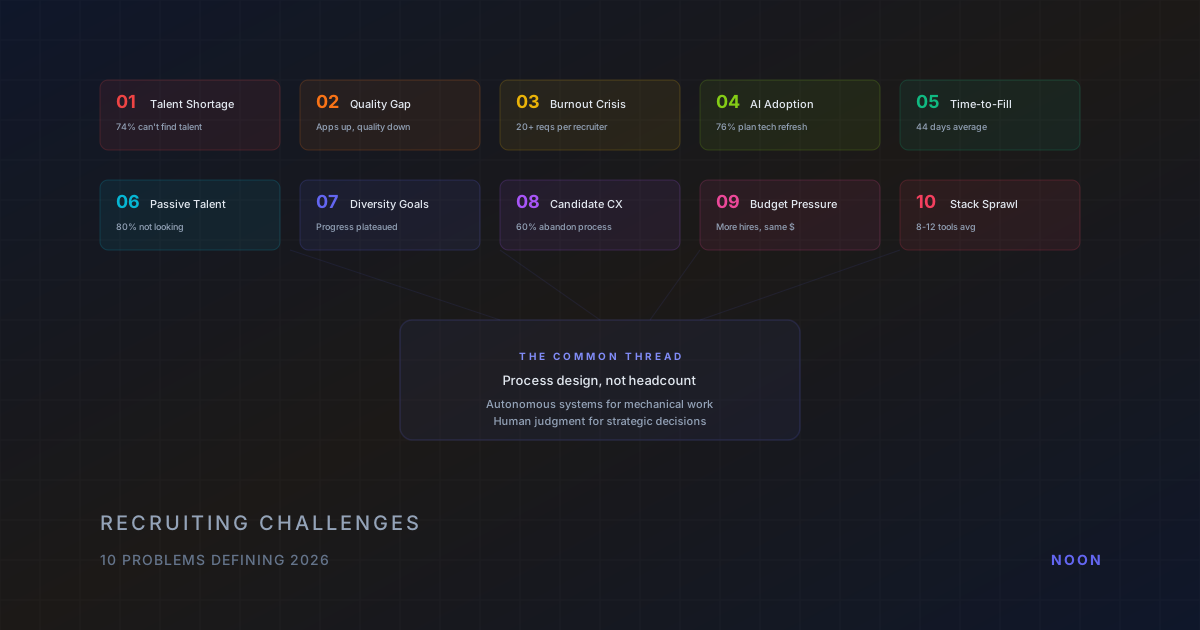
Key takeaway: The 10 biggest recruiting challenges in 2026 are: talent shortage (74% of employers), application quality gap, recruiter burnout, AI adoption anxiety, rising time-to-fill, passive candidate engagement, diversity hiring, candidate experience, budget pressure, and tech stack fragmentation. Each has specific, proven solutions, from AI-powered screening for the quality gap to RLHF-calibrated sourcing for passive talent.
Recruiting in 2026 feels paradoxical. Companies are flooded with applications, some roles receive 250+ in the first 48 hours, yet 74% of employers globally report difficulty finding skilled talent (ManpowerGroup, 2025 Global Talent Shortage). Hiring budgets are under pressure, but open requisitions keep climbing. AI tools promise to fix everything, but adoption creates its own category of challenges. These problems represent a fundamental shift in what effective recruiting requires, which is why teams increasingly turn to our hiring best practices guide for strategic frameworks that address modern talent acquisition challenges.
SHRM's 2026 Recruiting Executives Benchmarking, drawn from over 4,600 organizations, quantifies the squeeze: more than 2 in 3 organizations reported difficulty hiring for open positions, extra-large organizations absorbed a 67% increase in median requisitions per recruiter, and the median share of nonexecutive positions filled externally rose from 93% in 2025 to 97% in 2026 (SHRM, 2026). More reqs per recruiter, and almost none of them solvable by internal mobility.
This article covers the 10 most pressing recruiting challenges in 2026, backed by current data, and what the teams that are actually hitting their hiring goals are doing differently.
1. The talent shortage isn't temporary, it is structural
The numbers have been trending the same direction for a decade. ManpowerGroup's 2025 survey found that 71% of U.S. employers can't find the talent they need, more than double the 32% reported in 2015. Globally, the figure is 74%. This isn't a cyclical labor market issue. It's a structural mismatch between the skills employers need and the skills the workforce has.
The industries hit hardest: IT (73% shortage), healthcare (69%), manufacturing (76%), and financial services (67%). The AI boom has made things worse for tech roles, demand for machine learning engineers, AI infrastructure specialists, and data scientists has outpaced supply by a wide margin.
What works: Teams that have cracked this aren't just posting on LinkedIn and waiting. They're using AI sourcing tools that search across the entire web, GitHub, personal sites, publications, conference talks, to find passive candidates who aren't visible on traditional job boards. Noon's approach is representative: instead of waiting for candidates to apply, the system autonomously identifies and evaluates professionals across the web, going beyond the 20% of talent that's actively looking.
2. Application volume is up, but candidate quality is down
Robert Half's 2026 Hiring Challenges Report found that 58% of business leaders say finding skilled talent is harder than a year ago. Meanwhile, application volumes have surged thanks to AI-powered job application tools. Gem's 2026 Benchmarks Report shows that inbound applications per role are up 40% year-over-year, but quality metrics (screen-to-interview conversion, offer acceptance rates) haven't improved (Gem 2026 Recruiting Benchmarks).
The result: recruiters spend more time screening, not less. The promise of AI was supposed to reduce the top-of-funnel burden, but when candidates use AI to blast applications to hundreds of roles, it actually increases it.
What works: Automated screening that goes beyond resume parsing. Systems that evaluate candidates against non-negotiable criteria using LLM-based reasoning, not just keyword matching, can filter out unqualified applications before a human reviewer sees them. This cuts screening time from hours to minutes without sacrificing quality.
3. Recruiter burnout is a retention crisis
SHRM's data shows that recruiters at more than half of surveyed organizations manage roughly 20 open requisitions simultaneously. Each role requires sourcing, screening, outreach, scheduling, and follow-up. Multiply that by 20, and the math doesn't work.
The 2025 Recruiter Nation Report found that recruiter burnout is now a primary driver of TA team turnover. Hiring leaders are losing their best recruiters to the very workload problems those recruiters are trying to solve. It's a vicious cycle: burned-out recruiters leave, remaining recruiters absorb their req load, they burn out faster, and institutional knowledge walks out the door.
What works: Splitting or automating the pipeline layer so closing work is not competing with sourcing work for the same hours. Some teams do this by hiring a dedicated sourcer, and our guide to what a talent sourcer does covers when that seat pays for itself versus when automation is the better buy. Either way, the mechanical parts of recruiting, sourcing, initial screening, outreach sequencing, follow-up cadences, move off the recruiter's plate to autonomous systems. This isn't about replacing recruiters. It's about ensuring they spend their time on work that actually requires human judgment: selling the role, evaluating cultural fit, negotiating offers, and building relationships. When an AI agent handles the first four steps of the seven-step sourcing process, recruiters can manage 40+ reqs without the burnout.
4. AI adoption is messy and uneven
76% of TA leaders plan to refresh their tech stack in 2026 (Employ Recruiter Nation Report). But adoption of AI specifically remains uneven. Some teams are running fully autonomous sourcing agents. Others haven't moved beyond ChatGPT for writing job descriptions.
The challenge isn't awareness, it is implementation. Leaders worry about bias, governance, data privacy, candidate fraud detection, and the fundamental question of how to evaluate AI recruiting tools when every vendor claims to be "AI-powered." SHRM's 2026 research found that recruiting executives rate AI as both their highest-priority opportunity and their highest-priority risk.
What works: Start with a single, high-impact use case rather than trying to overhaul the entire recruiting workflow. The highest-ROI entry point is typically AI-powered sourcing, it is where the most recruiter time is wasted and where AI delivers the most measurable improvement. Noon customers typically see this play out clearly: activate a role, let the AI source and screen candidates, review the results, provide feedback, and watch the quality improve with each batch. Once teams see it work for sourcing, expanding to outreach automation and pipeline management follows naturally.
5. Time-to-fill is flat while req load per recruiter climbs
The headline number actually improved slightly this year: SHRM's 2026 benchmarking puts median time-to-fill at 39 calendar days for nonexecutive positions, down from the prior year, while executive time-to-fill held flat (SHRM 2026 Recruiting Executives Benchmarking). The problem is what sits underneath it: extra-large organizations reported a 67% increase in median requisitions per recruiter, so the same fill speed is being produced by recruiters carrying far more open roles. Technical and executive positions regularly take 60-90+ days. Every additional day a role stays open costs the organization in lost productivity, overburdened teams, and candidates who accept competing offers.
Gem's 2026 Benchmarks found that interviews-per-hire has climbed to 13, up 42% in three years (Gem 2026 Recruiting Benchmarks). More interviews mean more scheduling coordination, more interviewer time, and more candidate drop-off. The process is getting longer at every stage.
What works: Compressing the top of the funnel, then capping the interview loop. If AI handles sourcing and initial screening, the pipeline reaches the interview stage with higher-quality candidates, reducing the number of interviews needed. Teams that automate sourcing remove the weeks otherwise spent building Boolean searches and scrolling profiles from the front of the timeline, which is where most of the compressible time in a 39-day fill sits.
On the interview side there is a defensible ceiling. Google's review of a subset of its own interview data found four interviews were enough to predict a hire decision with 86% confidence (Google, 2017), and structured interviews rank as the most predictive selection procedure in the revised validity meta-analysis (Sackett et al., Journal of Applied Psychology, 2022). A round count above four is buying calendar delay, not accuracy. Collapsing sequential rounds into a structured panel interview with one competency per interviewer is the cheapest days-saving change available mid-funnel.
6. The passive candidate paradox
An estimated 70-80% of the workforce isn't actively looking for a new role at any given time. These passive candidates are often the highest-quality targets, employed, performing well, and not flooding their resume to every job board. But reaching them requires a fundamentally different approach than inbound recruiting.
The challenge is twofold: finding passive candidates and engaging them effectively. Sending a generic LinkedIn InMail to a VP of Engineering at Stripe with a boilerplate message about an "exciting opportunity" doesn't work. They get 50 of those a week.
What works: Multi-channel, hyper-personalized outreach that demonstrates genuine understanding of the candidate's background. AI outreach platforms that analyze a candidate's career history, recent projects, and professional interests to craft messages that feel individually written, not templated, achieve significantly higher response rates. When Noon's AI generates outreach, it references specific aspects of a candidate's experience because it has already evaluated their full profile during the sourcing phase.
7. Diversity hiring goals are stuck
Many organizations set ambitious diversity hiring targets, but progress has plateaued. The problem is often sourcing: if you're searching for candidates in the same places with the same criteria, you'll get the same demographic distribution. LinkedIn's talent pool skews toward certain demographics, industries, and geographies.
SHRM's research shows that 72% of organizations consider diversity a priority, but fewer than half have measurable programs in place to achieve it.
What works: Expanding the sourcing surface area. AI systems that search beyond LinkedIn, across professional communities, open-source contributions, conference rosters, academic publications, and specialized platforms, naturally surface more diverse candidate pools. Additionally, matching based on skills and capabilities rather than proxy signals (school name, previous employer) reduces the bias embedded in traditional screening criteria. If your team is evaluating sourcing tools designed to expand reach and reduce bias, you can book a demo to see how autonomous agents search across the full web rather than limiting discovery to traditional job platforms.
8. Candidate experience has become a competitive weapon
In a tight labor market, how candidates experience your hiring process directly affects whether they accept your offer. 60% of applicants abandon applications due to slow or complex hiring processes (Bersin/AMS 2025). Candidates who feel ghosted or put through unnecessary hoops will tell their network, and 72% say they share negative hiring experiences on social media or review sites.
The challenge is that improving candidate experience usually means more work for recruiters: faster communication, more touchpoints, more personalized updates. When recruiters are already managing 20+ reqs, that's a hard ask.
What works: Automated candidate communication that feels personal. AI-powered systems can send timely updates, follow-up messages, and scheduling coordination without adding to recruiter workload. The key is that automation should enhance the candidate experience, not replace it with robotic impersonality. Personalized email and SMS outreach sequences that reference specific aspects of the candidate's background, their recent project, their career transition, their published work, make candidates feel valued even when the process is automated.
9. Budget pressure meets headcount demand
60% of company leaders plan to increase permanent headcount in the first half of 2026 (Robert Half). But TA budgets aren't growing proportionally. Leaders are expected to hire more people with roughly the same resources, or fewer, as some organizations cut recruiting tools and agency spend.
This creates impossible math: more roles × same budget = lower cost-per-hire required. But cost-per-hire can't drop unless something in the process changes fundamentally.
What works: Reducing reliance on expensive channels. SHRM's benchmarking puts average cost-per-hire at nearly $4,700, and that is before agency fees, which typically run 15-25% of first-year salary when a search is outsourced. AI sourcing eliminates or reduces agency dependency for most roles. When an autonomous system handles what previously required an external recruiter, finding candidates, verifying fit, initiating contact, the cost structure changes dramatically.
10. Tech stack fragmentation
The average TA team uses 8-12 different tools: ATS, CRM, sourcing platform, outreach sequencer, interview scheduler, assessment platform, analytics dashboard, background check service, and more. Data lives in silos. Recruiters spend significant time switching between tools and manually syncing information.
76% of TA leaders plan to refresh their tech stack in 2026 (Employ), but adding another tool to the pile often makes the fragmentation problem worse. What teams actually need is consolidation, fewer tools that do more.
What works: Platforms that combine sourcing, screening, outreach, and ATS sync in a single workflow. Instead of using one tool to find candidates, another to look up their email, a third to write outreach, and a fourth to track responses, the entire process runs in one system. Noon's approach is this consolidation taken to its logical conclusion: one AI agent that handles the full sourcing-to-outreach workflow and syncs candidates and activity to your ATS through its 20+ integrations.
What should a TA team change in the next 90 days?
Ten challenges is a diagnosis, not a plan. The changes below are the ones that address more than one problem at once, ordered by how quickly they show up in the numbers.
| Change | Challenges it addresses | Leading indicator to watch (30-90 days) |
|---|---|---|
| Cap interview loops at four structured rounds | 5 (time-to-fill), 8 (candidate experience), 3 (burnout) | Interviews per hire; offer-stage drop-off |
| Move first-pass screening to criteria-based automation with hard non-negotiables | 2 (application volume), 3 (burnout) | Recruiter hours per req at screen stage |
| Source outside the active-applicant pool, beyond a single network | 1 (shortage), 6 (passive candidates), 7 (diversity) | Share of pipeline from passive sources; slate diversity |
| Consolidate sourcing, outreach, and scheduling into one workflow | 10 (fragmentation), 9 (budget) | Tools per recruiter; cost per hire excluding salary |
| Publish a candidate SLA (response within 48 hours, decision within a week of final round) | 8 (candidate experience), 5 (time-to-fill) | Candidate withdrawal rate; days from final interview to offer |
The common feature is that none of them require more headcount. They require deciding which steps a recruiter should still touch. For the sourcing and outreach layer specifically, the candidate sourcing tools guide compares the tools that automate it, and the Noon vs LinkedIn Recruiter page shows what changes when a team replaces per-seat search with an autonomous sourcer.
What's the common thread across AI recruiting mistakes?
Look across all 10 challenges and a pattern emerges: the recruiting problems of 2026 aren't about effort or headcount. They're about process design. Teams that are hitting their hiring goals have made a fundamental shift, from manually executing each step of recruiting to designing systems that handle the mechanical work autonomously, freeing recruiters for the strategic work that drives outcomes.
The organizations still struggling are the ones trying to solve 2026 problems with 2020 processes: more Boolean searches, more LinkedIn InMails, more recruiter hours. The math doesn't work anymore. The volume of hiring, the scarcity of talent, and the speed of competition have outpaced what manual processes can deliver.
Frequently asked questions
What is the biggest recruiting challenge in 2026? The talent shortage remains the top challenge, with 74% of employers globally reporting difficulty finding skilled talent. But it's compounded by application volume inflation (from AI-powered job application tools), making it harder to identify genuinely qualified candidates among the noise.
How are companies solving recruiting challenges with AI? The highest-impact application is autonomous sourcing, AI systems that find, evaluate, and contact candidates without manual recruiter intervention. This directly addresses the top-of-funnel bottleneck that underlies most other recruiting challenges (time-to-fill, burnout, cost-per-hire).
Is recruiter burnout getting worse? Yes. SHRM's 2026 benchmarking found extra-large organizations reported a 67% increase in median requisitions per recruiter, on top of recruiters at more than half of surveyed organizations already managing roughly 20 open reqs at once. Combined with increasing application volumes and more complex screening requirements, burnout is driving significant turnover in TA teams.
How can recruiting teams do more with less budget? Reduce reliance on agencies and expensive channels by using AI sourcing tools that handle candidate discovery and initial engagement autonomously. The cost structure of hiring changes fundamentally when you're not paying $15,000-50,000 per placement to external recruiters.