Key takeaway: Effective talent evaluation combines structured interviews (roughly 2x more predictive than unstructured), skills assessments (practical work samples), and behavioral scoring rubrics. The three evaluation dimensions are: can they do the job (skills), will they do the job (motivation), and will they thrive here (culture fit). Structured evaluation reduces mis-hires by 30-40% compared to gut-feel interviewing.
Key takeaways:
- Unstructured interviews predict performance at only r=0.20; structured interviews reach r=0.42 (Sackett et al. 2022), roughly 2x more predictive.
- Even the best single method explains under 18% of performance variance, so combine methods: structured interviews, work samples, assessments, and AI screening.
- Evaluate three dimensions: can they do the job (skills), will they do the job (motivation), and will they thrive here (culture fit).
- Write the non-negotiables down before the first screen, and re-score the whole pool when they change, or the evaluation drifts with each interviewer.
Talent evaluation is where most hiring processes fail. Not because teams don't try, but because the methods they use have predictive validity barely better than a coin flip. Building an effective evaluation system is one of the most critical elements covered in our hiring best practices guide, and this article breaks down exactly how to structure that system.
The meta-analysis by Sackett et al. (2022) (the most comprehensive review of selection method validity ever conducted) found that unstructured interviews predict job performance at r = 0.20. That's slightly better than chance. Structured interviews improve to r = 0.42. Work sample tests reach r = 0.33. Cognitive ability tests hit r = 0.31.
None of these numbers are particularly impressive. The best single predictor of job performance (the structured interview) still explains less than 18% of the variance in outcomes. Which means 82% of what determines whether someone succeeds in a role isn't captured by even the best interview process.
This guide covers how to build an evaluation framework that combines multiple methods (assessments, structured interviews, AI screening, and work samples) to maximize predictive validity while keeping the process fast enough to compete for top candidates.
Why most evaluation processes fail
The unstructured interview problem
Despite decades of research showing that unstructured interviews have poor predictive validity, they remain the dominant evaluation method. Why?
Interviewer confidence doesn't correlate with accuracy. Interviewers who feel most confident about their assessments are no more accurate than those who feel uncertain. The confidence comes from rapport and pattern matching ("this person reminds me of our best engineer") which is a bias signal, not a quality signal.
First impressions dominate. Research consistently shows that interviewers form judgments within the first 3-5 minutes and spend the remaining time confirming their initial impression. The rest of the interview is performance theater.
Inconsistent evaluation criteria. Without a structured framework, each interviewer evaluates different things. One focuses on technical depth. Another on cultural fit. A third on communication style. The debrief becomes a negotiation between different, often contradictory, assessments.
The résumé problem
Résumés are the universal first filter, but they're a poor signal:
- They describe roles, not impact. "Led a team of 8 engineers" says nothing about whether the team shipped good software.
- They're optimized for keywords. Candidates craft résumés to pass screening, not to accurately represent their experience.
- They're backward-looking. Past titles and companies don't predict future performance in a different context.
- They're easily inflated. A résumé is a self-report with no verification step, and in 2026 it is usually drafted or polished by an AI writing tool, so it tells you how well the candidate presents rather than what they did. Treat it as a list of claims to verify, not evidence.
The four-layer candidate evaluation framework
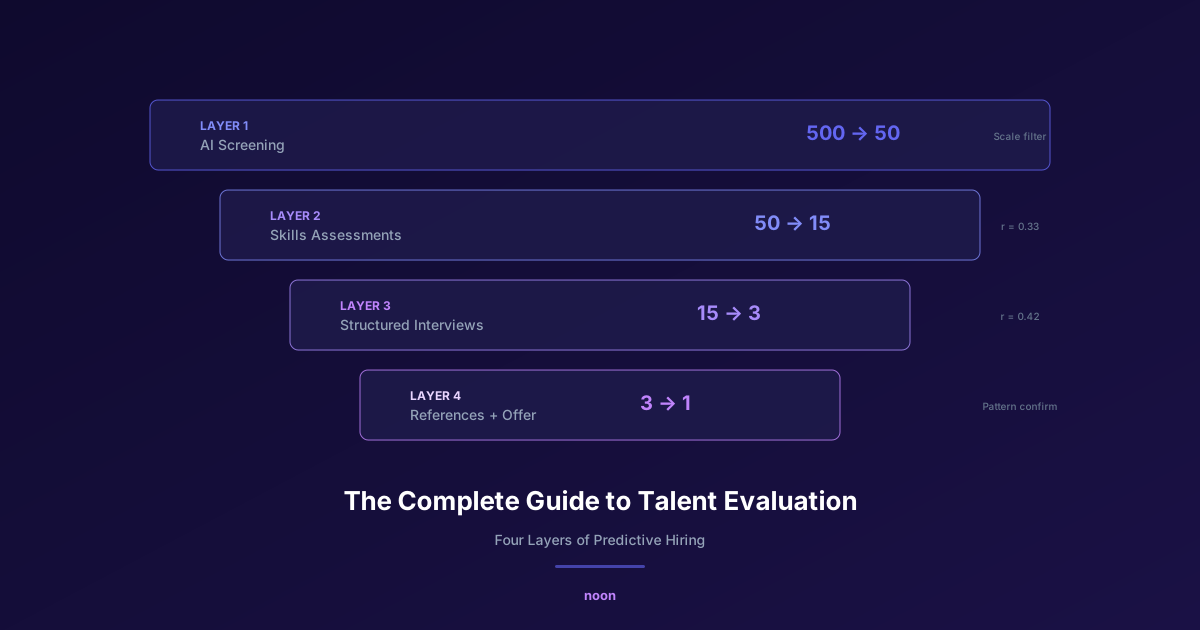
Effective talent evaluation uses multiple methods in sequence, each filtering for different signals. The key insight: no single method is highly predictive, but methods in combination are significantly more predictive than any method alone.
Layer 1: AI-powered screening
What it evaluates: Basic qualification alignment: does this candidate's experience match the role requirements at a fundamental level?
How it works: Modern AI screening goes beyond keyword matching. LLM-based screening systems read the candidate's full profile and evaluate it against the role requirements in context. Instead of checking whether "Python" appears on the résumé, the system evaluates whether the candidate's described experience suggests genuine Python proficiency at the required level.
At Noon, the AI screening layer uses non-negotiables, mandatory criteria that are contextually evaluated by the LLM. "Must have 3+ years of B2B SaaS sales experience" is evaluated by analyzing the candidate's actual work history, not by searching for the string "B2B SaaS." A candidate who sold enterprise software to healthcare companies for 4 years qualifies even if they never used the exact phrase "B2B SaaS." If you're building a multi-layer evaluation framework like this for your hiring process, you can book a demo to see how Noon's AI screening integrates with your structured interview process.
What it filters out: Candidates who clearly don't meet the basic requirements. This layer should be generous and err toward advancing candidates rather than rejecting them. The goal is to remove obvious mismatches, not to identify the best candidates.
Predictive value: Low for predicting performance, but high for efficiency: it reduces the candidate pool to a manageable size without requiring recruiter time.
Layer 2: Skills assessments
What they evaluate: Specific technical or functional capabilities that the role requires.
Types of assessments:
- Technical skills tests: Coding challenges (HackerRank, CodeSignal), domain-specific knowledge tests, portfolio reviews
- Cognitive assessments: Problem-solving, logical reasoning, learning agility (Criteria Corp, Wonderlic, Pymetrics)
- Behavioral assessments: Communication style, work preferences, collaboration patterns (Hogan, Predictive Index)
- Work sample tests: Give the candidate a realistic task similar to what they'd do on the job and evaluate the output
Best practices:
- Use validated assessments with published reliability and validity data, not homegrown quizzes
- Keep assessments relevant; a 4-hour take-home coding project for a product manager role is disrespectful of the candidate's time
- Score assessments before seeing the candidate's identity to reduce bias
- Communicate expectations clearly: tell candidates what to expect, how long it will take, and how it will be evaluated
Predictive value: Moderate to high, especially for work sample tests. The closer the assessment is to actual job tasks, the more predictive it becomes.
Layer 3: Structured interviews
What they evaluate: Deeper competencies: problem-solving approach, communication, leadership, cultural alignment, and how the candidate thinks through complex situations.
What makes an interview "structured":
- Predetermined questions: Every candidate is asked the same core questions for the same role
- Behavioral anchors: Each question has a rubric defining what a strong, average, and weak answer looks like
- Consistent scoring: Interviewers rate each answer on the rubric immediately after the question, not at the end
- Multiple interviewers: At least two interviewers evaluate independently to reduce individual bias
Question types that work:
- Behavioral: "Tell me about a time you had to make a decision with incomplete information. What was the situation, what did you do, and what happened?" Evaluates decision-making and reflection
- Situational: "If you joined this team and discovered the primary codebase had no test coverage, how would you approach the problem?" Evaluates problem-solving and prioritization
- Case-based: Present a realistic scenario from the actual job and ask the candidate to work through it. Evaluates applied skills and thinking process
What to avoid:
- Brainteaser questions ("How many golf balls fit in a school bus?"): no predictive validity
- Trivia questions ("What's the time complexity of quicksort?"): tests memorization, not ability
- "Culture fit" without defined criteria: usually means "seems like someone I'd want to have a beer with," which is a bias signal
Predictive value: High (r = 0.42): the strongest single predictor of job performance according to meta-analytic research.
Layer 4: Reference and verification
What it evaluates: Pattern confirmation: does the candidate's self-reported experience align with what former colleagues and managers describe?
How to make references useful: Most references are worthless because candidates provide only people who will say nice things. To extract signal:
- Ask specific behavioral questions: "Can you describe a time when [candidate] handled a project that wasn't going well? What did they do?"
- Ask calibration questions: "On a scale of 1-10, how would you rate [candidate] compared to others in similar roles you've managed? What would it take to be a 10?"
- Ask about development areas: "If you were managing [candidate] again, what would you focus on developing?"
- Check for patterns across multiple references; consistent themes are more meaningful than individual data points
Combining layers for maximum validity
The power of a multi-layer framework is that each layer catches what the others miss:
- AI screening catches basic qualification mismatches at scale
- Skills assessments verify claimed competencies with objective evidence
- Structured interviews evaluate judgment, communication, and thinking process
- References confirm patterns and catch fabrications
Research suggests that combining multiple valid selection methods can achieve combined predictive validities of r = 0.60-0.65, significantly higher than any single method.
How AI is changing evaluation
AI is transforming each layer of the evaluation framework:
Screening: LLM-based screening at Noon evaluates candidates contextually rather than with keyword matching, catching both false positives (keyword matches who don't actually qualify) and false negatives (qualified candidates who describe their experience differently).
Assessment scoring: AI can evaluate coding challenges, written responses, and even video interview responses with greater consistency than human scorers, though with the important caveat that AI scoring should augment, not replace, human judgment for final decisions.
Interview intelligence: Platforms like Metaview record and analyze interviews to provide structured feedback, ensure interviewers are following the structured format, and surface patterns across interviews that help teams improve their evaluation consistency.
Bias detection: AI can flag patterns in evaluation data that suggest bias: if candidates from certain backgrounds are consistently scoring lower on subjective interview criteria despite strong assessment scores, the system can surface this for investigation.
How should you evaluate candidates who used AI to prepare?
This question comes up in almost every evaluation conversation now, and the honest answer is that it changes the design of the evaluation more than the verdict on any single candidate.
Assume every written artefact was AI-assisted. Cover letters, take-home write-ups, and polished answers to predictable questions no longer discriminate between candidates, because the floor has risen for everyone. Drop the weight you give them rather than trying to detect AI use, which detection tools do unreliably and which penalises candidates unevenly.
Move weight to work you can observe. Live work samples, pair sessions, and structured interviews that ask for specific detail about the candidate's own past decisions are hard to outsource in real time. "What did you try first, why did it fail, and what did you change?" separates a practitioner from a well-prepared reader whether or not a model wrote their notes.
Make AI use part of the assessment when the job involves it. For most knowledge roles in 2026, the job includes using AI tools well. A take-home that permits AI and then interviews the candidate on the choices they made with it tells you more than a ban you cannot enforce.
Hold the AI you use to the same standard. If a screening model scores candidates, you should be able to read the criteria, edit them, mark the hard requirements as non-negotiables, and re-run the pool when the criteria change. Noon's evaluation works this way: criteria are role-specific and visible, the ranking recalibrates on hiring-manager feedback about the first shortlist, and candidates already screened are re-evaluated when the requirements move. An evaluation you cannot inspect is not structured, whoever or whatever is doing it. Our guide to AI candidate screening covers what an explainable score should show.
Building speed into the process
The best evaluation process in the world is worthless if candidates drop out before completing it. SHRM's 2026 recruiting benchmarking of more than 4,600 organizations puts median time-to-fill at 39 days for nonexecutive roles and 45 for executive (SHRM 2026 Recruiting Executives Benchmarking); a strong candidate in three parallel processes will accept whichever one reaches an offer first, so every evaluation day you add is a day for a competitor to close.
Principles for maintaining speed:
- Front-load the easiest steps. AI screening first (instant), then short assessment (30-60 minutes), then interviews (scheduled). Don't make candidates wait two weeks for a screening call.
- Parallelize when possible. Multiple interviews on the same day, not spread across weeks.
- Set SLAs for feedback. Hiring managers should provide interview feedback within 48 hours. The hiring team should make decisions within 5 business days of the final interview.
- Communicate timeline upfront. "Our process takes 10-14 days from first conversation to offer" sets expectations and reduces dropout.
At Noon, the AI handles the front-loading automatically: the AI Sourcer evaluates candidates against role-specific criteria before a recruiter touches the pipeline, the AI Interviewer runs a structured voice screen, and the AI Scheduler books the human rounds, compressing the early stages from days to hours.
FAQ
What is the most predictive method for evaluating candidates? Structured interviews have the highest single-method predictive validity at r = 0.42 for job performance (Sackett et al. 2022). However, combining multiple methods (structured interviews, work sample tests, cognitive assessments) achieves higher combined validity (r = 0.60-0.65) than any single method alone.
How do I reduce bias in talent evaluation? Four strategies: (1) Use structured interviews with predetermined questions and scoring rubrics. (2) Score assessments before seeing candidate identity. (3) Use multiple independent interviewers and compare ratings. (4) Monitor evaluation data for demographic patterns that suggest bias. AI tools can help with (4) by flagging statistical anomalies in evaluation outcomes.
Should I use AI for candidate evaluation? AI is excellent for initial screening (evaluating qualification alignment at scale) and assessment scoring (consistent, objective evaluation of skills tests). It's useful but not sufficient for interview evaluation; AI can provide analysis and consistency monitoring, but final hiring decisions should involve human judgment. At Noon, AI handles screening and contextual evaluation while humans make advancement decisions.
How long should the evaluation process take? 10-14 business days from first contact to offer is competitive for professional roles. Beyond 21 days, candidate dropout increases significantly. The key is front-loading automated steps (AI screening, short assessments) and parallelizing interviews to compress the timeline without cutting evaluation depth.
Can interview scorecards live in the ATS? Most ATSs support scorecard templates per stage, and that is where they belong, because the scorecard then travels with the candidate record and feeds the calibration data you need to check interviewer consistency. The gap is usually upstream: the screening criteria live in one tool and the interview scorecards in another, so nobody checks whether the interviews test what the screen selected for. Choose evaluation tools that write their scores back to the ATS (Noon syncs with 20+ ATS platforms) and build the scorecard from the same criteria list.
How do I calibrate interviewers? Have every interviewer score the same two or three recorded or transcribed interviews independently, then compare ratings against the rubric anchors and discuss the disagreements. Repeat quarterly. Interview intelligence tools and Noon's AI Notetaker make this practical by producing consistent transcripts and summaries to score against; our interview transcripts guide covers how to structure that review.
What is a structured interview? A structured interview uses predetermined questions, behavioral anchors defining strong/weak answers, consistent scoring rubrics, and multiple independent interviewers. It predicts job performance at r = 0.42, roughly double the predictive validity of unstructured interviews (r = 0.20). Despite this, many organizations still rely on unstructured formats because they feel more "natural."