Key takeaway: Good interviewers use structured formats (2.5x more predictive than unstructured), score against predefined rubrics, and ask the same core questions to every candidate. The five qualities of effective interviewers are: preparation (reviewing the candidate's background beforehand), consistency (standardized questions), active listening, evidence-based scoring, and candidate experience awareness. Training interviewers improves hiring accuracy by 30-40%.
Most organizations obsess over finding the right candidates. Few invest the same energy in developing the people who evaluate those candidates.
This is a critical oversight. The quality of your interviewers directly determines the quality of your hires. A world-class candidate pipeline means nothing if the interview process can't reliably identify who's actually good. And most interview processes can't — research consistently shows that unstructured interviews predict job performance only slightly better than a coin flip.
The uncomfortable truth is that bad interviewing is the norm, not the exception. Most interviewers are never formally trained. They rely on instinct, ask whatever questions come to mind, and form opinions in the first 5 minutes that the remaining 40 minutes merely confirm. The result: inconsistent evaluations, missed signals, and hiring decisions based on charisma rather than capability. For broader context on how interviewer quality fits into the full hiring process, see our hiring best practices guide.
This guide breaks down the specific behaviors that separate good interviewers from bad ones — with actionable advice for each dimension.
The core difference
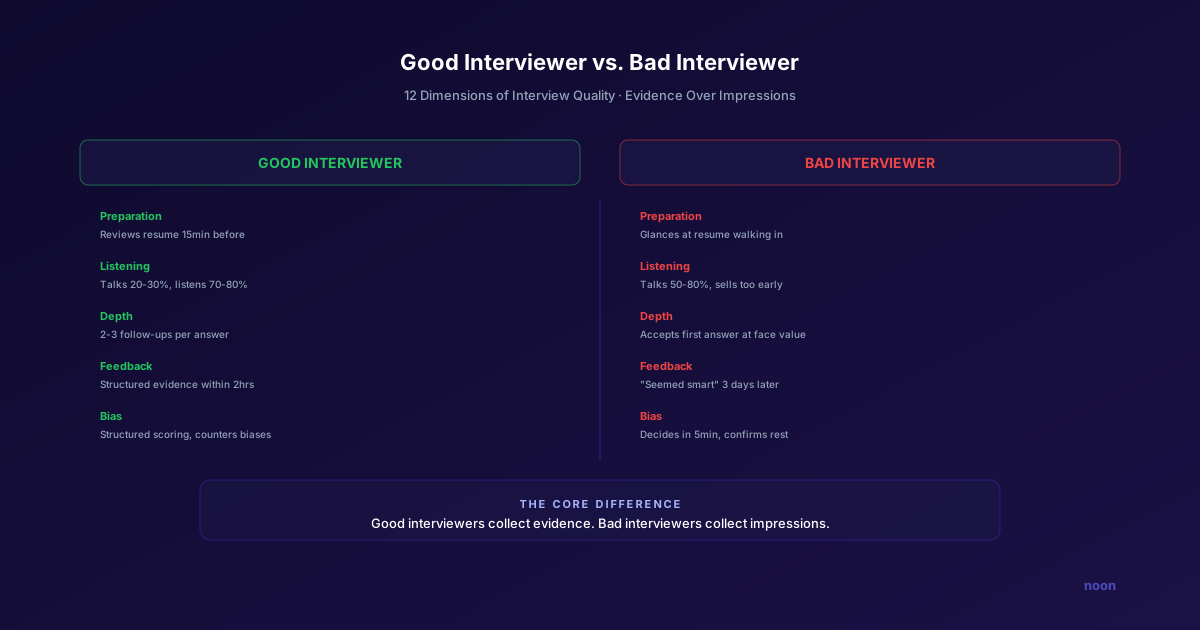
Good interviewers are evidence collectors. Bad interviewers are impression collectors.
A good interviewer enters the room with a plan: specific competencies to assess, prepared questions that elicit evidence, and a scoring framework to evaluate responses. They leave with structured notes that other stakeholders can act on.
A bad interviewer enters with vague intentions ("let's see if they're smart"), asks whatever comes to mind, and leaves with a feeling ("I liked them" or "something felt off"). Their feedback is a paragraph of subjective impressions that provides no signal for the hiring committee.
The difference matters because hiring committees make decisions based on interviewer feedback. Evidence-based feedback leads to accurate decisions. Impression-based feedback leads to whoever was most charming in the room.
12 dimensions of interviewer quality
1. Preparation
Good interviewer: Reviews the candidate's resume 15-20 minutes before the interview. Reads the job description and scorecard. Identifies 2-3 specific areas to probe based on the candidate's background. Knows which competencies they're assessing and has prepared questions for each.
Bad interviewer: Glances at the resume while walking to the interview room. Hasn't looked at the scorecard. Asks the candidate "so, tell me about yourself" as a stall tactic while they figure out what to ask next.
Why it matters: Unprepared interviewers ask generic questions that produce generic answers. They waste the first 10-15 minutes of the interview on information they could have gathered from the resume.
2. Questioning depth
Good interviewer: Asks a question, listens to the answer, then follows up 2-3 times to get past the rehearsed response and into real specifics. Uses the STAR method (Situation, Task, Action, Result) to extract concrete examples.
"Tell me about a time you led a major technical migration." → "What specifically was your role versus the team's?" → "What was the hardest trade-off you had to make?" → "What would you do differently if you did it again?"
Bad interviewer: Asks a question, accepts the first answer at face value, and moves to the next question. Never probes, never challenges, never asks for specifics.
Why it matters: Surface-level questions produce surface-level signal. Every candidate can give a polished answer to "what's your greatest strength?" The signal is in the follow-ups that test whether the answer is real.
3. Listening ratio
Good interviewer: Talks 20-30% of the time. Listens 70-80% of the time. Asks concise questions and gives the candidate space to answer fully before asking the next question.
Bad interviewer: Talks 50-80% of the time. Describes the company, the team, the project, and their own career for 20 minutes, then rushes through 2-3 questions in the remaining time. Sometimes sells the candidate on the opportunity before assessing whether they're qualified.
Why it matters: You learn nothing while talking. The interview is for collecting data about the candidate, not pitching the company. Selling should happen after evaluating, not before or during.
4. Bias awareness
Good interviewer: Recognizes that first impressions, similarity bias (liking candidates who remind them of themselves), and halo effects (one strong answer colors everything) are real. Actively counteracts these by sticking to structured questions and scoring candidates against pre-defined criteria, not against each other.
Bad interviewer: Makes up their mind in the first 5 minutes and spends the rest of the interview confirming their initial impression. Favors candidates from the same alma mater, similar companies, or similar backgrounds.
Why it matters: Bias doesn't just create DEI problems — it creates hiring accuracy problems. When interviewers evaluate based on pattern-matching to their own background rather than evidence of competency, they miss strong candidates and advance weak ones.
5. Feedback quality
Good interviewer: Writes detailed, structured feedback within 2 hours of the interview. Each competency has a score with specific evidence: "Demonstrated strong system design thinking — described designing an event-driven architecture that handled 100K events/second, including the specific trade-offs they made between consistency and availability (chose eventual consistency with a 200ms SLA)."
Bad interviewer: Submits feedback 3 days later (if at all) with vague statements: "Seemed smart. Good communication skills. Would be a good fit." No evidence, no specifics, no actionable signal for the hiring committee.
Why it matters: Other decision-makers rely on your feedback. If they can't distinguish "seemed smart" from "demonstrated deep technical knowledge with specific examples," they can't make good decisions.
6. Candidate experience
Good interviewer: Starts with a brief agenda ("I'll ask you about your experience with distributed systems and your approach to team leadership, then save 10 minutes for your questions"). Makes the candidate feel comfortable. Engages genuinely with their answers. Treats the interview as a two-way conversation.
Bad interviewer: Creates an adversarial dynamic. Uses gotcha questions to make themselves feel smart. Shows visible boredom or distraction (checking phone, looking at clock). Makes the candidate feel interrogated, not evaluated.
Why it matters: Top candidates have options. A bad interview experience can cost you a strong hire — and 72% of candidates share negative interview experiences on sites like Glassdoor (CareerArc, 2024).
7. Consistency across candidates
Good interviewer: Asks the same core questions to every candidate for the same role. Uses the same scoring rubric. Evaluates each candidate independently, not relative to the last person they interviewed.
Bad interviewer: Asks different questions to different candidates based on mood, conversation flow, or what they happen to think of. Makes it impossible to compare candidates fairly because no two interviews assessed the same things.
8. Calibration with the team
Good interviewer: Participates in calibration sessions where interviewers compare notes on what "good" looks like for specific competencies. Understands how their scores compare to other interviewers' and adjusts for personal tendencies (some people are consistently harsh graders, others consistently lenient).
Bad interviewer: Interviews in isolation. Never discusses with the team what a "strong" vs. "adequate" response looks like for key questions. Their "strong hire" might be another interviewer's "weak hire" because they've never aligned on standards.
9. Time management
Good interviewer: Covers all planned competencies within the allotted time. Allocates time proportionally — more time for critical competencies, less for secondary ones. Leaves 5-10 minutes for candidate questions.
Bad interviewer: Spends 30 minutes on one topic, realizes they're out of time, and rushes through or skips the remaining competencies. Submits feedback that says "didn't have time to assess system design" — defeating the purpose of the interview.
10. Adaptability
Good interviewer: Adjusts their approach when a candidate gives an unexpected answer. If a candidate reveals they have experience in an area not on the scorecard but relevant to the role, the good interviewer explores it while still covering the planned competencies.
Bad interviewer: Rigidly follows a script regardless of what the candidate says. Misses opportunities to uncover relevant experience because it wasn't on their question list.
11. Intellectual honesty
Good interviewer: Acknowledges uncertainty. "I couldn't fully assess their system design abilities — the examples they gave were from a domain I'm not familiar with. I'd recommend a follow-up technical deep-dive with someone from the infrastructure team."
Bad interviewer: Pretends to have a strong opinion even when they don't have enough evidence. Gives a confident "hire" or "no hire" recommendation based on insufficient data rather than admitting they need more information.
12. Continuous improvement
Good interviewer: Asks for feedback on their interviewing. Reviews hiring outcomes to see if their assessments were accurate. Adjusts their approach based on which questions and techniques produce the best signal.
Bad interviewer: Interviews the same way they did five years ago. Never reflects on whether their evaluations predicted actual job performance. Assumes they're good at interviewing because they've done a lot of it.
How to improve interviewer quality across your team
Train explicitly
Interviewing is a skill. Most companies train people on everything else — the product, the codebase, the sales process — but expect interviewers to figure it out on their own.
Implement a structured interviewer training program:
- Shadow 3+ interviews before conducting one independently
- Scorecard walkthrough for every role (what does "strong" look like for each competency?)
- Mock interviews with feedback from experienced interviewers
- Quarterly calibration sessions to align scoring standards
Use structured scorecards
Every interview should have a pre-defined scorecard with:
- 3-5 competencies to assess
- Prepared questions for each competency
- A scoring rubric (1-5 scale with descriptions for each level)
- Space for evidence notes (not just scores)
Tools like Greenhouse and Ashby provide structured scorecard functionality built into the ATS.
Leverage interview intelligence tools
AI interview tools capture what actually happens in the interview so you can improve over time:
- Metaview — Auto-generates interview notes from the conversation, ensuring accurate, detailed feedback
- BrightHire — Records interviews with structured highlights and analytics
- Noon's integrated pipeline — When candidates sourced by Noon reach the interview stage, the context from the sourcing and screening process carries through, giving interviewers better preparation material. Noon's AI Coordinator also handles interview scheduling and candidate Q&A, so the loop starts on time with the right context. If you want to see how this interviewer context handoff works in practice, you can book a demo to walk through a live example. For related tooling, see our guides on candidate experience and interview quality tools.
Measure interviewer effectiveness
Track interviewer metrics over time:
- Feedback completion rate — % of scorecards submitted within 24 hours
- Feedback quality score — Rate feedback on specificity and evidence (peer-reviewed or manager-reviewed)
- Prediction accuracy — Do the candidates this interviewer rates "strong hire" actually perform well on the job?
- Candidate experience scores — Do candidates rate this interviewer's session positively?
FAQ
How long should an interview be? 45-60 minutes for most interviews. Shorter than 30 minutes doesn't allow enough time for depth. Longer than 60 minutes creates fatigue for both parties. Technical assessments or case studies may justify 90 minutes.
Should interviewers see other interviewers' feedback before their session? No — for competency-based interviews, each interviewer should form their independent assessment first to avoid anchoring bias. Interviewers can review prior feedback after submitting their own scorecard, before the debrief discussion.
How many interviews should be in a loop? 3-5 interviews plus a recruiter screen is standard for professional roles. Each interview should assess different competencies with minimal overlap. More than 6 interviews signals process bloat and increases candidate drop-off.
What if a hiring manager is a bad interviewer? This is common and delicate. Approach it as skill development, not criticism. Share interviewer calibration data (anonymized). Offer coaching. Pair them with a strong interviewer for a few sessions. If the problem persists, consider restructuring the panel so the hiring manager does a final fit conversation rather than a technical assessment.
How do structured interviews reduce hiring bias and support compliance? Structured interviews — same questions, same rubric, evidence-based scores — reduce bias by forcing every candidate to be evaluated against the same predefined criteria rather than gut feel or similarity to the interviewer. This also creates an auditable record, which matters as AI-hiring regulations such as NYC Local Law 144 push employers to document and audit how hiring decisions are made. The same principle applies upstream: AI screening should evaluate candidates against explicit, role-relevant criteria it can explain, not opaque scores.
Can AI help interviewers without replacing human judgment? Yes. The strongest setup keeps humans making the decision while AI removes administrative drag: auto-generated interview notes so feedback is detailed and prompt, consistent scorecards, and carried-through context from sourcing and screening. The goal is more evidence per interview, not automated hire/no-hire calls.