
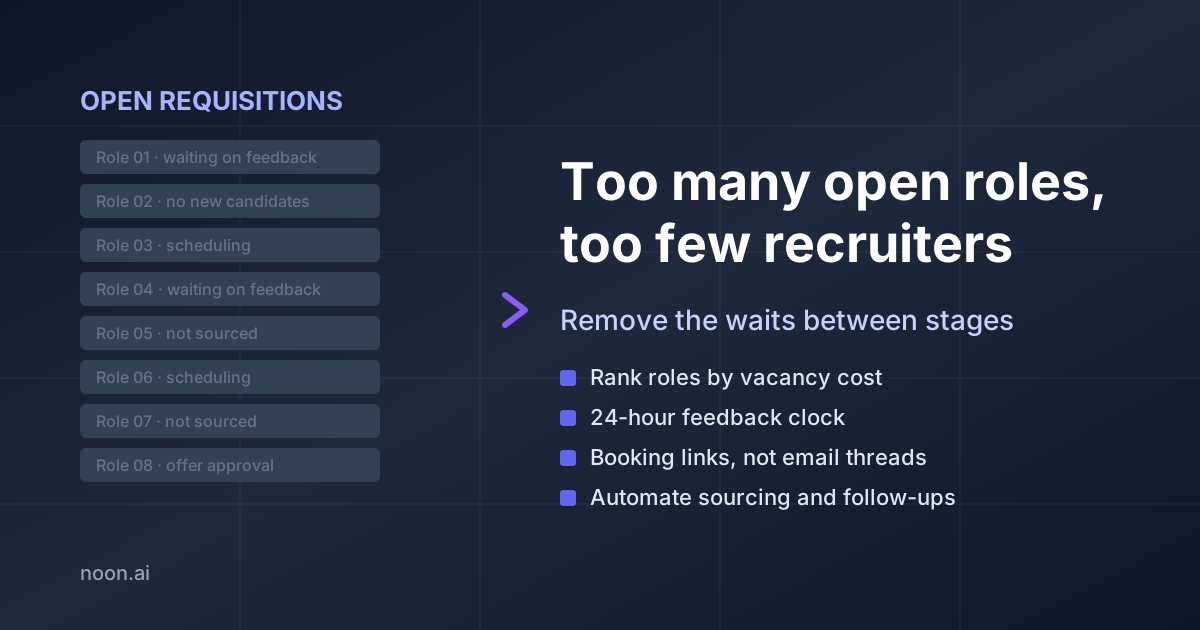
Key takeaway: When a small recruiting team carries too many open roles, time to fill grows because roles sit in queues, not because anyone works slowly. Median time to fill for nonexecutive roles is 39 days in 2026, while extra-large employers saw requisitions per recruiter rise 67% in one year (SHRM, 2026). To cut the days without adding headcount: rank every role by vacancy cost, put a 24-hour clock on hiring-manager feedback, shorten the interview loop, take scheduling out of email threads, build pipeline before the role opens, and hand the repetitive steps (sourcing, follow-ups, booking) to automation.
It is Monday and a team of two has 23 open requisitions. Six are urgent, the hiring managers say. Four have had no new candidates in two weeks. Three have finalists waiting on feedback that was due last Thursday. The recruiters spend the morning answering status pings and moving calendar invites, and by the afternoon nobody has looked for a single new candidate.
This is one of the pains we hear most often in evaluation calls. Small teams rarely say "we are bad at recruiting." They say they spend too much of the week on admin work that could be automated, and that sourcing never gets a protected block of time because everything else has a person waiting on it. Neither problem gets fixed by working harder, because the bottleneck is how the work is set up.
The numbers say the load is growing. SHRM's 2026 benchmarking data shows median requisitions per recruiter at extra-large organizations rose 67% in a year, and 97% of nonexecutive roles were filled with external hires, up from 93% in 2025 (SHRM, 2026). External hires mean someone has to find, contact, and screen people who are not yet in your system. Applications per role keep climbing too: Greenhouse reported an average of 95 applications per job in August 2025, up from 28 in 2021 (Greenhouse, October 2025). And 72% of employers worldwide report difficulty filling roles (ManpowerGroup, February 2026). More roles, more applicants, same headcount.
Why does time to fill grow when roles pile up?
Time to fill is the sum of working time and waiting time, and with many roles open the waiting time grows much faster than the working time. Every role spends most of its life waiting: for a recruiter to source, for a candidate to reply, for a hiring manager to review, for three calendars to line up. Each wait is short. Across 20 roles and five stages they add up to weeks.
Three things make the queues worse on small teams:
- Context switching. A recruiter carrying 12 roles touches each one for a few minutes a day. Every switch costs time spent working out where the role stands before any work happens.
- Urgency set by whoever asks loudest. Without an explicit ranking, the role whose hiring manager sends the most messages gets the attention, which is not the same as the role that costs the business the most while it stays open.
- Hand-offs with no deadline. Recruiter-owned steps get done because recruiters feel the pressure. Steps owned by someone else, like feedback, panel availability, and offer approval, have no clock and drift.
This is why the fix is mostly about removing waits. For the measurement side, our guide to hiring velocity shows how to instrument stage-to-stage time, and the 2026 time-to-hire benchmarks give a stage-by-stage reference.
Where do the days actually go?
Before changing anything, pull the last 10 filled roles and time each stage. Most teams find the same pattern: the recruiter-owned stages are not where the days go.
| Stage | Who owns the wait | What the wait looks like | Fix in this article |
|---|---|---|---|
| Role opens to first qualified candidate | Recruiter | Sourcing waits until the recruiter has a free block | Steps 1, 5, 6 |
| Outreach to reply | Candidate | Replies arrive days after first contact, often after a follow-up | Step 6 |
| Screen to hiring-manager decision | Hiring manager | Profiles sit unreviewed in an inbox | Step 2 |
| Decision to interview booked | Everyone's calendar | Days of back-and-forth email | Step 4 |
| Interview loop to final decision | Interview panel | Extra rounds, late scorecards | Step 3 |
Write each stage's median in days next to the table. The two or three biggest numbers are where this week's effort goes.
Step 1: Rank every open role by the cost of the vacancy
Put every open requisition on one list and score it on two things: what the vacancy costs the business each week (revenue not booked, a team blocked, overtime paid) and how hard the role is to fill (niche skills, location, compensation versus market). Agree the ranking with the hiring leaders once a week, in one meeting, not role by role in chat.
Then commit to it. The top third gets daily sourcing and same-day responses. The middle third gets a fixed twice-weekly block. The bottom third is either paused with the hiring manager's agreement or moved to a lighter process, like a referral push or an internal posting. Pausing two low-priority roles out loud is better than letting all 23 move slowly.
If you are not sure what the requirement on a role is, fix that before you rank it. A vague requisition is the most common reason a role sits open; our guide on how to write a job requisition covers the fields to settle before sourcing starts.
Step 2: Put a 24-hour clock on hiring-manager feedback
On most small teams the biggest wait sits with the hiring manager. A shortlist sent on Tuesday and reviewed the following Monday has added six days to time to fill, and the best candidate on it may already have taken another offer.
Agree a written rule with each hiring manager: shortlists and scorecards get a decision within one business day, and a missed deadline triggers one reminder, then an escalation to their manager. Make feedback cheap to give, with a yes or no and a one-line reason per candidate rather than a free-form essay. If a hiring manager keeps rejecting candidates that match the brief, the problem is the brief, not the candidates; our guide to that situation walks through the calibration conversation.
Step 3: Shorten the interview loop
Every extra round adds a scheduling cycle and a decision cycle. For each role, write down what each interview stage is meant to test, and cut any stage that tests something another stage already covers. Most professional roles can be decided on a structured screen, one skills-focused interview, and one final conversation.
Two more rules remove days without lowering the bar. Hold interview panels in one block on the same day instead of spreading them over a week. And require scorecards within a few hours of the interview, before the debrief, so the decision meeting is about the evidence, not about chasing it.
Step 4: Take scheduling out of email threads
A three-person interview booked by email can take four or five messages and several days. Publish fixed interview windows for each panel at the start of the week, send candidates a booking link instead of proposed times, and let the candidate's confirmation create the invite for everyone. When a slot falls through, the link offers the next one without a recruiter in the loop.
This is one of the easiest days to win back, and it is also where small teams lose candidates quietly: the candidate who waits three days for a time slot is still interviewing elsewhere. Our comparison of interview scheduling software covers tools if you do not have a booking flow yet.
Step 5: Build pipeline before the role opens
The longest wait for most roles is the first one, from "role approved" to "first qualified candidate in the pipeline." The fastest way to shorten it is to start before the role exists.
- Keep warm pools for roles you hire repeatedly. If you hire account executives every quarter, keep a short list of people you have already spoken to, and re-contact them the day the role opens.
- Search your own database first. Past finalists, silver medalists, and earlier applicants are already in your ATS. They know the company, and some will now be a fit.
- Ask for referrals with a specific brief. "Do you know a backend engineer who has run payments infrastructure at scale" gets names. "We are hiring, please share" gets silence.
If sourcing keeps slipping because nobody has a free hour, our guide to keeping open roles moving when nobody has time to source covers how to protect a daily sourcing block.
Step 6: Hand repetitive steps to automation
Some recruiting work needs judgment: the intake conversation, the close, the hard call between two finalists. A lot of it is repetitive: re-running the same searches every week, sending follow-up two and three, finding a contact email, offering interview times. Those steps do not need a recruiter, but on a small team they eat the hours that the judgment work needs.
Follow-ups are the clearest case. Across 812,633 outreach sequences on the Noon platform, 67.8% of candidate replies arrived after the first message and the median reply came 2.7 days after first contact (Noon recruiting follow-up benchmarks). A team that sends one message per candidate because nobody has time for the second is missing most of its replies. Automate the cadence, keep the recruiter on the replies.
The test for each task is simple: if the recruiter would do it the same way every time, a system should do it.
How Noon fits
Noon is an autonomous AI recruiter built for teams in exactly this position, where there are more open roles than recruiter hours. For each role, its agent searches the open web, not just LinkedIn, evaluates every profile against your criteria and non-negotiables, and learns from hiring-manager thumbs-up and thumbs-down feedback, so the shortlist gets more precise with each batch. It then runs personalized email and SMS sequences, follow-ups included, and its AI Coordinator books interviews through a Calendly integration.
Steps 5 and 6 come built in. With an ATS connected, Noon can search your existing candidate database using the same criteria, with results right away and no calibration period. It also screens inbound applicants against the role's criteria and syncs decisions back to 20+ ATS platforms. The plan does not charge per role, seat, or contact: one plan covers unlimited sourcing, contacts, agents, and seats, so running an agent on all 23 roles costs the same as running it on 3. See how Noon pricing works, or book a demo to see it run on one of your open roles.
Frequently asked questions
How many open roles can one recruiter handle? There is no single benchmark that fits every team, because a requisition for a niche engineering role takes far more work than a repeat hire for a role you fill every month. What the data shows is direction: SHRM measured a 67% rise in median requisitions per recruiter at extra-large organizations in 2026. Track your own load alongside stage-by-stage time to fill. When adding a role makes every other role slower, you are past capacity.
How can we automate recruiting to increase speed and decrease time to hire? Automate the steps a recruiter would do the same way every time: recurring candidate searches, contact finding, follow-up messages, and interview booking. Keep humans on intake, the hiring-manager relationship, and the close. Most of the time saved comes from removing waits between stages, not from faster individual tasks.
How quickly can an AI tool build a pipeline of candidates for a new role? Searching your own ATS database can return candidates right away, since there is nothing to learn first. Outbound sourcing on a new role usually improves over the first few rounds of hiring-manager feedback, because the system learns what "qualified" means for that role. Ask any vendor how many feedback rounds calibration usually takes and test it on a live requisition.
What is a good time to fill for a small company? SHRM's 2026 median for nonexecutive roles is 39 days. A small team hiring for a specialist role should expect longer and measure itself against its own history by role family. A falling median over two quarters is a better goal than any external number.
Is an AI recruiting platform affordable for a small team? It depends on the pricing model. Per-seat and per-credit tools get more expensive as roles and contacts grow. Noon runs one plan with unlimited sourcing, contacts, agents, and seats, so the price does not rise with the number of open roles. Noon does not publish a dollar price; the pricing page explains how it is quoted.
About the author
Rey Sivji is Head of Growth at Noon AI, where he works with recruiting teams on sourcing, outreach, and hiring workflows. Email rey@noon.ai.