
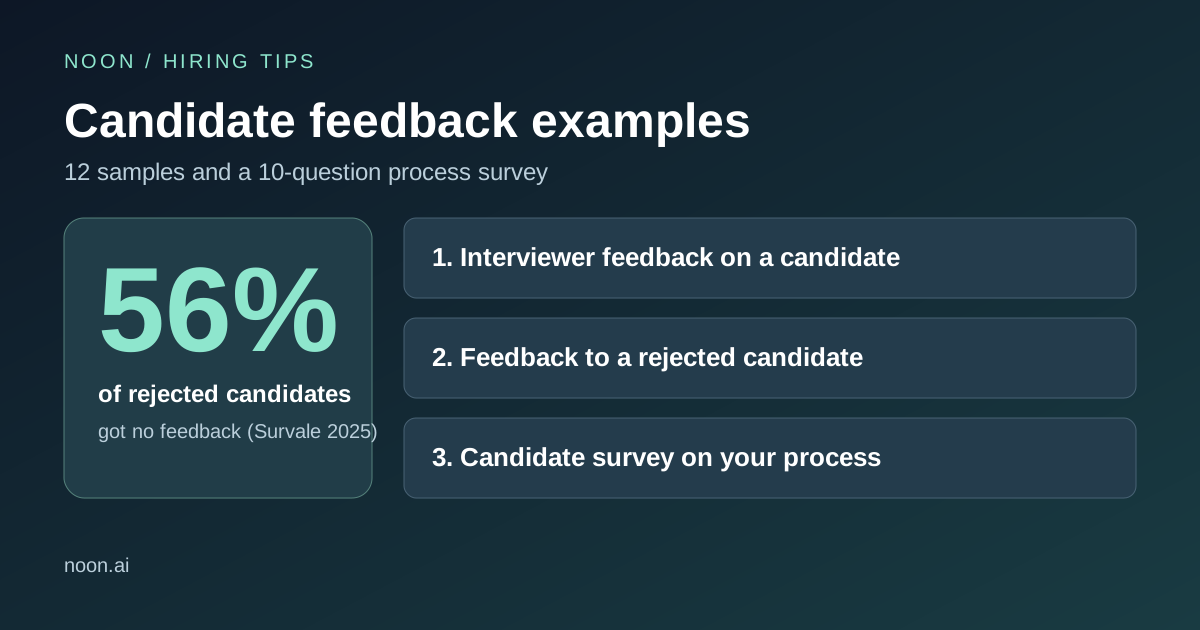
Key takeaway: "Candidate feedback" covers three different documents: what an interviewer writes about a candidate, what you tell a candidate you are not moving forward, and what a candidate tells you about your process. Most teams only do the first well. In Survale's 2025 CandE Benchmark Research (66,000+ candidate surveys, data collected January to August 2025, published July 2026), 56% of candidates rejected during screening and interviewing got no feedback at all, yet specific feedback raised candidates' willingness to refer others by 69%. The samples below cover all three documents, with wording you can paste and adapt.
The gap is widest after interviews. Greenhouse's 2024 State of Job Hunting report (2,500 workers in the US, UK, and Germany) found 61% of job seekers had been ghosted after a job interview, and 42% said stronger recruiter communication was the change they most wanted. Asking candidates for their view is just as uneven: the same Survale research found 75% of North American employers asked for candidate feedback after a hire was made, but only 42% asked after the application stage. Candidates who were invited to give feedback after the interview stage were 106% more likely to refer others.
None of this requires a new process. It requires three short templates that recruiters and interviewers actually use.
What are the three types of candidate feedback?
| Type | Who writes it | Who reads it | When | Goal |
|---|---|---|---|---|
| Interviewer feedback on a candidate | Each interviewer | Hiring team, ATS record | Within 24 hours of the interview | A decision tied to job criteria |
| Feedback to a candidate | Recruiter or hiring manager | The candidate | With or shortly after the decision | A clear, respectful, specific close |
| Candidate feedback on the recruitment process | The candidate | Recruiting team | After the application, the interview stage, and the offer or rejection | Find where your process loses people |
The first document feeds the second. If interviewers write vague notes ("not a culture fit", "just didn't click"), the recruiter has nothing specific to tell the candidate and defaults to a form rejection. Good candidate feedback starts with good interviewer write-ups tied to the evaluation criteria you set before the interview.
What should interviewer feedback on a candidate include?
Every interviewer write-up should answer four things in the same order, so a hiring manager can compare five interviewers' notes in two minutes:
- Recommendation: strong yes, yes, no, or strong no. No "maybe".
- Evidence per criterion: what the candidate said or did, not your impression of them.
- Concerns and how to test them: what the next interviewer should probe.
- Anything you could not assess: so the gap is covered, not assumed.
Here are six examples written to that structure.
Example 1: Strong yes, senior backend engineer
Recommendation: Strong yes. System design: proposed a queue-based ingestion design, identified the write-amplification problem in her own first draft without prompting, and sized the partitions correctly for the stated 50k events per second. Ownership: described leading a Postgres-to-managed-database migration, including the rollback plan she wrote before cutover. Concern: little people-management experience; not required for this level. Not assessed: frontend work, not in scope for my round.
Example 2: Yes with a concern, account executive
Recommendation: Yes. Discovery: asked five qualifying questions in the role-play before pitching, including budget owner and timeline. Objection handling: handled the pricing objection by reframing around cost of the status quo. Concern: the forecast example was vague ("usually hit my number"); the next round should ask for quota attainment by quarter for the last four quarters.
Example 3: No, data analyst (skills gap)
Recommendation: No. SQL: completed the join exercise but could not write the window function needed for the running total after a hint. Communication: explained the dashboard project clearly and tied it to a business decision. The role requires daily work with window functions and cohort queries, so the gap is core to the job. Would be a fit for the junior analyst opening if it reopens.
Example 4: No, customer success manager (criteria mismatch, not a weak candidate)
Recommendation: No. Relationship management: strong, gave two specific examples of saving at-risk accounts. Commercial ownership: has never owned renewals or expansion targets, and this role carries a net revenue retention number from day one. Recommend keeping in the pipeline for the onboarding specialist role.
Example 5: Strong no, with a factual inconsistency
Recommendation: Strong no. Stated two years at the previous employer; resume and the ATS application both show eight months. When asked about the difference, gave a third answer. Technical answers were generic and did not reference any specific system the candidate worked on. Flagging for the recruiter to verify before any further steps.
Example 6: Could not assess (interview cut short)
Recommendation: Not enough evidence. Interview ended after 20 minutes because of the candidate's connection problems. Covered only the first of three planned questions; the answer on stakeholder conflict was solid and specific. Recommend rescheduling the remaining 25 minutes rather than making a decision.
Notice what the examples leave out: "culture fit", comments about personality, appearance, age, family, accent, or anything unrelated to the criteria. Those comments do not help the decision and they read badly if the record is ever reviewed. Under 29 CFR 1602.14, employers covered by Title VII must keep records having to do with hiring for one year from the date the record was made or the personnel action, whichever is later, and longer if a discrimination charge is filed. Write every note as if the candidate might read it.
If your interviewers struggle to write notes during the conversation, a transcript makes the write-up faster and more accurate; our interview transcripts guide covers how to set that up and what to keep.
How do you give feedback to a candidate you are not moving forward?
Feedback to candidates fails in two ways: saying nothing specific, or saying too much and arguing the decision. Aim for three sentences: the decision, one specific and job-related reason, and a door left open if you mean it. Match depth to stage. A candidate who spent 20 minutes on an application needs a fast, clear close; a finalist who gave you six hours needs a real conversation.
| Stage | Channel | Depth | Timing |
|---|---|---|---|
| After application review | Decision only, plus the main requirement not met if it is objective | Within 3 to 5 business days | |
| After screening call | Decision plus one job-related reason | Within 2 business days | |
| After first interview | Decision plus one or two specific observations | Within 2 business days | |
| After take-home or assessment | Decision plus what the strongest submissions did differently | Within 3 business days | |
| After final round | Phone call, then short email | Decision plus the main deciding factor and what was strong | Within 1 to 2 business days |
Survale's 2025 research found only 23% of North American candidates received job-fit or qualification feedback as finalists. Finalists are where specific feedback matters most and where it is missing most often.
Example 7: After a screening call
Hi [Name], thank you for speaking with me on Tuesday. We've decided not to move forward for the [Role] opening. The team is prioritizing candidates who have run payroll for multi-state employers, and your experience so far has been single-state. I'd be glad to keep your details for future roles that match your background.
Example 8: After a first interview
Hi [Name], thanks for the time you spent with [Interviewer] this week. We won't be moving you to the next round. Your walkthrough of the reporting project was clear and well structured. Where other candidates were stronger was in hands-on experience building forecasting models, which is a large part of this role in the first six months.
Example 9: After a take-home assignment
Hi [Name], thank you for completing the case study. We've decided to go with other candidates. Your analysis of the churn data was accurate. The submissions we advanced also turned the analysis into a recommendation with a clear next step and an estimate of impact, which is what this role presents to leadership weekly.
Example 10: After a final round (follow-up to a call)
Hi [Name], thanks again for talking earlier today. As I mentioned, the team chose a candidate with more direct experience leading a sales team through a pricing change. Everyone you met was impressed by your territory planning and your questions about the product roadmap. If a senior individual contributor role opens on the team, I'll reach out to you first.
Example 11: Internal candidate
Hi [Name], thank you for applying for the [Role] position. We've offered the role to another candidate whose background includes managing a budget of this size. I'd like to set up 30 minutes with you and [Manager] to talk through which experience would make you a strong candidate next time, and what projects could help you get it this year.
Example 12: Silver medalist you want to keep warm
Hi [Name], this was a close decision, and I wanted to be direct: we offered the role to another finalist whose experience with enterprise onboarding matched one specific client need. You were our second choice. With your permission, I'll contact you before we post the next opening on this team.
Three rules keep these safe and useful:
- Tie every reason to a stated job requirement. "More experience with forecasting models" is job-related. "Better energy" is not.
- Compare with the requirement, not with the person hired. Do not share details about other candidates.
- Do not debate. If the candidate disagrees, thank them, note the comment, and do not reopen the decision by email.
For the full set of rejection, follow-up, and re-engagement emails by stage, see our recruiting email templates.
What phrases should you avoid in candidate feedback?
| Avoid | Why | Say instead |
|---|---|---|
| "Not a culture fit" | Vague and hard to defend | "The role needs X; your examples focused on Y" |
| "Overqualified" | Can read as age-related | "The scope of this role is narrower than your recent roles, specifically [scope]" |
| "We went with a stronger candidate" | Tells them nothing | "The candidates we advanced had [specific skill or experience]" |
| "You seemed nervous" | About the person, not the work | "Your answer on [topic] did not include a specific example" |
| "We'll keep your resume on file" (when you won't) | Candidates notice | Only offer it if a recruiter will actually search the pipeline |
| "Maybe next time" (with no path) | Sounds like a brush-off | Name the experience that would make them competitive |
What should a candidate feedback survey on the recruitment process ask?
A process survey tells you where candidates drop out or turn negative. Keep it to under three minutes, send it at more than one stage, and make it anonymous or clearly separate from the hiring decision. The sample below works after the interview stage for both hired and rejected candidates; drop questions 8 and 9 for candidates rejected at the application stage.
Sample candidate feedback survey on the recruitment process (10 questions)
- How likely are you to recommend applying here to a friend or colleague? (0 to 10)
- How clear was the job description about the role's responsibilities and requirements? (1 to 5)
- How easy was the application to complete? (1 to 5)
- How long did you wait between applying and hearing from us? (under 1 week / 1 to 2 weeks / 2 to 4 weeks / longer / never heard)
- Did you know what to expect at each step before it happened? (yes / partly / no)
- How respectful were we of your time in scheduling interviews? (1 to 5)
- Did the interviews feel relevant to the job you applied for? (1 to 5)
- Did your interviewers seem prepared and familiar with your background? (1 to 5)
- Did you feel the process was fair? (1 to 5)
- What is one thing we should change about our hiring process? (open text)
How to use the results:
- Question 1 is your candidate NPS. Track it by stage and by role family. Survale's 2025 research reported a North American NPS of minus 28 for candidates who were not selected, so a negative score for rejected candidates is normal; the trend matters more than the absolute number.
- Questions 4 and 5 find communication gaps, the most common complaint in the Greenhouse data above.
- Questions 7 to 9 find interviewer problems. Low scores concentrated on one role usually point to one interview loop, not the whole process. Our guide to interview quality tools covers ways to measure and coach interviewers.
- Question 10 is where the useful detail lives. Read every answer for the first month before you try to summarize them.
Send the survey at three points: after the application decision, after the interview stage, and after an offer or final rejection. The Survale data suggests most employers skip the first two, which is where most candidates exit.
How do you give specific feedback without adding recruiter hours?
The reason most candidates get no feedback is time, not intent. A recruiter carrying 25 requisitions cannot write a custom note for every screen-out. Three changes make specific feedback cheap:
- Structure the evidence at the source. When interviewers write to the four-part format above, the recruiter can copy one criterion-level observation into the candidate email.
- Capture interviews automatically. A transcript and summary of each conversation means nobody has to reconstruct what was said two days later.
- Screen with defined questions. When every candidate at a stage answers the same role-specific questions, feedback can point to a specific answer rather than a general impression. Our guide to screening calls shows how to design that stage.
This is where Noon fits. Noon's AI Interviewer runs voice screening interviews on the role-specific questions your team defines and produces a full transcript, a structured analysis, and a next-round recommendation. Noon's AI Notetaker joins live interviews, transcribes them with speaker labels, writes a post-meeting summary, and tracks which of your expected questions were covered. Noon also runs personalized email and SMS sequences, so the follow-up message reaches the candidate on time. Recruiters start each feedback note from evidence instead of memory. Noon is one plan with unlimited seats; see pricing for how it is quoted.
For the wider set of practices around structured hiring, see our hiring best practices guide.
FAQ
What is an example of good interviewer feedback on a candidate?
Good interviewer feedback starts with a clear recommendation, then gives evidence for each job criterion, then lists concerns for the next interviewer to test. For example: "Yes. Discovery: asked five qualifying questions before pitching. Concern: forecasting example was vague; next round should ask for quota attainment by quarter." It describes what the candidate said or did, not personality.
Should you give feedback to rejected candidates?
Yes, at a depth that matches the stage. Survale's 2025 CandE research found specific feedback raised candidates' willingness to refer others by 69%, and giving feedback has raised referral willingness by 50% to 75% across 14 years of the research. Keep it to one or two job-related reasons and do not compare the candidate with the person hired.
What should a candidate feedback survey on the recruitment process include?
A short survey (under three minutes) with a 0 to 10 recommendation question for candidate NPS, ratings for job description clarity, application ease, communication speed, scheduling, interview relevance, interviewer preparation and fairness, and one open question asking what to change. Send it after the application decision, after interviews, and after the final decision.
How soon should you give feedback after an interview?
Interviewers should submit written feedback within 24 hours so details are accurate. Candidates should hear the decision within about two business days after an interview, and the same day or the next day after a final round. Survale's 2025 research found offers made within one week of the final interview raised candidates' willingness to refer others by 108%.
Can candidate feedback create legal risk?
Feedback creates risk when it cites something unrelated to the job, such as age, family status, or accent, or when it contradicts the documented reason for the decision. Tie every reason to a stated requirement and keep interview records: under 29 CFR 1602.14, covered employers must keep hiring records for at least one year. For anything beyond that, check with employment counsel in your jurisdiction.