
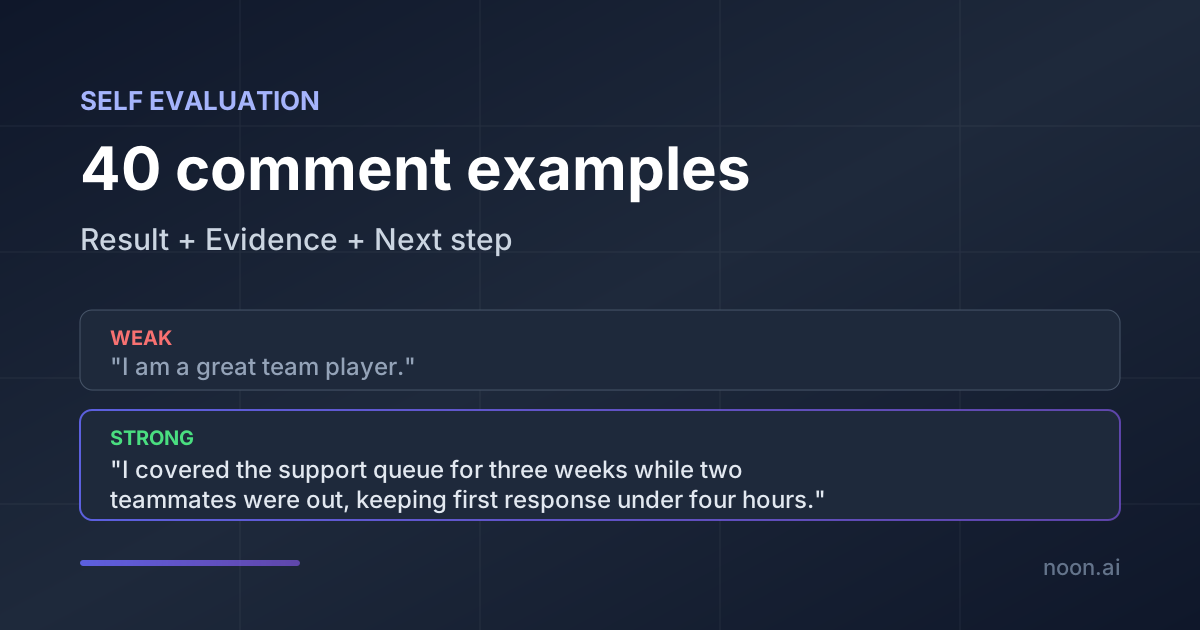
Key takeaway: A strong employee self evaluation comment names one result, proves it with a number or a concrete example, and says what you will do next. Vague comments ("I am a hard worker and a team player") give your manager nothing to rate, which is part of why only 14% of employees strongly agree their performance reviews inspire them to improve (Gallup, 2019). Below are 40 self-appraisal comments by skill area, written to be adapted rather than pasted, plus a fill-in formula, weak vs strong rewrites, and what managers should write back.
Most self-evaluations fail for the same reason: the employee describes effort instead of outcomes. A manager reading ten self-reviews in a week remembers the one that says "cut invoice processing from five days to two" and forgets the nine that say "worked diligently on process improvements."
The problem is not only on the employee side. Gallup's research on performance management (2018) found only 2 in 10 employees strongly agree their performance is managed in a way that motivates them to do outstanding work, and only 21% strongly agree they have performance metrics within their control. If you do not know what you are measured on, your self-evaluation is the place to say what you think it should be, with evidence.
That makes the self-review less of a form to survive and more of a short argument for how your year should be judged.
What should an employee self evaluation include?
A complete self-evaluation answers five questions. Most review templates ask for some version of each, even if the labels differ:
- What did I achieve? Two to four results tied to your goals or your team's goals.
- How did I achieve it? The skills and behaviors behind the results: collaboration, communication, judgment.
- Where did I fall short? One or two honest growth areas, each paired with what you are doing about it.
- What do I need? Training, tools, scope, or support from your manager.
- What comes next? Goals for the next review period.
Keep each comment to two or three sentences. A full self-evaluation usually fits on one page; if yours runs to three, your manager will skim it, and the strongest results get the same attention as the weakest.
How do you write a self evaluation comment?
Use a three-part formula for every comment: Result + Evidence + Next step.
- Result: what changed because of your work, stated as an outcome, not an activity.
- Evidence: a number, a date, a named project, or a piece of feedback someone gave you.
- Next step: what you will build on, fix, or try in the next period.
Fill-in version: "I [result] by [action], which [evidence]. Next quarter I plan to [next step]."
The formula works for growth areas too. "I missed two sprint deadlines in Q2 because I underestimated QA time. I now add a QA buffer to every estimate, and I have hit every deadline since August" is a stronger comment than most achievement statements, because it shows judgment.
Weak vs strong self evaluation comments
The difference between a forgettable comment and a useful one is usually one specific detail.
| Weak comment | Strong rewrite | What changed |
|---|---|---|
| "I am a great team player." | "I covered the support queue for three weeks while two teammates were out, keeping first-response time under four hours." | A situation and a measured outcome |
| "I improved my communication skills." | "I started sending a Friday status note to the four project stakeholders; status-check meetings dropped from weekly to monthly." | A behavior and its effect |
| "I worked hard this year." | "I closed 112 tickets in Q3, up from 80 in Q1, with no increase in reopen rate." | Output plus a quality check |
| "I sometimes struggle with deadlines." | "I missed two deadlines in Q2 by underestimating review time. I now build in a two-day buffer and have met every deadline since." | Ownership plus a fix that worked |
| "I want to grow into a leadership role." | "I want to lead the Q1 onboarding redesign and would like to shadow our team lead's planning meetings to prepare." | A concrete ask your manager can say yes to |
Self evaluation examples for achievements and results
- "I delivered the customer portal migration two weeks ahead of the March deadline by splitting the work into weekly releases, which let support start training early."
- "I exceeded my quarterly target by 18% by focusing my pipeline on the two segments with the highest close rate. I plan to document that segmentation for the rest of the team."
- "I reduced month-end close from eight working days to five by automating three manual reconciliations in our spreadsheet model."
- "I owned the vendor renewal process this year and renegotiated two contracts, saving the department about $40,000 annually."
- "I shipped all four of my committed roadmap items and one unplanned fix for a checkout bug that was affecting mobile users."
Replace the numbers with your own. If you do not track a metric, use a before-and-after description ("the report used to take a full day; it now runs in an hour").
Self evaluation examples for teamwork and collaboration
- "I paired with the design team every week on the pricing page redesign, which cut revision rounds from four to two."
- "When our team lost a member in Q2, I took over the weekly reporting and trained a new hire on it within a month."
- "I proactively shared my onboarding notes with three new hires, and two of them told our manager the notes shortened their ramp-up."
- "I resolved a scheduling conflict between operations and sales by proposing a shared calendar for launch dates, which both teams still use."
- "I could do more to involve quieter teammates in planning. Next quarter I will ask for written input before each planning meeting."
Self evaluation examples for communication
- "I write a weekly project summary for stakeholders, which has reduced ad hoc status requests to almost none."
- "I presented our Q3 results to the leadership team and answered follow-up questions without needing to escalate to my manager."
- "I rewrote our internal FAQ for the billing system, and support tickets on that topic dropped noticeably in the following month."
- "I sometimes send long messages when a short one would do. I now lead with the decision or question in the first line."
- "I gave direct, specific feedback to a peer on a proposal draft, and we agreed on a revised plan in one meeting instead of three."
Self evaluation examples for problem solving and initiative
- "I spotted that our lead-routing rule was sending enterprise leads to the SMB queue, fixed the rule, and recovered 30 misrouted leads."
- "I proposed and built a simple tracker for recurring customer complaints, which surfaced the top three issues for the product team."
- "When the reporting tool went down before the board meeting, I rebuilt the key charts from raw exports in two hours."
- "I investigated why our trial-to-paid rate dipped in May and traced it to a broken email step, which we fixed the same week."
- "I tend to solve problems myself before asking for help. I am learning to flag blockers within a day so the team can help sooner."
Self evaluation examples for time management and reliability
- "I met 95% of my deadlines this year and flagged the two I missed at least a week in advance."
- "I set up time-blocking for deep work on Tuesdays and Thursdays, which helped me finish the analytics project without overtime."
- "I consistently reply to internal requests within one business day, and my manager has not had to follow up on any open item."
- "I took on too many side projects in Q1 and my core work slipped. Since then I check new requests against my priorities before saying yes."
- "I keep a running list of commitments from meetings and close each one out in writing, so nothing falls through between teams."
Self appraisal comments for areas of improvement
Growth-area comments are where most employees hedge. Name the gap, show what you are doing about it, and stop. Do not apologize or list five weaknesses.
- "I want to strengthen my data analysis skills. I enrolled in a SQL course and will use it to build my own reports next quarter."
- "Public speaking is still uncomfortable for me. I volunteered to run two team demos next quarter to practice."
- "I need to delegate more. I have identified two recurring tasks I will hand to a junior teammate with a written guide."
- "My estimates were often optimistic. I now track estimate vs actual hours and adjust future estimates using the gap."
- "I want to understand the business side of my work better, and I would like to sit in on one customer call per month."
Self evaluation examples for leadership and ownership
- "I mentored two junior analysts this year. Both now run their own weekly reports without review."
- "I led the planning for our team offsite, including the agenda, budget, and follow-up action list, which my manager now uses as a template."
- "When priorities conflicted between two stakeholders, I set up a short decision meeting and documented the outcome so the team could move forward."
- "I took ownership of our team's onboarding checklist and updated it for the new tools we adopted this year."
- "I am ready for more scope. I would like to own the Q1 vendor evaluation end to end, with my manager as the final approver."
Self evaluation examples for recruiters
Recruiters have an advantage in self-reviews: most of their work already produces numbers. Use the funnel metrics your team tracks, and compare them to your own baseline or to published benchmarks such as time-to-hire benchmarks and offer acceptance rate benchmarks.
- "I filled 14 of my 16 assigned roles this year, with a median time to fill of 38 days, down from 47 days last year."
- "I built a pipeline of 60 qualified candidates for our engineering roles before the requisitions opened, so the first two hires came from that pipeline."
- "I set a 24-hour feedback expectation with my hiring managers, which shortened the interview stage on my roles by about a week."
- "My offer acceptance rate was 85%. On the two declined offers, I learned compensation expectations came too late, so I now confirm them at the first screen."
- "I want to improve my sourcing response rate. I will test two new outreach messages per quarter and keep the one that performs best."
For recruiters, the strongest growth areas tie to a stage in the funnel. Our guide to talent management metrics covers which numbers managers usually expect to see.
Performance appraisal employee final comments
Many review forms end with a free-text "employee comments" box after the manager's rating. Use it for one of three things:
- Agreement and a forward goal: "I agree with the rating and the feedback on stakeholder updates. My main goal for next year is leading a cross-team project."
- A respectful correction: "I would like to add context on the Q2 delay: the scope changed twice after kickoff, documented in the project tracker. I have since added a change-request step."
- A specific ask: "I would appreciate a check-in at the six-month mark to review progress on the analytics goal."
Avoid arguing the rating in this box. If you disagree with something material, state the fact once, point to the evidence, and ask for a follow-up conversation.
What should a manager write back?
Most self-evaluation guides stop at the employee's side. Managers need a response pattern too, because an employee who writes a careful self-review and gets a one-line reply learns not to bother next time.
- Confirm what you agree with, using their evidence: "Agreed, the migration landing two weeks early gave support real training time."
- Add what they missed. Employees under-report collaboration and help given to others; name it.
- Address gaps between their rating and yours directly, with a specific example, not a general impression.
- Agree on one or two goals for the next period and how they will be measured.
This is the same discipline as good interview feedback: specific, tied to observable behavior, and written soon after the conversation. Our candidate feedback examples and talent evaluation guide apply the same rules to hiring decisions. If your team is choosing a system to run reviews, compare options in our roundup of performance management software.
How Noon fits
Recruiters write the most persuasive self-evaluations when their numbers are easy to pull: roles filled, time to fill, response rates, candidates advanced. Noon is an AI recruiting platform that sources candidates across the web (not only LinkedIn), evaluates them against each role's criteria, runs personalized email and SMS outreach, and books interviews, with funnel and outreach analytics for every role. That frees recruiter time for the work a self-review should highlight, such as closing candidates and advising hiring managers. Noon runs one plan with unlimited sourcing, contacts, agents, and seats. See Noon pricing or book a demo to discuss pricing for your team.
Frequently asked questions
What should I write in a self evaluation comment? Write one result, the evidence that proves it (a number, a project, or feedback from someone), and what you plan to do next. Two or three sentences per comment is enough.
How long should an employee self evaluation be? Usually one page, or 300 to 600 words: two to four achievements, one or two growth areas, a request for support, and goals for the next period. Follow any word limit in your company's form.
Should I mention weaknesses in a self evaluation? Yes, one or two. Pair each with the specific step you are taking to improve. Managers generally read an honest, handled weakness as a sign of judgment, while a review with no growth areas reads as unreflective.
How do I rate myself on a self evaluation? Rate against the written definition of each level on your company's scale, not against how hard you worked. If you met every goal, "meets expectations" or its equivalent is accurate; reserve the top rating for results clearly beyond the goal, and cite the evidence.
What are good sentence starters for a self evaluation? "I delivered...", "I reduced...", "I led...", "I took ownership of...", "I learned... and now...", "I would like to..." Starting with a verb keeps the comment focused on what you did.
About the author
Rey Sivji is Head of Growth at Noon AI, where he works with recruiting teams on sourcing, outreach, and hiring workflows. Email rey@noon.ai.