
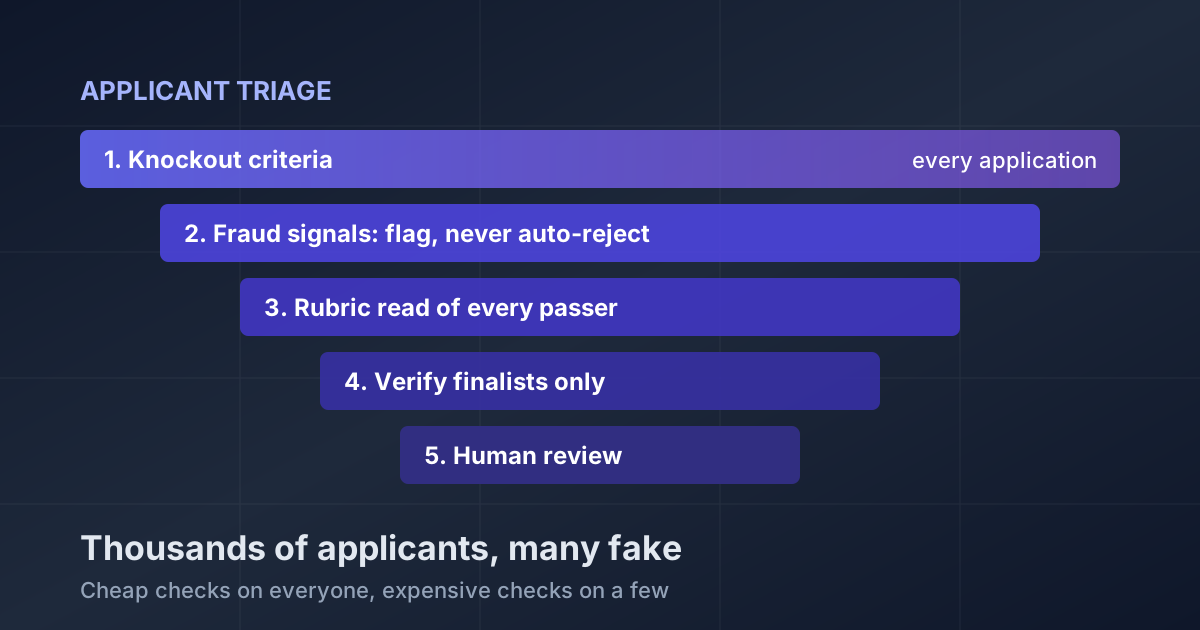
Key takeaway: When a posting draws thousands of applicants and many are unqualified or fake, screen in a fixed order: cheap checks on everyone, expensive checks on a few. Greenhouse measured 244 applications per job in 2025, up 111% since 2022, while recruiters per organization fell 56% (Greenhouse Hire Standard, March 2026). Run five stages: knockout criteria on every application, fraud signals on every application (flag, never auto-reject), a full rubric read of what survives, identity verification only for finalists, and a human review of every fraud-based rejection. Log each stage's pass rate so you can show the screen is job-related and fair.
A customer-support role goes live on a Tuesday. By Friday it has 3,100 applications. Roughly a third answer the screening question with a paragraph that restates the job description. Two hundred share eleven phone numbers. Forty list the same street address in Texas and connect from a datacenter in another country. Somewhere in the queue are the 25 people the hiring manager would actually want to meet.
Volume and fraud are usually treated as two problems with two owners. In practice they arrive together, and the order you deal with them decides both how fast you get to a shortlist and how exposed you are if a rejected applicant challenges the process. The single most common workflow pain we hear in evaluation calls is a team that cannot sift its inbound applicants by hand at all. A smaller but sharper version of it: thousands of applicants for one post, with a high share that turn out not to be real people.
The load per recruiter has tripled. Greenhouse's March 2026 benchmark, built from more than 6,000 companies, puts annual applications per recruiter at 4,890 in 2025 against 1,610 in 2022, a 203.7% rise (Greenhouse Hire Standard, March 2026). Fraud is organized, not incidental: on June 30, 2025 the U.S. Justice Department announced searches of 29 suspected "laptop farms" across 16 states tied to North Korean remote-IT-worker schemes that had obtained jobs at more than 100 U.S. companies using stolen and fake identities (U.S. Department of Justice, June 2025).
Why do volume and fraud show up together?
Both come from the same change: applying now costs almost nothing. An auto-apply agent can submit hundreds of applications a day, and a fraud ring uses the same tooling, with better-written resumes. That has three consequences for the person holding the queue.
- Fakes hide in volume. At 80 applications a recruiter notices four that share a phone number. At 3,000 nobody does, unless a check looks for it.
- Fake applications often look more qualified, not less. A fabricated resume is written to the posting. On a keyword match it scores higher than a real candidate who described the same work in different words.
- Every manual shortcut makes fraud easier. Reading in arrival order, skimming the first 200 or filtering on keywords all favor applications produced fastest and closest to the posting text, which is how bulk and fraudulent applications are produced.
The signals that separate real from fake applicants also cluster. In our 2026 fake job applicant statistics, the median flagged applicant tripped 7 separate risk signals, and only 3.8% were flagged on one or two. That matters for the design below: a screen that waits for several independent signals rarely has to act on one weak one.
What should run on every application?
Two stages run on the full queue, because they cost seconds per application and do not require anyone to read a resume.
Stage 1: Knockout criteria. These are the three to five requirements without which the person cannot do the job on day one: work authorization, a required license, a location or time-zone constraint, the one hard skill. Write them into the posting and the application form, and screen on the answer rather than on the resume. If you are drafting these questions, our guide to screening calls that triage candidates covers which questions separate candidates and which only restate the resume.
Stage 2: Fraud signals. Check every application, not only the ones that look suspicious, for signals that need no judgment: a VPN or datacenter connection, a stated location that does not match the time zone or phone country code, a disposable email domain, and the same phone number, email or resume text reused across applications. Flag, do not reject. Each of these signals has innocent explanations (a corporate VPN, a recent move, a shared family phone), which is why the next stages exist.
| Stage | Runs on | Cost per application | Decision it can make | What it must never do |
|---|---|---|---|---|
| 1. Knockout criteria | Everyone | Seconds | Reject on a stated, job-related requirement | Screen on anything that proxies a protected trait |
| 2. Fraud signals | Everyone | Seconds | Flag with the triggering signals | Reject automatically on one signal |
| 3. Rubric read | Knockout passers | Minutes by hand | Rank and shortlist | Run in arrival order or stop at the first 200 |
| 4. Identity verification | Finalists only | Tens of minutes | Confirm the person is who applied | Run a third-party report without written consent |
| 5. Human review | Every fraud-based rejection | Minutes | Confirm or override the flag | Be skipped because the queue is long |
How do you read thousands of applications fairly?
Stage 3: The rubric read. Score every application that passed Stage 1 against the same criteria, in the same order, with the same weights. Every one, not the first 200. This is the step that breaks when the queue is in the thousands: at four minutes per application, 2,000 passers is 133 hours of reading, so teams sample instead of screen, and the sample is biased toward whoever applied first.
Consistency here is also the legal position. The EEOC's Uniform Guidelines treat a selection rate for any race, sex or ethnic group below four-fifths (80%) of the rate for the highest group as general evidence of adverse impact (29 CFR 1607.4(D)). A screen with that impact has to be job-related and consistent with business necessity. A rubric built from the knockout criteria is easy to defend. "Did not look like a fit when I skimmed it" is not.
If you are doing this step by hand, the full worked method, including the knockout questions that auto-apply tools answer badly, is in our guide to too many unqualified applicants per job posting. At thousands of applications per role, this is the step to move onto software that reads each application in full rather than matching keywords.
Where does identity verification belong?
Stage 4: Verify finalists, not the queue. Identity checks are slow and intrusive, so they belong after the rubric, on the 10 to 30 people you intend to interview or hire. Practical checks: a live video conversation with camera on where the candidate does unscripted work, confirmation that the person on the call matches the person who applied, a reference reached through a company switchboard rather than a number the candidate supplied, and a re-check at offer and onboarding. Our guide to detecting fake job applicants for remote roles lays these out step by step.
If you buy a background or identity report from a company that compiles them, federal rules add steps. The EEOC and FTC's joint guidance says you must tell the applicant in writing, in a stand-alone document that is not part of the application, that you may use the report, and get their written permission. Before rejecting someone based on it, you must give them a copy of the report and a summary of their rights, so they can explain or dispute it (EEOC and FTC, Background Checks: What Employers Need to Know). The same guidance says to apply the same standards to everyone, regardless of race, national origin or other protected traits. That is the strongest argument for running Stage 2 on every applicant rather than on the ones a reviewer finds suspicious.
Why must a person review every fraud rejection?
Stage 5: Human review of fraud-based rejections. Rejecting a qualified applicant because of a flag costs you that hire and invites a complaint. Real fraud tends to trip several signals at once, so the review is usually fast: a reviewer sees the flags, checks whether they correlate, and either confirms the rejection or clears the applicant. Two rules keep it honest:
- No rejection on a single signal. A VPN alone, or a time-zone mismatch alone, is a reason to look, not a reason to reject.
- Keep the record. Federal rules require employers to keep application records and records of hiring decisions for one year from the date of the record or the personnel action, whichever is later (29 CFR 1602.14). Store the flag, the signals behind it and the reviewer's decision with the application.
Finally, measure the funnel. For each stage, record how many applications entered, passed and were rejected, and break the pass rates out by group where you collect that data. If one stage removes a group at a much higher rate than the others, the four-fifths comparison tells you where to look. Pair it with a work-sample or skills assessment at Stage 3 or 4 when the role allows; job-related tasks are both harder to fake and easier to defend.
What does this look like for one 3,000-applicant role?
The example below is illustrative arithmetic, not a benchmark. It shows why the order matters more than the speed of any single stage.
| Stage | Applications in | Typical outcome | Reviewer time |
|---|---|---|---|
| 1. Knockout criteria | 3,000 | 1,800 pass on work authorization, location and license | Automated on the form |
| 2. Fraud signals | 3,000 | 240 flagged on several correlated signals | Automated |
| 3. Rubric read | Unflagged passers | Ranked list, top 60 shortlisted | 100+ hours by hand; minutes with software |
| 4. Identity verification | 20 finalists | 1 or 2 fail live verification | About 30 minutes each |
| 5. Human review | 240 flagged | Most confirmed, a few cleared and returned to Stage 3 | A few minutes each |
The time sink is Stage 3, and it is the stage teams skip. Stages 1 and 2 are cheap because they run on structured data. Stages 4 and 5 are expensive but run on small numbers.
How Noon fits
Noon handles Stages 2 and 3 on inbound roles. With inbound screening, Noon pulls applications from a connected ATS (Greenhouse, Lever, Ashby, Workable, Atlas or Loxo) several times a day, evaluates every application in full against the role's criteria and non-negotiables, ranks the queue, and syncs advance and reject decisions back to your mapped ATS stages with your own rejection reasons. Feedback calibrates the ranking for each role, and changing a criterion re-ranks the queue.
Noon's fraud detection is a layered system: it checks every inbound applicant across network, identity-location and email signals (VPN or datacenter connections, location and time-zone mismatches, disposable email), correlates them rather than acting on any one, and marks flagged applicants with the signals that triggered the flag. Applicants are never hidden, and recruiters can override a flag, which is exactly the Stage 5 review. Flags persist across roles, so a profile flagged on one requisition is not new on the next. Noon is not a background check or identity verification service, so Stage 4 stays with your team and your verification process.
On the outbound side, Noon sources candidates from their public professional footprint rather than a self-submitted resume and verifies contact emails before outreach, which removes the fake-resume problem from that half of the pipeline. One plan covers unlimited sourcing, contacts, agents and seats; see how Noon pricing works, or book a demo to see it rank a live inbound queue.
Frequently asked questions
How do you identify fake candidates in a large applicant pool? Check every application for signals that need no reading: VPN or datacenter connections, a stated location that does not match the time zone or phone country code, disposable email domains, and phone numbers, emails or resume text reused across applications. Act on correlated signals, not single ones, and confirm identity live with finalists only.
Should we auto-reject applicants flagged as fraudulent? No. Every single fraud signal has innocent explanations, and a wrongful rejection costs you a hire and can create a discrimination complaint if the flags fall unevenly across groups. Flag, show the reviewer the triggering signals, and have a person confirm each rejection. Keep the flag and the decision with the application record for at least one year.
Can we run background checks on every applicant to stop fraud? It is slow, expensive and adds legal steps. A report from a company that compiles background information needs a stand-alone written notice and the applicant's written permission first, and a pre-adverse action notice with a copy of the report before you reject on it. Reserve it for finalists and apply the same standard to everyone at that stage.
How accurate is automated fraud detection? Ask any vendor what it does with a single weak signal. Systems that correlate several independent signals and show their reasoning are easier to trust and audit than a black-box score. In our 2026 data, flagged applicants tripped a median of 7 signals, so a well-designed system rarely needs to act on one. Test it on a past role's queue before relying on it.
How do you screen thousands of applicants without creating bias? Use job-related knockout criteria, score every remaining application against the same rubric in the same order, and track pass rates by stage. Under the EEOC's four-fifths rule, a group selected at less than 80% of the highest group's rate is a signal of adverse impact worth investigating at that stage.
Does Noon detect fake applicants on inbound roles? Yes. Noon's fraud detection checks every inbound applicant for VPN or datacenter connections, location and time-zone mismatches and disposable email, marks flagged applicants with the reasons rather than hiding them, and lets recruiters override. Inbound screening then ranks the remaining queue against the role's criteria and syncs decisions to your ATS.
About the author
Rey Sivji is Head of Growth at Noon AI, where he works with recruiting teams on sourcing, screening, and hiring workflows. Email rey@noon.ai.