
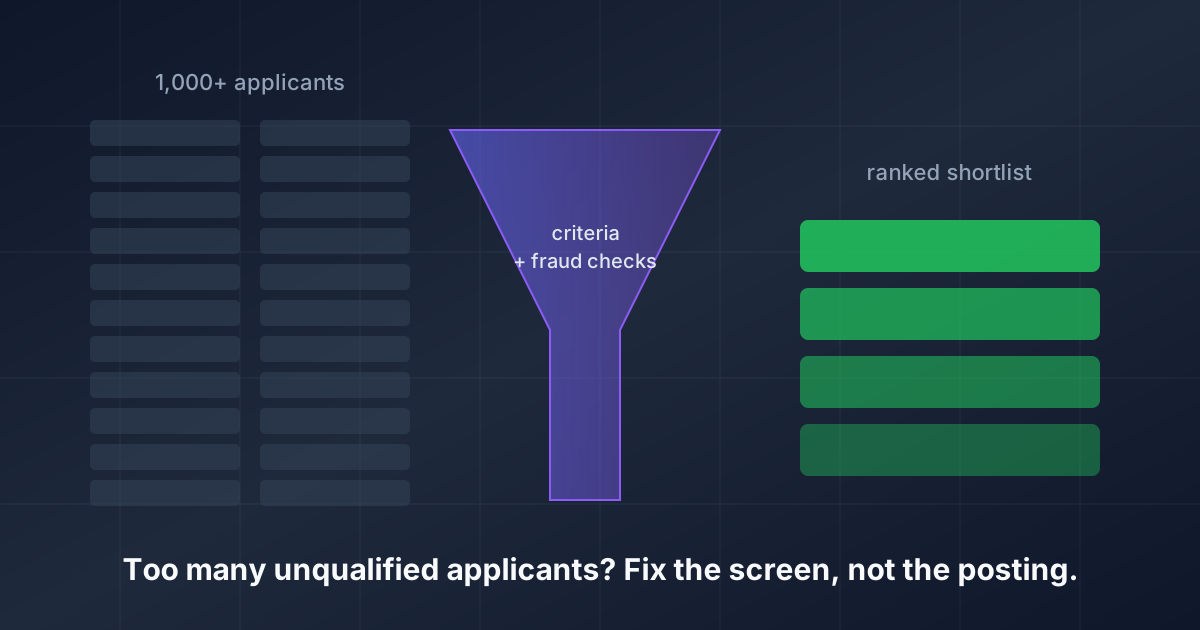
Key takeaway: A job posting that draws thousands of applicants is not a sourcing success. It is a screening problem that arrives all at once. Greenhouse's benchmark of 640 million applications puts the average at 244 applications per job in 2025, up 111% since 2022, while recruiters per organization fell 56% over the same period (Greenhouse Hire Standard, 2026). Fix the pile in this order: write the non-negotiables before you post, add two or three knockout questions that a bot cannot answer well, screen for fraud signals before you screen for fit, evaluate every application against the same rubric instead of reading in arrival order, and move the reading step onto software that can do it in full.
The role went live on Monday. By Wednesday there are 1,400 applications in the queue, the recruiter has opened 200 of them, and roughly 15 look like they might be worth a call. Several of the rest are word-for-word copies of the job description with a name at the top. A handful list a U.S. address and a phone number with a country code that does not match. The hiring manager wants a shortlist by Friday.
This is the pain recruiting teams raise with us more than almost any other. In evaluation calls, buyers describe the same three variants: a team cannot manually sift through the volume of inbound applicants at all, a team can sift but spends the day on unqualified and fraudulent submissions, and a team receives thousands of applications for a single post with a high percentage that turn out not to be real people. The remote-role version is the sharpest, because remote postings draw applicants from everywhere and give fake profiles the least friction.
The numbers say this is structural, not a bad week. LinkedIn reported that 73% of HR professionals say less than half the applications they receive meet all the listed criteria, and 22% spend three to five hours a day sifting through applications (LinkedIn, 2025). Applications submitted on LinkedIn rose more than 45% in a year to roughly 9,500 per minute (CNBC, October 2025). Workday's recruiting data showed applications growing four times faster than job openings as early as 2024 (Workday, 2024). The posting did not get worse. The cost of applying dropped to zero.
Why are so many applicants unqualified?
Three mechanics produce most of the pile.
Applying is now automated on the candidate side. Greenhouse's 2025 Workforce Report found that more than one in five U.S. candidates have used AI agents to apply for jobs automatically, and 28% say they have used AI to generate fake work samples or portfolios (Greenhouse, October 2025). An agent that applies to 300 postings a day does not read your requirements. It matches on title and location, fills the form, and moves on. Every one of those submissions lands in your queue with the same weight as a candidate who spent an hour on it.
Job posts optimize for reach, and reach is the problem. Job boards distribute a posting to the widest possible audience, then rank it by clicks and applies. Postings written to attract volume, with generic titles, broad locations, and requirements buried below a long company pitch, attract exactly that. The per-recruiter load compounds it: Greenhouse's August 2025 customer data showed recruiters managing about a third fewer roles than in 2021 while applications per job rose from 28 to 95, a 239% increase (Greenhouse, October 2025).
Fraud rides on volume. When thousands of applications arrive, a few hundred fake ones are invisible without a deliberate check. Gartner has predicted that by 2028 one in four candidate profiles worldwide will be fake, and Greenhouse documents recruiters learning to scan for buzzword-heavy resumes with no specifics, brand-new or broken profile links, and inconsistencies across a candidate's own submissions (Greenhouse, October 2025). Our guide to candidate fraud red flags covers the individual tells; this article is about processing the pile they hide in.
How much does reading in arrival order cost?
Run the arithmetic on the 1,400-application example. If a recruiter spends four minutes on each application, the full queue is 93 hours of reading, more than two working weeks for one role. Most teams do not have two weeks, so they read the first 200 to 300, shortlist from those, and never open the rest. That is not screening. It is sampling the applicants who happened to apply first, which over-selects for the people (and bots) with the fastest apply loop and under-selects for the working professional who applied on Saturday.
The second cost is quieter. When the first 200 include 180 unqualified submissions, reviewer attention degrades. A qualified candidate with a non-standard title, described in the same vocabulary problem that breaks keyword search, gets skimmed and rejected at minute 90 because she looked like the last 40 rejects.
| Approach to a 1,400-application queue | Time to a shortlist | What it misses | Fraud exposure |
|---|---|---|---|
| Read in arrival order, stop at 200 to 300 | 1 to 2 days | The 1,100 never opened; late applicants | High: fakes are not checked, only skimmed |
| ATS keyword filter, then read the matches | Hours to 1 day | Qualified people who used different words; passes copy-paste resumes | High: a pasted job description matches every keyword |
| Knockout questions plus manual read of the passers | 1 to 3 days | Less, if the questions are specific | Medium: bots answer generic questions well |
| Rubric-based evaluation of every application, fraud signals first | Hours | Very little, if the criteria are right | Low: flagged before fit is scored |
Step 1: Write the non-negotiables before you post
Most unqualified applications are invited by the posting. A requisition that lists twelve "requirements" of which three actually matter tells applicants nothing about who should not apply, and tells your screen nothing about how to sort.
Sit with the hiring manager and force-rank the list into three to five non-negotiables (without which the person cannot do the job on day one) and preferences. Write the non-negotiables in the first 100 words of the posting, in plain language, with the disqualifiers spelled out: work authorization, location or time-zone constraints, licensure, the one hard skill. This does not stop automated applicants, who do not read, but it does sharply cut the human applicants who are hopeful rather than qualified, and it gives every later step a rubric to work from. If the role is one of your hard-to-fill roles, this list is also what tells you the pile is large but the qualified pool inside it is small.
Step 2: Add two or three knockout questions a bot cannot answer well
Add screening questions to the application, not a questionnaire. Two or three, each tied to a non-negotiable, each requiring a specific answer rather than a yes or no. "Describe the largest data pipeline you have operated in production: volume, tooling, and what broke" produces an answer a real data engineer writes in three minutes and an auto-apply agent either skips or fills with boilerplate that is easy to spot.
Avoid questions that ask the candidate to restate the resume or that have a single right answer available on the posting. Avoid anything that functions as a test of protected characteristics. The goal is a short-answer sample of how the applicant thinks about the actual work, which is also the most useful thing you can hand to a screen in Step 5.
Step 3: Screen for fraud signals before you screen for fit
Order matters. A fake applicant who is scored for fit first wastes the score, and if the profile is good fiction it can reach a hiring manager. Run the fraud pass first and run it on every application, not only the suspicious ones.
The signals that scale are the ones that do not require reading: whether the application came through a VPN or datacenter connection, whether the stated location matches the time zone and phone country code, whether the email is a throwaway domain, whether the same resume text or phone number appears across several applications or roles. Flag rather than reject. The flag and its triggering signals go to a human reviewer, because a VPN alone is not fraud and a mismatch alone is sometimes a candidate relocating. Remote postings deserve a stricter default, since the friction that normally deters fake profiles (showing up somewhere) is absent. Our outbound vs inbound recruiting comparison covers why outbound pipelines carry much less of this risk: candidates found from their public professional footprint are not self-submitted.
Step 4: Evaluate every application against the same rubric
Take the non-negotiables from Step 1 and the knockout answers from Step 2 and score every remaining application against them, in the same order, with the same weights. Not the first 200. Every one. A rubric applied consistently is also the defensible position: the EEOC's guidance on selection procedures is explicit that a screen with a disparate impact must be job-related and consistent with business necessity, and it notes that the large-scale adoption of online applications is precisely what drove employers to look for non-subjective ways to screen large numbers of applicants (EEOC, Employment Tests and Selection Procedures). A recruiter reading a random 15% of the queue in arrival order is neither consistent nor documented.
If you are doing this manually, the practical version is a two-column sheet per non-negotiable (meets, does not meet, evidence) and a hard rule that nobody advances on "seems strong" without the evidence column filled. Expect it to be slow. That is the argument for Step 5.
Step 5: Move the reading step onto software that reads in full
There is a ceiling on Steps 1 through 4 when the queue is in the thousands. The manual rubric takes the same four minutes per application, and an ATS keyword filter does not read at all; it matches strings, which is why a pasted job description scores perfectly on it. The structural fix is to have software read every application in full against the rubric and rank the queue, so the recruiter's time goes into the top of the ranked list and the flagged exceptions rather than into page 30 of the pile.
This is where AI candidate screening actually differs from the resume-parsing your ATS already does. A language-model evaluator reading the knockout answer and the full resume can conclude that "ran the nightly loads for the finance warehouse and cut the failure rate" is production data-pipeline experience, and can conclude that a resume which mirrors the posting's phrasing paragraph for paragraph is not evidence of anything. It applies the same rubric to application 1 and application 1,400 at the same hour. The questions buyers ask us about this step are consistent: how the platform handles inbound screening including filtering and duplicates, what the review features can and cannot do, and why an automated score is sometimes wrong. The honest answer to the last one is that the score is only as good as the criteria, which is why Step 1 comes first and why the evaluation needs a feedback loop, not a fixed model.
Step 6: Calibrate on the queue you already have
Whatever tooling you use, pick the last two roles that drew large inbound volume and check the outcome against the method. How many of the people you eventually interviewed were in the first 200 applications? How many of the eventual finalists would have passed the knockout questions? How many applications that reached a hiring manager were later flagged as not real? Each answer tightens a step: rewrite a non-negotiable that let through the wrong people, replace a knockout question a bot answered fluently, add a fraud signal you missed. Teams that run this loop for a quarter typically stop describing the problem as "too many applicants" and start describing it as "the top 40 are the right 40," which is the only version of the problem worth having.
How Noon fits
Noon's inbound screening runs Steps 3 through 5 as a default. It pulls inbound applications from a connected ATS (Greenhouse, Lever, Ashby, Workable, Atlas, and Loxo) several times a day, evaluates every application against the role's non-negotiables and preferences by reading it in full, ranks the queue, and syncs advance and reject decisions back to the mapped ATS stages with the ATS's own rejection reasons. Recruiters calibrate by reacting to the ranked candidates, and changing a criterion re-ranks the queue rather than requiring a re-read.
For the fraud half of the problem, Noon's fraud detection checks every inbound applicant for VPN or datacenter connections, location and time-zone mismatches, and disposable email domains, correlates the signals, and marks flagged applicants with the triggering reasons rather than hiding them, so a reviewer makes the final call. On roles where the qualified pool inside the pile is small, the same criteria drive Noon's AI sourcer across the whole web and its ATS search over candidates the team already has, so the shortlist does not depend on who happened to apply. For teams comparing this against a search console such as SeekOut, the difference is the step in between: the evaluation reads the applications rather than returning a filtered list for a recruiter to read.
FAQ
Why am I getting so many unqualified applicants for my job posting?
Because the cost of applying has dropped to nearly zero. More than one in five U.S. candidates say they have used AI agents to apply automatically, job boards distribute postings for maximum reach, and postings that bury their real requirements invite hopeful applicants. Greenhouse's benchmark puts the 2025 average at 244 applications per job, more than double 2022.
How do you screen thousands of applicants for one job?
Do not read in arrival order. Define three to five non-negotiables, add two or three specific knockout questions, run a fraud-signal pass on every application first, then score every remaining application against the same rubric. At volumes in the thousands, the scoring step needs software that reads each application in full rather than a keyword filter.
Are knockout questions enough to filter unqualified applicants?
They help, and they are the cheapest fix, but they are not sufficient at high volume. Generic questions are answered fluently by auto-apply tools, and a good question still leaves hundreds of passers to read. Treat knockout answers as evidence for the rubric in the next step, not as the screen itself.
How can I tell which applicants are fake?
Look for signals that do not require reading: VPN or datacenter connections, a stated location that does not match the time zone or phone country code, disposable email domains, and the same resume text or phone number appearing across multiple applications. Flag rather than auto-reject, and have a reviewer confirm, since any single signal has innocent explanations.
Does ATS keyword filtering solve the unqualified-applicant problem?
Partly, and it creates a new one. A keyword filter passes any resume that repeats the posting's words, including copy-paste submissions, and rejects qualified candidates who described the same work in different terms. It reduces the pile without improving its quality.
How does Noon handle inbound applicant screening and fraud?
Noon pulls inbound applications from a connected ATS several times a day, checks each for fraud signals (VPN or datacenter connection, location and time-zone mismatch, disposable email), evaluates every application against the role's criteria, and ranks the queue. Flagged applicants are marked with the reasons rather than hidden, decisions sync back to the ATS stages, and changing a criterion re-ranks the queue. Noon does not automatically contact inbound applicants; outreach runs on sourced candidates.