Key takeaway: The top AI recruitment platforms in 2026 span three tiers: autonomous agents (Noon), AI-enhanced sourcing and outreach (Gem, hireEZ, SeekOut, Fetcher, GoPerfect), and AI-augmented ATS/HCM (Eightfold, Paradox, Phenom) — plus budget-friendly options like Manatal. Noon leads for fully autonomous sourcing-to-outreach. Gem leads for CRM-first teams. The right platform depends on whether you need an operator or an agent.
Every recruiting platform in 2026 claims to be "AI-powered." That label now covers everything from a chatbot that answers candidate FAQs to fully autonomous systems that source, screen, and reach out to candidates without human intervention. For buyers, this makes evaluation genuinely difficult. Our broader recruiting tools guide covers the full spectrum of hiring software, but this comparison focuses specifically on AI-native platforms that automate sourcing, screening, and outreach.
Most platforms automate only a slice of the recruiting workflow: sourcing without screening, screening without outreach, outreach without ATS integration. The result: teams buy three or four "AI" tools and still spend their days manually connecting the gaps.
This buyer's matrix evaluates the 10 most relevant AI recruitment platforms in 2026 across the dimensions that actually matter: what they automate, how they integrate, what they cost, and who they're built for. No vendor paid for placement in this guide.
How did we evaluate these platforms?
We assessed each platform across five dimensions:
- Sourcing capability — Does it find candidates autonomously, or does it require manual search queries? How broad is its data coverage?
- Screening intelligence — Can it evaluate candidates against specific criteria, or does it just rank by keyword match?
- Outreach automation — Does it handle personalized multi-channel outreach, or is it limited to templated emails?
- Integration depth — Does it sync with your ATS in real time, or does it create another data silo?
- Learning ability — Does it improve over time based on feedback, or does it produce the same results regardless of how much you use it?
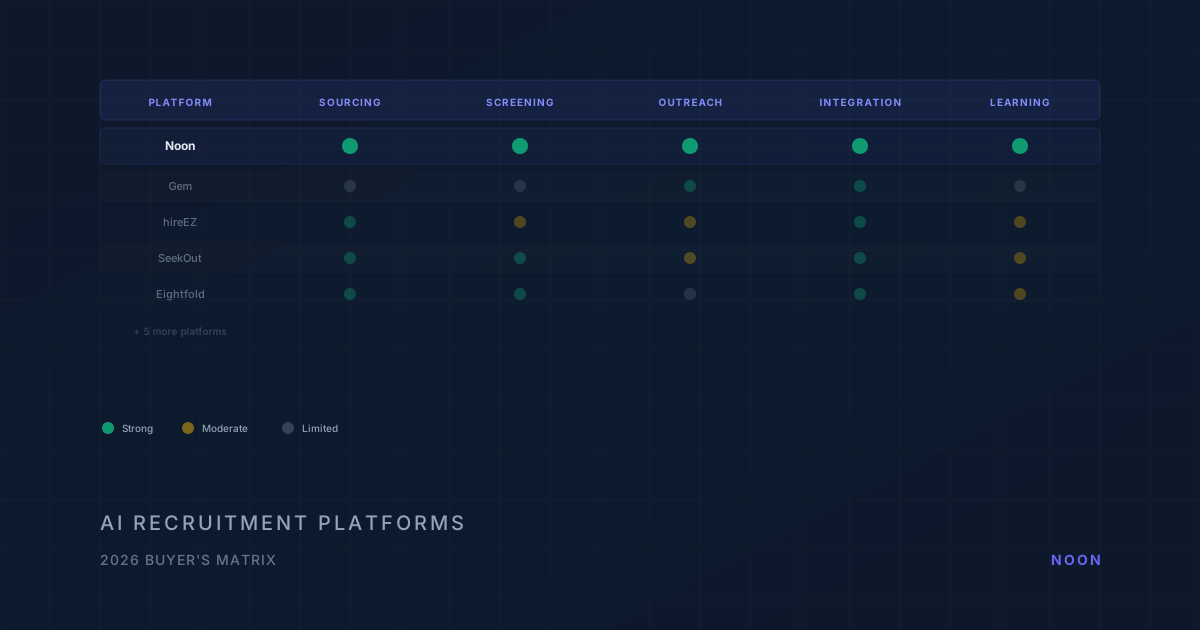
What does the 2026 AI recruitment buyer's matrix look like?
| Platform | Sourcing | Screening | Outreach | ATS Integration | Learning | Best For | Starting Price |
|---|---|---|---|---|---|---|---|
| Noon | Autonomous, web-wide | LLM-based with non-negotiables | Personalized email + SMS | Real-time bi-directional | RLHF from feedback | Teams wanting end-to-end autonomy | Contact sales |
| Gem | CRM-based rediscovery | Basic filtering | Email sequences + analytics | Strong (Greenhouse, Lever) | Limited | Pipeline nurturing | Custom (FTE-based); startup plan $130/mo |
| hireEZ | 45+ platform search | AI-assisted ranking | Multi-channel sequences | Good (30+ ATS) | Moderate | Diverse sourcing | $494/mo (solo) |
| SeekOut | Deep technical profiles | Skills-based scoring | LinkedIn + email | Good (major ATS) | Moderate | Engineering hiring | $149/mo (annual, 1 seat) |
| Eightfold.ai | Talent graph (1B+ profiles) | Skills taxonomy matching | Limited native outreach | Enterprise-grade | Platform-level | Enterprise talent management | Custom pricing |
| Fetcher | Curated candidate batches | Basic qualification filters | Email campaigns | Moderate | Limited | Lean teams, SMB | $115/mo (Self-Serve) |
| Paradox (Olivia) | Inbound-focused | Conversational screening | Chatbot engagement | Strong | Moderate | High-volume hourly hiring | Custom pricing |
| Manatal | Job board + social | Resume scoring | Email templates | Basic (Zapier) | Limited | Budget-conscious teams | $15/user/mo |
| Phenom | Career site + CRM | AI matching | Chatbot + campaigns | Enterprise-grade | Platform-level | Large enterprise | Custom pricing |
| GoPerfect | AI-powered search | Contextual evaluation | AI-written personalized | Growing | Strong | Autonomous outreach | Contact sales |
Let's break down each platform in detail.
1. Noon — Autonomous end-to-end recruiting agent
Noon takes a fundamentally different approach than most platforms on this list. Instead of providing tools that recruiters operate, Noon deploys an AI agent that operates autonomously — sourcing, evaluating, and reaching out to candidates without requiring manual input at each step.
Sourcing: Noon's agentic AI searches the entire web, not just LinkedIn. It evaluates candidate profiles by interpreting career trajectories, assessing company caliber, and understanding role context — similar to how a senior recruiter thinks, but at scale and speed that manual processes can't match.
Screening: The system uses LLM-based reasoning to evaluate candidates against non-negotiable criteria defined by the hiring manager. This isn't keyword matching — it's contextual evaluation. A candidate with 8 years of distributed systems work at a top-tier infrastructure company passes the "senior backend engineer" screen even if their resume doesn't use those exact words.
Outreach: Multi-channel personalized sequences across email and SMS. Each message references specific aspects of the candidate's background because the system has already evaluated their full profile during sourcing. This isn't template-fill — it's genuinely personalized messaging.
Learning: Noon uses reinforcement learning from human feedback (RLHF). As hiring managers review candidates and provide thumbs-up/thumbs-down signals, the system calibrates its matching criteria for that specific role. Each review sharpens the shortlist for that role, so feedback given early in a search pays off for the rest of it.
Best for: Teams that want to compress the entire sourcing-to-outreach workflow into a single autonomous system. Particularly strong for technical hiring and roles where passive candidates are the primary target. If this approach sounds right for your recruiting workflow, you can book a demo to see how the autonomous agent handles your specific roles.
2. Gem — CRM + sequencing powerhouse
Gem started as a Chrome extension for CRM-style relationship tracking and has grown into a comprehensive recruiting platform. Its core strength is pipeline management and candidate nurturing — knowing who you've talked to, when, and what happened.
Strengths: Excellent email sequencing with detailed analytics (open rates, reply rates, click rates). Strong ATS integrations, particularly with Greenhouse and Lever. The CRM functionality helps teams track long-term candidate relationships across multiple touchpoints.
Limitations: Sourcing is CRM-based — it helps you rediscover candidates you've already found, but doesn't autonomously discover new ones. Screening is basic filtering. Outreach personalization relies on templates with variable insertion rather than AI-generated messaging.
Pricing: No list price. Gem quotes on your company's FTE count; its published Startup Program for 1-10 FTE companies lists $130/month on yearly billing, down from $270 (gem.com/pricing, read 9 October 2026).
Best for: Teams that have strong sourcing already and need better pipeline management, sequencing, and analytics.
3. hireEZ — Multi-source diversity recruiting
hireEZ differentiates by searching across 45+ platforms — far beyond LinkedIn. This breadth makes it particularly effective for diversity sourcing, since different platforms surface different candidate demographics.
Strengths: Broad search coverage. Built-in diversity analytics. AI-assisted candidate ranking that goes beyond keywords. Multi-channel outreach (email, LinkedIn, phone).
Limitations: The breadth of sources can mean noisier results that require more manual review. Outreach personalization is improving but still template-heavy. Solo pricing at $494/month with a 7-day trial (hireEZ pricing page, read 9 October 2026) puts it in an awkward middle ground, too expensive for small teams, lacking enterprise features that justify the cost for large organizations.
Best for: Teams with specific diversity hiring goals or those recruiting in niches where LinkedIn coverage is thin.
4. SeekOut — Deep technical talent intelligence
SeekOut has built the deepest technical candidate profiles in the market. It aggregates data from GitHub, Stack Overflow, patents, publications, and open-source contributions to create rich profiles of engineering and technical candidates.
Strengths: Unmatched technical profile depth. Power filters for very specific skill combinations. Diversity sourcing tools integrated into the search workflow. Strong data on specialized technical roles (security, ML, infrastructure).
Limitations: Self-serve Sourcing Core is $149/month paid annually ($1,788/year), but team plans and the deeper modules are quoted. Primarily useful for technical hiring, less differentiated for business, sales, or operations roles. Outreach capabilities are functional but not a standout. Limited autonomy, it's a powerful search tool, but the recruiter still drives each step.
Best for: Companies with heavy engineering hiring needs and the budget to support premium tooling. Particularly strong for deep technical roles (staff+ engineers, ML researchers, security architects).
5. Eightfold.ai — Enterprise talent intelligence platform
Eightfold takes a platform approach, offering talent acquisition, talent management, and workforce planning under one roof. Its talent graph claims to map over a billion professional profiles using skills-based matching.
Strengths: Enterprise-grade compliance and governance. Skills taxonomy matching that goes beyond job titles. Internal mobility features that let you match existing employees to open roles. Workforce planning tools.
Limitations: Complex implementation — enterprise deployments often take months. Outreach is not a native strength (most Eightfold customers pair it with a separate outreach tool). Pricing is custom and typically enterprise-only. The platform's breadth can be overwhelming for smaller teams.
Best for: Large enterprises (5,000+ employees) that need an integrated talent intelligence platform spanning acquisition, internal mobility, and workforce planning.
6. Fetcher — Curated candidate delivery
Fetcher takes a different approach: instead of giving you a search tool, it delivers curated batches of candidates directly to your inbox. You define the role requirements, and Fetcher's combination of AI and human researchers finds and delivers matching profiles.
Strengths: Low-effort for recruiters — candidates come to you. Quality curation means less noise than self-serve platforms. Simple onboarding.
Limitations: Lower volume than self-serve tools. Limited control over search criteria adjustments in real time. Email-focused outreach. Smaller candidate database than platforms like SeekOut or hireEZ.
Best for: Lean recruiting teams (1-3 recruiters) that don't have bandwidth for manual sourcing and want a hands-off approach.
7. Paradox (Olivia) — Conversational AI for high-volume hiring
Paradox's chatbot, Olivia, handles inbound candidate engagement at scale. It answers questions, screens candidates through conversational flows, schedules interviews, and manages logistics — all via text, web chat, or messaging platforms.
Strengths: Exceptional at high-volume hourly hiring (retail, hospitality, healthcare, logistics). Conversational screening is natural and candidate-friendly. Scheduling automation eliminates back-and-forth. Supports 100+ languages.
Limitations: Inbound-focused — not designed for proactive sourcing of passive candidates. Less useful for specialized or senior roles where volume isn't the problem. Requires integration with other tools for outbound recruiting.
Best for: Companies hiring at scale for frontline roles. If your challenge is processing thousands of applicants efficiently, Paradox excels. If your challenge is finding passive senior engineers, look elsewhere.
8. Manatal — Budget-friendly AI recruiting
Manatal offers AI-powered recruiting at the lowest price point in this comparison. It covers job board posting, resume parsing, AI candidate scoring, and basic CRM features.
Strengths: Affordable ($15/user/month). Quick setup. AI candidate recommendations from social media enrichment. Compliance features for regulated industries.
Limitations: AI capabilities are less sophisticated than premium platforms. Limited sourcing depth — primarily pulls from job boards and LinkedIn. Outreach is email-template based. Integrations are mostly via Zapier rather than native.
Best for: Small companies or startups that need basic AI recruiting capabilities without enterprise pricing.
9. Phenom — Enterprise career site + talent CRM
Phenom combines an AI-powered career site, talent CRM, chatbot, and internal mobility platform. It's designed to be the front door of your employer brand — handling everything from the moment a candidate visits your career site through hiring and internal career growth.
Strengths: Career site personalization that shows different content to different candidates. Strong employer branding tools. Internal mobility features. Enterprise-grade integrations.
Limitations: Primarily inbound-focused. Career site + CRM is the strength, not proactive outbound sourcing. Complex implementation. Custom pricing that typically requires enterprise budgets.
Best for: Large companies that want to modernize their career site and candidate experience while building a comprehensive talent CRM.
10. GoPerfect — AI-written autonomous outreach
GoPerfect focuses specifically on the outreach problem — generating genuinely personalized messages that don't feel templated. It analyzes candidate profiles and writes unique outreach for each person, aiming for the quality of a hand-written message at the scale of automation.
Strengths: Outreach quality is among the best in the category. Zero-template approach means every message is unique. Learning from engagement data (open rates, reply rates) to improve messaging over time.
Limitations: Narrower scope — outreach only, not sourcing or screening. Requires candidates to be sourced and loaded into the system first. Pricing is custom.
Best for: Teams that have strong sourcing but struggle with outreach personalization and response rates.
What do these platforms publish about price in October 2026?
List prices are the part of an AI recruiting contract buyers can verify before a sales call, so we re-read each vendor's own pricing page on 9 October 2026. Platforms that publish no number are marked as quoted rather than estimated.
| Platform | Published entry price (read 9 October 2026) | What the price is attached to |
|---|---|---|
| Noon | No published dollar figure; one plan (noon.ai/pricing) | Nothing usage-based: unlimited sourcing, contacts, email enrichment, agents, and seats |
| Manatal | $15 per user/month billed yearly ($19 monthly) | Users, with job and candidate caps on Professional |
| Fetcher | $115/month Self-Serve, $379 Growth, $649 Amplify, 30% off annual (fetcher.ai/pricing) | Plan tier and sourcing volume |
| SeekOut | $149/month paid annually for one Sourcing Core seat, 14-day trial (seekout.com/pricing) | Seats, plus quoted modules |
| hireEZ | $494/month for a solo recruiter, 7-day trial (hireez.com/pricing) | Seats; enterprise quoted against the stack it replaces |
| Gem | Custom, FTE-based; Startup Program $130/month yearly for 1-10 FTE (gem.com/pricing) | Company headcount |
| Eightfold, Paradox, Phenom, GoPerfect | Quoted | Contract terms set in sales |
Manatal's figures are from our Manatal pricing breakdown, verified 7 October 2026. The newer pattern to watch is metered AI agents. Workable's pricing page (workable.com/pricing, read 9 October 2026) charges its Workable Agent in AI credits: 1 credit to screen a candidate against your profile, 2 to source a passive candidate into the pipeline, and 10 each time a candidate uses the chat, with 3,000 free credits and packs from $600 for 5,000 credits. Under that model the agent gets more expensive the more candidates it touches, which is the opposite of what a team wants from automation.
How should you choose an AI recruitment platform?
The right platform depends on your specific bottleneck:
| Your biggest problem | Platform type to prioritize |
|---|---|
| "We can't find enough qualified candidates" | Autonomous sourcing (Noon, hireEZ) |
| "We find candidates but can't engage them" | Outreach-focused (Noon, GoPerfect, Gem) |
| "We're drowning in applications" | Screening + automation (Paradox, Eightfold) |
| "We have too many disconnected tools" | End-to-end platform (Noon, Phenom, Eightfold) |
| "We need enterprise governance" | Enterprise platforms (Eightfold, Phenom) |
| "We have minimal budget" | Cost-effective (Manatal, Fetcher) |
The trend is clear: the market is moving from point tools toward integrated platforms, and from human-operated tools toward autonomous agents. Platforms that can handle the full sourcing-to-outreach workflow — finding candidates, evaluating fit, and initiating contact — eliminate the manual gap-filling that consumes recruiter time.
Frequently asked questions
What's the difference between AI recruiting tools and traditional ATS? Traditional ATS platforms (Greenhouse, Lever, iCIMS) organize candidate data and manage workflows. AI recruiting tools actively participate in the process — finding candidates, evaluating them, and conducting outreach. They're complementary: AI tools typically integrate with your existing ATS rather than replacing it.
How much do AI recruiting platforms cost? Published entry prices run from $15 per user a month (Manatal Professional, billed yearly) through $115 a month (Fetcher Self-Serve) and $149 a month (one SeekOut Sourcing Core seat, paid annually) to $494 a month (hireEZ for a solo recruiter), all read on vendor pages in October 2026. Gem, Eightfold, Paradox, Phenom, and GoPerfect quote. Noon is one plan with unlimited seats and no published dollar price. Compare total cost at your real volume of seats, roles, and contacts, not the entry tier.
Can AI recruiting platforms replace recruiting agencies? For most roles, yes. AI sourcing and outreach tools can handle what agencies traditionally provide — finding candidates and initiating contact — at a fraction of the cost. Agencies remain valuable for executive search, confidential roles, and hyper-specialized positions where relationship networks matter more than search scale.
What should I look for in terms of bias and compliance? Look for platforms that match based on skills and qualifications rather than demographic proxies. Ask about bias auditing, explainable AI (can the system tell you why it ranked a candidate?), and compliance with emerging AI hiring regulations (NYC Local Law 144, EU AI Act). Platforms that use RLHF should have monitoring to ensure feedback loops don't reinforce historical biases.
How do credits and usage limits work on AI recruiting platforms? It varies by vendor, and it decides your real bill. Juicebox's Starter plan includes 500 contact credits and 500 export credits per seat; Loxo's Professional plan pools 2,500 AI credits per user a month; Workable's agent spends 1 to 10 AI credits per candidate action; Indeed Smart Sourcing includes 100 contacts a month, then charges $5.20 each (all read on vendor pricing pages, 9 October 2026). Noon meters none of these: sourcing, contacts, email enrichment, agents, and seats are unlimited on one plan.