Key takeaway: LinkedIn Recruiter's AI features in 2026 include AI-assisted search, recommended matches, InMail optimization, and Hiring Assistant. LinkedIn's own published figures (checked 19 August 2026) are 81% fewer profiles reviewed to find a qualified match, 66% higher InMail acceptance rates versus manual sourcing, and 1.5 hours saved per role reviewing applicants. All of that happens inside LinkedIn: LinkedIn's more than 1 billion members, LinkedIn profiles, LinkedIn InMail. For cross-platform sourcing, multi-channel outreach, and autonomous operation, dedicated AI sourcing tools address gaps that LinkedIn's built-in AI cannot reach.
LinkedIn has invested heavily in AI features for Recruiter over the past year. The headline product is Hiring Assistant, an AI agent that builds sourcing strategies, surfaces candidates, and helps with screening. LinkedIn's published performance claims, still live on its Hiring Assistant page as of 19 August 2026, are that recruiters using it "review 81% fewer profiles to find a qualified match", see "66% higher InMail acceptance rates with Hiring Assistant vs. manual sourcing", and save on average 1.5 hours per role identifying top-qualified applicants.
Those are meaningful numbers, and they are vendor-reported. LinkedIn also publishes a named customer example: Biocon Biologics reports "a 65% InMail acceptance rate from candidates sourced by Hiring Assistant compared to just 39% from manual sourcing". Read the 66% as a relative lift on your own baseline rather than an absolute acceptance rate you should expect.
The other context LinkedIn's marketing does not emphasize is scope. Every AI feature LinkedIn builds operates within LinkedIn's ecosystem. It searches LinkedIn profiles. It sends LinkedIn InMails. It learns from LinkedIn activity. Against a network of more than 1 billion members in more than 200 countries, that is powerful. For the candidates who are not active on LinkedIn, or who are effectively invisible because their profiles are thin, these features do not help.
This guide covers what LinkedIn Recruiter's AI features actually do in 2026, where they add genuine value, where they fall short, and what teams are using alongside LinkedIn to close the gaps. LinkedIn's documented sourcing volume limits are covered separately in LinkedIn limits for recruiters, and for broader context on how LinkedIn's AI fits into the larger ecosystem of recruiting technology, see our guide to recruiting tools.
What AI features has LinkedIn Recruiter added in 2026?
Hiring Assistant
Hiring Assistant is LinkedIn's biggest AI bet, and LinkedIn now sells it as part of the product name: the Recruiter tier on its own pricing pages is "LinkedIn Recruiter + Hiring Assistant". Here is what it actually does:
Strategy building. Instead of jumping straight to Boolean search strings, Hiring Assistant "asks the right questions to build a sourcing strategy tailored to your role", going beyond standard keywords or filters. It also learns from your past Recruiter activity for similar roles.
AI-assisted candidate surfacing. Based on the strategy, Hiring Assistant recommends candidates proactively. It goes beyond basic filter matching, considering factors like career trajectory, skill adjacency, and engagement signals.
Applicant screening. For roles with inbound applications, Hiring Assistant automatically reviews applicants and surfaces the most qualified ones. LinkedIn claims this saves 1.5 hours per role on average.
Natural language search. You can describe what you are looking for in plain English, for example "senior backend engineer with distributed systems experience who has worked at a top-tier infrastructure company", instead of writing Boolean strings. The AI interprets your intent and applies relevant filters.
AI-assisted messaging. The system drafts personalized InMails for each candidate based on their profile. It attempts to reference specific aspects of the candidate's background rather than sending generic templates.
AI-assisted search upgrades
Beyond Hiring Assistant, LinkedIn has enhanced its core search functionality:
- Semantic understanding. Search now understands synonyms and related concepts. Searching for "container orchestration" also surfaces candidates with "Kubernetes" and "Docker Swarm" experience.
- Skill inference. The system infers skills from context. A candidate who has listed "built recommendation engines at Netflix" is recognized as having machine learning and data engineering skills even if those terms are not explicitly listed.
- AI-powered suggestions. As you review candidates, LinkedIn suggests additional profiles based on patterns in who you are engaging with.
- Performance metrics. Analytics on InMail response rates, candidate engagement, and sourcing funnel performance.
Where does LinkedIn's AI genuinely help recruiters?
For high-volume roles with strong LinkedIn presence. If you are hiring for roles where candidates are actively on LinkedIn and have complete profiles, such as software engineers, product managers, sales professionals, and marketers, LinkedIn's AI features are a significant upgrade over Boolean search. The natural language search alone saves hours of query building.
For teams already paying for Recruiter. If your team has LinkedIn Recruiter Corporate, these AI features are part of the product rather than an upsell. The incremental value is real: better candidate surfacing, less time screening applicants, more personalized InMails.
For reducing profile review time. The 81% reduction in profiles reviewed to find a qualified match is the most impactful claim. If your recruiters are spending 2+ hours per role scrolling through profiles, cutting that to 20 to 30 minutes is meaningful.
For InMail performance. The 66% higher InMail acceptance rate versus manual sourcing suggests the AI is doing a reasonable job of targeting and messaging. Biocon Biologics' reported move from 39% to 65% acceptance is the one worked example LinkedIn publishes, so measure your own manual baseline before and after rather than assuming either number transfers.
Where does LinkedIn's AI fall short?
Single-platform constraint
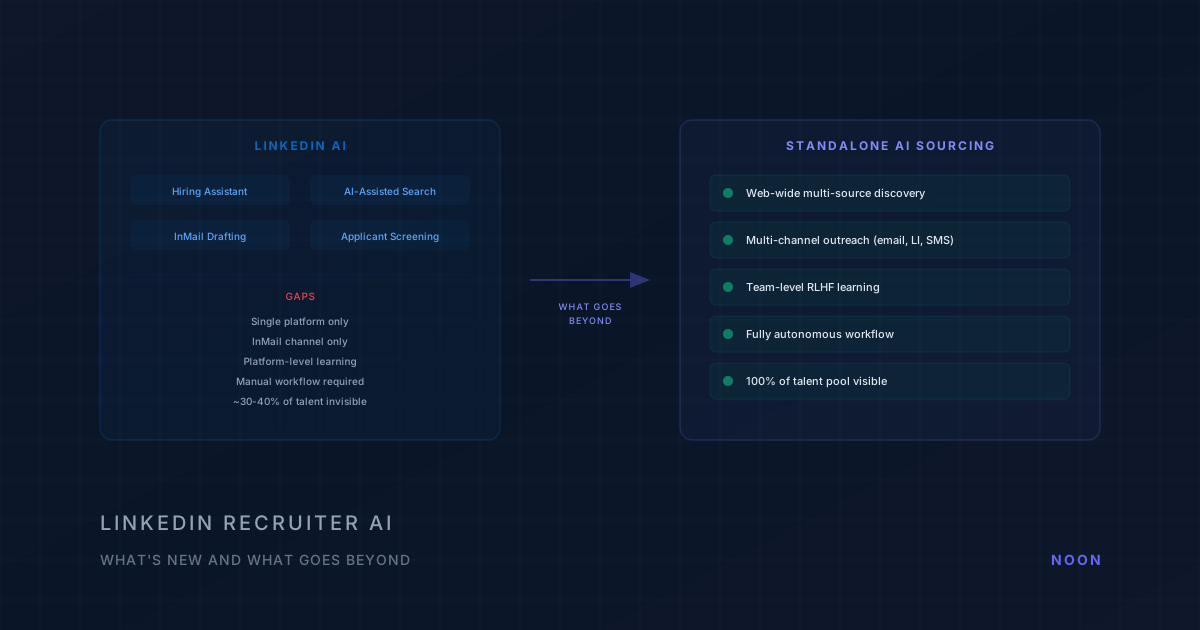
This is the fundamental limitation. LinkedIn AI searches LinkedIn. It evaluates LinkedIn profiles. It contacts candidates through LinkedIn InMail. For candidates who are not on LinkedIn, or who have thin profiles, or who do not check InMail, the AI cannot help.
Who gets missed:
- Technical talent on GitHub and Stack Overflow who maintain rich technical profiles but minimal LinkedIn presence
- Academic researchers whose publication record matters more than their LinkedIn summary
- Executives who deliberately keep low LinkedIn profiles to avoid recruiter outreach
- International markets where LinkedIn penetration is lower, for example China, Russia, and parts of Southeast Asia
- Early-career talent who have not built substantial LinkedIn profiles yet
LinkedIn does not publish how many of its members have profiles complete enough to be found by a skills-based search, and no independent number exists, so treat any "X% of the workforce is missing from LinkedIn" figure, including the ones in competitor marketing, as an estimate. The reliable version of the claim is narrower and easy to test yourself: run a search for a niche technical skill, then check how many of the qualified people you know personally appear in the results.
Everyone uses the same tool
When large numbers of recruiters use the same AI-enhanced search on the same platform, the competitive advantage narrows quickly. Hiring Assistant helps every recruiter find the same high-quality candidates more efficiently. The result is that top candidates get more InMails, not fewer. Response rates may improve individually, because messages are more personalized, but saturate collectively, because candidates receive more outreach.
This is the paradox of any platform-native AI: it makes every user better at the same thing, which erodes the advantage for any individual user.
InMail is one channel
Despite improvements in messaging, InMail remains a single channel. Modern outreach strategies coordinate across email and SMS. Some candidates do not check InMail regularly. Others prefer email. LinkedIn's AI does not help with multi-channel coordination, and LinkedIn's own InMail credit and invitation limits cap how much of it you can do at all.
Follow-up timing is your problem, not LinkedIn's
Acceptance rate is a first-touch metric. Getting a reply is mostly a function of what happens afterward, and that is where a single-channel assistant leaves the work with you. Across 812,633 outreach sequences and 135,938 timestamped replies on the Noon platform, 67.8% of candidate replies arrived after the first message, the median reply landed 2.7 days after first contact, and 43.4% of replies came within 48 hours. See our recruiting follow-up benchmarks for the per-touch data. A tool that optimizes the first message and then hands you a manual follow-up list is optimizing the smaller share of the outcome.
Learning is platform-level, not team-level
LinkedIn's AI learns from aggregate activity across all recruiters. This is useful for broad patterns, for example understanding that "Kubernetes" and "container orchestration" are related. But it does not learn from your team's specific preferences, hiring patterns, and feedback in the way a dedicated feedback-trained system does.
When a hiring manager at your company reviews 30 sourced candidates and provides thumbs-up or thumbs-down feedback, that feedback should train a model to understand what this specific hiring manager values. LinkedIn's Hiring Assistant incorporates your past Recruiter activity, but it is not running a dedicated feedback loop for each of your roles.
No autonomous workflow
Hiring Assistant helps with individual steps, including search, screening, and messaging, but does not run an autonomous sourcing workflow. A recruiter still needs to:
- Set up the role in Hiring Assistant
- Review suggested candidates
- Decide who to message
- Review applicant screening results
- Manage responses across conversations
Each step requires recruiter involvement. For teams managing 20+ open reqs, this is still a significant time commitment.
What can standalone AI sourcing do that LinkedIn can't?
The gaps in LinkedIn's AI features, namely single platform, single channel, limited learning, and no autonomous workflow, are exactly what standalone AI sourcing platforms are designed to address.
Multi-source discovery. Tools like Noon search across the entire web, not just LinkedIn. GitHub profiles, personal websites, conference talks, publications, and patent filings all contribute to a richer candidate evaluation. This surfaces candidates that LinkedIn AI simply cannot see.
Multi-channel outreach. Standalone platforms coordinate outreach across email and SMS. If a candidate does not respond on one channel, the sequence continues on another, and follow-up pacing is handled by the system rather than by a recruiter's reminder list.
Team-level calibration. Dedicated AI sourcing systems learn from your specific team's feedback. When a hiring manager reviews sourced candidates on Noon and provides feedback, the model calibrates to that hiring manager's preferences for that role, including the non-negotiables that a keyword filter cannot express. LinkedIn's Hiring Assistant does not offer this level of role-specific calibration.
Autonomous operation. The biggest difference: standalone AI agents run the full sourcing workflow without requiring recruiter intervention at each step. Activate a role, and the system finds candidates, evaluates them, and initiates outreach. The recruiter reviews results and provides calibration feedback, but does not need to operate the search.
How should you combine LinkedIn and AI sourcing tools?
Most teams do not need to choose between LinkedIn and standalone AI sourcing. The optimal stack uses both:
- LinkedIn Recruiter for its massive database, brand recognition among candidates, and built-in AI search improvements
- Standalone AI sourcing such as Noon for autonomous discovery beyond LinkedIn, multi-channel outreach, and team-level learning
The combination is additive. LinkedIn covers the professionals with strong, searchable LinkedIn presence, and standalone AI sourcing covers the ones LinkedIn cannot see or cannot reach within its messaging limits. Outreach goes multi-channel. Learning happens at the team level. And the autonomous workflow means recruiter time is spent on high-value activities rather than operating search tools. If you are evaluating whether to add cross-platform AI sourcing alongside your LinkedIn subscription, you can book a demo to see how multi-source discovery and autonomous workflows complement LinkedIn's AI features.
Frequently asked questions
Is LinkedIn Hiring Assistant worth the upgrade? If you already have LinkedIn Recruiter Corporate, Hiring Assistant is part of the product, so use it. If you are on Recruiter Lite or considering an upgrade specifically for Hiring Assistant, weigh the time savings against the price difference between the tiers on your quote; see our LinkedIn Recruiter pricing breakdown for what each tier includes.
What results does LinkedIn publish for Hiring Assistant? 81% fewer profiles reviewed to find a qualified match, 66% higher InMail acceptance rates versus manual sourcing, and an average of 1.5 hours saved per role identifying top-qualified applicants, all from LinkedIn's Hiring Assistant page as of 19 August 2026. These are vendor-reported figures measured on LinkedIn's own platform.
Does LinkedIn Hiring Assistant replace AI sourcing tools? No. It enhances sourcing within LinkedIn but does not address multi-source discovery, multi-channel outreach, or team-level learning. Teams using both LinkedIn and a standalone AI sourcing tool cover parts of the market that neither covers alone.
How does LinkedIn's AI compare to dedicated AI recruiting platforms? LinkedIn's AI has the advantage of the largest single professional dataset, more than 1 billion members. Dedicated platforms have the advantage of multi-source search, autonomous workflows, and deeper learning from team feedback. They solve different problems and work well together.
Does Hiring Assistant handle follow-ups? It helps draft and target the initial InMail. Sustained multi-touch follow-up across channels is not what it does, which matters because 67.8% of replies in our platform data arrive after the first message.
Can LinkedIn's AI help with diversity sourcing? To some extent, since it can surface diverse candidates within LinkedIn's database. But if the goal is expanding the diversity of your candidate pool beyond LinkedIn's demographic distribution, you will need tools that search across multiple platforms and communities.