Key takeaway: The best AI outreach platforms for recruiters in 2026 are Noon, Gem, hireEZ, SeekOut, and GoPerfect, each strong in a different area. Noon leads for autonomous end-to-end sourcing and outreach. Gem dominates CRM-integrated sequences. hireEZ and SeekOut offer the deepest candidate databases. GoPerfect delivers fully AI-written, zero-template messaging. Whichever you pick, hold it to measured timing: across 812,633 sequences on the Noon platform, 67.8% of replies arrive after the first message and the median reply lands 2.7 days after first contact, so follow-up automation matters more than first-message copy.
Sending more outreach messages doesn't fix recruiting. Sending better ones does.
That's the core problem AI candidate outreach platforms solve. The traditional workflow, which is find a profile, open a new tab, draft a message, send, track in a spreadsheet, repeat, worked when recruiters managed a handful of open roles. It breaks down as soon as one recruiter carries a dozen or more live requisitions, because the part that gets dropped first is follow-up. Candidates get generic templates, response rates drop, and employer brands take damage.
AI outreach platforms promise to fix this by generating personalized messages at scale, automating multi-step sequences, and tracking engagement across channels.
But not all platforms are equal. Some are glorified mail-merge tools with an AI label. Others are genuinely autonomous systems that handle the full cycle from sourcing through engagement. This guide covers the 12 best options for 2026, what actually differentiates them, and how to choose.
What should you look for in an AI outreach platform?
Before the list, here's what separates effective AI outreach from expensive spam:
- Real personalization, not template variables. Inserting {first_name} and {company} into a template isn't personalization. Good AI outreach platforms analyze a candidate's career history, skills, and background to write messages that feel individually crafted.
- Multi-channel capability. Email-only outreach leaves responses on the table. The best platforms coordinate across email and SMS with intelligent sequencing.
- Sourcing integration. Outreach is only half the equation. Platforms that combine sourcing and outreach in one workflow eliminate the gap between finding candidates and contacting them.
- Learning from outcomes. Static message templates degrade over time. Platforms that learn from response data, meaning which messages get replies and which don't, improve automatically.
- ATS synchronization. Outreach activity that lives in a silo creates data gaps. The best platforms sync with your ATS in real time so every touchpoint is recorded.
- Follow-up automation you do not have to babysit. Reply timing is spread out: in our platform data, only 35.1% of replies arrive within 24 hours of first contact, 43.4% within 48 hours, and 74.3% within a week. A platform that leaves touches two through five to a recruiter's memory is leaving most of the yield on the table.
What reply timing should you hold a platform to?
Use these as the yardstick when a vendor shows you a reply-rate chart. The figures come from 812,633 recruiting outreach sequences and 135,938 timestamped candidate replies on the Noon platform between August 2025 and July 2026:
| Measure | Value | What it means for platform selection |
|---|---|---|
| Median time to reply, from first contact | 63.7 hours (2.7 days) | Sequences that stop after 48 hours cut off before the median |
| Median time to reply, from the message that triggered it | 4.7 hours | Response handling has to be same-day, so scheduling automation matters |
| Replies arriving after message one | 67.8% | Follow-up automation is the feature, not personalization alone |
| Highest per-touch conversion | Message two, at 5.59% | The second touch is worth as much as the first, so never ship a one-touch campaign |
| Share of achievable replies captured by touch five | About 95% | Sequence builders that cap below five touches leave yield unclaimed |
Full per-touch detail is in our recruiting follow-up benchmarks. These are observational platform aggregates, not a controlled test, and they are reported in aggregate with no customer or candidate identifiable information.
The 12 best AI outreach platforms for recruiters in 2026
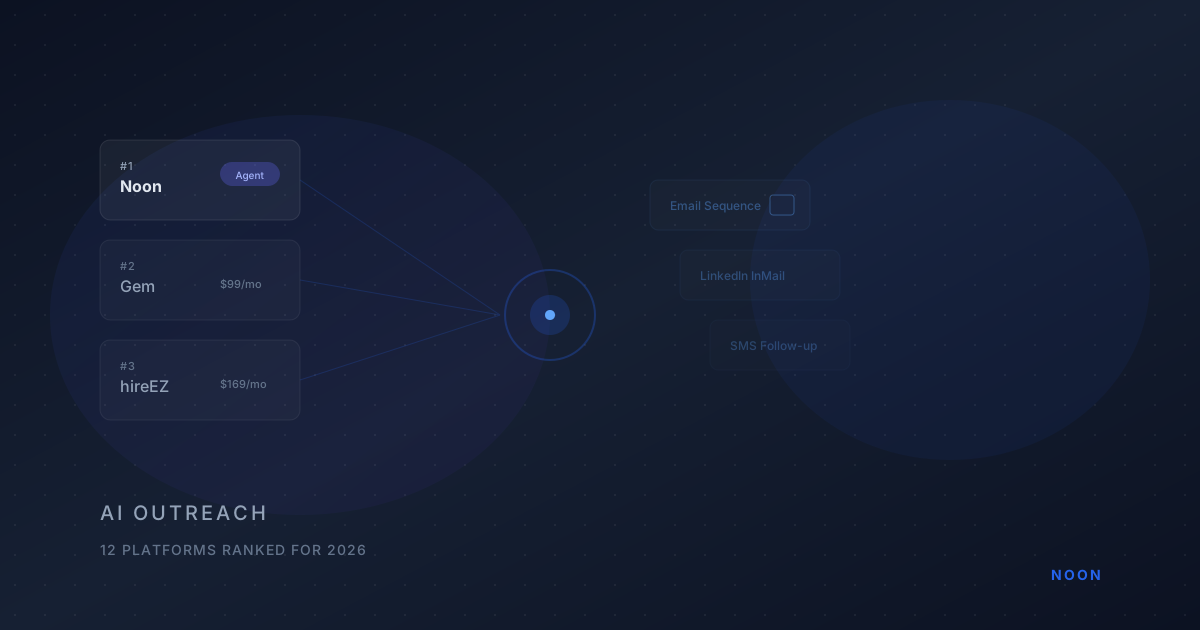
| Platform | Primary Strength | Best For | Starting Price |
|---|---|---|---|
| Noon | Autonomous end-to-end sourcing + outreach | Teams wanting a fully autonomous sourcing agent | Contact sales |
| Gem | CRM + sequencing + analytics | Pipeline nurturing and long-term relationship management | ~$99/user/mo (staffing); custom (in-house) |
| hireEZ | Multi-source outbound | Diverse talent sourcing across 45+ platforms | Reported ~$169/user/mo |
| SeekOut | Technical talent intelligence | Engineering and specialized role hiring | Not published; reported ~$799/user/mo |
| GoPerfect | AI-written autonomous outreach | Teams wanting zero-template personalization | Contact sales |
| SourceWhale | A/B testing and deliverability | Outreach optimization and agency teams | Contact sales |
| Fetcher | Automated candidate delivery | Lean recruiting teams with limited sourcing bandwidth | Contact sales |
| Eightfold.ai | Skills-based talent intelligence | Enterprise talent management and internal mobility | Custom enterprise |
| Loxo | All-in-one ATS + CRM + outreach | Recruiting agencies managing multiple clients | Contact sales |
| Humanly | Conversational AI screening | High-volume hiring with automated screening | Contact sales |
| Findem | Attribute-based sourcing | Hard-to-fill and niche roles | Contact sales |
| Reply.io | Multi-channel sequence automation | Email-heavy outreach with LinkedIn and SMS add-ons | From $49/user/mo (annual); $89 all-inclusive |
1. Noon
Noon isn't just an outreach tool. It is an autonomous recruiting agent that handles the full workflow from role understanding through candidate engagement.
Most outreach platforms start after you've already found candidates. You still need a separate sourcing tool, a separate contact finder, and manual effort to connect the dots. Noon collapses the entire pipeline into one system.
Here's what makes Noon's approach different:
Autonomous sourcing plus outreach in one agent. Noon's AI continuously sources candidates, evaluates them against your specific criteria, and sends personalized outreach, all without the recruiter manually triggering each step. It operates as a persistent team member, not a tool you run searches on. Sourcing, contacts, email enrichment, agents, and seats are unlimited on a single plan, so sequence length is a strategy decision rather than a budget one.
AI-generated intros, not templates. Every outreach message includes a personalized intro generated from the candidate's specific profile, covering career trajectory, notable projects, and relevant experience. It's not mail-merge with better copy. It's a genuinely unique message for each candidate.
Multi-channel by default. Email and SMS outreach runs as coordinated sequences. The system manages timing, follow-ups, and channel selection automatically.
Reinforcement learning from feedback. As hiring managers accept or reject sourced candidates, Noon's model learns what "good" means for each specific role, including the non-negotiables that should never be traded away. This improves not just sourcing quality but outreach targeting: the system gets better at identifying who to contact and how to message them.
Real-time ATS sync. Every outreach touchpoint, response, and candidate status change syncs to your ATS automatically. No manual data entry, no gaps in your candidate history.
Built-in AI scheduling, interviewing, and notetaking. After a candidate responds, Noon's workflow continues with AI-powered interview scheduling, an AI Interviewer for voice screening, and AI notetaking, covering the full post-outreach lifecycle. That matters given the 4.7-hour median reply-to-message latency: the fastest way to lose a warm reply is to answer it a day later.
Best for: Teams that want an autonomous end-to-end recruiting agent, not just an outreach tool bolted onto a separate sourcing workflow.
2. Gem
Gem is a CRM-first talent engagement platform built around long-term candidate relationship management. Its strength is organizing and nurturing pipelines over time rather than pure outreach velocity.
Recruiters can see full engagement history, run multi-touch campaigns across email and LinkedIn, and analyze response rates at the team level. For organizations invested in structured recruiting operations, Gem acts as a central system for pipeline tracking and outreach coordination.
Key features:
- Talent CRM with structured pipeline stages
- Multi-channel outreach sequences (email + LinkedIn)
- Team-level response rate and engagement analytics
- AI sourcing across 800M+ profiles (Growth plan and above)
- ATS integrations (Greenhouse, Workday, Lever, and 10+ others)
- Diversity reporting and pipeline insights
Pricing: staffing plans start at $99/user/mo. In-house team pricing (Growth and Enterprise) is custom, and third-party benchmark data from procurement platform Vendr has put the median in-house contract near $24,800 a year. Treat any custom-tier figure as a negotiation reference point rather than a rate.
Best for: Teams prioritizing CRM-driven outreach, pipeline analytics, and long-term candidate nurturing.
3. hireEZ
hireEZ (formerly Hiretual) stands out for its breadth of sourcing. While most platforms lean heavily on LinkedIn data, hireEZ searches 45+ platforms simultaneously, including GitHub, Google Scholar, Stack Overflow, and professional directories.
Its EZ Agent feature automates top-of-funnel workflows: finding candidates, enriching profiles with contact data, and launching multi-step email outreach sequences. For teams whose talent pools are underserved on LinkedIn, this broader reach matters.
Key features:
- AI-powered search across 45+ data sources
- Automated multi-step email and LinkedIn outreach
- Contact enrichment (email and phone)
- Diversity sourcing filters
- ATS integrations
- Candidate engagement tracking and analytics
Pricing: Starts at ~$169/user/mo (Starter plan); Professional at ~$199/user/mo. Enterprise plans are custom. All plans billed annually.
Best for: Teams focused on diversity sourcing, passive candidates, and reaching talent beyond LinkedIn.
4. SeekOut
SeekOut goes deeper than most platforms on technical talent intelligence. Beyond standard profile data, it indexes patents, publications, open-source contributions, and specialized skills, making it particularly strong for engineering, research, and hard-to-fill roles.
Its AI search surfaces candidates that wouldn't appear in standard LinkedIn queries. Combined with outreach sequencing tools, SeekOut provides both discovery and engagement for specialized hiring.
Key features:
- Advanced AI search across technical signals (patents, publications, GitHub)
- Skills and competency mapping
- Diversity and inclusion filters
- Email finding and outreach sequencing
- Talent market analytics and insights
- ATS and CRM integrations
Pricing: SeekOut does not publish rates on its site. Third-party reports have put SeekOut Recruit near $799 per user per month, which is useful as a negotiation reference point rather than a quoted rate.
Best for: Engineering, research, and technical role sourcing where depth matters more than volume.
5. GoPerfect
GoPerfect positions itself around fully AI-written outreach, where every message is uniquely generated from the candidate's career history, skills, and goals. No templates, no mail merge. It also includes A/B testing, so the system learns which message styles, subject lines, and CTAs perform best for your specific audience.
Key features:
- AI-written personalized messages (zero templates)
- Multi-channel campaigns (LinkedIn, email, SMS)
- A/B testing with auto-optimization
- Smart follow-ups based on engagement signals
- Campaign analytics (open rates, reply rates, positive response rates)
- Configurable tone and brand voice
Pricing: Contact sales. Custom pricing based on team size.
Best for: Teams wanting zero-template, fully AI-generated outreach with built-in experimentation.
6. SourceWhale
SourceWhale is built for outreach optimization. Its core strength is helping recruiting teams (especially agencies) test and refine their messaging through A/B testing, deliverability tools, and behavioral analytics.
It tracks when candidates are most engaged and adjusts timing accordingly. For teams whose primary bottleneck is outreach response rates rather than sourcing volume, SourceWhale provides the testing infrastructure to systematically improve.
Key features:
- Multi-channel sequences (email, SMS, phone)
- A/B testing for subject lines, message copy, and timing
- Deliverability monitoring and optimization
- Behavioral engagement analytics
- Team-level campaign duplication and best-practice sharing
- CRM and ATS integrations
Pricing: Contact sales. Custom pricing.
Best for: Recruiting agencies and teams focused on optimizing outreach response rates through systematic testing.
7. Fetcher
Fetcher takes a "set it and forget it" approach. Recruiters define their ideal candidate profile, and Fetcher's AI delivers batches of matched candidates with contact info on a regular cadence, weekly or biweekly. It removes the active searching step entirely.
For lean teams that don't have dedicated sourcers, this passive delivery model keeps the pipeline filled without adding headcount.
Key features:
- Automated candidate batch delivery
- AI-powered profile matching
- Contact information discovery
- Email outreach sequences
- Diversity analytics
- ATS integrations
Pricing: Contact sales. Plans vary by delivery volume and team size.
Best for: Small recruiting teams that need consistent pipeline flow without dedicated sourcing time.
8. Eightfold.ai
Eightfold.ai is an enterprise talent intelligence platform that goes well beyond outreach. Its skills-based matching engine maps talent across internal and external pools, supporting internal mobility, workforce planning, and external sourcing.
Outreach capabilities exist within a broader enterprise talent management vision. This makes it a strong fit for large organizations but potentially overbuilt for teams focused solely on external candidate outreach.
Key features:
- Deep skills-based talent matching
- Internal mobility and redeployment intelligence
- AI-driven talent pool curation
- Enterprise workforce planning
- Bias detection and DEI analytics
- Integrations across the HR tech stack
Pricing: Custom enterprise pricing. Typically sold as a platform deal, not per-seat.
Best for: Large enterprises wanting a unified talent intelligence platform that includes outreach alongside workforce planning and internal mobility.
9. Loxo
Loxo brands itself as an all-in-one recruiting platform combining ATS, CRM, sourcing, and outreach in a single system. It's designed primarily for recruiting agencies managing multiple clients and roles simultaneously.
Its value proposition is consolidation, replacing three or four separate tools with one platform. For agencies, this reduces tech stack complexity and per-client overhead.
Key features:
- Combined ATS + CRM + sourcing + outreach
- AI candidate matching and ranking
- Multi-channel outreach sequences
- Client-facing reporting
- Contact enrichment
- Job board distribution
Pricing: Contact sales. Pricing scales with agency size and usage.
Best for: Recruiting agencies wanting an all-in-one platform to manage multiple clients without juggling separate tools.
10. Humanly
Humanly uses conversational AI to automate the top of the recruiting funnel: screening, scheduling, and initial candidate engagement via chat. Its chatbot handles repetitive screening questions, surfaces qualified candidates, and books interviews without recruiter involvement.
This is less about outreach personalization and more about handling inbound volume efficiently.
Key features:
- Conversational AI for screening and scheduling
- Chat-based candidate engagement
- Automated screening question workflows
- Integration with career sites and job boards
- Analytics on screening completion and candidate quality
- ATS integrations
Pricing: Contact sales. Pricing based on hiring volume.
Best for: High-volume hiring teams that need to screen and engage large applicant pools quickly.
11. Findem
Findem takes an attribute-based approach to sourcing, building candidate profiles from hundreds of data points beyond the standard resume fields. This lets recruiters search on criteria like "worked at a company that went through an IPO" or "managed a team during hypergrowth."
For hard-to-fill roles where standard keyword search falls short, this attribute depth provides unique sourcing leverage.
Key features:
- Attribute-based candidate search (200+ data points)
- AI-powered talent pool creation
- Email outreach sequences
- Market intelligence and talent analytics
- Diversity sourcing insights
- ATS and CRM integrations
Pricing: Contact sales. Custom pricing.
Best for: Hiring managers and recruiters working on niche, specialized, or hard-to-fill positions.
12. Reply.io
Reply.io is a multi-channel outreach automation platform that serves both sales and recruiting teams. It's more of a general-purpose outreach tool than a recruiting-specific platform, but its sequence builder, email deliverability tools, and LinkedIn automation make it viable for recruiters who want a lower-cost outreach engine.
Key features:
- Multi-channel sequences (email, LinkedIn, SMS, WhatsApp)
- Real-time contact data search (1B+ verified contacts)
- Email deliverability monitoring
- AI message generation
- Chrome extension for LinkedIn prospecting
- CRM and ATS integrations
Pricing: verified on Reply.io's pricing page on 19 August 2026: the Email Volume plan starts at $49 per user per month billed annually (1,000 active contacts a month), and the all-inclusive Multichannel plan starts at $89 per user per month. On the cheaper plan the other channels are add-ons: LinkedIn automation is $69 per account a month and calls and SMS are $29 per account a month, so a genuinely multi-channel recruiting setup is not the $49 headline.
Best for: Budget-conscious teams looking for capable multi-channel outreach without recruiting-specific features.
How to choose the right platform
The right tool depends on where your team's biggest bottleneck actually is:
| If your bottleneck is... | Consider... |
|---|---|
| You need end-to-end automation from sourcing to engagement | Noon, autonomous agent that handles the full workflow |
| You have candidates but can't reach them effectively | SourceWhale or GoPerfect, outreach optimization with testing |
| You need a CRM to nurture candidates over time | Gem, pipeline management and relationship tracking |
| You're hiring specialized technical roles | SeekOut, deep technical talent intelligence |
| You want to reach candidates outside LinkedIn | hireEZ, 45+ data source coverage |
| You're a lean team with no dedicated sourcers | Fetcher, automated candidate delivery |
| You're an agency managing multiple clients | Loxo, all-in-one ATS/CRM/outreach |
| You need to screen high-volume inbound applicants | Humanly, conversational AI screening |
What's the biggest outreach mistake recruiting teams make?
The biggest mistake recruiting teams make with AI outreach isn't choosing the wrong tool. It is treating outreach as an isolated step, and stopping too early. Two thirds of replies arrive after the first message, so a campaign that sends one beautifully written note and moves on discards most of its own pipeline.
Outreach quality depends on sourcing quality. If you're sending personalized messages to the wrong candidates, your response rates will be low regardless of how good the copy is. The tools that deliver the best results are the ones that connect sourcing, outreach, and feedback in a single loop.
This is why platforms that integrate sourcing and outreach, rather than treating them as separate workflows, tend to produce better outcomes. When the system knows why it selected a candidate, it can craft outreach that speaks to those reasons. When it sees which outreach gets responses and which doesn't, it can refine both targeting and messaging simultaneously.
At Noon, this integrated loop is the core design principle. The same AI that sources candidates also writes their outreach, paces the follow-ups against measured reply behavior, tracks responses, and learns from the outcomes. There's no handoff between tools, no gap where context gets lost. To see how Noon's autonomous sourcing and outreach agent performs for your specific hiring needs, book a demo.
Frequently asked questions
What's the difference between AI outreach and email automation? Email automation sends pre-written templates on a schedule. AI outreach generates unique, personalized messages for each candidate based on their profile data, and adapts the follow-up schedule to what the candidate does. Ask any vendor how their sequences handle touches two through five, since that is where 67.8% of replies come from.
How many follow-ups should a recruiting sequence have? Five is the defensible default and six is the practical ceiling. Per-touch conversion in our platform data stays close to 5% through message three (5.39%, 5.59%, and 4.84% for messages one to three), then falls to 3.89% and 3.49% at messages four and five. Five touches capture roughly 95% of achievable replies and six capture about 98%, so a seventh adds work rather than hires. The follow-up benchmarks article shows the per-touch math and why raw completed-sequence reply rates mislead.
Do AI outreach platforms work for passive candidates? Yes, they're specifically designed for it. Passive candidates (who aren't actively job-searching) respond to relevant, personalized outreach at much higher rates than generic messages. AI platforms analyze a candidate's background to craft messages that resonate with their specific experience and career trajectory.
How much do AI outreach platforms cost? Published entry prices in this list run from $49 per user per month (Reply.io's Email Volume plan, verified on its pricing page in August 2026) up into the high hundreds per user per month at the talent-intelligence end, and most vendors here publish nothing at all and quote per deal. Treat any figure that is not on the vendor's own pricing page as a third-party report rather than a rate, and confirm it on a current quote. The cost calculation should also include what you're replacing, since a LinkedIn Recruiter seat is itself a five-figure annual line item for most teams.
Can I use multiple outreach platforms together? You can, but consolidation usually produces better results. Using separate tools for sourcing, outreach, and CRM creates data silos and breaks the feedback loop that makes AI outreach improve over time. Platforms that combine these functions tend to deliver better personalization and higher response rates.
How do I measure whether an AI outreach platform is working? Track three metrics: response rate (what percentage of candidates reply), positive response rate (what percentage express interest), and time to first response (how quickly you hear back). Give the measurement window enough room: 74.3% of replies land within seven days but 97.0% take up to 30 days, so a 30-day read against your manual baseline is the shortest honest comparison. Judging a pilot after one week undercounts replies by roughly a quarter.