Key takeaway: The most effective candidate engagement strategies in 2026 combine AI-personalized multi-channel outreach, value-first messaging, and strategic timing. Top-performing teams achieve 25-40% response rates by leading with candidate-specific value propositions, using 5-touch sequences across email and LinkedIn, with SMS as an optional third channel, and sending outreach within candidate-specific optimal windows.
Recruiter outreach is in a signal-to-noise crisis. The average recruiter sends 50 to 150 outreach messages per week, but response rates have been declining for years. Candidates are drowning in generic InMails. The copy-paste templates that worked in 2019 are now practically invisible.
The data confirms what recruiters already feel. Teams using three or more outreach channels see 287% higher candidate engagement compared to single-channel approaches (Landbase, 2026). Yet most recruiting teams still default to email-only campaigns or LinkedIn InMail and hope for the best. That gap — between what works and what teams actually do — is where engagement strategy creates a competitive advantage.
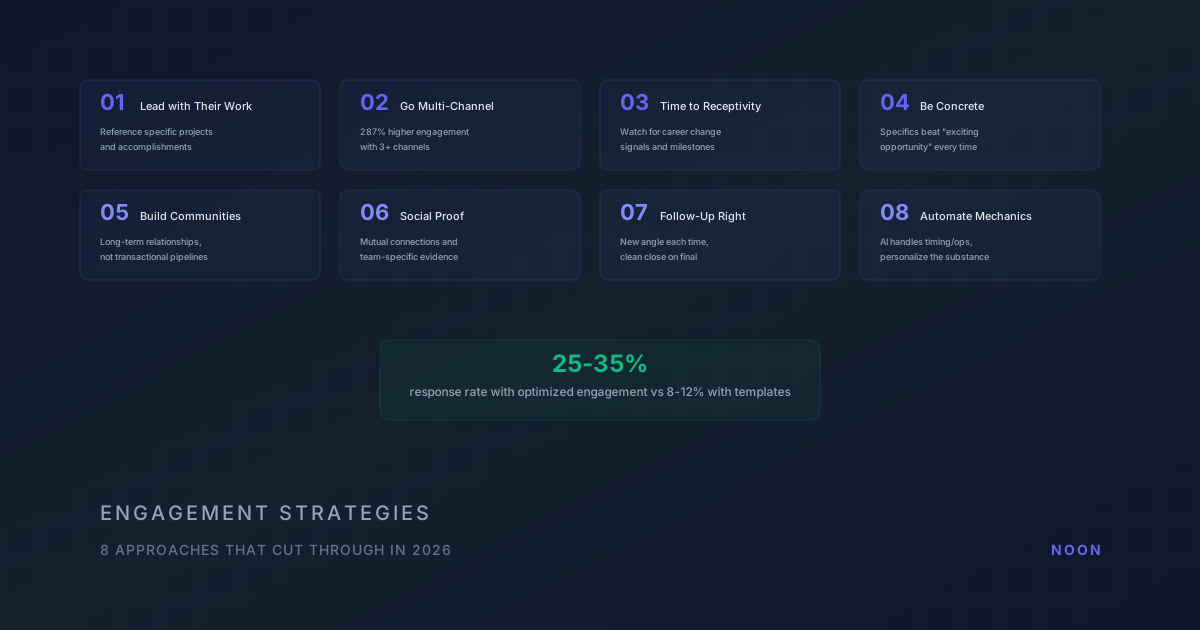
This guide covers eight engagement strategies that are delivering results in 2026. Not generic advice like "be personal" or "follow up" — specific, actionable approaches backed by data from teams that are hitting their hiring targets.
1. Lead with the candidate's work, not your job description
The most common engagement mistake is opening with what you need, not what the candidate has done. "We have an exciting senior engineer role…" tells the candidate nothing they couldn't learn from a job posting. It signals that you haven't looked at their profile — or that you've looked at a hundred profiles and are sending the same message to all of them.
What works instead: Open with a specific observation about the candidate's actual work. Not "I was impressed by your experience" (vague), but "Your work on distributed caching at Stripe — particularly the migration from Redis to their custom solution — is exactly the type of infrastructure thinking we're building around." This demonstrates genuine understanding and makes the candidate feel seen rather than targeted.
The challenge is that genuine personalization at this level is time-intensive when done manually. Writing 20-30 truly personalized opening lines per day isn't realistic for a recruiter managing 20 reqs. This is where AI outreach platforms create leverage — systems like Noon analyze each candidate's full profile during sourcing and generate opening lines that reference specific projects, career transitions, and technical contributions. The personalization is genuine because the AI has already evaluated the candidate's background in detail.
The data: Personalized outreach consistently achieves 2-3x higher response rates compared to template-based messaging. Messages that reference specific candidate accomplishments achieve the highest engagement rates across all channels.
2. Go multi-channel — and sequence intelligently
Email alone misses candidates who don't check that inbox. LinkedIn InMail alone misses candidates who've turned off notifications. SMS alone feels invasive if you haven't established a connection first. The solution isn't picking the "best" channel — it's coordinating across channels in an intelligent sequence.
An effective multi-channel sequence looks like:
- Day 1: Email — Personalized outreach referencing specific background
- Day 3: LinkedIn connection request — Short, professional note referencing the email
- Day 5: Email follow-up — New angle or additional context, not just "checking in"
- Day 8: LinkedIn message — Brief, direct, acknowledging they're busy
- Day 12: Final email — Clean close with no pressure
The key is that each touchpoint adds new information or a new angle — not just repeating the same message on a different channel. A candidate who ignored your email might engage on LinkedIn because the message approached the opportunity from a different perspective.
The data: Companies using 3+ coordinated channels see 287% higher candidate engagement than single-channel outreach (Landbase, 2026). The sequence matters as much as the channels — contacts made on the second or third channel typically convert at higher rates because the candidate has already been primed by the first touchpoint.
3. Time your outreach to receptivity signals
Not all candidates are equally receptive at all times. A software engineer who just posted about completing a major project might be more open to hearing about new opportunities than one who just tweeted about their exciting new team. An executive who just had a leadership change above them might be quietly exploring options.
Signals worth watching:
- Recent LinkedIn profile updates (new skills, headline changes)
- Changed job title or role description
- Company-level events (layoffs, acquisitions, funding rounds)
- Anniversary milestones (1-year, 2-year marks where people often reassess)
- Conference attendance or speaking engagements (indicates active professional development)
- GitHub activity patterns (changes in contribution frequency can signal career shifts)
What works: Timing outreach to coincide with receptivity signals dramatically increases engagement. A message sent the week after a candidate updates their LinkedIn headline converts at a significantly higher rate than the same message sent randomly. Some AI sourcing platforms monitor these signals automatically and prioritize outreach timing based on predicted receptivity.
4. Make the opportunity concrete, not abstract
"Exciting opportunity at a fast-growing startup" means nothing. Every startup says they're fast-growing and every recruiter says the opportunity is exciting. Candidates have been conditioned to ignore this language entirely.
What works instead: Be specific about what makes this role different:
- "You'd own the ML inference pipeline that serves 400M predictions/day"
- "This role reports directly to the CTO. The team is 6 engineers, all from Stripe/Plaid/Square backgrounds"
- "Comp range is $220-260K base + equity worth $X at current valuation"
- "Fully remote, async culture, team spans 4 time zones"
Each of these tells the candidate something concrete they can evaluate. "Exciting opportunity at a fast-growing startup" tells them nothing. The more specific you are, the more you demonstrate that this isn't a mass outreach campaign — it's a targeted conversation about a real opportunity.
The data: Messages that include specific role details (team size, reporting structure, compensation range) see measurably higher response rates than those with generic descriptions. Candidates consistently report that compensation transparency in initial outreach is the single most valued piece of information.
5. Build talent communities, not just pipelines
A pipeline is transactional: find candidates, contact them, hope they respond for this specific role. A talent community is relational: create ongoing touchpoints that keep candidates warm across roles and time.
How to build talent communities:
- Content sharing. Send genuinely useful content (industry reports, salary data, technical deep dives) to candidates you've engaged with, even when you don't have a matching role
- Event invitations. Invite past candidates to webinars, meetups, or AMAs relevant to their field
- Periodic check-ins. Brief, non-recruiting touchpoints every quarter: "Noticed your team shipped X — congrats"
- Alumni networks. Stay connected with candidates who declined or weren't hired — their circumstances change
The payoff: When you do have a matching role, you're reaching out to someone who knows your brand, has found value in your communications, and sees you as a trusted connection — not a stranger sending cold outreach. Response rates from warm community members are 3-5x higher than cold outreach.
This is where CRM functionality matters. Tools like Gem excel at maintaining these long-term relationships with automated nurture sequences, while AI sourcing tools handle the initial discovery and engagement.
6. Use social proof strategically
Candidates are more likely to engage when they see evidence that people like them — similar background, similar career stage, similar role — have chosen this company and are happy about it.
Effective social proof in outreach:
- "Three of your former Stripe colleagues are on the team — [names]. I can connect you with [name] if you'd like an off-the-record conversation"
- Link to a specific team blog post or talk by someone on the team
- Reference a recent product launch or company milestone that's publicly known
- Mention relevant press coverage or analyst recognition
What doesn't work: Generic claims like "we have a great culture" or "our Glassdoor rating is 4.5." These feel corporate and impersonal. Specific connections — especially mutual contacts who can vouch for the opportunity — are far more compelling.
7. Optimize your follow-up game
Most recruiters either follow up too aggressively (daily messages) or give up too quickly (one message, no response, move on). The data suggests a middle ground:
Effective follow-up patterns:
- First follow-up (Day 3-4): Add new information. Share a specific aspect of the role you didn't mention initially. "One thing I forgot to mention — this role includes a $50K annual learning budget and 4 weeks for conference attendance."
- Second follow-up (Day 7-8): Change the angle. If your initial outreach focused on the technical challenge, this one might focus on the team composition or the company mission.
- Final follow-up (Day 12-14): Clean close. "I know you're busy, so I'll leave it here. If the timing is ever right, I'd love to chat — my calendar is always open." No guilt, no pressure. This message often generates the highest response rate because it removes pressure.
The data: 80% of responses come after the first follow-up. Candidates who don't respond to the initial message aren't necessarily uninterested — they're often busy, evaluating, or waiting to see if you're serious enough to follow up.
8. Automate the mechanics, personalize the substance
The biggest engagement gains come from separating what should be automated from what should be personalized:
Automate:
- Sequence timing and channel switching
- Follow-up scheduling
- Response tracking and analytics
- CRM updates and ATS sync
- A/B testing of subject lines and send times
Personalize (via AI or human):
- Opening lines that reference specific candidate background
- Role descriptions tailored to what this candidate cares about
- Social proof relevant to this candidate's network
- Follow-up angles based on the candidate's professional interests
This is where AI outreach platforms provide the most leverage. Noon's approach is representative: the AI handles all the mechanical aspects (sequencing, timing, follow-up, tracking) while generating genuinely personalized content for each candidate based on their full profile evaluation. The recruiter's time goes to reviewing engaged candidates and having substantive conversations — not to writing individual messages and managing follow-up calendars. If you're looking to implement this level of intelligent automation in your recruiting workflow, you can book a demo to see how these engagement strategies work in practice.
What does the candidate engagement math look like?
Here's why these strategies compound:
| Metric | Template outreach | Optimized engagement |
|---|---|---|
| Messages sent/week | 100 | 60 (more targeted) |
| Response rate | 8-12% | 25-40% |
| Positive responses | 8-12 | 15-21 |
| Interviews scheduled | 3-5 | 10-14 |
| Time per message | 2 min (template) | 30 sec (AI-personalized) |
| Total time | 3.3 hours | 30 minutes |
The counterintuitive insight: sending fewer, better messages produces more results in less time. Quality engagement isn't just more effective — it's more efficient.
Frequently asked questions
What's a good response rate for recruiter outreach in 2026? Industry benchmarks: cold email outreach averages 8-15% response rates. LinkedIn InMail averages 15-25%. Multi-channel coordinated outreach with personalization achieves 25-40%. Top-performing teams using AI-personalized, multi-channel approaches report response rates toward the higher end of that 25-40% range.
How many follow-ups should I send? Four total touchpoints (initial + three follow-ups) is the sweet spot. Each follow-up should add new information or a new angle — not just "checking in." A clean, no-pressure close on the final message often generates the highest response rate.
Is SMS appropriate for candidate outreach? Use SMS sparingly and only after establishing initial contact via email or LinkedIn. It works well as a third-channel touch in a sequence, not as a cold outreach method. Always provide an opt-out.
How does AI change candidate engagement? AI enables genuine personalization at scale — writing messages that reference specific aspects of each candidate's background without requiring 5-10 minutes per message. It also automates sequence management, timing, and analytics. The result: more personalized outreach, fewer recruiter hours, higher response rates.