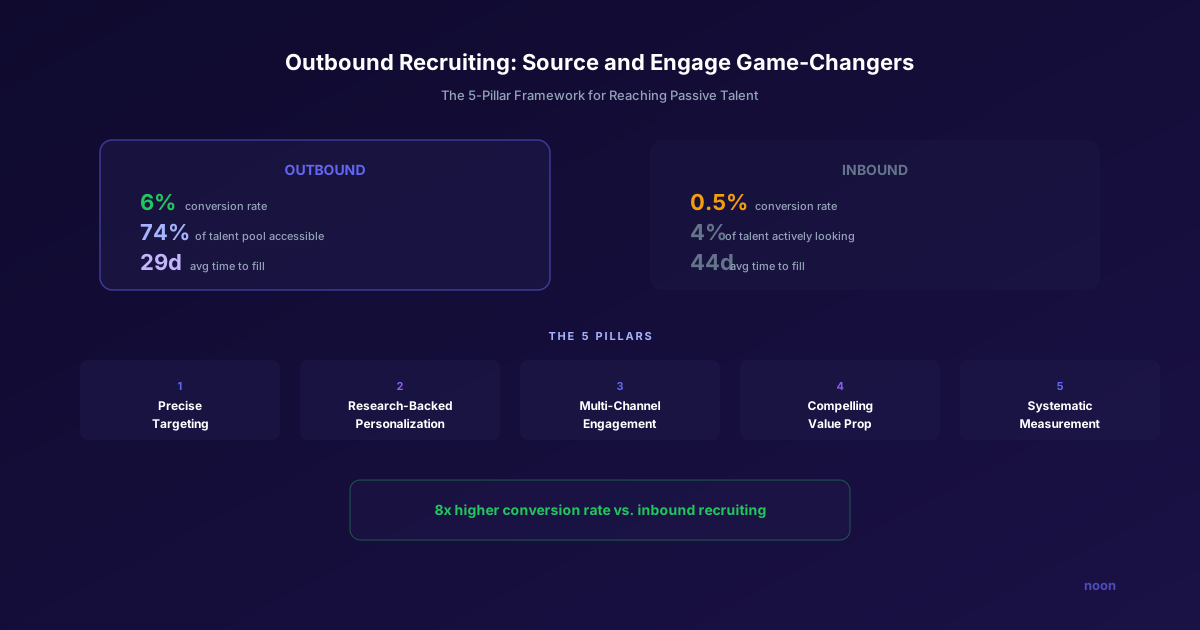
Key takeaway: Outbound-sourced candidates convert at 6% — 8x higher than inbound's 0.5% — because you're targeting qualified, pre-vetted talent instead of filtering mass applications. The five pillars of effective outbound recruiting are: precise targeting (ideal candidate profiles), research-backed personalization, multi-channel engagement (5-7 touches), compelling value propositions, and systematic measurement. AI-powered outbound scales this to hundreds of candidates simultaneously.
The best candidates rarely apply for jobs. They're employed, productive, and not refreshing job boards. If your recruiting strategy depends on inbound applications, you're fishing in a pond that contains about 4% of the available talent. The other 96% — passive candidates who are open to the right opportunity but aren't actively looking — are invisible to your job postings.
Outbound recruiting is how you reach them.
The data is compelling: outbound-sourced candidates convert to hires at approximately 6%, compared to 0.5% for inbound applicants — an 8x difference (Vamo, 2026). Sourced hires fill roles in an average of 29 days versus 44 for inbound (SHRM 2025). And the quality ceiling is higher because you're selecting from the full talent market, not just the subset that happened to see your posting.
But outbound recruiting done badly is spam. It's 500 identical InMails that annoy candidates and damage your employer brand. Done well, it's targeted, personalized, and genuinely valuable — a well-crafted introduction to an opportunity the candidate wouldn't have discovered otherwise.
This guide covers how to build an outbound recruiting function that consistently sources and engages high-quality candidates: the strategy, the execution, the tools, and the metrics.
Inbound vs. outbound: different problems, different strengths
These aren't competing strategies — they're complementary. But they solve different problems and require different skills.
| Factor | Outbound | Inbound |
|---|---|---|
| Who initiates | Recruiter contacts candidate | Candidate applies |
| Candidate type | Passive (employed, selective) | Active (looking, applying) |
| Conversion rate | ~6% | ~0.5% |
| Talent pool access | ~96% of workforce | ~4% actively looking |
| Candidate quality | Higher ceiling (you select from full market) | Variable (self-selected) |
| Resource intensity | Higher per candidate | Lower per candidate |
| Speed to pipeline | Faster (proactive control) | Slower (reactive, dependent on brand) |
| Best for | Senior/specialized roles, competitive markets | Entry-level, high-volume, strong employer brand |
Most teams should run both, weighted based on role type and market conditions. For senior engineering, product leadership, and specialized technical roles, outbound should be 60-80% of your pipeline. For early-career roles with strong inbound flow, outbound is a supplement at 20-30%.
The five pillars of effective outbound recruiting
Pillar 1: Precise targeting
The most important decision in outbound recruiting isn't what you write — it's who you write to.
A perfectly crafted outreach message sent to the wrong candidate gets ignored. A decent message sent to a precisely matched candidate gets responses. Targeting quality determines outbound effectiveness more than any other variable.
Build your ideal candidate profile (ICP) with specificity:
Don't define your ICP as "senior engineer." Define it as: "Backend engineers with 5-8 years of experience, currently at Series B-D companies, with distributed systems experience (event-driven architecture, microservices at scale), in New York or open to remote, who've been in their current role for 18+ months."
That level of specificity does two things: it ensures you only contact genuinely relevant candidates, and it gives you the context needed to write personalized outreach that demonstrates you understand their career.
Use timing signals to prioritize: Not all qualified candidates are equally receptive. Look for:
- Tenure above the industry average in their current role (potential restlessness)
- Company-level events (layoffs, reorgs, leadership changes, bad press)
- Profile updates (new skills, certifications, project completions)
- Increased LinkedIn activity (posting, commenting, engaging with career content)
- Recent promotions that didn't come with a title change (plateau signals)
Noon's sourcing engine incorporates these targeting dimensions automatically. When you describe the role, the AI evaluates candidates on fit, relevance, and receptivity, presenting a shortlist that's pre-qualified on all dimensions, not just skills matching. If you're building an outbound recruiting function and want to see this targeting in action, you can book a demo to walk through how Noon generates these high-precision candidate lists.
Pillar 2: Research-backed personalization
Once you have your target list, invest in understanding each candidate before reaching out. The depth of personalization directly correlates with response rates:
- No personalization (template blast): 3-5% response
- Surface personalization (name + company): 5-8% response
- Context personalization (specific project/skill reference): 15-25% response
- Deep personalization (multi-source context synthesis): 25-40% response
For each candidate, look at:
- Their LinkedIn activity and posts (what topics do they care about?)
- Their GitHub/portfolio (what have they built?)
- Conference talks or publications (what expertise do they showcase?)
- Company context (what's happening at their current employer?)
- Career trajectory (what's their likely next move?)
The time investment pays off. Spending 5 minutes researching a candidate before writing outreach generates 4-5x the response rate of spending 30 seconds on a template fill.
Noon automates this research layer. For every candidate surfaced, the AI synthesizes context from multiple sources and generates a personalized introduction that connects the candidate's specific background to the role — at the quality level of 5 minutes of manual research, but in seconds.
Pillar 3: Multi-channel engagement
Single-channel outbound (LinkedIn InMail only, or email only) leaves conversion on the table. Multi-channel sequences that combine email, LinkedIn, and selective SMS generate 2.5x more responses than single-channel approaches of the same length.
Recommended channel sequence for professional roles:
Touch 1 (Day 0) — Email. Your strongest channel for detailed outreach. Email allows longer messages with links, formatting, and attachments. Lead with the personalized hook.
Touch 2 (Day 3) — LinkedIn. Connection request with a brief note referencing the email. LinkedIn provides social proof (mutual connections, company affiliation) that email doesn't.
Touch 3 (Day 7) — Email. New angle. If Touch 1 emphasized the role, Touch 3 emphasizes the team, the technical challenge, or the compensation range.
Touch 4 (Day 12) — LinkedIn or Email. Social proof touch — share a relevant article, team achievement, or company milestone.
Touch 5 (Day 18) — Email. Graceful close. "I know you may not be looking right now. I'll leave this open — if your situation changes, I'd genuinely love to connect."
For VP+ and executive candidates:
- Longer intervals between touches (7-10 days)
- Hiring manager outreach instead of recruiter (15-20% higher response rates per Gem data)
- No more than 3 touches total (less is more at senior levels)
Pillar 4: Compelling value proposition
Candidates who aren't looking for jobs have a high bar for engagement. Your outreach needs to answer three questions in the first 30 seconds of reading:
"Why me?" — What specifically about their background makes them interesting for this role?
"Why now?" — Why should they consider this opportunity at this particular moment?
"Why this company?" — What's genuinely interesting about the opportunity beyond standard recruiter pitch?
Most outreach fails because it answers none of these. It talks about the company's funding, the mission statement, and the open role — but never explains why this specific candidate should care.
Strong value propositions for outbound:
- Technical challenge: "We're rebuilding our data pipeline to handle 10M events/second. Your experience with Kafka at scale at [Current Company] is exactly the expertise we need."
- Career growth: "This is a founding team role — you'd go from managing a pod of 3 to building and leading a 15-person platform team within 18 months."
- Impact: "The product serves 2M users daily. Changes you make ship to production in hours, not quarters."
- Compensation: "We know you're well-compensated at [Company]. We're prepared to make a compelling offer — happy to share our range if you're curious."
Pillar 5: Systematic measurement and iteration
Outbound recruiting is a system, not a series of one-off emails. Track performance rigorously and iterate based on data:
Metrics to track:
| Metric | What it measures | Benchmark |
|---|---|---|
| Response rate | % who reply to any touch | 20-35% target |
| Positive response rate | % who express interest | 10-20% target |
| Response-to-screen | % of responses that convert to phone screen | 50-70% |
| Screen-to-hire | % of screens that result in hire | 10-20% |
| Time-to-first-response | Days from first touch to reply | 3-7 days |
| Sequence completion rate | % who reach last touch with no response | Below 60% ideal |
Iteration cadence:
- Weekly: Review response rates by role and recruiter. Identify top and bottom performers.
- Monthly: A/B test results. Which subject lines, hooks, and CTAs are winning?
- Quarterly: Channel effectiveness review. Which channels drive the highest-quality responses for which candidate segments?
Scaling outbound without losing quality
The biggest challenge in outbound recruiting is maintaining personalization quality as you scale. Here are the levers:
AI-powered outreach generation. Noon generates personalized outreach at the quality level of manual research but at 10x the speed. This is the single biggest lever for scaling outbound: you get personalization and volume simultaneously.
Templatized structure with personalized content. Build a messaging architecture (hook, bridge, ask) that's consistent, but personalize the content within each section. The structure scales; the content stays unique.
Segment-specific playbooks. Create outreach playbooks for your most common candidate personas (e.g., senior engineers at FAANG, product managers at startups, data scientists in healthcare). The playbook provides the structure and value proposition; personalization fills in the candidate-specific details.
Tiered personalization by candidate value. Not every candidate needs 5 minutes of manual research. For high-priority targets (VP+, rare specialists, silver medalists), invest in deep personalization. For qualified-but-replaceable candidates, AI-generated personalization is sufficient.
FAQ
How many outbound messages should a recruiter send per day? With manual personalization: 15-25 high-quality messages. With AI-assisted personalization (Noon or similar): 50-100+ messages at equivalent quality. The constraint isn't sending speed — it's the recruiter's capacity to handle the resulting conversations.
Is outbound recruiting intrusive? Only when it's irrelevant. A well-targeted, personalized message about a genuinely interesting opportunity is not intrusive — it's helpful. A generic mass blast to 500 candidates is intrusive. The line between helpful and annoying is personalization quality.
When should I hire a dedicated sourcer vs. use AI? Use AI first. A single recruiter with an AI sourcing platform (Noon) can generate the same outbound pipeline as 2-3 dedicated manual sourcers. Only add dedicated sourcers when you need human judgment for highly specialized or confidential searches that AI can't fully handle.
How do I balance outbound with my other recruiting work? Block time. Dedicate 2-3 hours per day specifically to outbound sourcing and outreach. The rest of the day is for candidate conversations, interview coordination, and stakeholder management. AI tools compress the outbound time — what takes 3 hours manually takes 30-60 minutes with Noon.
What's the biggest mistake in outbound recruiting? Optimizing for volume over quality. Sending 500 messages that generate 15 responses (3%) is worse than sending 100 messages that generate 30 responses (30%). The 100-message approach uses less time, generates more responses, and doesn't burn your employer brand with hundreds of annoyed candidates.