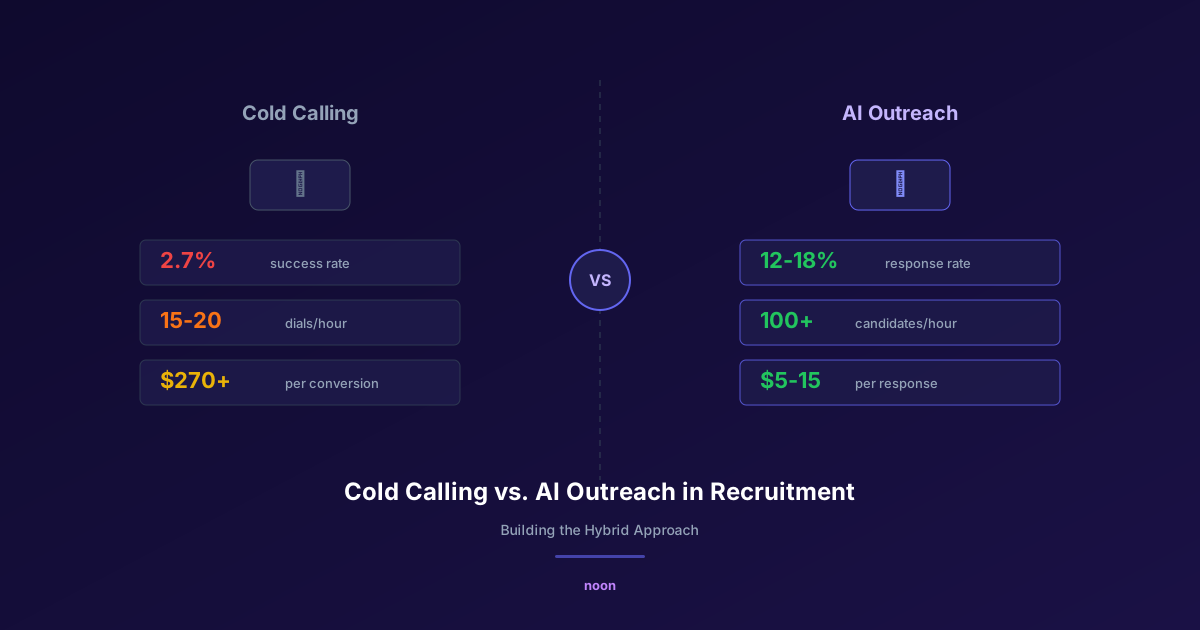
Key takeaway: AI-powered outreach achieves 12-18% response rates compared to cold calling's 2.7% success rate, at an estimated 20-50x lower cost per conversion. Cold calling still wins for executive search and low-digital-presence industries. The optimal approach is a hybrid multi-channel sequence: AI-personalized email + LinkedIn + strategic phone calls for high-value targets.
The recruitment industry has been debating cold calling for 15 years. Half of recruiters insist it's dead. The other half — especially in agency search and executive recruiting — argue it's the one tactic that still fills senior roles consistently.
The data settles the debate, but not the way either side expects.
Cold calling works. The average cold call success rate is 2.7% according to Cognism's 2026 State of Cold Calling report, and about 32% of prospects answer calls from strangers (RAIN Group 2024). For certain roles — senior executives, niche technical specialists, candidates who don't respond to text-based outreach — the phone is still the highest-signal channel.
But "works" is relative. A 2.7% success rate means 97.3% of your calls don't convert. At 15-20 dials per hour, a recruiter might generate 3-4 meaningful conversations per day. For high-volume roles, that math doesn't scale.
AI-powered outreach doesn't replace the phone. It changes when and how you use it. This article covers the specific scenarios where cold calling still outperforms, where AI outreach wins, and how to combine both into a sequence that maximizes response rates across channels.
When does cold calling still work in recruitment?
Despite the rise of AI outreach, there are specific scenarios where the phone outperforms every other channel:
Senior executive searches
Executives at the VP level and above rarely respond to cold emails or LinkedIn messages. Their inboxes are overwhelmed — many have assistants filtering messages. But a well-timed phone call to a direct line still gets through.
The key is preparation. A cold call to an executive without context is a wasted dial. A call that opens with "I noticed your team just closed a Series C, and I'm working with a company in the same space that's building out their product leadership" converts at 8-12% — three to four times the average cold call rate.
Candidates in low-digital-presence industries
Healthcare, manufacturing, construction, government — these industries have large talent pools that aren't active on LinkedIn and don't check professional email frequently. For a nursing director or plant manager, a phone call is often the only reliable way to reach them.
Time-critical roles
When you need to fill a role this week — not this quarter — the phone compresses the timeline. Email has a 24-48 hour response lag. LinkedIn messages may sit unread for days. A phone call gets an immediate yes or no.
Re-engaging warm leads
Candidates who previously expressed interest but went cold often respond better to a call than another email. The phone signal cuts through the noise of a crowded inbox.
Where does AI outreach beat cold calling?
For the majority of recruiting scenarios, AI-powered outreach delivers better results than cold calling — not because the technology is inherently superior, but because it solves the scaling and personalization problems that make cold calling inefficient at volume.
Personalization at scale
A recruiter can research a candidate and write a personalized cold call script in 5-10 minutes. That's 6-12 candidates per hour of preparation. AI can generate genuinely personalized outreach — referencing specific projects, publications, career trajectory, and why the role fits — for hundreds of candidates in the same time.
The distinction is important: this isn't mail-merge personalization ("Hi {first_name}, I noticed you work at {company}"). Modern AI generates unique messages that reference the candidate's actual work. Noon's AI reads the candidate's full profile, understands their career trajectory, and generates an introduction that explains why this specific opportunity fits their background — a different message for every candidate.
Multi-channel sequencing
Cold calling as a standalone tactic has a 2.7% success rate. But when the phone call is part of a multi-channel sequence — email first, then LinkedIn connection, then a call — response rates increase dramatically.
Research from Landbase found that multi-channel outreach (email + LinkedIn + a third channel) generates 287% higher engagement than single-channel approaches. The optimal sequence:
- Day 1: Personalized email introducing the opportunity
- Day 3: LinkedIn connection request with a brief note
- Day 5: Follow-up email with additional detail (if no response)
- Day 7-10: Phone call (now the candidate has context)
When the phone call comes after the candidate has already seen your email and LinkedIn message, it's no longer a cold call — it's a warm call. You have context. They may recognize your name. The conversation starts from a higher baseline.
AI orchestrates the digital touches in this sequence automatically. Noon sequences outreach across email and SMS, adjusting timing based on candidate engagement signals. If a candidate opens the email but doesn't reply, the system adjusts the follow-up approach. If they click through to the role, the system knows they're aware of the opportunity.
Response timing optimization
One of the most underrated advantages of AI outreach: timing. Research from Gem's 2025 Outreach Timing Analysis found that messages sent at 7-8 AM local time on Tuesdays and Wednesdays had the highest response rates.
A recruiter making cold calls doesn't have this granularity. They call when they have time to call. AI schedules messages to arrive at optimal times for each candidate based on their timezone, historical engagement patterns, and channel preferences.
Passive candidate engagement
70% of the workforce is passive — not actively looking for a job (LinkedIn Talent Solutions 2024). These candidates won't respond to a cold call from an unknown number. But they might open a well-crafted email that arrives at the right moment — after a recent company reorganization, post-acquisition, or when their LinkedIn activity suggests they're exploring.
AI excels at identifying these timing signals and reaching passive candidates when they're most receptive. Noon monitors candidate signals and activates outreach when the timing suggests receptivity, rather than blanket-dialing a list.
The real comparison: Cost and conversion
Let's compare the economics honestly.
Cold calling math
- Average dials per hour: 15-20
- Connection rate: 32% (RAIN Group)
- Success rate per call: 2.7% (Cognism)
- Conversations per hour: ~5-6
- Conversions per hour: ~0.15
- Recruiter cost: ~$40-60/hour (fully loaded)
- Cost per conversion: ~$270-400
AI outreach math
- Candidates contacted per hour: 50-100+ (automated)
- Email open rate: 40-55% (personalized AI)
- Response rate: 12-18% (personalized AI outreach)
- Responses per 100 messages: 12-18
- Platform cost: Varies, but typically $500-2,000/month
- Effective cost per response: ~$5-15
These figures aren't calculated on identical bases — cold calling cost is derived from an hourly recruiter rate, while AI outreach cost is derived from a monthly platform fee spread across per-hour candidate volume — so treat the comparison as directional rather than a precise apples-to-apples figure. Even accounting for that, the gap is large: AI outreach costs an estimated 20-50x less per conversion than cold calling for high-volume searches.
But for senior executive roles where a single placement is worth $50,000-150,000 in fees, the cold call's higher signal quality can justify its economics. The 8-12% conversion rate for well-researched executive calls produces fewer but higher-value conversations.
Building the hybrid approach
The best recruiting teams don't choose between cold calling and AI outreach. They use both, with AI handling the volume and the phone handling the high-signal conversations.
How it works in practice
Step 1: AI sources and segments the candidate pool. The AI identifies qualified candidates, assesses their likely receptivity, and categorizes them:
- High value, high difficulty: Senior candidates who likely won't respond to email → Phone call recommended
- High volume, standard difficulty: Mid-level candidates who are active online → AI outreach sequence
- Warm leads: Previous applicants or silver medalists → Re-engagement email sequence
Step 2: AI runs the outreach sequence for the majority. For most candidates, the AI sends personalized email and SMS outreach, monitors engagement, and adjusts the sequence based on signals.
Step 3: The recruiter picks up the phone for high-value targets. Armed with AI-generated intelligence — the candidate's background, likely motivations, optimal talking points — the recruiter makes 10-15 highly targeted calls per day instead of 80 generic ones.
Step 4: AI handles follow-up. After a productive phone conversation, the AI sends a follow-up email with the job details, schedules the next step, and logs everything in the ATS.
This approach combines the reach and efficiency of AI outreach with the relationship-building power of the phone. Each channel plays to its strength.
What the future looks like
AI hasn't killed cold calling. It's made it more selective. Instead of being the primary outreach channel, the phone becomes the premium channel — reserved for candidates who warrant the investment of a human conversation.
The recruiters who thrive in 2026 aren't choosing between cold calling and AI. They're using AI to handle the 80% of outreach that doesn't require a human touch, freeing themselves to have better, more prepared phone conversations with the 20% of candidates where the phone makes a difference.
At Noon, this philosophy is built into the platform. The AI handles sourcing, initial outreach, and follow-up sequences across email and SMS. When the system identifies a high-value candidate who hasn't responded to digital outreach, it flags them for a recruiter call — complete with talking points, background intelligence, and optimal timing. If you're evaluating whether AI outreach can reduce your team's reliance on cold calling while improving response rates, you can book a demo to see the multi-channel sequence builder in action.
The goal isn't to eliminate the phone. It's to make every phone call count.
FAQ
Is cold calling in recruitment dead in 2026? No. Cold calling still works at a 2.7% average success rate (Cognism 2026), and 32% of prospects answer calls from strangers (RAIN Group 2024). It remains effective for senior executive searches, candidates in low-digital industries, and time-critical roles. But it's no longer efficient as a primary outreach method for high-volume recruiting.
What is the average cold call success rate for recruiters? 2.7% according to Cognism's 2026 State of Cold Calling report. However, well-researched calls with specific context about the candidate and role can achieve 8-12% for senior positions. The key factor is preparation quality, not dial volume.
How does AI outreach compare to cold calling for recruiting? AI outreach generates 12-18% response rates with personalized messages (versus 2.7% for cold calls) at an estimated 20-50x lower cost per conversion. However, cold calls produce higher-signal conversations and work better for senior executives and candidates in low-digital-presence industries. The best approach combines both.
What is a multi-channel recruiting outreach sequence? A coordinated series of touchpoints across email, LinkedIn, and phone that increases response rates by 287% compared to single-channel approaches (Landbase 2025). The optimal sequence typically starts with personalized email, follows with LinkedIn, and reserves phone calls for high-value candidates or follow-up after initial digital engagement.
Should recruiters still learn cold calling? Yes, but as one skill among many rather than the core skill. Cold calling is still valuable for executive search, agency recruiting, and time-critical roles. However, the ability to manage AI outreach tools, calibrate personalization, and build multi-channel sequences is becoming equally important. The best recruiters in 2026 are channel-agnostic.