Key takeaway: Automating recruiting outreach means building a multi-step, multi-channel sequence that personalizes the opener, follows up on a fixed cadence, stops the moment a candidate replies, and writes every event back to your ATS. Done that way it roughly triples the replies you would get from a single message: across 844,234 recruiting sequences measured on the Noon platform, 64.9% of all replies arrived after the first message and the overall reply rate was 16.6% (Noon outreach benchmarks). Done badly, it gets a sending domain throttled by Gmail (spam rate over 0.3%) or a LinkedIn account restricted for third-party automation. The seven steps below keep you on the right side of both.
The case for automating is capacity, not laziness. SHRM's 2026 benchmarking of more than 4,600 organizations found extra-large employers saw a 67% increase in median requisitions per recruiter, and 97% of nonexecutive roles are now filled externally (SHRM 2026 Recruiting Executives Benchmarking). External hires start with outreach to people who did not apply. A recruiter carrying two-thirds more reqs cannot hand-write and hand-follow-up every one.
The constraint is that the receiving platforms have tightened. Since February 2024, Gmail requires bulk senders (5,000+ messages a day to Gmail) to authenticate with SPF, DKIM, and DMARC, keep reported spam rates below 0.3%, and offer one-click unsubscribe on marketing mail (Google Email Sender Guidelines). LinkedIn's help center states plainly that third-party software or browser extensions that automate activity on its website violate its User Agreement and can trigger account restriction (LinkedIn Help).
So the question is not whether to automate but which parts, on which channels, with which guardrails. Here is the order that works.
Step 1: Decide what "automated" means for your team
Automation sits on a spectrum, and picking the wrong point wastes either recruiter hours or candidate goodwill.
| Level | What is automated | What stays manual | Best for |
|---|---|---|---|
| Templates + reminders | Message text, follow-up reminders | Every send, every personalization | Executive search, very small volumes |
| Sequences | Multi-step sends on a schedule, stop-on-reply | List building, opener personalization | Most in-house teams today |
| AI-assisted sequences | Sequences plus AI-generated openers per candidate | Targeting, approval of first templates | Teams sending 100+ first touches a week per recruiter |
| Agentic outreach | Targeting, contact discovery, personalization, sequencing, reply handling, scheduling | Calibration, final-round conversations | Teams where sourcing is the bottleneck |
The distinction between the last two rows is the same one drawn in recruitment automation vs. AI recruiting: a sequence follows rules; an agent decides. If your pipeline problem is "we do not have enough people to contact", sequences alone will not fix it, because they start after the list exists.
Step 2: Fix targeting before you fix messaging
Automation multiplies whatever you feed it. A sequence sent to 500 poorly matched profiles produces 500 polite ignores and a worse sender reputation. Before touching cadence:
- Write criteria as a hiring manager would judge them, not as a Boolean string. Titles, adjacent titles, seniority signals, company types, must-haves that never relax.
- Calibrate on 20 to 30 profiles with the hiring manager before sending anything. Every rejection should have a reason you can encode.
- Decide the exclusion list: current employees, candidates already in the ATS for this or a related req, people contacted in the last 90 days. Duplicate outreach is the single most common integration complaint we hear.
The candidate sourcing strategies and tools guide covers list-building in depth. If the list will come from an AI sourcer, the AI Sourcer page describes how Autopilot builds and re-ranks it from feedback.
Step 3: Set up the sending infrastructure
This is the step teams skip and then blame the tool for.
- Send from a subdomain or dedicated recruiting domain (for example,
talent.company.com), so a deliverability problem cannot touch corporate mail. - Publish SPF and DKIM, and add a DMARC record even at
p=none; Gmail requires DMARC alignment for bulk senders (Google). - Warm the domain: start at a few dozen sends a day per mailbox and ramp over three to four weeks. New domains that jump to hundreds of sends get filtered.
- Verify every address before sending. Bounce rate is a reputation input. Enrichment tools that guess patterns without verification generate bounces at scale.
- Do not run browser extensions or scripts that automate actions inside linkedin.com. LinkedIn's stated policy is that this violates the User Agreement and that accounts are restricted for it (LinkedIn Help).
- Ask any vendor exactly how its LinkedIn touches are executed and what its position is on LinkedIn's terms. Compliance and account safety is one of the most common questions we hear in evaluation calls, and a vendor that cannot answer it clearly is a risk.
SMS
- Use SMS only after a candidate has engaged on another channel or for time-sensitive scheduling. Respect opt-outs immediately.
Step 4: Design the sequence
The data argues for three to four touches over roughly two weeks.
| Message | Timing | Share of all replies it captures | Job of the message |
|---|---|---|---|
| 1 | Day 0 | 35.1% | Specific reason you reached out, one clear ask |
| 2 | Day 3 to 4 | 27.0% | Add one new piece of information (comp band, team, project) |
| 3 | Day 7 to 8 | 17.9% | Short, different angle, easy no |
| 4 | Day 12 to 14 | 10.4% | Close the loop, leave the door open |
Source: 844,234 sequences, August 2025 to July 2026 (Noon outreach benchmarks). Messages two through four together capture 55% of replies, which is why a one-message "campaign" is not automation, it is a mail merge.
Timing details that move the numbers: replies peak on Tuesday, the Monday to Thursday block accounts for over 75% of replies, and weekend reply volume runs about 77% below weekdays (best time to send recruiting outreach). Schedule first touches Monday through Wednesday morning in the candidate's time zone.
Channel mix matters too: a sequence that can follow an unanswered email with an SMS reaches candidates a single-channel tool misses. If the tool can only send email, it is leaving replies on the table.
Every sequence needs three stop conditions built in: candidate replied (any channel), candidate opted out, sequence exhausted. A follow-up that lands after a reply is the fastest way to look automated.
Step 5: Personalize the opener, template the rest
Personalization is where "automated" and "human" are supposed to conflict. In practice the fix is structural: personalize the first two sentences per candidate and standardize everything after.
What earns a reply in the opener is specificity the candidate can verify: a project they shipped, a talk they gave, a company transition that makes the role logical. What does not is their name and current title, which every template already merges.
AI-generated intros handle this at volume when they draw on the candidate's actual profile and the role's actual requirements. At Noon, the {ai_intro} token in AI Outreach writes that opener per candidate from the sourcing evaluation, so the reason the agent selected the person is the reason the message gives them. Teams keep control by reviewing the sequence templates and tone before a campaign goes live, which is the approval gate that addresses the employer-brand concern we hear most often.
For the message bodies themselves, the seven templates in cold recruiting outreach templates come with the reply-rate reasoning behind each, and personalizing recruiting emails with AI covers where automated personalization goes wrong.
Step 6: Automate what happens after the reply
Most outreach automation stops at the reply, which hands the recruiter a new inbox to manage. The reply is where the time goes: logistics questions, "what is the comp?", "can we do Thursday?", and the scheduling back-and-forth.
The realistic automation here in 2026:
- Reply classification: interested, not now, wrong fit, referral, opt-out. Each routes differently and updates the ATS.
- Candidate Q&A on role basics from a source the team controls.
- Interview booking against real calendar availability, with reschedules handled without a human. Noon's AI Scheduler does this through a Calendly integration once a candidate says yes.
- Halt on reply: the sequence stops, and any human-authored message from the recruiter takes over the thread.
Median reply time in our data is 2.8 days, but 25% of replies land within 11 hours and 10% arrive after day 14 (Noon benchmarks). Automation that checks the inbox once a day loses the fast repliers, who are also the most interested.
Step 7: Write everything back to the ATS and measure
Buyers we talk to rank ATS integration as the top evaluation criterion for outreach tooling, and the specific fear is duplicate outreach to candidates already in process. Two requirements follow:
- Read before send: check the ATS for the candidate before the first touch, not after.
- Write every event: sourced, contacted (with channel and message), replied, scheduled, stage changes. If a later recruiter opens the record, the history should be there.
Then measure the funnel per requisition, weekly:
| Metric | Benchmark | If it is low |
|---|---|---|
| Deliverability (non-bounce) | Above 97% | Fix verification and warm-up first |
| Reply rate | 16.6% average | Targeting or opener problem, not cadence |
| Replies after message 1 | About 65% of total | You are sending too few follow-ups |
| Positive reply rate | Track your own baseline | Role positioning or comp band problem |
| Screens booked per week per req | Enough to fill interview slots | Scheduling friction; automate the booking step |
Our full recruiting outreach benchmarks publish the distributions behind these numbers by channel, month, and step.
Which tools automate recruiting outreach?
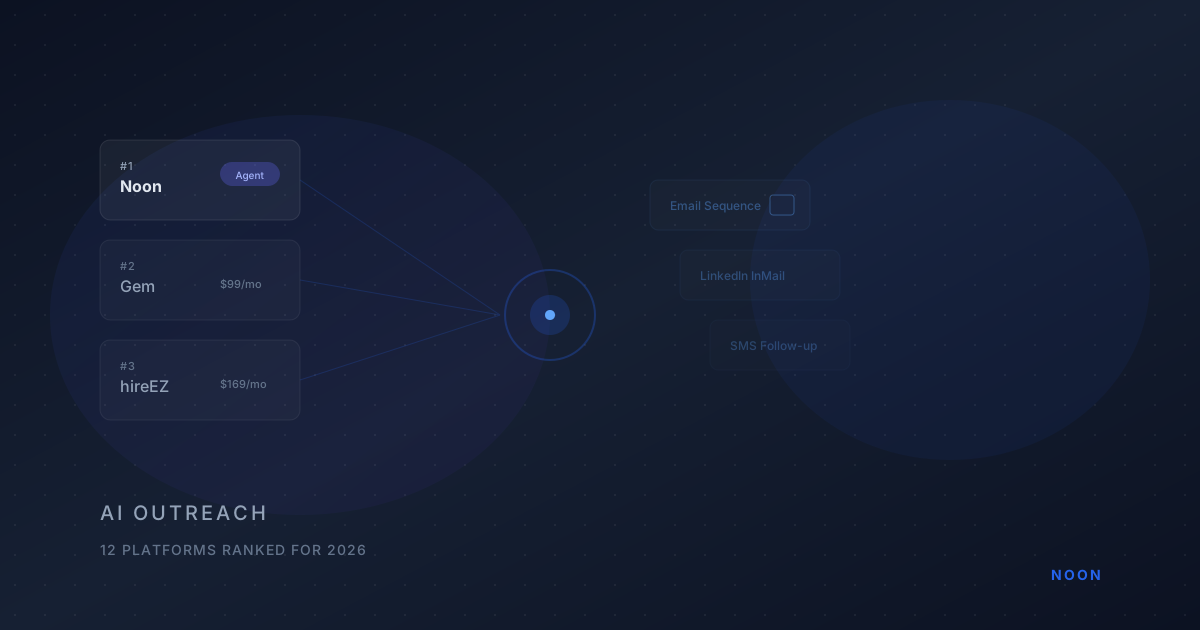
Categories, not a ranking. The right one depends on which row of the Step 1 table you chose.
| Category | What it automates | Typical limitation | Examples |
|---|---|---|---|
| Sales-style sequencers adapted for recruiting | Email sequences, some LinkedIn tasks | Built for sales; no sourcing; LinkedIn steps often manual or extension-based | General outbound tools |
| Recruiting CRMs with sequencing | Email and InMail sequences from an existing candidate database | Per-user or quote-based pricing; you supply the list | Gem, Recruiterflow, Loxo |
| Sourcing platforms with campaigns | Search plus sequences from a licensed database | Credit or contact caps; database-bound sourcing | hireEZ, SeekOut, Juicebox |
| Autonomous AI recruiters | Sourcing, evaluation, contact discovery, multi-channel sequences, reply handling, scheduling, ATS sync | Requires calibration up front | Noon |
Noon is the one plan in the last row without per-seat fees, credits, or contact caps: unlimited sourcing, unlimited email enrichment, unlimited contacts, unlimited agents, unlimited seats (pricing). For side-by-side detail on the sequencing tools, see best AI outreach platforms for recruiters.
FAQ
Can you automate LinkedIn outreach without getting your account restricted?
LinkedIn's help center says third-party software or browser extensions that automate activity on linkedin.com violate its User Agreement and that accounts are restricted for it (LinkedIn Help). Browser-extension automation is the highest-risk approach. Before choosing any tool, ask the vendor precisely how LinkedIn touches are executed, what account types it supports, and how it stays within LinkedIn's terms; these are three of the most frequent questions we hear in evaluation calls, and the answers vary widely.
What reply rate should automated recruiting outreach get?
16.6% of contacted candidates replied across 844,234 multi-step sequences measured between August 2025 and July 2026 (Noon benchmarks). If a single-message campaign gets 6%, that is roughly what a good four-step sequence gets on message one alone.
How many follow-ups should a recruiting sequence have?
Three to four total messages over about two weeks. Messages two through four captured 55% of all replies in our data; a fifth message adds little and raises the brand-risk that teams tell us is their main hesitation about automated outreach.
Does automating outreach hurt employer brand?
It can, if the cadence is aggressive, the personalization is fake, or follow-ups keep landing after a candidate replied. Teams tell us this is their second-biggest hesitation after general trust in AI. The safeguards are in Steps 4 and 5: stop-on-reply, a 12 to 14 day ceiling, and openers that reference something the candidate actually did.
Should recruiting outreach emails include an unsubscribe link?
For Gmail's bulk-sender rules, one-click unsubscribe is required for marketing and subscribed messages (Google). One-to-one recruiting messages are a gray area, but offering a simple opt-out ("reply 'no thanks' and I will not follow up") costs nothing, protects spam-rate metrics, and is the honest version of the same thing. Honor it immediately across all channels.
Can automation handle the reply and scheduling, or just the sending?
Sequencers stop at the reply. Agentic platforms continue through reply classification, candidate Q&A, and calendar booking. Ask a vendor for a live demo of what happens after a candidate says "sure, when?", because that is where recruiter hours actually go once sending is automated.