Key takeaway: Recruitment automation follows rules (if-then workflows). AI recruiting makes decisions (evaluating fit, personalizing outreach, learning from feedback). Automation handles scheduling, email sequences, and status updates. AI handles sourcing, screening, and calibration. Most teams need both, automation for process efficiency, AI for decision quality.
These two terms get used interchangeably in recruiting, and that confusion costs teams real money. A company buys an "AI recruiting platform" expecting it to find and evaluate candidates autonomously, only to discover it's really just workflow automation with a chatbot on top. Or a team that only needs automated email sequences pays for a full AI recruiting agent and never uses 80% of the capabilities.
SHRM's 2025 Talent Trends report found that 43% of companies now use AI for HR tasks, up from 26% the previous year. But "use AI" covers an enormous range. Scheduling an interview automatically when a candidate passes a screening threshold is automation. Evaluating whether a candidate should pass that threshold based on their full career context is AI. The distinction matters because these approaches solve different problems, require different investments, and deliver different results.
This guide breaks down both approaches, explains where each one fits, and shows how they work together in a modern recruiting stack. The September 2026 update adds a third category that vendors now market heavily, agentic AI, along with a buyer's checklist for telling the three apart in a demo and current pricing for representative tools in each category.
What is the core difference between automation and AI recruiting?
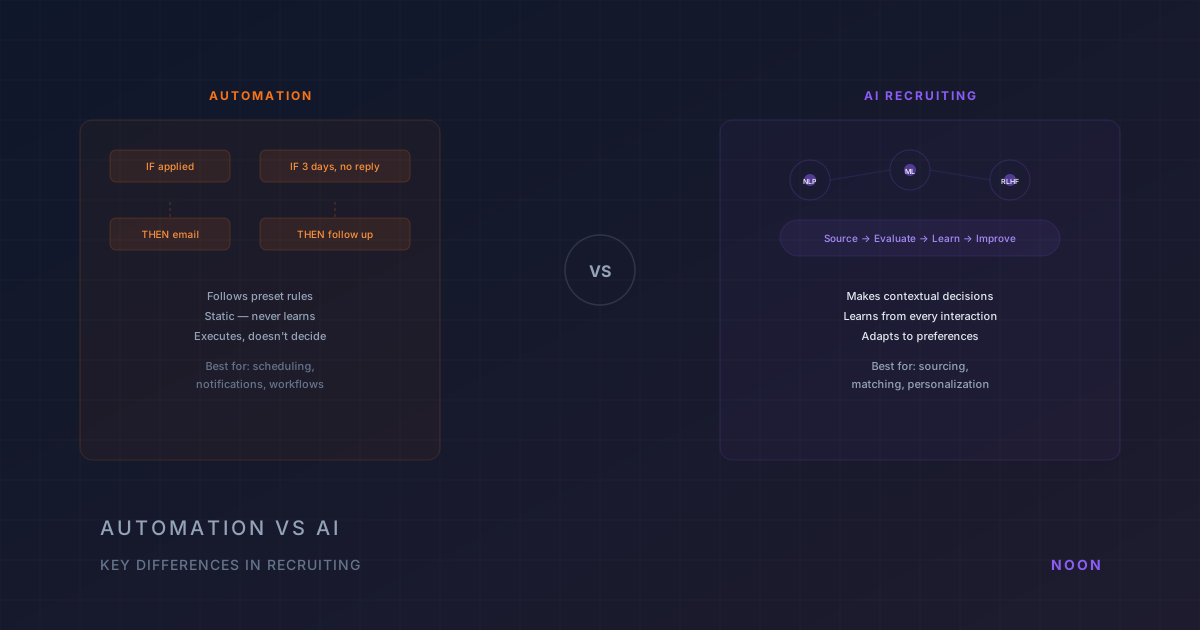
Recruitment automation executes pre-defined rules without judgment. It follows if-then logic that a human configured:
- If a candidate applies → then send acknowledgment email
- If recruiter marks candidate as "phone screen complete" → then schedule next interview
- If 3 days pass with no response → then send follow-up message
- If candidate accepts offer → then trigger background check workflow
The rules don't change unless a human changes them. The system never looks at a situation and decides what to do, it executes what it was told to do.
AI recruiting makes decisions based on data and learning. It evaluates situations, draws conclusions, and improves over time:
- Given this job description and team context → identify candidates who fit (without being told exactly where to look or what keywords to use)
- Given this candidate's career trajectory → assess whether they're qualified (without a human reviewing every resume)
- Given this candidate's background → write personalized outreach (without using a template)
- Given feedback on sourced candidates → adjust future searches to better match preferences
AI recruiting involves judgment, learning, and adaptation. Automation involves execution, consistency, and efficiency.
How do automation and AI recruiting compare across eight dimensions?
| Dimension | Recruitment Automation | AI Recruiting |
|---|---|---|
| Decision-making | Follows preset rules | Makes contextual judgments |
| Learning | Static: same rules until changed | Adapts from feedback and outcomes |
| Sourcing | Posts to job boards, distributes listings | Searches autonomously, evaluates profiles |
| Screening | Keyword filters, knockout questions | Contextual evaluation using NLP/LLMs |
| Outreach | Template sequences with variable insertion | AI-generated personalized messaging |
| Scheduling | Calendar integration, availability matching | Same (automation handles this well) |
| Analytics | Pipeline metrics, time tracking | Predictive analytics, quality-of-hire signals |
| Cost | Lower: simpler technology | Higher, but automates more of the workflow |
What is agentic AI recruiting, and how is it different from both?
Since 2025 nearly every vendor in the category has added "agents" to its product page, so the two-way distinction above needs a third rung. The useful test is who holds the goal.
| Recruitment automation | AI-assisted recruiting | Agentic AI recruiting | |
|---|---|---|---|
| Who sets the goal | Human configures rules | Human runs each step, AI suggests | Human sets the outcome (fill this role), AI plans and executes the steps |
| Typical product | ATS workflows, scheduling tools, email sequencers | AI search, resume ranking, copy suggestions, notetakers | Sourcing agents, AI interviewers, AI schedulers that run end to end |
| What the recruiter does per candidate | Nothing after setup | Reviews and acts on every suggestion | Reviews exceptions and gives feedback that changes future behavior |
| Failure mode | Rules fire in situations nobody anticipated | Recruiter becomes the bottleneck on volume | Agent optimizes for the wrong criteria if calibration is skipped |
| Where it sits in the stack | Layer 1 (see below) | Layer 2, human-in-the-loop | Layer 2, human-on-the-loop |
Most "AI recruiting" products sold in 2024 were AI-assisted: a recruiter typed a query, the AI ranked results, and the recruiter did everything after that. Agentic products remove the per-candidate step. Noon, for example, takes a role description, sources and evaluates candidates continuously, runs email and SMS outreach, and books interviews through its AI Coordinator, with the recruiter steering by thumbs-up and thumbs-down calibration rather than by running searches. Our roundup of the best AI recruiting tools sorts current vendors along this line.
Where does recruitment automation outperform AI?
Automation is the right tool for tasks that are structured, repetitive, and have clear rules. These are tasks where human judgment doesn't add value, where the "right" answer is always the same regardless of context.
Interview scheduling. When a candidate needs to be scheduled for an interview, the task is mechanical: find available time slots, match them against interviewer availability, send calendar invites, handle reschedules. Automation handles this faster and more reliably than a human coordinator. Tools like Calendly, GoodTime, and built-in ATS schedulers have essentially solved this problem.
Status updates and notifications. Automatically notifying candidates when their application moves to a new stage, reminding interviewers about upcoming sessions, alerting hiring managers when a req has been open for 30+ days, these are pure automation use cases. No judgment required.
Pipeline stage transitions. Moving candidates through workflow stages based on triggers (passed phone screen → move to on-site stage) is a natural fit for rule-based automation. Most modern ATS platforms handle this natively.
Job posting distribution. Automatically distributing job listings to multiple job boards, formatting them for each platform, and managing posting durations, automation, not AI.
Compliance tracking. Ensuring every candidate receives required communications, tracking EEO data collection, maintaining audit trails, these need consistency and reliability, which is exactly what automation provides.
Bullhorn reports that agencies using recruitment automation save an average of 12.75 hours per recruiter per week, see 36% more placements, and achieve a 22% higher fill rate. Those numbers come primarily from automating administrative tasks that were consuming recruiter time.
Where does AI recruiting outperform automation?
AI recruiting is the right tool for tasks that require judgment, context, or adaptation. These are tasks where the "right" answer depends on the specific situation and changes over time.
Candidate sourcing. Finding qualified candidates for a specific role isn't a rule-based task. It requires understanding what the role needs, what makes a candidate qualified, where to look, and how to evaluate non-obvious indicators of fit. A senior recruiter does this through experience and intuition. AI recruiting systems do it through trained models that process career data, skills context, and company caliber signals.
At Noon, this distinction is concrete. When you activate a role, the AI agent doesn't execute a pre-written Boolean search string. It interprets the job description, understands the role context, and searches across the web for candidates who fit, even candidates who use different terminology or have unconventional backgrounds that a keyword search would miss. Teams evaluating this approach can book a demo to see how the AI agent sources and evaluates candidates for a specific open role.
Resume screening. Automated resume screening filters by keywords. AI resume screening evaluates context. When a job requires "5+ years of machine learning experience," keyword matching looks for the phrase "machine learning" and a number ≥ 5. AI screening evaluates whether a candidate's work history demonstrates ML expertise at the required depth, even if their resume describes the work differently (e.g., "built recommendation systems" or "developed predictive models for supply chain optimization").
Outreach personalization. Automated outreach inserts variables into templates: {first_name}, {company}, {role_title}. AI outreach analyzes a candidate's specific background and writes messages that reference their actual experience, career trajectory, and potential fit for the role. The difference in response rates is significant, candidates can immediately tell the difference between a template and a message that demonstrates genuine understanding of their background.
Calibration and learning. This is where the gap between automation and AI is widest. Automated systems produce the same results regardless of how much you use them. AI recruiting systems that incorporate reinforcement learning from human feedback (RLHF) improve with every interaction. When a hiring manager reviews sourced candidates and provides feedback, the system adjusts its matching criteria. The tenth batch of candidates is meaningfully better than the first.
What does the automation spectrum look like in recruiting?
Rather than a binary choice, most teams end up with a mix of automation and AI across their recruiting workflow. Here's how the spectrum typically looks:
| Task | Pure Automation | Hybrid | Pure AI |
|---|---|---|---|
| Job posting | ● | ||
| Application acknowledgment | ● | ||
| Interview scheduling | ● | ||
| Resume parsing | ● | ||
| Candidate sourcing | ● | ||
| Skills assessment | ● | ||
| Outreach personalization | ● | ||
| Follow-up sequencing | ● | ||
| Candidate matching | ● | ||
| Pipeline analytics | ● | ||
| Offer generation | ● | ||
| Onboarding workflows | ● |
The trend is clear: tasks are migrating from left to right as AI capabilities mature. Resume parsing was pure automation five years ago (regex-based extraction). Now it's hybrid (NLP-based with structured output). In two years, it will likely be pure AI (contextual understanding of career narratives).
What mistakes do teams make when choosing between automation and AI?
Mistake 1: Buying AI for automation tasks. If your primary pain point is scheduling interviews or sending status updates, you don't need an AI recruiting platform. You need better automation in your ATS. Paying for AI capabilities you'll use for if-then workflows wastes budget.
Mistake 2: Expecting automation to solve sourcing problems. If your team can't find enough qualified candidates, no amount of workflow automation will fix that. Automating the steps after a candidate enters your pipeline doesn't help if the pipeline is empty. This is an AI problem, you need a system that can autonomously identify and evaluate candidates.
Mistake 3: Treating "AI-powered" labels at face value. The term "AI-powered" has become meaningless in vendor marketing. A chatbot that answers pre-written FAQs is not AI, it's a decision tree. A resume parser that matches keywords is not AI, it's text search. Ask vendors to demonstrate actual machine learning: where does the system make decisions that weren't explicitly programmed? Where does it improve over time?
Mistake 4: Skipping automation for AI. Some teams jump to sophisticated AI tools without automating their basic workflows first. If recruiters are still manually sending interview confirmations and status updates, fix that first. AI recruiting delivers maximum value when it's layered on top of a well-automated foundation.
Mistake 5: Confusing an agent with a copilot. A product that requires a recruiter to launch every search, approve every message, and move every candidate is AI-assisted, however it is labeled. That is not a flaw, but it does mean headcount still scales with requisition volume. Ask what happens to a role at 2 a.m. with nobody logged in.
How do you tell automation, AI, and agents apart in a demo?
Six questions separate the categories faster than any feature list. Bring them to every vendor call.
- "Show me a decision the system made that nobody programmed." Automation cannot answer this. AI-assisted tools will show a ranking. Agentic tools should show a candidate they chose to contact, and why.
- "What changes if I reject this candidate?" If the answer is "nothing, the next search runs the same way," it is not learning. Calibration should visibly change subsequent results for that role.
- "What runs when nobody is logged in?" Automation runs its triggers. An agent should be sourcing, following up, and re-evaluating the pipeline as new candidates enter the market.
- "Where does the human sit?" In the loop (approving each step) or on the loop (reviewing exceptions)? Both are legitimate; they price and staff very differently.
- "Which channels does outreach actually use, and who writes each message?" Template merge fields are automation. A message that references the candidate's specific work is AI. Confirm the channels are ones you can legally and practically use.
- "How does it handle applicants who are not who they say they are?" Rule-based knockout questions cannot catch a fabricated identity. Ask whether the system correlates network, location, and email signals and shows the recruiter why an applicant was flagged. Our guide to detecting fake job applicants for remote roles explains what good looks like.
A vendor that answers all six clearly is selling you something specific. A vendor that answers with "AI-powered" is selling you a label. For a category-by-category map of what each product type actually does, see our guide to the types of recruiting software.
How do automation and AI work together in a modern recruiting stack?
The most effective recruiting teams combine both approaches:
Layer 1: Automation foundation. Automate all structured, repetitive tasks: scheduling, notifications, pipeline transitions, job posting, compliance tracking. This creates a reliable operational backbone and frees recruiter time. Our guide to interview scheduling software covers the most common Layer 1 purchase.
Layer 2: AI for sourcing and evaluation. Use AI to handle the judgment-heavy tasks: finding candidates, evaluating fit, screening inbound applicants, generating personalized outreach. This is where the real leverage comes from, because these tasks consume the most recruiter time and benefit most from machine learning.
Layer 3: Human judgment for closing. Recruiters focus on the work that genuinely requires human expertise, selling the opportunity, evaluating cultural fit, negotiating compensation, and making final hiring decisions.
Noon's approach represents this architecture. The AI agent handles Layers 1 and 2: it autonomously sources candidates across the whole web, evaluates them against role criteria and non-negotiables, generates personalized email and SMS outreach, manages follow-up sequences, books interviews through the AI Coordinator, and syncs everything to the ATS through 20+ integrations. Recruiters operate at Layer 3, reviewing sourced candidates, providing calibration feedback, conducting high-touch conversations, and closing offers.
The result is a system where automation handles what's mechanical, AI handles what requires judgment at scale, and humans handle what requires genuine relationship and strategic thinking.
Frequently asked questions
Is AI recruiting just a more advanced form of automation? No. They're fundamentally different approaches. Automation follows rules that don't change. AI learns from data and improves over time. A recruiter automation tool that sends the same email sequence to every candidate is operating differently than an AI system that writes unique messages based on each candidate's specific background.
Do I need to replace my ATS to get AI recruiting? No. AI recruiting platforms typically integrate with your existing ATS (Greenhouse, Lever, Workday, etc.) rather than replacing them. The ATS remains your system of record for candidate data and workflow management. AI layers on top to handle sourcing, screening, and outreach.
How much does AI recruiting cost compared to automation? Automation features are increasingly included in standard ATS subscriptions. AI-assisted tools now publish self-serve seat pricing: SeekOut's Recruit Core is $149 per user per month billed annually, Metaview's sourcing agent runs from a free tier to $300 per user per month, and hireEZ lists a solo seat at $494 per month (all vendor pricing pages, checked September 25, 2026), with team tiers custom at each. Agentic platforms are typically priced by plan rather than by seat; Noon runs one plan with unlimited sourcing, contacts, agents, and seats, so cost does not rise with recruiter headcount or requisition volume. The ROI calculation should factor in recruiter hours saved, reduced agency spend, and faster time-to-fill; see our AI sourcing tools guide for how to model it.
Can automation or AI catch fake applicants? Automation cannot; knockout questions and keyword filters only see what the applicant typed. AI systems can, if they correlate signals the applicant does not control: VPN or datacenter connections, mismatches between stated location and observed timezone, disposable email domains, and a professional footprint that does not predate the application. Noon's Fraud Detection works this way and shows the recruiter the triggering signals rather than silently hiding the applicant.
What recruiting tasks should never be automated or handled by AI? Relationship-dependent tasks: final interviews, offer negotiations, candidate motivation conversations, and hiring manager alignment. These require empathy, persuasion, and contextual judgment that AI can't replicate. The best approach is using AI to ensure recruiters spend maximum time on these high-value interactions.
Is recruitment automation the same as an ATS? No. An ATS is a system of record for applicants, while recruitment automation refers to workflows, triggered emails, interview scheduling, status updates, that may live inside or alongside the ATS. AI recruiting adds decision-making on top of both.
Can you have AI recruiting without automation? Not really in practice. AI recruiting platforms bundle automation as the delivery mechanism, the AI decides who to contact and what to say, and automation executes the sequence. Automation without AI is common; AI without automation is rare.
Which should a small team invest in first? If your bottleneck is repetitive admin (scheduling, follow-ups), start with automation, it's cheaper and fast to deploy. If your bottleneck is finding and engaging qualified candidates, an AI recruiting platform addresses the harder problem directly.