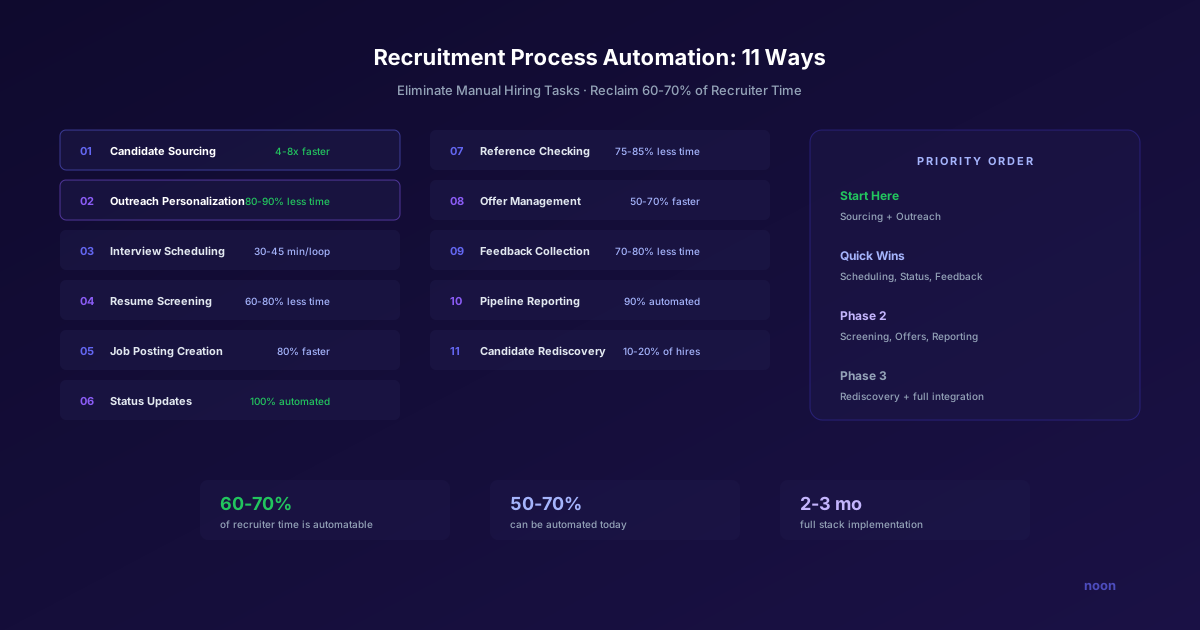
Key takeaway: Recruitment process automation handles 11 key workflows: candidate sourcing, outreach personalization, interview scheduling, resume screening, job posting distribution, candidate status updates, reference checking, offer letter generation, interview feedback collection, pipeline reporting, and candidate rediscovery. Automating these processes reduces administrative workload by 60-70% and cuts time-to-fill by 30%. Start with the three highest-volume manual tasks in your current process.
Recruiters spend 60-70% of their working hours on administrative and repetitive tasks that don't require human judgment: scheduling interviews, reviewing resumes, formatting job postings, sending status updates, copying data between systems. That's 24-28 hours per week — time that could be spent on the activities that actually require a recruiter's expertise: evaluating candidates, selling opportunities, and building relationships.
Recruitment process automation (RPA) targets this administrative overhead. Not by replacing recruiters, but by handling the mechanical steps in the hiring workflow so recruiters can focus on the human ones.
This guide identifies 11 specific recruiting workflows that can be automated in 2026, ordered by impact. For each, we cover what the manual process looks like, what automation changes, which tools handle it, and the expected ROI.
1. Candidate sourcing and shortlist generation
Manual process: Recruiter builds Boolean search strings, reviews 50-200 profiles, evaluates each one, builds a shortlist manually. Time: 2-4 hours per role.
Automated process: AI sourcing platform takes a natural language role description, searches across multiple databases, evaluates candidates on fit, and delivers a ranked shortlist with explanations. Time: 15-30 minutes (review only).
Tools: Noon (autonomous end-to-end), hireEZ (database search + AI), SeekOut (deep technical search), Fetcher (curated batches). If you're evaluating autonomous sourcing platforms, you can book a demo to see how AI handles candidate identification and shortlist generation for your specific roles.
ROI: 4-8x time reduction on the most time-consuming recruiting task. For a team with 20 open roles, this saves 40-80 hours per week.
2. Outreach personalization and sequencing
Manual process: Recruiter researches each candidate, writes a personalized email, sends it, tracks responses, writes follow-ups, manages multi-touch sequences manually. Time: 5-15 minutes per candidate per touch.
Automated process: AI generates personalized outreach referencing each candidate's specific background, launches multi-channel sequences (email + SMS), adapts follow-ups based on engagement, and auto-pauses on reply. Time: 1-2 minutes per candidate (review + approve).
Tools: Noon (integrated with sourcing), Gem (CRM-based sequencing), Lemlist (email personalization), Instantly (high-volume infrastructure).
ROI: 80-90% time reduction on outreach while improving response rates by 2-3x through better personalization.
3. Interview scheduling
Manual process: Coordinator emails candidate with available times, candidate responds, coordinator checks interviewer calendars, sends calendar invites, handles reschedules. Time: 15-45 minutes per interview loop.
Automated process: Candidate receives a scheduling link with available slots (auto-generated from interviewer calendars). They select a time. Calendar invites, reminders, and prep materials are sent automatically. Reschedules happen through the same self-service interface.
Tools: Noon (integrated scheduling), GoodTime (purpose-built), Calendly (simple scheduling), ModernLoop (complex panel coordination).
ROI: 30-45 minutes saved per interview loop. For a team scheduling 50 interviews/week, that's 25-37 hours saved weekly.
4. Resume screening and application review
Manual process: Recruiter opens each application, scans resume (6-8 seconds average), makes a gut-feel decision, moves to next. Time: 2-3 hours per role per application batch.
Automated process: AI reads every resume, evaluates against defined criteria, scores candidates with explainable rationale, auto-advances clear matches and auto-rejects clear non-matches. Recruiter reviews borderline cases only. Time: 30-60 minutes per role.
Tools: Noon (pre-sourcing screening), SeekOut Sam (inbound applicant evaluation), Arahi (resume auto-scoring), Greenhouse (basic AI screening).
ROI: 60-80% time reduction on resume review with more consistent, less biased evaluation.
5. Job posting creation and distribution
Manual process: Recruiter writes job description from scratch, formats it for multiple job boards, manually posts to each board, updates postings when requirements change. Time: 1-2 hours per role.
Automated process: AI generates job descriptions from role requirements, optimizes language for inclusivity and SEO, automatically distributes to configured job boards, and updates all postings when changes are made. Time: 10-15 minutes (review + approve).
Tools: Datapeople (JD optimization), Textio (language analysis), Greenhouse (multi-board posting), LinkedIn (Jobs integration).
ROI: 80% time reduction on posting creation plus improved application quality through better job descriptions.
6. Candidate status updates and communication
Manual process: Recruiter manually sends status updates at each pipeline stage: application received, moved to phone screen, interview scheduled, post-interview feedback pending, decision made. Time: 5-10 minutes per candidate per update.
Automated process: Trigger-based messages sent automatically when a candidate moves between pipeline stages in the ATS. Templates are pre-written but personalized with candidate name, role, and relevant details. Time: Zero recruiter time for standard updates.
Tools: Greenhouse (automated workflows), Ashby (stage-triggered messages), Lever (automated nurture), any ATS with workflow automation.
ROI: Eliminates 100% of manual status update work while improving candidate experience (faster, more consistent communication).
7. Reference checking
Manual process: Recruiter contacts references by phone or email, schedules calls, asks questions, documents responses, compiles summary. Time: 1-2 hours per candidate.
Automated process: References receive an automated survey with structured questions. Responses are collected, analyzed, and summarized with flags for concerning patterns. Recruiter reviews the summary instead of conducting live calls. Time: 10-15 minutes per candidate.
Tools: Checkster (automated reference surveys), Crosschq (360 reference analytics), Searchlight (predictive reference checks).
ROI: 75-85% time reduction per reference check while capturing more consistent, structured data.
8. Offer letter generation and approvals
Manual process: Recruiter requests compensation approval from hiring manager and finance, drafts offer letter in Word, gets legal review, sends for signature, tracks acceptance. Time: 2-4 hours per offer including back-and-forth.
Automated process: Compensation range pre-approved by role level. Offer letter auto-generated from template with candidate-specific details. Approval workflow routes to the right stakeholders automatically. Digital signature sent and tracked. Time: 30-60 minutes.
Tools: Greenhouse (offer workflows), Compa (comp benchmarking), DocuSign (signatures), Pave (offer modeling).
ROI: 50-70% time reduction plus faster offers (reduced candidate drop-off during the offer stage).
9. Interview feedback collection
Manual process: After each interview, interviewer fills out a scorecard. Coordinators chase down late feedback. Debrief meetings are scheduled manually. Time: 30-60 minutes of coordinator time per interview loop.
Automated process: Interviewers receive automated reminders with pre-populated scorecard links immediately after the interview. Late feedback triggers escalation. Debrief is auto-scheduled when all scorecards are submitted. Time: 5-10 minutes of coordinator time.
Tools: Greenhouse (structured scorecards + reminders), Ashby (automated feedback workflows), BrightHire (interview intelligence + auto-notes).
ROI: 70-80% reduction in coordinator time on feedback collection. Faster debrief cycles (days instead of weeks).
10. Pipeline reporting and analytics
Manual process: TA leader exports data from ATS, cleans it in Excel, builds charts, writes commentary, distributes report to stakeholders. Time: 3-5 hours per weekly/monthly report.
Automated process: Dashboard auto-updates with real-time pipeline data. Alerts fire when metrics cross thresholds (time-in-stage too long, conversion dropping, sourcing pipeline thin). Stakeholders self-serve the data.
Tools: Ashby (best-in-class native analytics), Gem (outreach analytics), Visier (workforce analytics), Greenhouse (pipeline reporting).
ROI: 90% reduction in reporting time. Real-time visibility means problems are caught faster.
11. Candidate rediscovery and re-engagement
Manual process: When a new role opens, recruiter manually searches the ATS for previously interviewed candidates who might be a fit. Time: 1-2 hours per role (if done at all — most teams skip this step).
Automated process: AI automatically cross-references new requisitions against the existing candidate database, surfaces silver medalists and previously sourced candidates who match, and triggers re-engagement outreach. Time: 10-15 minutes per role (review recommendations).
Tools: Noon (continuous pipeline monitoring), Gem (talent rediscovery), Lever (candidate relationship management), Eightfold (talent rediscovery AI).
ROI: Fills 10-20% of roles from existing database without any new sourcing cost.
Implementation priority matrix
Not all automations are equal in impact or complexity. Prioritize based on your team's biggest bottlenecks:
| Automation | Impact | Complexity | Priority |
|---|---|---|---|
| Candidate sourcing | Very High | Medium | Start here |
| Outreach personalization | Very High | Medium | Start here |
| Interview scheduling | High | Low | Quick win |
| Resume screening | High | Medium | Phase 2 |
| Status updates | Medium | Low | Quick win |
| Job posting | Medium | Low | Quick win |
| Reference checking | Medium | Low | Phase 2 |
| Offer generation | Medium | Medium | Phase 2 |
| Feedback collection | Medium | Low | Quick win |
| Pipeline reporting | Medium | Medium | Phase 2 |
| Candidate rediscovery | High | Medium | Phase 3 |
FAQ
How much can a recruiting team realistically automate? In 2026, teams can automate 50-70% of recruiting tasks by volume (not by importance). The remaining 30-50% — candidate conversations, hiring manager alignment, complex negotiations, and judgment calls — remain fundamentally human activities.
Does automation hurt candidate experience? It depends on implementation. Well-implemented automation improves candidate experience through faster responses, more consistent communication, and self-service scheduling. Poorly implemented automation (generic messages, impersonal rejections, broken chatbots) damages it.
What's the total cost of a fully automated recruiting stack? For a mid-market team: $500-2,000/month for an AI sourcing/outreach platform (Noon), $300-1,000/month for ATS (Ashby, Greenhouse), plus specialized tools as needed. Total: $1,000-4,000/month for a stack that supports 5-15 recruiters.
How long does implementation take? Quick wins (scheduling, status updates, feedback reminders) can be configured in days. Core automations (AI sourcing, outreach, screening) take 2-4 weeks to implement and calibrate. Full stack automation with all 11 workflows integrated takes 2-3 months.