Key takeaway: An automated hiring process reduces time-to-fill by 40-60% and saves recruiters 5-10 hours per week through automated outreach. The key components are AI-powered sourcing, automated screening and scoring, multi-channel outreach sequences, self-service scheduling, and feedback-loop calibration. Companies that automate these five stages hit hiring targets at 1.6x the rate of teams running manual processes.
Here's the uncomfortable truth about recruiting in 2026: most teams are still running a fundamentally manual process. They scroll through LinkedIn, copy profiles into spreadsheets, write individual outreach emails, manually track responses, and start from scratch with every new role. It's like digging a new well every time you need a glass of water.
The numbers tell the story. 90% of companies missed their hiring goals recently, with one in three missing by a wide margin. Meanwhile, companies using AI-driven tools were 1.6x more likely to hit their targets. The average time-to-fill still sits at 44 days (SHRM 2025), and the average cost per hire is $5,475 for non-executive roles.
This guide lays out how to build an automated hiring process that actually works — not by buying disconnected tools with "AI" stickers, but by designing an integrated system that handles sourcing, screening, and outreach as one continuous workflow.
Why is manual hiring structurally broken?
The problem isn't effort. Recruiters are working harder than ever. The problem is that the manual process is a series of disconnected bottlenecks that don't build on each other.
Consider the operational tax:
- Schedule coordination alone eats 38% of a typical recruiter's time (GoodTime, 2023)
- Recruiters manage ~20 open requisitions simultaneously (SHRM 2025), each requiring the same seven-step manual process
- 60% of applicants abandon applications due to slow or complex hiring processes (Bersin/AMS, 2025)
- LinkedIn dependency means you're fishing in the same pond as every other recruiter, missing the 80% of passive talent scattered across other platforms
Each of these friction points compounds. A recruiter spending 38% of their week on scheduling has less time for outreach. Slower outreach means candidates accept other offers. Lost candidates mean missed targets. Missed targets mean pressure to add headcount — when the real problem was the process, not the people.
Manual vs. automated: what actually changes
| Activity | Manual Process | Automated Process | Impact |
|---|---|---|---|
| Sourcing | Hours on LinkedIn, reviewing profiles one by one, starting from zero each role | AI searches across the web, evaluates profiles against specific criteria continuously | 10x faster candidate discovery, broader talent pool |
| Screening | Reading every resume, making pass/fail judgments manually | AI evaluates candidates against non-negotiable criteria with consistent standards | Eliminates fatigue-driven inconsistency, scales with volume |
| Outreach | Writing individual emails, manual follow-ups, low response rates | Personalized multi-channel sequences (email and SMS) run automatically | 5-10 hours/week saved, significantly higher response rates |
| Calibration | Recruiter intuitively adjusts search criteria over time | AI learns from hiring manager feedback, improves match quality continuously | Compounding accuracy gains — gets better with every hire |
| ATS sync | Manual data entry after every interaction | Real-time synchronization across all touchpoints | Zero data gaps, complete candidate history |
| Candidate experience | Slow communication, scheduling delays, candidates dropping off | Instant engagement, consistent follow-up, faster process | Dramatically reduces drop-off |
The difference isn't incremental. It's a shift from a reactive, labor-intensive process to a proactive system that builds momentum over time.
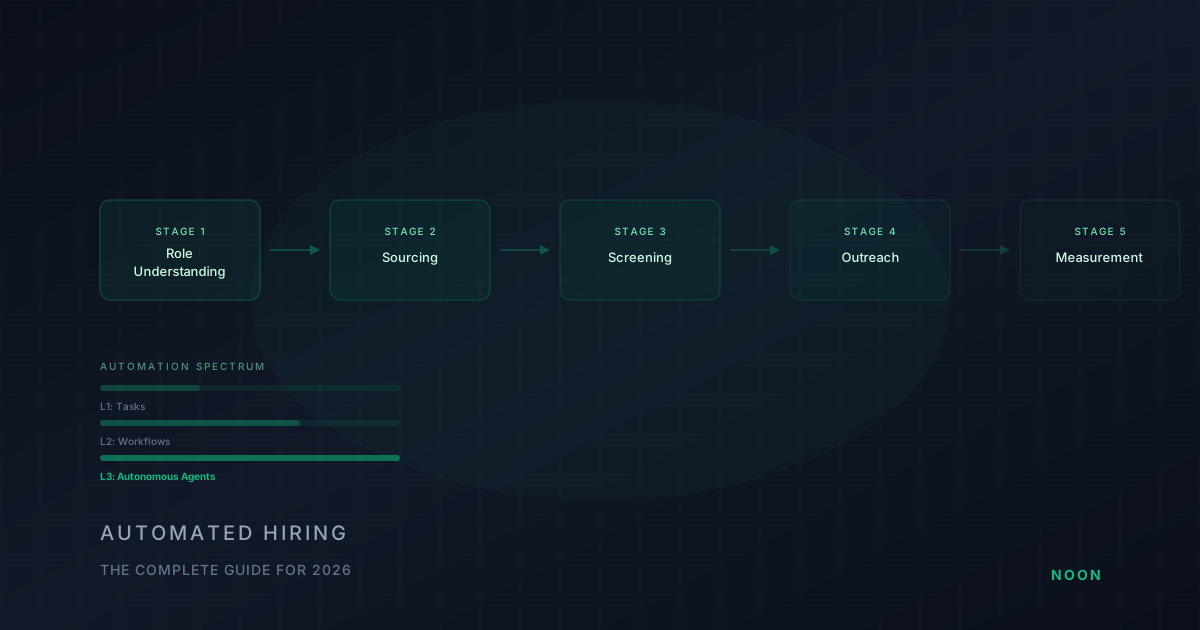
What are the five stages of an automated hiring process?
Building an automated hiring engine isn't about buying one tool. It's about designing a workflow where each stage feeds into the next without manual handoffs. Here's how each stage works and what to get right.
Stage 1: Role understanding and intake
Every bad hire traces back to misalignment between what the recruiter searches for and what the hiring manager actually wants. Manual processes rely on a kickoff meeting and a job description — then the recruiter interprets both on their own.
What automation changes:
An AI-powered system can ingest a job description, collaborate with the hiring manager on specific requirements, and translate that into search criteria — without requiring the recruiter to manually build Boolean strings or guess at keywords.
At Noon, this is the foundation of the autopilot workflow. The system ingests role requirements, identifies non-negotiable criteria (must-haves vs. nice-to-haves), and uses that structured understanding to drive every downstream decision — sourcing, screening, and outreach. The recruiter and hiring manager align on criteria upfront, and the AI holds that alignment throughout the process. If you're evaluating how this approach might work for your team, you can book a demo to see the autopilot intake process in action with your own open roles.
What to get right:
- Define non-negotiable criteria explicitly. "5+ years of experience" is different from "has built and shipped production systems at scale." The more specific your criteria, the better the AI performs.
- Include context beyond the JD. Target companies, seniority signals, team culture fit, compensation range — these shape who should be sourced.
- Build in calibration from the start. Plan for the hiring manager to review the first batch of candidates and provide feedback. This is how the system learns.
Stage 2: Autonomous sourcing
This is where manual processes waste the most time. A recruiter building Boolean searches on LinkedIn, reviewing profiles one by one, opening tabs, reading work history — this is high-effort, low-leverage work.
What automation changes:
AI sourcing searches across multiple data sources simultaneously, evaluates candidates against your specific criteria, and surfaces a ranked shortlist — in minutes rather than hours. The best systems don't just match keywords; they interpret career trajectories, assess company caliber, and understand seniority context.
At Noon, sourcing runs continuously as an autonomous agent. It doesn't stop after the first batch. As new candidates enter the market, as criteria evolve through calibration feedback, the system keeps sourcing in the background. It's not a search tool — it's a persistent team member.
What to get right:
- Don't limit yourself to one platform. LinkedIn has dominant market share, but the strongest passive candidates are often discoverable through other signals — publications, open-source contributions, industry-specific communities.
- Demand real AI, not just keyword search with a chatbot interface. Test this by describing a role in natural language and evaluating whether the system returns genuinely relevant candidates, not just keyword matches.
- Look for systems that improve over time. Static search is table stakes. The real value is in models that learn from your feedback and get measurably better at identifying what "good" looks like for your specific roles.
Stage 3: AI-powered screening and evaluation
Sourcing finds candidates. Screening determines which ones are worth contacting. In manual processes, the recruiter does both — which means screening quality degrades as volume increases. The 50th profile reviewed in a session doesn't get the same attention as the 5th.
What automation changes:
AI screening evaluates every candidate against the same criteria with the same rigor. It doesn't get tired. It doesn't pattern-match on school name or employer brand as a shortcut. It applies the non-negotiable criteria defined in Stage 1 consistently across every candidate.
Noon's system uses LLM-based evaluation to assess candidates against specific criteria — not just surface-level keywords, but contextual evaluation of experience depth, career trajectory, and role fit. Each candidate gets a structured verdict (pass, fail, likely pass, likely fail) with specific reasoning, so the hiring manager understands why the AI made each call.
What to get right:
- Keep humans in the loop on final decisions. AI screening should filter and rank — not make hiring decisions autonomously. The hiring manager reviews the shortlist and provides calibration feedback.
- Evaluate the system's reasoning, not just its output. A good AI screening system should explain why it passed or rejected each candidate. If you can't audit the reasoning, you can't trust the output.
- Monitor for bias. Consistent criteria reduce unconscious bias, but the criteria themselves can embed bias. Regularly audit what the system is optimizing for and whether it's producing diverse candidate pools.
Stage 4: Personalized multi-channel outreach
Finding great candidates means nothing if your outreach gets ignored. Manual outreach — individual emails, copy-pasted templates with {first_name} swapped in — produces declining response rates because candidates can smell a template a mile away.
What automation changes:
AI-generated outreach crafts genuinely personalized messages for each candidate based on their specific background. Not template variables. Actual references to their career trajectory, notable projects, and relevant experience.
Noon's outreach system generates what we call an "AI Intro" — a personalized opening for each candidate that references specific details from their profile. Combined with multi-channel delivery (email and SMS) and automated follow-up sequences, this produces response rates significantly higher than manual template-based outreach.
What to get right:
- Personalization must go beyond name and company. Reference specific projects, career transitions, or skills that make this candidate a fit for this specific role. Generic compliments ("I'm impressed by your background") don't count.
- Multi-channel matters. Some candidates respond to email. Others respond to SMS. A system that coordinates across both channels catches responses you'd miss with email alone.
- Timing and cadence are critical. Follow-ups should be spaced intelligently — not too aggressive (daily emails annoy), not too slow (weekly emails get forgotten). AI can optimize timing based on engagement signals.
Stage 5: Measurement and continuous optimization
The final stage is what separates teams that merely automate from teams that build hiring engines that compound in effectiveness over time.
What automation changes:
Instead of measuring hiring success retroactively (did we fill the role?), automated systems provide real-time visibility into pipeline health, conversion rates at each stage, and leading indicators of problems.
Key metrics to track:
| Metric | What it tells you | Target |
|---|---|---|
| Time-to-first-qualified-candidate | How quickly your sourcing engine produces results | < 48 hours |
| Outreach response rate | Whether your messaging is resonating | > 15% (AI-personalized can reach 30%+) |
| Screen-to-interview conversion | Whether your screening criteria are well-calibrated | > 30% |
| Interview-to-offer ratio | Whether sourced candidates are actually good | > 25% |
| Time-to-fill | End-to-end hiring cycle length | < 25 days |
| Calibration feedback volume | Whether hiring managers are actively training the AI | > 20 reviews per role |
At Noon, these metrics are built into the platform. The autopilot dashboard shows pipeline health in real time — how many candidates have been sourced, screened, contacted, and responded. This lets recruiting leaders identify bottlenecks (is the issue sourcing volume? screening criteria? outreach messaging?) and address them specifically rather than guessing.
What's the difference between hiring tools, agents, and platforms?
Not all automation is equal. It helps to understand where different solutions sit on the spectrum:
Level 1: Task automation. Individual tools that automate single steps — a scheduling tool, an email sequencer, a contact finder. Each works in isolation. The recruiter still manually orchestrates the workflow between them. This is where most teams start.
Level 2: Workflow automation. Platforms that connect multiple steps into sequences — "when a candidate is sourced, automatically enrich their profile, add to sequence, send outreach." Better, but still rule-based and reactive.
Level 3: Autonomous agents. AI systems that handle the full sourcing-to-engagement workflow independently, learning and improving from feedback without manual configuration. The recruiter sets criteria and reviews results — the agent handles everything in between.
Noon operates at Level 3. The autopilot is an autonomous agent that manages the full cycle: understanding the role, sourcing candidates, screening against criteria, sending personalized outreach, tracking responses, and learning from hiring manager feedback to improve over time. It's not a workflow you configure — it's a system that runs.
Most tools on the market today are Level 1 or early Level 2. They automate individual tasks but still require significant recruiter effort to connect the dots. The difference in recruiter time savings between Level 1 and Level 3 is dramatic — the difference between saving an hour per day and saving a full day per week.
What are the most common mistakes when automating hiring?
1. Automating without defining criteria first. If your role requirements are vague ("we want a strong engineer"), automation will amplify that vagueness at scale — you'll source and contact hundreds of irrelevant candidates faster than ever. Define non-negotiable criteria before turning on any automated system.
2. Treating automation as "set and forget." The best automated hiring systems require calibration. A recruiter who never reviews sourced candidates or provides feedback is leaving the most valuable part of the system — the learning loop — unused. Budget time for calibration, especially in the first 2-3 weeks.
3. Buying disconnected tools. A scheduling tool + a sourcing tool + an outreach tool + a CRM creates four data silos and three manual handoff points. Every handoff is a place where context gets lost and candidates slip through cracks. Consolidation isn't just about convenience — it's about data continuity.
4. Ignoring candidate experience. Automating outreach without attention to quality turns you into a spam machine. Every automated message should meet the bar of "would I be comfortable if a candidate screenshot this and posted it on Twitter?" If not, fix the messaging before scaling it.
5. Not measuring the right things. Tracking "number of messages sent" is a vanity metric. Track response rates, positive response rates, and screen-to-interview conversion. These tell you whether your automation is producing quality, not just volume.
How do you automate your hiring process in 30 days?
Week 1: Audit and define criteria. Pick 2-3 active roles. Document the non-negotiable criteria for each. Identify where your current process has the biggest bottleneck — sourcing, screening, outreach, or scheduling.
Week 2: Set up the automated workflow. Connect your AI sourcing platform to your ATS. Configure role requirements and non-negotiable criteria. Launch the first sourcing cycle.
Week 3: Calibrate aggressively. Review every candidate the AI surfaces. Accept or reject with clear reasoning. This is the highest-leverage activity in the entire process — it's training the system to understand your hiring bar.
Week 4: Measure and adjust. Compare your automated pipeline metrics against your manual baseline. Time-to-first-qualified-candidate, response rate, and screen-to-interview conversion are the three that matter most. Adjust criteria and outreach messaging based on what you see.
By the end of 30 days, you'll have concrete data on whether your automated system is outperforming manual processes — and a calibrated model that's already materially better than it was on day one.
What's the bottom line on AI vs. manual sourcing?
The gap between manual and automated hiring isn't closing — it's widening. Teams that automate effectively are filling roles faster, spending less, and producing better candidate quality through continuous learning loops. Teams that don't are working harder to achieve worse results.
The shift doesn't require ripping out your entire tech stack overnight. It starts with defining clear criteria, choosing a system that connects sourcing, screening, and outreach into one workflow, and investing in calibration feedback that makes the system smarter over time.
If you want to see what a fully autonomous hiring process looks like in practice, Noon's autopilot handles the end-to-end workflow — from role understanding through personalized engagement — and gets measurably better with every hire.
Frequently asked questions
What's the difference between recruiting automation and AI recruiting? Recruiting automation uses rule-based workflows to handle repetitive tasks (send this email on day 3, move candidate to this stage). AI recruiting uses machine learning to make decisions — which candidates to source, what to write in outreach, how to adjust criteria based on feedback. Automation follows rules you set. AI learns and adapts.
How long does it take to see results from an automated hiring process? Most teams see their first qualified candidates within 48 hours. The system improves meaningfully after 2-3 weeks of calibration feedback. By the end of the first month, teams typically have concrete data showing time-to-fill improvements and higher-quality candidate pools.
Will automated hiring replace recruiters? No. It replaces the mechanical parts of the recruiter's job — building search strings, hunting for contact info, writing follow-up emails. The parts that require human judgment — evaluating cultural fit, selling the opportunity, negotiating offers, building relationships — become a larger share of the recruiter's workday. The best teams report that automation makes their recruiters more effective, not redundant.
How do I ensure automated hiring doesn't introduce bias? Three practices: (1) Define screening criteria explicitly and review them for potential bias before launching, (2) Monitor the demographic composition of your automated pipeline compared to your manual baseline, (3) Audit the AI's screening reasoning regularly to ensure it's evaluating substance rather than proxies.
What's the minimum team size for automated hiring to make sense? Even solo recruiters benefit from automation. The ROI scales with volume, but even at low volume, eliminating manual sourcing and outreach tasks frees significant time. Teams with 20+ open requisitions see the most dramatic impact because that's where manual processes break down most visibly.
How does automated hiring integrate with existing ATS systems? Most AI recruiting platforms integrate with major ATS providers (Greenhouse, Lever, Workday, iCIMS, etc.) through native integrations or APIs. The key requirement is real-time sync — candidate status, outreach activity, and feedback should flow bidirectionally so your ATS remains the system of record.