Key takeaway: Across 844,234 recruiting sequences measured on the Noon platform in the twelve months ending July 2026, 16.6% of contacted candidates replied, and 64.9% of all replies arrived only after a follow-up (Noon recruiting outreach benchmarks, 2026). The three components that separate outreach at the top of that range from outreach at the bottom are personalization depth (referencing specific projects, skills, or career moves), value-first messaging, and multi-channel sequencing with enough follow-up to capture the two-thirds of replies that never come from message one.
The average recruiter sends between 50 and 150 outreach messages per week, and most of the replies they will ever get are decided by three choices: which channels the sequence uses, how relevant the first message is, and whether there is a second message at all.
Gem's 2026 Email Outreach Benchmarks report — analyzing 6.2 million email sequences and 15.5 million messages sent through their platform in 2025 — confirmed what most recruiters already feel: open rates are down, inboxes are more crowded than ever, and the gap between top-performing outreach and average outreach is widening.
The fix is not more volume. It never was.
The fix is relevance — messages that feel written for a specific person because they were written (or generated) with that person's actual context. AI has made this possible at scale for the first time. Not the kind of AI that swaps a first name into a template, but the kind that reads a candidate's work history, infers what they might care about, and generates an opening that connects their experience to a specific opportunity.
This article breaks down what AI-personalized recruiting outreach actually looks like in 2026, the measured data behind why it works, and the step-by-step system for building sequences that land at the top of the observed range rather than the bottom.
Why generic outreach stopped working
Three structural shifts killed template-based outreach:
Inbox saturation. Candidates in competitive fields receive recruiting messages continuously, and the undifferentiated ones are the first to be ignored. A generic opener competes with dozens of near-identical messages a week; a message that references something specific to the candidate does not.
Pattern recognition. Candidates have developed an immune response to templated outreach. They can identify a mass message within the first sentence. Once a message is categorized as spam, it doesn't matter how strong the opportunity is — the email is archived or deleted without a full read.
Channel proliferation. Email is no longer the only channel, and it's no longer the best channel for many candidates. Some respond to LinkedIn. Some respond to SMS. Some only engage when a hiring manager reaches out instead of a recruiter. Generic blast-and-pray approaches can't adapt to these preferences.
The result, measured rather than surveyed: 16.6% of candidates contacted through a full multi-step sequence reply, with monthly rates peaking at 19.7% in March 2026 (Noon candidate reply rate benchmarks, 2026). Single-message cold outreach performs far below that, because it forfeits the follow-ups where most replies live.
Single-touch outreach lands near 5.8% on those same numbers (16.6% × the 35.1% of replies that arrive without a follow-up). The gap between a ~6% single-touch reply rate and a 17% full-sequence reply rate is the difference between sourcing 3 interested candidates per week and sourcing 8. Over a quarter, that's the difference between filling roles on time and missing hiring targets entirely.
What AI personalization actually means
Real AI personalization in recruiting outreach operates on three layers:
Layer 1: Contextual personalization
This is where most people think AI outreach starts and stops — inserting candidate-specific details into a message. But the sophistication matters enormously.
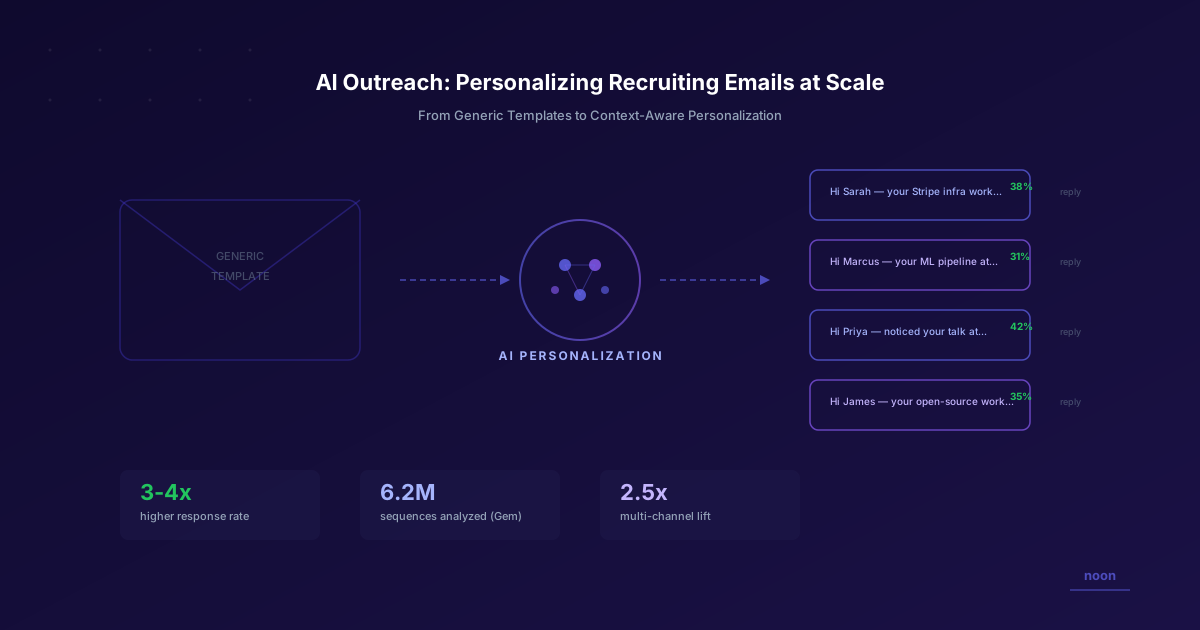
Surface-level personalization (what most tools do): "Hi Sarah, I noticed you've been at Stripe for 3 years as a Senior Engineer."
Context-aware personalization (what good AI does): "Hi Sarah — your work on Stripe's payment infrastructure, especially the migration to event-driven architecture you described at StrangeLoop last year, maps directly to the distributed systems challenges we're solving at [Company]."
The difference is that context-aware personalization requires the AI to synthesize information from multiple sources — LinkedIn profile, GitHub contributions, conference talks, published articles, patent filings, open-source commits — and identify the specific detail most likely to resonate with this particular candidate for this particular role.
Noon's AI outreach works this way. For every candidate the system surfaces, it generates a personalized opening paragraph that connects specific elements from the candidate's background to the role requirements. It's not pulling a random fact from their profile — it's identifying the intersection between what they've done and what the role needs, then articulating that connection in a way that demonstrates genuine understanding. Teams evaluating outreach platforms can book a demo to see how context-aware personalization works against real candidate profiles and job specs.
Layer 2: Timing and channel optimization
When you send matters almost as much as what you send.
Measured reply timestamps say the same thing every year: replies peak on Tuesday, run strong Monday through Thursday, and collapse roughly 77% on weekends, with volume concentrated in the 9am–2pm US window. A quarter of all replies arrive within 11 hours of first contact, and the median reply takes 2.8 days (Noon send-time data, 147,882 timestamped replies, 2026). But that's the aggregate. Individual candidates have individual patterns.
AI-powered outreach systems track engagement signals — when a candidate typically opens emails, which channel they respond on, whether they engage more with shorter or longer messages — and optimize delivery accordingly. A candidate who always opens email at 7 PM on weekdays should receive your message at 6:55 PM, not at 9 AM when the benchmark says to send.
Multi-channel sequencing amplifies this further. The most effective sequences in 2026 don't rely on a single channel. They combine:
- Email as the anchor (broadest reach, most space for detail)
- SMS as the urgency trigger (for high-priority candidates who haven't responded)
- Hiring manager outreach as the premium touch (for VP+ or hard-to-reach talent)
Layer 3: Adaptive sequencing
This is where AI outreach separates from automation.
Traditional automation runs a fixed sequence: Email 1 on Day 0, Email 2 on Day 3, Email 3 on Day 7. Same content cadence for every candidate regardless of engagement.
AI-adaptive sequencing adjusts the sequence in real time based on candidate behavior:
- Opened but didn't reply? The next message shifts angle — maybe the first email emphasized role scope, so the follow-up leads with team culture or compensation range.
- Clicked a link but didn't respond? The system notes what they clicked (job description, company page, team page) and tailors the follow-up to that interest signal.
- No engagement at all? The system switches channels or adjusts timing before the next touch.
- Replied with a question? The sequence pauses and routes to a human for personalized follow-up.
Noon's outreach engine does this automatically. Candidates who engage get different follow-ups than candidates who don't. The system learns from response patterns across all roles and candidates to continuously improve what it sends, when it sends, and through which channel.
Building an AI-personalized outreach system: the 5-step framework
Step 1: Build your candidate context layer
Before you can personalize, you need data to personalize with. The minimum context you need for each candidate:
- Professional history (companies, titles, tenure, progression)
- Skills and technologies (from work history, certifications, open-source)
- Content signals (articles published, talks given, repos contributed to)
- Engagement history (have they been contacted before? by whom? what happened?)
- Connection signals (mutual connections, shared alma maters, shared previous employers)
Most ATS and CRM systems store a fraction of this. AI sourcing platforms like Noon aggregate it automatically — pulling from professional networks, GitHub, patent databases, publication records, and community profiles to build a rich context profile for every candidate before any outreach is generated.
Step 2: Define your messaging architecture
Don't let AI generate messages from scratch without guardrails. Define your messaging architecture first:
Email 1 (The Hook): Personalized opening paragraph (AI-generated) + one sentence on why this role exists + one sentence on why their background is relevant + clear CTA (usually a 15-minute call or a link to learn more).
Email 2 (The Proof): Share something concrete — a team project, a recent achievement, a data point about company growth. This is where you demonstrate substance beyond the initial outreach.
Email 3 (The Reframe): If no response, change the angle entirely. Lead with something the first two emails didn't mention — compensation range, remote flexibility, the specific technical challenge they'd work on, or a connection to someone they know at the company.
SMS (The Direct Ask): Short, direct, respectful. "Hi [Name], I sent an email about the [Role] at [Company]. Worth a quick call? No pressure either way." Only for high-priority candidates and only after the email touches.
Step 3: Set up A/B testing at the sequence level
AI outreach is only as good as the feedback loop behind it. From day one, A/B test:
- Subject lines — Question vs. statement vs. name-drop
- Opening approach — Achievement reference vs. mutual connection vs. industry insight
- Email length — Short (50-80 words) vs. medium (100-150 words) vs. detailed (200+ words)
- CTA type — Calendar link vs. "reply to this email" vs. "interested? I'll send more details"
- Send time — Morning vs. afternoon vs. evening
Run each test for at least 200 sends before drawing conclusions. Gem's benchmarking data shows that even small optimizations — a subject line change, a different CTA — can move response rates by 20-30% relative.
One test is worth running before all the others: send a second message. Message two alone captures 27% of all replies, and messages two through four capture 55%, across 140,001 measured replies (Noon follow-up email benchmarks, 2026). Sequence length beats copy tweaks by an order of magnitude.
Step 4: Implement engagement-triggered branching
Connect your outreach system to engagement tracking so sequences adapt in real time:
| Trigger | Action |
|---|---|
| Opened email, no reply | Send follow-up with different angle after 3 days |
| Clicked job description link | Follow up emphasizing role details and team |
| Opened all emails, no reply | Switch to SMS or hiring manager outreach |
| Replied with "not interested" | Polite acknowledgment + ask if they'd refer someone |
| Replied with question | Route to recruiter for personal response |
| Bounced email | Find alternate email or switch to SMS |
| Unsubscribed | Remove from all sequences immediately |
This branching logic is what separates AI outreach from blast automation. Every candidate gets a different experience based on their actual behavior.
Step 5: Measure what matters (not just response rates)
Response rate is the headline metric, but it's not the only one that matters:
- Positive response rate — Responses that express interest, not just replies. A response that says "not interested" shouldn't count the same as "tell me more."
- Response-to-screen conversion — What percentage of responses convert to an actual phone screen or interview?
- Time-to-first-response — How quickly do candidates respond? Faster responses correlate with higher close rates.
- Channel-specific performance — Which channels drive the most (and highest quality) responses for different candidate segments?
- Sequence completion rate — How many candidates reach the end of the sequence without responding? If it's above 80%, your early touches aren't working.
- Opt-out rate — If more than 2-3% of candidates opt out or mark as spam, your targeting or messaging needs adjustment.
Track these at the role level, not just the aggregate. A 20% response rate on senior engineers is very different from a 20% response rate on junior analysts.
Common outreach mistakes that kill response rates
Sending too many messages too fast. Three emails in five days screams desperation. Space your touches appropriately — 3-4 days between the first and second touch, 5-7 days before the third. For senior candidates, even longer gaps are appropriate.
Personalizing the first email but templating the follow-ups. If your opening email is beautifully personalized and your follow-up is a generic "just circling back," you've undermined the trust the first email built. Every touch should maintain the same level of relevance.
Ignoring candidate preferences. Some candidates explicitly state on their LinkedIn that they don't want to be contacted about new roles. Ignoring this damages your employer brand. AI systems should flag and respect these signals.
Optimizing for open rates instead of response rates. Clickbait subject lines ("Re: Our conversation" when you've never spoken) may get opens, but they generate negative sentiment and lower ultimate response rates. Optimize for genuine engagement.
Stopping after one message. Roughly two-thirds of the replies you will ever receive arrive after a follow-up (Noon platform data, 2026). A single-touch campaign is not a low-performing sequence, it is a truncated one.
Not connecting outreach to sourcing quality. If your AI is sourcing poor-fit candidates, no amount of outreach personalization will save you. The outreach layer and the sourcing layer must be connected — Noon runs both from one system, with the AI sourcer feeding evaluated candidates straight into sequences, so targeting quality and message relevance are tuned together rather than in separate tools.
The ROI of getting outreach right
The math is straightforward, and it is worth doing with measured rates rather than aspirational ones.
A recruiter contacting 100 candidates with a single cold email converts at well under half the full-sequence rate, because 64.9% of replies only arrive after a follow-up (Noon platform data, 844,234 sequences, 2026). The same 100 candidates worked through a full 3-5 touch sequence reply at 16.6%, roughly 17 conversations instead of 6.
That multiple compounds against pipeline maths. Median time-to-fill for nonexecutive roles is 39 days (SHRM, 2026), and the largest block of those days sits in sourcing and top-of-funnel. Tripling the conversations per 100 contacts removes sourcing cycles rather than interview rounds, which is why outreach quality shows up in time-to-hire benchmarks rather than in interview metrics.
One caution on cost modelling: per-message costs vary enormously by tool, because credit- and contact-metered platforms charge per candidate contacted while unlimited plans do not. Indeed's Smart Sourcing lists additional candidate contacts at $5.20 each on top of a $520/month subscription (Indeed, checked 3 August 2026); Noon's single plan includes unlimited sourcing, contacts, agents, and seats, so improving reply rates lowers cost per conversation without also raising the bill for volume.
FAQ
How much personalization is enough? At minimum, reference one specific detail from the candidate's background that connects to the role. Ideally, reference 2-3 details from different sources (work history, content they've published, skills they've demonstrated). The goal is to make the candidate feel that someone actually read their profile and understood their career trajectory.
Does AI outreach feel impersonal to candidates? Only when it's done badly. Well-executed AI personalization is indistinguishable from a thoughtful manual outreach message — and often better, because AI can synthesize more context than a recruiter skimming a LinkedIn profile for 30 seconds. The key is quality control: review a sample of generated messages regularly to ensure they sound natural and accurate.
How many touches should a sequence have? Gem's data suggests 3-4 touches is the sweet spot for most roles. Response rates drop significantly after the 4th touch. For senior/executive roles, 2-3 touches with longer intervals works better. For high-volume hiring, 4-5 touches across multiple channels is appropriate.
Should I disclose that AI helped write the outreach? There's no legal requirement, and most candidates don't ask. The content should be accurate and the tone should be genuine. If a candidate asks, be honest — "We use AI to help us write more relevant outreach" is a perfectly acceptable answer in 2026.
What's the best way to start with AI outreach? Start with a single role. Use your current outreach as the control group and AI-personalized outreach as the test group. Run both for 2-3 weeks with at least 100 candidates per group. Measure response rates, positive response rates, and screen conversion. The data will tell you whether to scale.
What response rate should I expect from recruiting outreach? 16.6% of contacted candidates reply across full multi-step sequences, measured over 844,234 sequences in the twelve months to July 2026. If your sequence rate is materially below 16%, the usual causes are targeting quality or too few follow-ups, in that order.
Which outreach channels can be automated together? Email and SMS sequences can run as one campaign with a shared cadence and a single stop-on-reply rule, which is how Noon's outreach is structured. Running them from separate tools is what produces the classic failure of a candidate receiving an SMS follow-up two days after replying "yes" by email.
How do outreach limits and credits affect campaign design? On metered platforms they shape it heavily: when each contact has a price, teams ration follow-ups — which is exactly the behaviour that forfeits the 65% of replies arriving after message one. Noon's plan has no per-contact or per-seat metering, so sequence length is a strategy decision rather than a budget one.