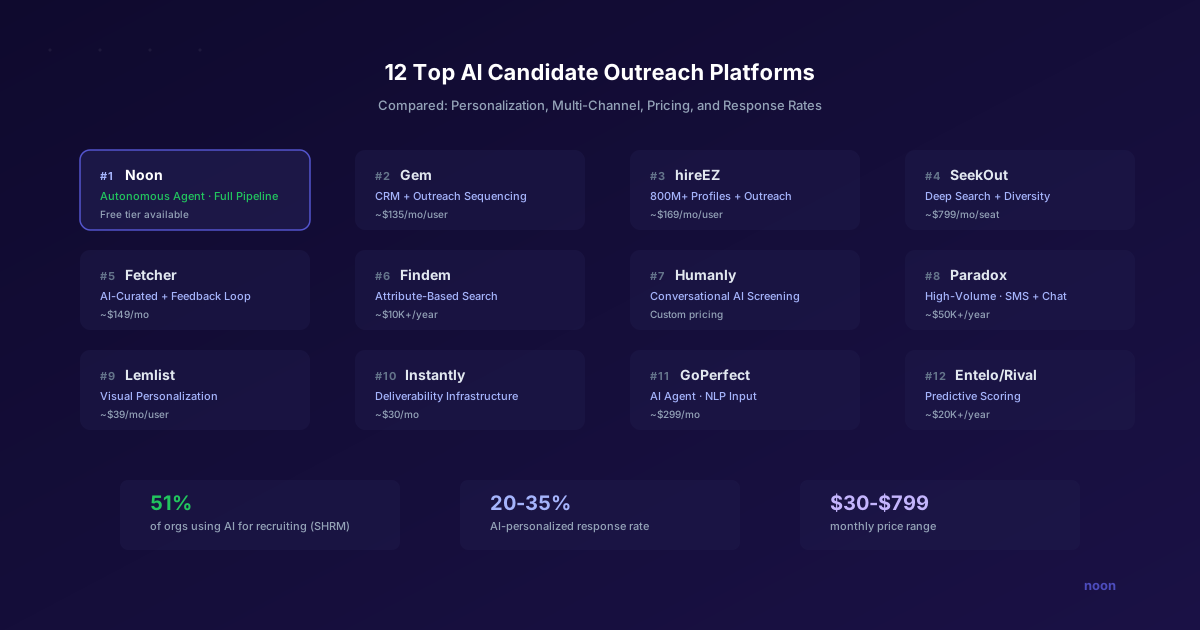
Key takeaway: The top 12 AI outreach platforms for recruiters are: Noon (autonomous end-to-end), Gem (CRM-integrated sequences), hireEZ (multi-channel + database), SeekOut (diversity + outreach), Fetcher (automated outbound), Findem (people intelligence), Humanly (conversational AI), Paradox (chatbot + scheduling), Lemlist (cold email personalization), Instantly (email deliverability infrastructure), GoPerfect (autonomous sourcing agent), and Entelo/Rival (predictive outreach signals). Choose based on whether you need a standalone outreach tool or an integrated platform.
Recruiting outreach in 2026 looks nothing like it did three years ago. Back then, "outreach automation" meant a Mailchimp-style drip sequence with merge tags. Today, the category has split into three distinct tiers: basic email sequencers, AI-enhanced CRM platforms, and fully autonomous outreach agents that source, personalize, and send without human intervention.
SHRM's 2025 Talent Trends report found that 51% of organizations now use AI specifically for recruiting, interviewing, or hiring - up from 26% just one year earlier. That adoption has flooded the market with platforms claiming AI-powered outreach. But the label "AI-powered" covers everything from template variable insertion to genuine natural-language generation with candidate-specific context.
This guide evaluates 12 platforms that handle candidate outreach in 2026. For each, we break down what the AI actually does, what it costs, and who it's built for - so you can match the right tool to your team's workflow.
How did we evaluate these platforms?
We assessed each platform on five dimensions:
- Personalization depth - Does the AI reference candidate-specific context (projects, skills, publications), or just insert name/company tokens?
- Multi-channel capability - Can it orchestrate across email, SMS, and hiring manager sends?
- Adaptive sequencing - Does the sequence adjust based on candidate engagement, or run a fixed cadence?
- Integration - Does it connect to your ATS, CRM, and calendar for a closed-loop workflow?
- Pricing transparency - Is pricing published, or do you need a sales call to learn the cost?
The 12 platforms
1. Noon - Autonomous AI Agent with End-to-End Outreach
Best for: Teams that want sourcing + outreach + scheduling handled entirely by AI.
Noon isn't an outreach tool bolted onto a CRM. It's an autonomous recruiting agent that handles the full pipeline - from understanding role requirements, to sourcing candidates autonomously across the open web rather than a single network, to generating personalized outreach, to scheduling interviews. Outreach is one step in a continuous workflow, not a standalone feature. You can book a demo to see how Noon's autonomous outreach compares to the multi-step workflow required by other platforms on this list.
What the AI actually does: For every candidate Noon surfaces, it generates a context-aware introduction paragraph that connects specific elements of the candidate's background (projects, skills, publications, career trajectory) to the role requirements. This isn't template-fill personalization - it's synthesis. The system reads the candidate's full profile, identifies the most relevant connection points, and writes an opening that demonstrates genuine understanding.
Outreach runs across email and SMS with adaptive sequencing. Follow-ups are written as new touches with a different angle rather than resends of the first message, and when a candidate replies, the AI Scheduler can book the interview without a recruiter trading emails.
Pricing: One unlimited plan, quoted per team: unlimited sourcing, enrichment, contacts, agents, and seats, with no per-seat fees and no credit packs to meter.
Standout feature: Because Noon handles sourcing and outreach in a single system, the personalization is directly informed by why the candidate was surfaced in the first place. There's no manual handoff between "find candidates" and "write messages" - the same AI that identified the candidate writes the outreach.
2. Gem - CRM-First Platform with Strong Outreach Sequencing
Best for: Mid-to-large teams already using Gem as their recruiting CRM who want outreach built into the same workflow.
Gem started as a Chrome extension for sourcing and evolved into a full CRM with email sequencing, analytics, and pipeline management. Their outreach capabilities are mature - supporting multi-step sequences, A/B testing, send-time optimization, and send-on-behalf-of (SOBO) functionality.
What the AI actually does: Gem added AI-powered content suggestions that help recruiters draft outreach messages faster. The AI can suggest subject lines and email body text based on the role and candidate profile. However, the personalization still leans on the recruiter to review and customize - it's an AI copilot, not an autonomous agent.
Pricing: No list price. Gem quotes on your company's FTE count; its published Startup Program for 1-10 FTE companies lists $130/month on yearly billing, down from $270 (gem.com/pricing, read 9 October 2026).
Standout feature: Gem's 2026 Email Outreach Benchmarks report (analyzing 6.2M sequences) provides best-in-class data on what works. If you're on Gem, you benefit from aggregate insights across their customer base.
Limitation: Gem requires significant recruiter involvement in the outreach process. The AI assists but doesn't autonomously generate and send. For high-volume teams with limited headcount, this means the recruiter is still the bottleneck.
3. hireEZ - AI Sourcing with Integrated Outreach
Best for: Teams that need deep talent pool access (800M+ profiles) combined with outreach capabilities.
hireEZ positions itself as an "outbound recruiting" platform - combining a massive candidate database with Boolean and AI-powered search, contact enrichment, and multi-step email sequences. The platform aggregates profiles from over 45 open web platforms including LinkedIn, GitHub, and professional associations.
What the AI actually does: hireEZ's AI handles candidate matching and can suggest outreach templates based on the role. The platform supports automated email sequences with personalization tokens, follow-up scheduling, and engagement tracking. Their AI Sourcing Assistant can generate candidate shortlists from natural language role descriptions.
Pricing: $494/month for a solo recruiter with a 7-day free trial; enterprise seats are quoted against the stack hireEZ replaces (hireez.com/pricing, read 9 October 2026).
Standout feature: The breadth of their candidate database - 800M+ profiles across diverse sources - gives access to candidates you might not find through LinkedIn alone, including those in healthcare, government, and academic sectors.
Limitation: Outreach personalization relies primarily on template tokens (name, company, title) rather than deep candidate-context synthesis. The AI is strong at finding candidates but less sophisticated at writing genuinely personalized messages.
4. SeekOut - Deep Search with Diversity-Focused Outreach
Best for: Teams hiring for highly specialized or technical roles who need advanced search filters and diversity analytics.
SeekOut built its reputation on deep search - pulling from LinkedIn, GitHub, patents, research papers, and academic publications. Their diversity filters and D&I analytics are among the best in the market. Outreach is integrated but is more of an add-on to the core search product.
What the AI actually does: SeekOut's AI powers candidate matching and can generate outreach suggestions. The platform supports email sequences with basic personalization. Their AI is strongest in the search and filtering phase, helping recruiters find niche talent that broader platforms miss.
Pricing: Sourcing Core (Recruit Core) is $149/month paid annually ($1,788/year) with a 14-day free trial; team plans and product modules are custom (seekout.com/pricing, read 9 October 2026).
Standout feature: Patent and research paper search. If you're hiring PhD-level talent or researchers, SeekOut surfaces candidates that other platforms can't find because it indexes academic and patent databases that most recruiting tools ignore.
Limitation: SeekOut's $149 entry price covers one self-serve seat; team plans and the deeper modules are quoted, so the real cost depends on the contract. The outreach functionality, while functional, is not as advanced as dedicated outreach platforms. You're paying primarily for search depth.
5. Fetcher - AI-Curated Candidate Lists with Automated Outreach
Best for: Small-to-mid teams that want a "set it and forget it" sourcing and outreach tool.
Fetcher's model is different from most platforms. You define your ideal candidate profile, and Fetcher's AI curates a batch of matching candidates and delivers them to your inbox. You review, approve, and Fetcher handles the outreach sequence. It's a hybrid between human review and AI execution.
What the AI actually does: Fetcher's AI searches across multiple public data sources to build candidate shortlists, then generates and sends personalized email sequences. The system refines its targeting based on recruiter feedback - which candidates you approve or reject inform the next batch.
Pricing: Self-Serve $115/month, Growth $379/month, Amplify $649/month, with 30% off on annual payment (fetcher.ai/pricing, read 9 October 2026).
Standout feature: The feedback loop. Unlike platforms where AI just runs searches, Fetcher's AI gets better over time as you train it on which candidates you want. After 2-3 weeks of feedback, the shortlists become significantly more accurate.
Limitation: The batch delivery model means you're reviewing candidates in waves rather than in real-time. For urgent roles, the 24-48 hour batch cycle can feel slow compared to platforms that source and outreach in real-time.
6. Findem - Attribute-Based Search with Outreach Workflows
Best for: Enterprise teams that need hyper-specific candidate targeting based on combined attributes.
Findem's differentiator is its "3D data" approach - building candidate profiles from dozens of sources and allowing searches based on combined attributes (e.g., "startup experience + Fortune 500 leadership + Bay Area + series B-D companies"). Their outreach is built on top of this targeting layer.
What the AI actually does: Findem's AI constructs rich candidate profiles from fragmented data across the web, then enables attribute-based search that goes beyond keyword matching. Outreach sequences can reference these attributes for personalization. The platform also provides market intelligence - talent pool sizing, salary benchmarks, and competitive landscape data.
Pricing: Enterprise pricing, typically starting at $10,000+/year. Requires a demo and custom quote.
Standout feature: Talent market analytics. Before you even start sourcing, Findem can tell you how many candidates match your criteria, where they're concentrated, and what you'll need to offer. This makes outreach more effective because you're targeting a pre-qualified, realistically sized pool.
Limitation: Overkill for small teams or straightforward roles. The attribute-based approach shines for niche hiring but adds complexity that isn't necessary for standard recruitment.
7. Humanly - Conversational AI for Screening and Engagement
Best for: High-volume hiring teams that need chatbot-driven candidate engagement alongside outreach.
Humanly combines conversational AI (chatbots for screening and scheduling) with outreach automation. Their focus is on the candidate engagement layer - keeping candidates warm through automated but natural-feeling interactions throughout the hiring process.
What the AI actually does: Humanly's chatbot handles initial candidate screening (asking qualifying questions via text/chat), schedules interviews, and sends follow-up messages. The outreach component integrates with the conversational flow - so candidates move from outreach email to chatbot screen to interview scheduling without manual handoffs.
Pricing: Custom pricing based on hiring volume and modules used. Typically mid-market pricing.
Standout feature: The conversational screening layer. After a candidate responds to outreach, instead of waiting for a recruiter to schedule a call, Humanly's chatbot immediately engages with screening questions and can schedule an interview in under 5 minutes.
Limitation: The outreach itself is less sophisticated than dedicated outreach platforms. Humanly's strength is what happens after the candidate engages, not the initial contact.
8. Paradox (Olivia) - Conversational AI for High-Volume Hiring
Best for: Enterprise companies with high-volume, hourly, or frontline hiring needs.
Paradox's AI assistant Olivia handles candidate communication at massive scale - from initial outreach to screening, scheduling, and offer management. It's built for organizations hiring thousands of people per month across retail, hospitality, healthcare, and logistics.
What the AI actually does: Olivia communicates with candidates via SMS, web chat, and WhatsApp in 100+ languages. The AI handles FAQ answering, application collection, interview scheduling, and follow-ups. For outreach specifically, Olivia can reach out to candidates who started but didn't finish an application, or re-engage silver medalist candidates from previous processes.
Pricing: Enterprise pricing, typically $50,000+/year. Scales with hiring volume and modules.
Standout feature: Multi-language conversational AI at scale. For global enterprises hiring across dozens of countries, Olivia's ability to engage candidates in their native language without translation overhead is a significant differentiator.
Limitation: Not designed for specialized or executive-level recruiting. Paradox is optimized for high-volume, process-driven hiring - not for sourcing and engaging passive senior talent.
9. Lemlist - Cold Email Platform Adapted for Recruiting
Best for: Recruiters who want sales-style cold email capabilities with maximum personalization control.
Lemlist isn't a recruiting tool - it's a cold email platform used by sales teams that some recruiting teams have adopted for outreach. It supports personalized image and video embedding, multi-step sequences, and advanced deliverability optimization.
What the AI actually does: Lemlist's AI generates email copy and subject line variations based on prospect (or candidate) data. Their personalization goes beyond text - you can embed personalized images (like a screenshot of the candidate's LinkedIn profile or a custom video thumbnail). The platform focuses heavily on email deliverability.
Pricing: Email plan $55/month on yearly billing ($69 monthly) with unlimited users and 50,000 emails a month; Multichannel $87/month yearly ($109 monthly); lead-data credits are an add-on from $16/month for 2,000 credits (lemlist.com/pricing, read 9 October 2026).
Standout feature: Personalized visual content. Embedding a custom image or video in a recruiting email dramatically increases open and response rates - Lemlist claims 2-3x compared to text-only emails.
Limitation: Zero recruiting-specific features. No ATS integration, no candidate database, no sourcing. You need to bring your own candidate lists and manage the pipeline separately.
10. Instantly - High-Volume Email Infrastructure for Outreach at Scale
Best for: Agencies or in-house teams running very high-volume outreach campaigns who need deliverability above everything else.
Instantly is an email infrastructure platform focused on sending large volumes of cold email without hitting spam filters. It manages email warmup, domain rotation, and deliverability monitoring - the plumbing that makes outreach work at scale.
What the AI actually does: Instantly's AI handles email warmup (gradually increasing send volume on new domains), generates email copy variations, and optimizes send timing. Their lead finder includes a B2B database, though it's not recruiting-specific.
Pricing: Growth $47/month (5,000 emails, 1,000 uploaded contacts), Hypergrowth $97/month (125,000 emails, 25,000 contacts), and Light Speed $358/month (500,000 emails, 100,000 contacts), each with unlimited email accounts and warmup (instantly.ai/pricing, read 9 October 2026).
Standout feature: Email deliverability infrastructure. If your team's outreach is getting caught in spam filters, Instantly solves that problem at a fundamental level - domain warmup, rotation, and monitoring that keeps your messages landing in primary inboxes.
Limitation: Purely email. No LinkedIn, no SMS, no chat. And the candidate data is generic B2B data - not recruiting-optimized. You'll need a separate sourcing tool to find candidates.
11. GoPerfect - AI Sourcing Agent with Outreach
Best for: Small recruiting teams and agencies who want an AI agent that sources and reaches out autonomously.
GoPerfect positions itself as an AI recruiting assistant that handles sourcing and initial outreach. You describe the role in natural language, and the AI finds matching candidates and generates personalized messages.
What the AI actually does: GoPerfect's AI interprets natural language job descriptions, searches across professional databases, and generates personalized outreach. The system can run autonomously - surfacing candidates and sending initial messages without recruiter intervention.
Pricing: Starting around $299/month for teams. Enterprise pricing available.
Standout feature: Natural language role input. Instead of building Boolean strings or configuring search filters, you describe what you're looking for in plain English, and the AI translates that into a sourcing and outreach workflow.
Limitation: Smaller candidate database compared to platforms like hireEZ or SeekOut. Best for common roles in tech and business; may struggle with highly niche or specialized positions.
12. Entelo (now Rival) - Predictive Outreach with Attrition Signals
Best for: Enterprise teams that want predictive signals about candidate openness to opportunities.
Entelo (acquired by Rival in 2024) built its reputation on predictive analytics - using machine learning to identify candidates who are likely to be open to new opportunities based on tenure, company growth signals, and career trajectory patterns. Their outreach layer builds on these predictions.
What the AI actually does: Rival's AI scores candidates on their likelihood of being receptive to outreach ("More Likely to Move" signals). Outreach sequences are prioritized based on these scores - candidates with higher propensity scores get contacted first. The platform supports email sequences with template-based personalization.
Pricing: Enterprise pricing, typically $20,000+/year.
Standout feature: Propensity-to-move scoring. Reaching out to candidates who are actively (or passively) considering a change dramatically improves response rates - Entelo/Rival claims 2-3x higher response rates when outreach targets high-propensity candidates.
Limitation: The predictive signals are probabilistic, not deterministic. A "More Likely to Move" score doesn't mean the candidate is actually looking - it means the model thinks they might be based on patterns. False positives are common.
Platform comparison table
| Platform | AI Depth | Multi-Channel | Pricing (Starting) | Best For |
|---|---|---|---|---|
| Noon | Deep context synthesis | Email + SMS | One unlimited plan, custom quote | Full-pipeline automation |
| Gem | Copilot/suggestions | Email + SOBO | Custom (FTE-based) | CRM-integrated outreach |
| hireEZ | Template + matching | $494/mo (solo) | Large database access | |
| SeekOut | Search-focused | $149/mo (annual seat) | Technical/niche hiring | |
| Fetcher | Curated + feedback loop | $115/mo | Set-and-forget sourcing | |
| Findem | Attribute-based | ~$10K+/year | Enterprise analytics | |
| Humanly | Conversational | Chat + email | Custom | Post-outreach engagement |
| Paradox | Conversational (Olivia) | SMS + chat + WhatsApp | ~$50K+/year | High-volume/hourly |
| Lemlist | Email copy generation | Email + LinkedIn | $55/mo (yearly) | Visual personalization |
| Instantly | Deliverability AI | Email only | $47/mo | Volume + deliverability |
| GoPerfect | Autonomous agent | Email + LinkedIn | ~$299/mo | Small teams, NLP input |
| Entelo/Rival | Predictive scoring | ~$20K+/year | Propensity-to-move signals |
Which provider rules constrain every platform on this list?
No amount of AI personalization overrides the rules the receiving mailbox enforces. Since February 2024, Gmail and Yahoo require SPF and DKIM plus an aligned DMARC record and one-click unsubscribe for anyone sending more than 5,000 messages a day to their users, and Gmail asks senders to keep the spam-complaint rate reported in Postmaster Tools below 0.10% and to never reach 0.30% (Google: Email sender guidelines, Yahoo Sender Hub). Microsoft applied the same authentication requirement to Outlook.com senders above 5,000 messages a day from 5 May 2025, and rejects failing mail with a 5.7.515 error (Microsoft 365 blog).
The practical consequences when you compare tools:
- Ask who owns authentication. A platform that sends from your domain needs your SPF, DKIM, and DMARC to be correct; a platform that sends from a shared subdomain inherits other customers' reputation.
- One-click unsubscribe is not optional at volume. It requires the
List-Unsubscribe-Postheader defined in RFC 8058 and a two-day processing window under Google's guidelines. - LinkedIn volume cannot substitute for email volume. LinkedIn states it offers no subscription with unlimited InMail credits, gives Recruiter Lite 30 credits a month with a 120-per-seat ceiling, and blocks a second InMail to the same person until they reply (LinkedIn Help).
- SMS is regulated separately. Consent rules apply per channel, so a tool that treats SMS as "just another step" is a compliance question for your legal team.
The full setup, including how to diagnose an inbox-placement drop, is in recruiting email deliverability, and the published LinkedIn ceilings are collected in LinkedIn limits for recruiters.
How to choose the right platform
The right platform depends on three factors:
Your team size and hiring volume. Solo recruiters and small teams benefit most from autonomous tools (Noon, Fetcher, GoPerfect) that minimize manual work. Mid-size teams with dedicated sourcers may prefer CRM-integrated tools (Gem, hireEZ) that enhance existing workflows. Enterprise teams with complex hiring needs may need platform-level solutions (Findem, Paradox).
Your candidate segment. Technical hiring with niche requirements → SeekOut or Findem for deep search. High-volume frontline hiring → Paradox. Passive senior talent → Noon or Gem with SOBO outreach. General professional hiring → hireEZ, Fetcher, or Noon.
Your desired level of automation. If you want recruiters in the loop reviewing every message → Gem, Fetcher. If you want AI handling outreach autonomously with human oversight → Noon, GoPerfect. If you want to build custom workflows → Lemlist, Instantly (bring your own pipeline).
FAQ
What response rate should I expect from AI outreach? Treat any single number you see quoted with suspicion, because reply rate depends far more on role scarcity, targeting precision, and inbox placement than on the tool. The controllable variables in order of impact are: whether your mail is authenticated and landing in the inbox at all, how narrowly the list is targeted, whether the first line reflects something specific about the candidate, and how many follow-up touches the sequence includes. Fix deliverability before benchmarking copy, since unauthenticated bulk mail is now rejected outright by Gmail, Yahoo, and Outlook (Google sender guidelines).
Can I use multiple outreach platforms simultaneously? Technically yes, but be careful. Sending the same candidate outreach from multiple platforms creates a terrible candidate experience and can trigger spam flags. Most teams use one primary platform for outreach and a separate tool for sourcing if needed.
Do candidates care if AI wrote their outreach email? Not if the email is genuinely relevant and well-written. Candidates care about whether the message demonstrates understanding of their background and offers something compelling - not whether a human or AI wrote it. Bad AI outreach (generic, wrong details, irrelevant role) is just as off-putting as bad human outreach.
How important is email deliverability? Critical, and it is now a published rule set rather than folklore. Gmail's ceiling is a 0.30% spam-complaint rate, and both Gmail and Outlook.com reject unauthenticated mail from senders above 5,000 messages a day. Platforms like Instantly and Lemlist market deliverability engineering directly; full-stack platforms handle authentication as part of onboarding. Either way the DNS records live on your domain, so the work is yours to verify: see recruiting email deliverability.
What's the minimum budget for AI outreach tools? Email-infrastructure tools start at $47 a month (Instantly Growth) and $55 a month billed yearly (Lemlist Email). Published recruiting platforms run from $115 a month (Fetcher Self-Serve) and $149 a month (one SeekOut seat, paid annually) to $494 a month (hireEZ solo), all read 9 October 2026, and enterprise platforms quote. Contact data is often a separate meter: tools like Lusha and Seamless.AI sell credits or quoted contact bands, compared in our Seamless.AI alternatives for recruiters. Noon prices as a single unlimited plan quoted per team rather than per seat or per credit, so the comparison to make is total cost at your real sourcing volume, not headline seat price.
How do sending limits and credits work on outreach platforms? Each tool caps a different thing. Instantly caps emails and uploaded contacts per plan (5,000 emails and 1,000 contacts on Growth); Lemlist caps emails at 50,000 a month on its Email plan and sells lead-data credits separately; Fetcher's tiers scale with sourcing volume (all read 9 October 2026). Mailbox providers add their own ceiling: Gmail's bulk-sender rules expect spam complaints under 0.30%. Noon has no credits or contact caps on its plan; the limit worth managing is deliverability on the email and SMS channels it uses.