
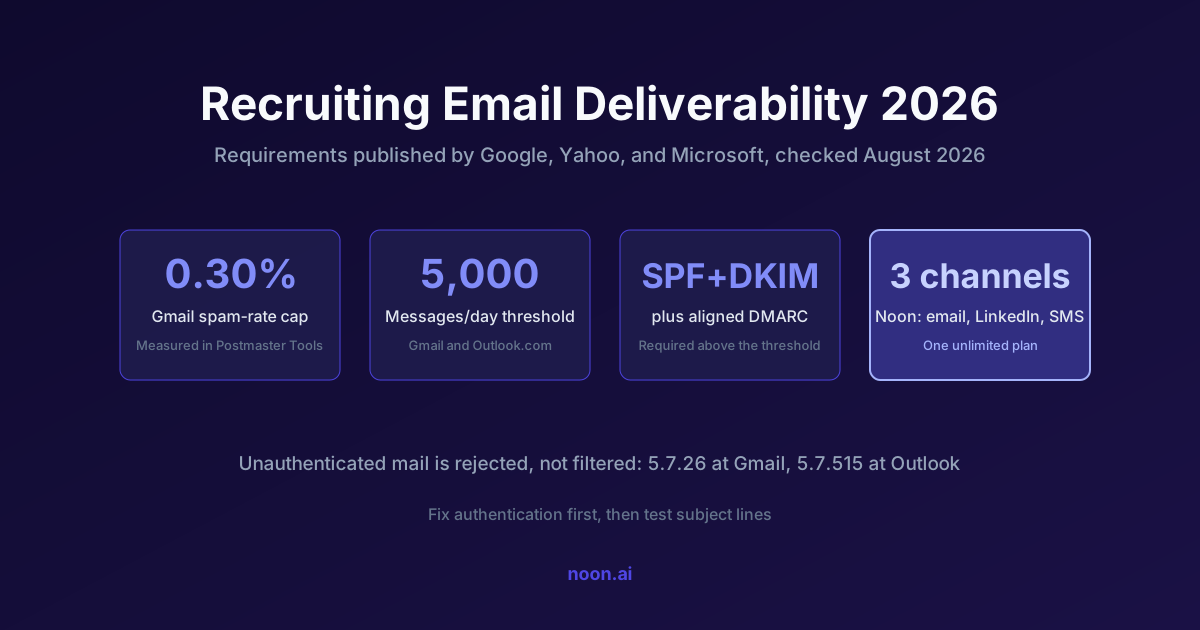
Key takeaway: Candidate outreach fails for infrastructure reasons far more often than for copywriting reasons. Since 1 February 2024, every sender to personal Gmail accounts must publish SPF or DKIM, and anyone sending more than 5,000 messages per day to Gmail must publish SPF, DKIM, and DMARC, keep the spam rate reported in Postmaster Tools below 0.30%, and support one-click unsubscribe (Google Email sender guidelines). Yahoo enforces the same 0.3% complaint ceiling and requires unsubscribes to be honored within two days (Yahoo Sender Requirements). Outlook.com added the same SPF plus DKIM plus DMARC requirement for domains sending over 5,000 messages per day, with enforcement that started 5 May 2025 (Microsoft, 2 April 2025). If your domain fails any of those, your best-written sequence never reaches the candidate.
Recruiters usually debug reply rates by rewriting subject lines. That is the wrong first move. A candidate who never sees the message cannot reply to it, and the three mailbox providers that hold most professional inboxes now publish hard, checkable requirements that decide whether your message is delivered at all.
Two numbers set the stakes. Google's threshold for reported spam is 0.30%, measured in Postmaster Tools, which is three complaints per thousand delivered messages (Google Email sender guidelines). Yahoo uses the same 0.3% ceiling and calculates it against mail delivered to the inbox (Yahoo Sender Requirements). For a team running 4,000 candidate emails a month, twelve "mark as spam" clicks is the entire budget.
The other reason to care in 2026: enforcement is no longer only about the junk folder. Microsoft's non-compliant high-volume senders are rejected outright with 550; 5.7.515 Access denied, sending domain does not meet the required authentication level (Microsoft, 2 April 2025), and Gmail rejects unauthenticated mail with a 5.7.26 error (Google Email sender guidelines). Those are bounces, not soft filtering, and they accumulate against your domain reputation.
What do Gmail, Yahoo, and Outlook actually require?
The three sets of rules overlap heavily, which is good news: one correct setup satisfies all of them. The differences are in thresholds and the volume line at which the strict tier begins.
| Requirement | Gmail (personal accounts) | Yahoo | Outlook.com (consumer) |
|---|---|---|---|
| Baseline authentication | SPF or DKIM for all senders | SPF or DKIM for all senders | SPF, DKIM, DMARC for high-volume domains |
| Strict tier starts at | More than 5,000 messages/day to Gmail | Bulk senders | More than 5,000 messages/day |
| Strict tier authentication | SPF and DKIM and DMARC (p=none is enough) |
SPF and DKIM and valid DMARC (at least p=none) |
SPF and DKIM and DMARC (at least p=none) |
| DMARC alignment | From: domain must align with SPF or DKIM domain | Relaxed alignment accepted, must align with SPF or DKIM | Align with SPF or DKIM, preferably both |
| Spam complaint ceiling | Below 0.30% in Postmaster Tools | Below 0.3%, measured on inbox-delivered mail | Not published as a number |
| One-click unsubscribe | Required for marketing and subscribed messages | Required, RFC 8058 POST method recommended | Recommended, functional unsubscribe link |
| Unsubscribe processing time | Not published as a number | Within 2 days | Not published as a number |
| Other | Valid forward and reverse DNS (PTR), TLS, RFC 5322 formatting | Valid forward and reverse DNS, RFC 5321/5322 | Valid, reply-capable From and Reply-To |
Sources: Google Email sender guidelines, Yahoo Sender Requirements, and Microsoft's April 2025 announcement, all checked 17 August 2026.
One detail catches recruiting teams specifically. The 5,000-per-day line at Gmail counts messages to Gmail accounts, not your total send. A 12-person agency running personalized sequences to consumer inboxes can cross it during a single high-volume campaign week and then drop back under, which means the strict requirements are the only safe assumption.
Why is recruiting outreach harder to deliver than marketing email?
Marketing email goes to people who opted in. Candidate outreach usually does not, and three structural differences follow from that.
Your list is enriched, not subscribed. Contact finding returns addresses that were never confirmed by the owner, so invalid-address rates are higher than in an opt-in marketing list. Every hard bounce is a reputation signal, and both Google and Yahoo tell senders to remove invalid recipients before sending (Yahoo Sender Requirements).
Your recipients are split across providers. A candidate list mixes corporate Microsoft 365 tenants, corporate Google Workspace tenants, and personal Gmail, Yahoo, and Outlook.com addresses. That means you are simultaneously subject to consumer rules and to whatever filtering each employer's IT team has configured, so a single "inbox rate" number hides most of the story. Segment reporting by recipient domain family before drawing conclusions.
Your best-performing tactic is also your riskiest. High personalization raises replies, but the volume needed to fill a pipeline is what triggers rate limits and complaint spikes. This is why sequencing decisions belong in the deliverability conversation rather than in a separate "copy" conversation, and why outreach personalization at scale has to be judged on inbox placement, not just on send volume.
How should a recruiting team set up its sending domain?
Run these in order. Steps 1 to 4 are the ones that gate delivery; the rest protect the reputation you build.
- Publish SPF, DKIM, and DMARC for every sending domain. Not just the domain you think you send from: include the domain your ATS, your outreach tool, and your scheduling tool send from. Google's own recommendation is to set up all three even below the bulk threshold (Google Email sender guidelines).
- Check DMARC alignment, not just DMARC presence. A published DMARC record with a From: domain that aligns with neither the SPF nor the DKIM domain still fails. Alignment is the requirement all three providers name explicitly.
- Add valid forward and reverse DNS (PTR) records and enforce TLS. Both Google and Yahoo list these as requirements for all senders, and both are usually the sending platform's responsibility rather than yours. Ask the vendor to confirm in writing.
- Implement one-click unsubscribe with the RFC 8058 POST method (RFC 8058), plus a visible unsubscribe link in the body. Yahoo asks for unsubscribes to be honored within two days, so the suppression list has to be automatic.
- Monitor Postmaster Tools weekly. The 0.30% spam-rate ceiling is only actionable if you can see the number. Treat 0.1% as your internal alarm level so you have room to react before the ceiling.
- Separate mail streams. Yahoo advises not sending bulk mail from the same IPs and DKIM domains as your transactional and one-to-one mail. For recruiting, that means campaign sends should not share reputation with offer letters and interview confirmations.
- Verify before you send. Remove role addresses, catch-all guesses, and any address that has already hard bounced. This is cheaper than repairing a domain reputation.
Which deliverability mistakes cost recruiters the most replies?
- Sending campaigns from the company's primary domain. One bad campaign then affects offer letters and candidate scheduling mail. A dedicated subdomain isolates the risk.
- Treating a hard bounce as a retry. Repeating a send to an invalid address is the fastest way to look like a spammer to a filter.
- Ignoring reply handling. Microsoft explicitly asks that the From or Reply-To address be valid and able to receive replies (Microsoft, 2 April 2025). No-reply candidate outreach is both bad practice and a compliance risk.
- Optimizing subject lines while the domain is unauthenticated. The order matters: fix authentication, then measure copy. Our cold recruiting outreach templates are worth testing only once the messages are reliably delivered.
- Ignoring the legal layer. In the US, CAN-SPAM violations are enforced through Section 5(m)(1)(A) of the FTC Act, for which the maximum civil penalty is currently $53,088, applying to penalties assessed after 17 January 2025 (16 CFR 1.98, checked 17 August 2026). Honest headers, an accurate From line, a working opt-out, and a physical postal address are the non-negotiables.
Does a multi-channel sequence fix a deliverability problem?
Partly, and this is the most useful strategic answer in the article. If email is one of two channels rather than the only channel, a filtered message costs you one touch instead of the whole candidate. Mechanically, a team running email alongside SMS loses a smaller share of its total touches when one provider tightens filtering, which is one reason multi-channel is now the default design in AI candidate outreach platforms.
It is not a licence to send more, though. LinkedIn enforces its own invitation and messaging limits, and exceeding them gets accounts restricted for about a week, so channel diversification has to respect each channel's rules. We cover those thresholds in LinkedIn limits for recruiters.
At Noon, outreach runs as personalized email and SMS sequences with AI-generated intros, so a single candidate can be reached on the channel that is actually open rather than through repeated email attempts. Noon's AI outreach sits directly on top of its own sourcing and enrichment, and the whole thing runs on one unlimited plan with no per-seat fees and no contact credits, so testing a cleaner sending setup does not cost extra volume. If you are comparing platforms on that dimension, the tradeoffs are laid out in our guide to the best AI recruiting software.
How do you diagnose a drop in inbox placement?
Work from infrastructure to content, in this order.
- Pull bounce codes. A
5.7.26from Gmail or a5.7.515from Outlook is an authentication failure, not a content problem. - Check Postmaster Tools for spam rate and domain reputation trends over the last 30 days.
- Segment reply rate by recipient domain family. If corporate Microsoft tenants dropped while Gmail held, the change is in filtering policy or your authentication on one stream.
- Check bounce rate by list source. A single bad enrichment batch usually explains a sudden spike.
- Only then test copy, volume per mailbox, and timing.
Sequence-level benchmarks are worth comparing against once the plumbing is right; our AI outreach platform comparison covers how the major tools handle sending controls.
Frequently asked questions
How does the platform ensure data privacy and security during sign-up and email integration? Ask for three specifics in writing: the OAuth scopes the tool requests on your mailbox, whether message bodies are stored or only referenced, and the subprocessor list for sending. Noon is SOC 2 Type II certified and GDPR compliant with SSO/SAML available, and enterprise deals include a dedicated support channel for security review questions.
Do we need DMARC if we send fewer than 5,000 emails a day? Technically the strict tier does not apply, but Google recommends SPF, DKIM, and DMARC for every domain, and Outlook's requirement is domain-level rather than per-recipient. Because a single campaign week can push a recruiting team over the line, publish all three and stop thinking about the threshold.
What spam complaint rate is safe for candidate outreach? Below 0.30% is the published Gmail requirement and Yahoo uses 0.3%, so treat 0.1% as your working ceiling. At that level a 4,000-message month allows four complaints before you are in the danger zone.
Should candidate outreach come from a subdomain or the main domain? Use a subdomain for campaign sending and keep the primary domain for transactional recruiting mail such as offers and interview confirmations. Yahoo's guidance to segregate mail streams by IP and DKIM domain is the reasoning behind this.
Why do my emails land in spam even though authentication passes? Authentication gets you evaluated, not delivered. After SPF, DKIM, and DMARC pass, placement is driven by complaint rate, bounce rate, engagement, and list quality. Check bounce rate by enrichment batch first, then reply rate by recipient domain family.
Does an unsubscribe link make candidate outreach feel like marketing? Every candidate who opts out is one who was not going to reply, and one-click unsubscribe is a requirement for bulk marketing and subscribed mail at both Google and Yahoo. A single line at the end of the message costs nothing and protects the complaint rate that decides delivery for everyone else on your list.