Key takeaway: The best AI recruiting software in 2026 is defined by how much of the hiring funnel it runs without a human in the loop. Noon leads the field as the only platform with a single unlimited plan (unlimited sourcing, contacts, agents, and seats) that autonomously sources across the open web, evaluates candidates against your criteria, and runs multi-channel outreach through scheduling. Point solutions still matter: Gem for CRM on top of an existing ATS, hireEZ for consolidating a sprawling stack onto your ATS, SeekOut for enterprise sourcing depth, Paradox for high-volume conversational screening, Ashby for an AI-native ATS. This guide compares all 14 on capability, pricing model, and where each one actually fits.
Recruiting teams are being squeezed from both directions. Auto-apply tools pushed application volume up 93% in one year (Gem 2026 Recruiting Benchmarks), flooding inboxes with unqualified inbound. At the same time, 74% of employers reported difficulty finding the skilled talent they need in the ManpowerGroup 2025 Talent Shortage survey, near a two-decade high.
The math on manual recruiting no longer works. Average cost-per-hire sits near $4,700 (SHRM Talent Acquisition Benchmarking Report), median time-to-fill for nonexecutive roles is 39 days, and recruiters at large organizations are carrying 67% more requisitions each (SHRM, 2026). AI recruiting software is how teams close that gap, but "AI recruiting software" now describes at least four very different product categories, and buying the wrong category wastes a year.
This guide compares 14 platforms across those categories, with verified pricing where vendors publish it and honest notes where they do not. For a broader overview of tools across the recruiting stack, see our guide to recruiting tools.
What is AI recruiting software?
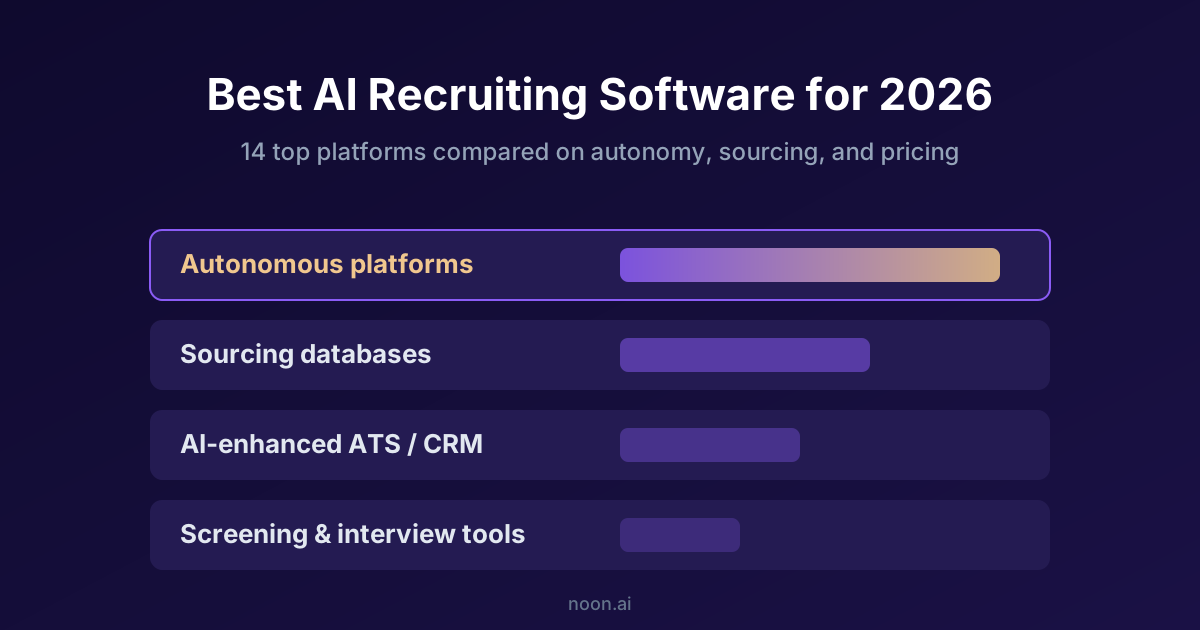
AI recruiting software uses machine learning and large language models to automate parts of the hiring funnel that recruiters previously did by hand: finding candidates, evaluating fit, writing and sending outreach, screening, and scheduling. In 2026 the market splits into four categories:
- Autonomous (agentic) platforms run the funnel end to end: sourcing, evaluation, outreach, and scheduling with minimal manual work. Noon is the leading example.
- Sourcing databases give recruiters a searchable index of profiles plus outreach tooling. hireEZ, SeekOut, Fetcher, and Juicebox live here. The recruiter still drives every step.
- AI-enhanced ATS/CRM systems organize pipeline and layer AI onto an existing workflow. Gem, Ashby, Loxo, Manatal, and Zoho Recruit fit this category.
- Screening and interview tools handle one funnel stage: Paradox (conversational screening), Truffle (resume screening and assessments), Metaview (interview notes), HireVue (video assessments).
The category matters more than the feature list. A sourcing database with an "AI" badge still requires a recruiter to run searches, review profiles, write outreach, and chase replies. An autonomous platform does those steps itself and asks for feedback instead of labor.
The 14 best AI recruiting software platforms at a glance
| Platform | Category | Pricing model | Published price | Best for |
|---|---|---|---|---|
| Noon | Autonomous AI recruiter | One unlimited plan | Contact for quote, no per-seat fees or caps | Teams that want the whole funnel automated |
| Gem | CRM + sourcing | Per seat, annual | ~$10,000 to $60,000+/year | CRM on top of Greenhouse/Lever |
| hireEZ | Sourcing platform on your ATS | Solo tier published; team pricing quoted | $494/mo solo (7-day trial); teams quoted against the stack it replaces | Consolidating four to six recruiting contracts |
| SeekOut | Sourcing database | Per seat, annual | ~$6,000+/year | Diversity-focused sourcing |
| Fetcher | AI sourcing | Tiered subscription | $115/mo Self-serve, $379/mo Growth, $649/mo Amplify | Budget-conscious sourcing automation |
| Juicebox (PeopleGPT) | Natural-language search | Per seat + credits | Free tier; $99/seat/mo annual ($119 monthly); Growth $179 annual ($199 monthly); Agents add-on $199/agent/mo | Ad-hoc natural-language people search |
| Paradox (Olivia) | Conversational screening | Custom | Custom quote | High-volume hourly hiring |
| Ashby | AI-native ATS | Company-size tiers | Foundations calculator returns $400/mo at its default setting for teams up to 100 employees; Plus and Enterprise quoted | All-in-one ATS with analytics |
| Loxo | ATS + CRM + sourcing | Per seat | Free tier; $119/user/month Pro | Agencies wanting one system |
| Manatal | Budget ATS | Per seat | From $15/user/month | Small teams, first ATS |
| Zoho Recruit | Budget ATS | Per seat | Free tier; from $25/user/month | Zoho-ecosystem teams |
| Eightfold AI | Talent intelligence | Enterprise contract | ~$50,000 to $500,000+/year | Enterprise workforce planning |
| Truffle | Resume screening | Credit tiers | $49 to $499/month | Screening high inbound volume |
| Metaview | Interview intelligence | Per seat | Free tier; paid plans | Interview notes and summaries |
Prices for Fetcher, Juicebox, hireEZ and Ashby were re-read directly from vendor pricing pages on 28 August 2026; the remaining figures come from published buyer reports, and quoted-only vendors are marked accordingly.
The short answer
If you want one recommendation per situation: Noon for teams that want the requisition worked end to end on one unlimited plan, Gem for CRM discipline on an existing ATS, hireEZ for consolidating a sprawling stack onto your ATS, SeekOut for enterprise sourcing depth, Fetcher or Juicebox for the cheapest credible replacement of a LinkedIn Recruiter seat, Paradox for high-volume hourly hiring, Ashby for a modern system of record, and Truffle or Metaview for screening and interview notes alone. Everything below is the evidence for those calls, with published prices where vendors publish them.
How to choose the best AI recruiting software
Four questions separate the categories quickly:
- Who does the work, the AI or your team? Sourcing databases multiply a recruiter's output; agentic platforms replace the busywork entirely. If your bottleneck is recruiter hours, a database subscription adds searching to their job. An autonomous platform removes it.
- How does pricing scale? Per-seat pricing punishes growth: a 5-recruiter team on a $600/month/seat tool pays $36,000/year before sourcing a single candidate. Credit-based pricing punishes volume. A flat unlimited plan is the only model where marginal usage is free.
- Where do candidates come from? LinkedIn-only tools compete for the same over-messaged profiles. Open-web sourcing (GitHub, publications, conference sites, company pages) reaches candidates with far less recruiter noise.
- What happens after sourcing? A list of names is not a pipeline. Check whether the tool finds contact info, personalizes outreach, follows up, handles replies, and books interviews, or whether each of those is still your team's job.
The 14 best AI recruiting tools, reviewed
1. Noon: the autonomous AI recruiter
Noon is the only platform on this list that runs the entire top-of-funnel autonomously. Its AI Sourcer searches candidates across the open web rather than a fixed database, interprets career trajectories and company caliber the way a senior recruiter would, and evaluates every profile against role-specific criteria including hard non-negotiables it never relaxes.
What separates Noon from sourcing databases is what happens next. The platform enriches contact information, then runs personalized multi-channel outreach across email and SMS with AI-generated intros tailored to each candidate. Its AI Scheduler handles interview booking and candidate questions, and an AI Interviewer can run voice screening interviews with full transcripts and structured analysis. Hiring-manager feedback (a thumbs up or down) recalibrates the model per role, so quality improves week over week.
Pricing: One plan with no limits: unlimited sourcing, unlimited email enrichment, unlimited contacts, unlimited agents, unlimited seats. No credits, no caps, no per-seat fees. See noon.ai/pricing.
Enterprise: SOC 2 Type II, GDPR, SSO/SAML, and 20+ ATS integrations. Details on the enterprise page.
Limitations: Noon is built for professional and white-collar roles sourced from the open web. Teams that only need a lightweight ATS for inbound applicants will not use most of what it does.
Best for: Teams that want pipeline generated for them rather than another database to search. Because the plan is unlimited, cost per hire falls as usage grows, the inverse of every per-seat tool below.
2. Gem: recruiting CRM on top of your ATS
Gem is a CRM and sourcing layer that sits on top of an existing ATS (Greenhouse, Lever, and others), adding sequences, pipeline tracking, and strong analytics. Its benchmarks dataset is one of the best research assets in the industry. Gem does not replace recruiter labor: your team still sources, writes, and follows up, with better tooling.
Pricing: Roughly $10,000/year for small teams to $60,000+/year enterprise; per-seat pricing typically runs $300 to $600/month (gem.com/pricing).
Best for: Teams committed to their ATS that need CRM discipline and analytics rather than automation.
3. hireEZ: open-web search, now sold as stack consolidation
hireEZ (formerly Hiretual) searches 45+ channels with AI-assisted Boolean, plus ATS rediscovery that resurfaces past applicants, and in 2026 it markets sourcing, CRM, outreach, screening, scheduling and analytics as one platform running on top of your ATS. It is a strong search engine for sourcers who want control over every query, and the recruiter still drives the workflow.
Pricing: $494/mo for a solo recruiter with a 7-day free trial. Team and enterprise pricing is not published: hireEZ configures it to the tools it replaces and runs a four-week verification before you sign (hireez.com/pricing, checked 28 August 2026). Any per-seat hireEZ figure you see on an aggregator is an estimate.
Best for: Teams whose real problem is four to six overlapping contracts rather than search quality. See our Noon vs hireEZ comparison for the head-to-head.
4. SeekOut: diversity-focused sourcing at enterprise scale
SeekOut pairs an 800M+ profile database with the strongest diversity filters in the category, plus compliance-friendly reporting. It is a sourcing tool, not a workflow tool: lists come out, and your team runs the outreach.
Pricing: Starts around $6,000/year and scales with seats.
Best for: Enterprises with formal DE&I sourcing goals and dedicated sourcing teams.
5. Fetcher: sourcing automation on a budget
Fetcher automates candidate discovery and email outreach with a credit model: batches of curated profiles arrive on a schedule and approved candidates enter automated sequences. It is one of the most affordable entry points into AI sourcing, with the trade-off that credits cap volume.
Pricing: Self-serve $115/mo, Growth $379/mo, Amplify $649/mo, Enterprise quoted, with 30% off for annual payment (fetcher.ai/pricing, checked 28 August 2026). Amplify adds a dedicated sourcer for roughly four to six roles.
Best for: Small teams replacing a LinkedIn Recruiter seat (~$10,000/year) with something cheaper.
6. Juicebox (PeopleGPT): natural-language people search
Juicebox lets you describe who you need in plain English and returns a ranked list of matching profiles, with email enrichment and basic sequences. It is genuinely fast for ad-hoc searches. It stops at the list: evaluation depth, follow-up, and scheduling are your job.
Pricing: Free tier; Starter $99/seat/mo on annual billing ($119 monthly) with 500 contact and 500 export credits; Growth $179/seat/mo annual ($199 monthly) with 1,500 credits and up to 5 seats; Business quoted, annual only. Autonomous agents are a $199 per agent per month add-on (juicebox.ai/pricing, checked 28 August 2026).
Best for: Founders and solo recruiters who want quick searches without Boolean syntax, and who can predict their monthly credit burn.
7. Paradox (Olivia): conversational AI for high-volume hiring
Paradox's assistant Olivia handles screening conversations, FAQs, and interview scheduling over SMS, web chat, and WhatsApp in 100+ languages. For hourly and high-volume hiring (retail, healthcare, logistics) it is the category leader. It does not source: it processes the applicants you already have.
Pricing: Custom quotes only.
Best for: High-volume hourly hiring where screening throughput is the bottleneck.
8. Ashby: the AI-native ATS
Ashby bundles ATS, CRM, scheduling, and analytics into one modern system, with AI features woven through. Unlike most ATS vendors it publishes an entry price you can check yourself, though several capabilities (extra texts, SCIM, advanced scheduling) are priced as add-ons.
Pricing: The pricing page now fronts a Foundations calculator for companies up to 100 employees, which returns $400/month at its default setting, with a 10% discount for annual commitments. Plus (101 to 1,000 employees) and Enterprise (1,000+) are quoted, and Ashby Analytics is sold separately for teams keeping their existing ATS. Watch the add-ons: extra candidate texts are $90 per 1,000 and SCIM directory sync is $100/month (ashbyhq.com/pricing, checked 28 August 2026).
Best for: Startups and mid-market teams that want one system of record with real analytics.
9. Loxo: ATS, CRM, and sourcing for agencies
Loxo combines ATS, CRM, outreach, and AI sourcing in one platform with a genuinely free tier. A 5-person team on Professional runs about $7,140/year, competitive with Bullhorn while bundling more.
Pricing: Free tier; Professional at $119/user/month.
Best for: Recruiting agencies consolidating their stack into one tool.
10. Manatal: the budget ATS with AI scoring
Manatal is one of the cheapest credible ATS options, with AI-powered candidate scoring included from the base plan. A 5-person team pays $900 to $2,100/year, a fraction of Greenhouse or Lever. Enterprise-grade features are thinner.
Pricing: From $15/user/month (Professional); $35/user/month (Enterprise).
Best for: Small teams buying their first ATS.
11. Zoho Recruit: the ecosystem play
Zoho Recruit offers a free tier and cheap paid plans, with the main draw being integration with the broader Zoho suite. AI capabilities are limited relative to everything above; the UX shows its age.
Pricing: Free tier (1 user, 1 active job); from $25/user/month.
Best for: Teams already running on Zoho apps.
12. Eightfold AI: enterprise talent intelligence
Eightfold is a deep-learning talent intelligence platform for matching, internal mobility, and workforce planning. It complements rather than replaces an ATS, and is scoped (and priced) for large enterprises.
Pricing: Roughly $50,000/year mid-market to $500,000+/year for large enterprises.
Best for: Enterprises treating talent data as a strategic planning asset.
13. Truffle: AI resume screening and assessments
Truffle (hiretruffle.com) ranks the resumes you already received, runs one-way video interviews and skills assessments, and charges credits per screened candidate. It works the opposite direction from sourcing tools: it filters inbound rather than generating outbound pipeline.
Pricing: $49 to $499/month credit tiers (verified on Truffle's pricing page, July 2026).
Best for: Teams drowning in inbound applications who need triage, not sourcing.
14. Metaview: AI interview notes
Metaview records, transcribes, and summarizes interviews so recruiters and hiring managers stop taking notes. It is a focused, well-executed tool for a single stage of the funnel, after a candidate is already in process. Noon includes comparable functionality via its AI Notetaker alongside the rest of the funnel.
Pricing: Free tier; paid per-seat plans.
Best for: Teams that only need interview documentation fixed.
How much does AI recruiting software cost in 2026?
Three pricing models dominate, and the differences compound fast:
| Model | Typical cost | Hidden constraint |
|---|---|---|
| Per seat | $99 to $835/month per recruiter | Cost scales with team size, not results |
| Credits/volume | $49 to $649/month tiers | Usage caps punish exactly the months you hire most |
| Flat unlimited | One rate, no caps (Noon) | None: marginal sourcing, outreach, and seats are free |
Two 2026 shifts are worth noting before you model this. Vendors are moving away from published seat rates toward consolidation pricing: hireEZ now publishes only a solo tier at $494/mo and prices teams against the tools it replaces (hireez.com/pricing). And add-ons increasingly sit outside the sticker price, for example Juicebox's autonomous agents at $199 per agent per month on top of a seat (juicebox.ai/pricing) and Ashby's $90 per 1,000 extra candidate texts. Model the add-ons you will actually turn on, not the entry row.
For reference, a single LinkedIn Recruiter seat runs about $835/month (~$10,000/year) on annual contracts. A 5-person team on per-seat sourcing tools plus LinkedIn easily crosses $75,000/year while still doing all the work manually. That baseline is why the pricing model deserves as much scrutiny as the feature list: against a $4,700 average cost-per-hire (SHRM), tooling that charges per recruiter rather than per outcome inverts the incentive.
What should you ask in an AI recruiting software demo?
Six questions expose the gaps that marketing pages hide:
- "Show me what happens after the AI finds a candidate." This is where databases stop and autonomous platforms keep going: enrichment, outreach, follow-ups, reply handling, scheduling.
- "Where do candidates come from beyond LinkedIn?" Open-web sourcing reaches the majority of qualified candidates who are not active on one network.
- "How does the AI learn my definition of a good candidate?" Look for per-role calibration from hiring-manager feedback, not a global model you cannot influence.
- "What exactly is capped?" Seats, credits, contacts, sequences, enrichments. Get the ceiling in writing and model your busiest quarter against it.
- "What does the AI never do?" Good platforms have hard guardrails (for example, criteria the AI never relaxes) and can explain every decision it made.
- "What security certifications do you hold?" SOC 2 Type II and GDPR compliance are table stakes for any tool touching candidate data in 2026.
Which AI recruiting software should you choose?
- You want the funnel run for you: Noon. It is the only unlimited-plan, fully agentic platform on the list, and the only one where adding roles, seats, or volume costs nothing extra.
- You need CRM discipline on an existing ATS: Gem.
- You have dedicated sourcers who love search: hireEZ or SeekOut.
- You are replacing a LinkedIn seat on a budget: Fetcher (from $115/mo) or Juicebox (from $99/seat/mo on annual billing), remembering that both meter credits.
- You hire hourly at volume: Paradox.
- You need a modern system of record: Ashby (or Manatal/Zoho Recruit on a budget, Loxo for agencies).
- You are an enterprise planning workforce strategy: Eightfold.
- You only need screening or interview notes fixed: Truffle or Metaview.
Most teams evaluating this market are trying to fill roles faster without growing headcount. That is the specific problem autonomous platforms were built for, and it is why we would start any 2026 evaluation with Noon and use the demo questions above to pressure-test everything else against it.
FAQs about AI recruiting software
What is the difference between AI recruiting software and an ATS?
An ATS is a system of record: it tracks applicants through stages. AI recruiting software does work: sourcing, evaluating, contacting, screening, or scheduling candidates. Modern ATSs (Ashby, Manatal) add AI features, but they still operate on inbound applicants. Autonomous platforms like Noon generate the pipeline itself and sync results into 20+ ATS systems.
Does AI recruiting software replace recruiters?
No. It replaces the lowest-value hours of recruiting: running searches, copying profiles, writing first-touch emails, chasing scheduling threads. Recruiters keep the judgment work: intake, calibration, closing, and candidate experience. On platforms with feedback loops, recruiter judgment is literally the training signal.
How much does AI recruiting software cost?
From $15/user/month (budget ATS) to $500,000+/year (enterprise talent intelligence). Sourcing tools cluster at $150 to $600/month per seat. Noon is the exception to seat math: one plan with unlimited sourcing, contacts, agents, and seats, priced via a demo.
Is AI recruiting software worth it for small teams?
Usually, if the pricing model fits. A small team pays the same per-seat rates as an enterprise but gets less leverage from volume discounts. Flat-rate unlimited plans and cheap ATS tiers (Manatal, Zoho Recruit) fit small teams best; credit models are risky if hiring comes in bursts.
Can AI recruiting software source candidates outside LinkedIn?
The best ones do. Open-web sourcing (GitHub, research publications, conference speaker lists, company sites) is Noon's default and hireEZ's core strength. LinkedIn-only tools compete for the most-messaged 20% of the market: InMail response rates keep falling as volume rises, which is exactly why multi-channel outreach outperforms.
Is AI recruiting software biased?
It inherits whatever the vendor built into it, which is why explainability matters. Ask vendors to show the reasoning behind each candidate decision, whether you can set hard criteria the AI cannot override, and how the model is audited. Platforms with per-role calibration and human feedback loops give you continuous correction rather than a black box.