Key takeaway: Personalizing candidate outreach at scale requires three systems: data enrichment (pulling candidate context from multiple sources), message generation (AI-written intros specific to each person's background), and multi-channel sequencing (coordinated touches across email and SMS). Teams using this approach achieve 15-25% response rates — with the best teams clearing 30%+ — compared to 3-5% for generic InMails and 5-8% for template emails.
There's a fundamental tension at the heart of recruiting outreach: personalization and scale are supposed to be opposites. You can write ten deeply researched, thoughtful emails per day, or you can blast a thousand generic templates. But you can't do both.
Except now you can. And the recruiters who've figured this out are operating at a completely different level than those still stuck in the volume-versus-quality tradeoff.
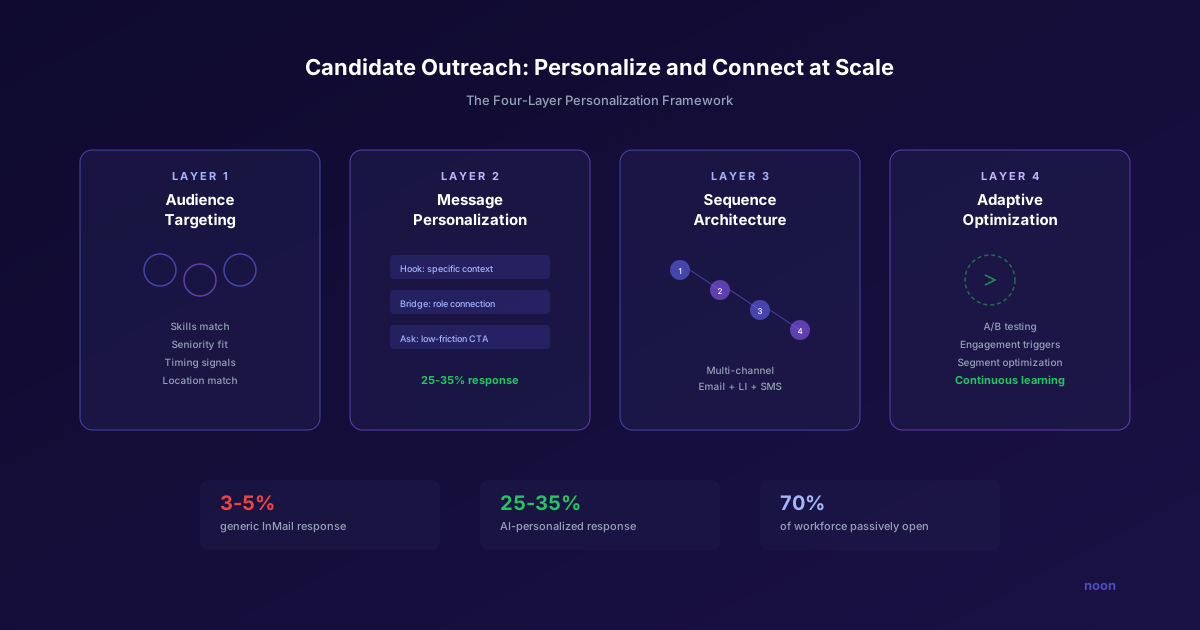
The data tells the story clearly. Generic LinkedIn InMails pull a 3-5% reply rate. Template emails with first-name insertion get 5-8%. Genuinely personalized outreach — messages that reference specific projects, skills, and career context — consistently hits 15-25%, and the best teams are clearing 30%+ (GoPerfect 2026, Gem Outreach Benchmarks 2026).
That gap — 5-8% versus 15-25%, and 30%+ for the best teams — isn't a marginal improvement. It's the difference between needing to contact 200 candidates to generate 10 interested responses versus contacting 35. For a recruiter managing 15 open roles, that's the difference between drowning and thriving.
This article breaks down how to build candidate outreach that connects at scale — the targeting framework, the personalization layers, the sequencing architecture, and the measurement system that keeps it all improving.
Why "personalization" doesn't mean what most recruiters think
Most recruiting teams define personalization as: insert the candidate's name, company, and title into a template. Maybe add a line about a mutual connection or their alma mater. That's not personalization. That's mail merge with extra steps.
Real personalization answers the question the candidate is asking when they open your message: "Why me, specifically, for this role, right now?"
Answering that question requires three things:
1. Contextual relevance. Reference something specific about the candidate's work that connects to the role. Not "I see you're a Senior Engineer at Stripe" (that's their LinkedIn headline), but "Your work on Stripe's payment infrastructure — specifically the migration to event-driven architecture — is directly relevant to what we're building."
2. Timing signals. Reaching out when a candidate is more likely to be receptive: after a company layoff announcement, after they've been in their role for 2+ years, after they've started engaging more actively on LinkedIn, after they've published content signaling interest in new challenges.
3. Channel fit. Some candidates live in email. Some respond to LinkedIn. Some only engage with SMS. Some will only talk to a hiring manager, not a recruiter. Genuine personalization includes matching the channel to the candidate's preferences.
When all three align — the right message, at the right time, through the right channel — response rates jump from single digits to 30%+.
The four-layer personalization framework
Layer 1: Audience targeting (before you write anything)
The most impactful personalization happens before a single word is drafted. It's in who you reach out to.
Tight targeting beats broad outreach. A beautifully personalized message sent to the wrong candidate still gets ignored. Conversely, a decent message sent to a perfectly matched candidate gets responses.
Build your candidate list with precision:
- Skills match — Not just job titles, but actual demonstrated skills (from projects, code commits, publications, patents)
- Experience relevance — Specific companies, industries, or problem domains that map to your role
- Seniority alignment — Nothing kills outreach credibility faster than messaging a VP about an individual contributor role
- Location and logistics — Remote/hybrid/onsite, visa requirements, relocation willingness
- Timing indicators — Tenure at current role, company stability, engagement activity
Noon's sourcing engine handles this targeting layer automatically. When you describe a role, the AI evaluates candidates across all these dimensions simultaneously — not just matching keywords, but understanding the semantic relationship between a candidate's experience and the role requirements. The output is a pre-qualified list where every candidate has a genuine reason to be contacted.
Layer 2: Message personalization (the content itself)
With a well-targeted list, personalization becomes about articulating why each specific candidate is a fit. Structure every outreach message around three components:
The hook (first two sentences). Reference something specific and verifiable about the candidate's background. This proves you actually looked at who they are, not just their job title.
Examples of good hooks:
- "Your open-source contributions to the React Native navigation library caught our attention — we're rebuilding our mobile navigation from scratch and could use that exact expertise."
- "The team you built at Datadog, scaling from 3 to 18 data engineers in 18 months, is exactly the kind of growth leadership we need at [Company]."
- "Your talk at KubeCon on multi-cluster service mesh resonated with our engineering team — we're tackling the same challenges at production scale."
The bridge (one to two sentences). Connect their background to the opportunity. Why does what they've done make them specifically interesting for what you're hiring for?
The ask (one sentence). Clear, low-pressure call to action. "Worth a 15-minute call to see if there's a fit?" works better than "Are you open to new opportunities?" because it's specific and time-bounded.
Layer 3: Sequence architecture (the multi-touch cadence)
Single-touch outreach is a coin flip. Multi-touch sequences with thoughtful cadence are what drive consistent results.
The optimal sequence structure for most professional roles in 2026:
| Touch | Timing | Channel | Purpose |
|---|---|---|---|
| 1 | Day 0 | The hook — personalized, specific, value-forward | |
| 2 | Day 3 | Connection request with brief note referencing the email | |
| 3 | Day 7 | New angle — share something they didn't see in Touch 1 (team, project, comp range) | |
| 4 | Day 12 | Email or LinkedIn | The reframe — different value proposition or social proof |
| 5 | Day 18 | The close — final touch, graceful, leave the door open |
Key principles:
Each touch adds new information. If your follow-up is "just circling back" or "wanted to bump this to the top of your inbox," you're wasting a touchpoint. Every message should give the candidate a new reason to respond.
Vary the channel. A candidate who ignores three emails might respond to a LinkedIn message. Multi-channel sequences outperform single-channel by 2.5x (Outreach.io data).
Respect the timeline. Don't compress 5 touches into 7 days. For senior candidates, space touches even further apart — 5-7 days between each.
Stop on engagement. If a candidate replies (even with "not interested"), the automated sequence pauses and a human takes over. This is non-negotiable for maintaining candidate experience.
Layer 4: Adaptive optimization (the learning loop)
The best outreach systems improve over time. They learn what works for different candidate segments and automatically adjust.
A/B testing at the sequence level. Test different hooks, subject lines, CTAs, and sequence lengths against each other. But test with discipline — run each variant against at least 200 candidates before drawing conclusions. Gem's benchmarks data shows that small optimizations can move response rates by 20-30% relative.
Engagement-triggered branching. When a candidate opens but doesn't reply, the next touch should shift angle. When they click a link, the follow-up should reference what they clicked. Noon's outreach engine does this automatically — adapting each candidate's sequence based on their actual engagement behavior.
Segment-level optimization. What works for senior engineers doesn't work for sales leaders. What works in San Francisco doesn't work in London. Track performance by segment and adjust accordingly.
Passive candidates require a different approach
About 70% of the workforce is passively open to new opportunities but not actively looking (LinkedIn Talent Trends, various years). These candidates are the highest-value targets — they're employed, productive, and selective. But they also have the highest barrier to engagement.
What passive candidates need from outreach:
Immediate relevance. They're not searching for jobs, so your message is an interruption. It needs to justify itself in the first sentence. Lead with why them, not with your company pitch.
Credibility signals. Who else is on the team? What stage is the company? What's the growth trajectory? Passive candidates evaluate opportunities differently than active candidates — they're assessing risk, not searching for any port in a storm.
Low-friction engagement. Don't ask for a 45-minute call. Ask for 15 minutes. Or even better, offer to send more information first: "If you're curious, I can share a brief on the team and the technical challenges. No commitment to chat unless you want to." This removes the time-commitment barrier.
Respect for their current role. Never disparage their current employer or suggest they should be unhappy. Phrases like "I know you're probably not looking, but..." actually work well because they acknowledge the candidate's current satisfaction while opening the door to something better.
How do you measure outreach effectiveness?
Track these metrics at the sequence level, the channel level, and the segment level:
Response rate — The headline metric. Percentage of candidates who reply to any touch in the sequence.
Positive response rate — The metric that actually matters. Percentage of candidates who express interest. A "no thanks" reply inflates your response rate but doesn't fill your pipeline.
First-touch response rate — How effective is your opening message? If most responses come on Touch 4 or 5, your early touches need work.
Channel conversion — Which channel drives the most responses for each candidate segment? Use this to optimize channel ordering in your sequences.
Time-to-response — How quickly do candidates reply? Faster responses correlate with higher close rates. If responses cluster on Day 7+, your timing or urgency signals may need adjustment.
Screen conversion — What percentage of positive responses convert to an actual interview? This measures whether your outreach is attracting genuinely interested and qualified candidates, or just generating polite curiosity.
Opt-out rate — If more than 2-3% of candidates unsubscribe or mark as spam, something is wrong with your targeting or messaging frequency.
Common outreach mistakes
Leading with the company, not the candidate. "We're a fast-growing Series B startup backed by Sequoia..." — candidates don't care about your funding round in the first sentence. Lead with why they're interesting, then bridge to the opportunity.
Sending identical follow-ups. "Just wanted to follow up on my last email" adds zero value. If you're going to follow up, bring new information.
Over-personalizing to the point of creepiness. Referencing a candidate's recent vacation photos or personal social media crosses a line. Stick to professional context — work history, published content, open-source contributions, conference talks.
Not testing subject lines. Subject lines determine whether your email gets opened at all. A/B test aggressively. Question-based subject lines often outperform statement-based ones (Gem benchmarks).
Ignoring timezone and cultural norms. Sending a message at 2 AM local time signals carelessness. Similarly, outreach norms differ by market — what works in the US (casual, direct) may not work in Germany or Japan (more formal, context-setting).
How AI changes the equation
AI doesn't just make outreach faster. It makes the personalization-at-scale tradeoff disappear.
Without AI, a recruiter can deeply research 10-15 candidates per day and write genuinely personalized outreach for each. With AI-powered tools, that same recruiter can send 100+ deeply personalized messages — each one referencing specific projects, skills, and career context — in the same time.
Noon takes this further by unifying sourcing and outreach. Because the same AI that finds candidates also generates outreach, the personalization is directly informed by why the candidate was selected. There's no context loss between "find this person" and "write them a message." The system understands the full picture — the role requirements, the candidate's background, and the specific intersection between the two — and articulates it in every message. If you'd like to see how this personalized outreach system works for your open roles, you can book a demo.
The result: recruiter time shifts from researching and writing to reviewing and engaging with candidates who respond. The highest-value human activity in recruiting isn't sending messages — it's having conversations. AI handles the former so recruiters can focus on the latter.
FAQ
How many outreach messages should a recruiter send per week? Quality over quantity, always. With AI personalization, 75-150 messages per week with genuine personalization outperforms 500+ generic blasts. Focus on positive response rate, not send volume.
What's the ideal email length for candidate outreach? For initial outreach: 80-120 words. Candidates skim, especially on mobile. Get to the point quickly — who you are, why them specifically, and a clear ask. Longer emails can work for senior/executive candidates if every sentence adds value.
Should recruiters or hiring managers send the outreach? Both. Recruiter outreach works well for initial contact and high-volume roles. Hiring manager outreach (SOBO — send on behalf of) significantly outperforms for senior roles — Gem's data shows 15-20% higher response rates when the message comes from the hiring manager vs. the recruiter.
How do you handle candidates who say "not right now"? Acknowledge, respect, and nurture. Add them to a long-term nurture sequence (monthly or quarterly touchpoint with relevant content — industry insights, team updates, salary market data). When they're ready to move, you want to be the first recruiter they think of.
Is cold outreach still effective in 2026? Yes, but only if it's genuinely personalized. Cold outreach with real context and relevance achieves response rates comparable to warm introductions. Generic cold outreach is effectively dead — candidates have too many ways to filter and ignore it.
How many outreach touchpoints should a sequence have? Three to five touches across channels is the sweet spot for most roles. A single email leaves replies on the table, while more than five or six touches yields diminishing returns and can hurt your sender reputation.
What makes AI-personalized outreach feel genuine? Referencing something specific and true about the candidate — a project, a career transition, a skill match to the role — rather than generic flattery. The best AI intros read like a recruiter actually studied the profile, because the AI did.
Which channel gets the best response rates for cold candidate outreach? Email generally outperforms InMail for cold outreach when it's personalized and deliverability is healthy, and combining email with LinkedIn touches beats either alone. The right mix depends on the candidate population and seniority.