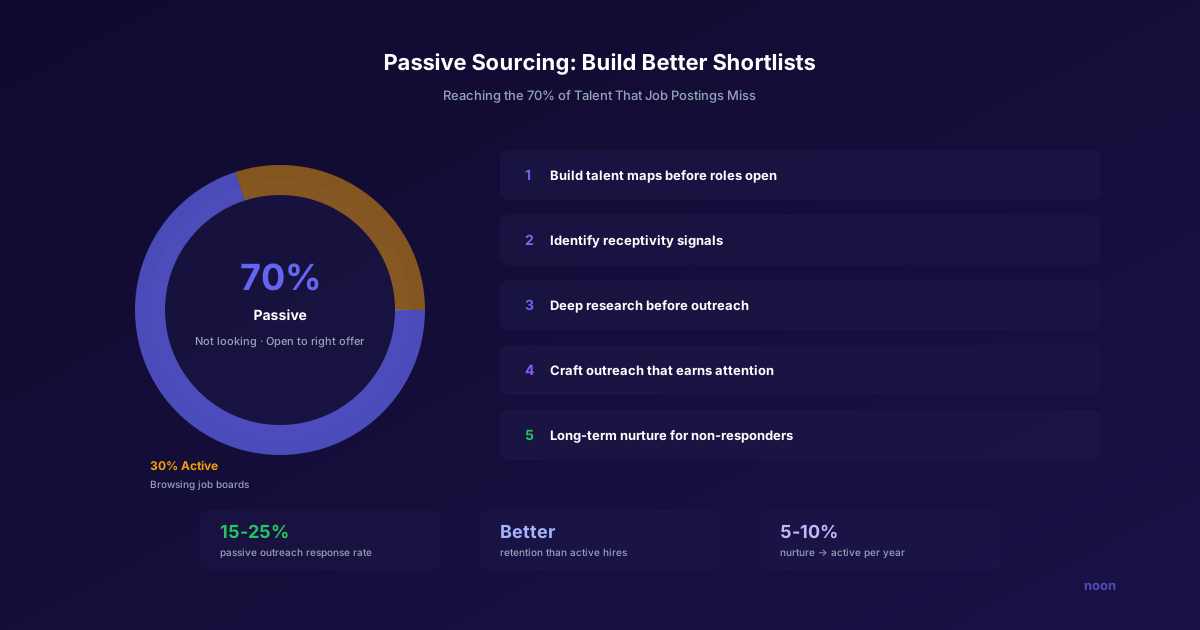
Key takeaway: 70% of the global workforce is passive — employed and not actively looking. Passive sourcing requires different strategies than active recruiting: research-based personalization (referencing specific projects or career moves), value-first messaging (leading with opportunity, not job descriptions), longer nurture sequences (3-6 months vs. days), and multi-channel touchpoints. Teams that master passive sourcing access 3x more qualified candidates.
The most qualified candidates for your open roles are almost certainly not looking for a job right now.
LinkedIn's Global Talent Trends data has consistently shown that approximately 70% of the global workforce is made up of passive candidates — professionals who are employed, generally satisfied, and not actively browsing job boards or submitting applications. But "not looking" doesn't mean "not interested." Most passive candidates would consider a new opportunity if the right one found them.
That's the core challenge of passive sourcing: finding people who aren't looking for you and presenting opportunities they didn't know they wanted.
This article covers the strategies, tools, and messaging approaches that recruiting leaders use to build high-quality shortlists from the passive talent pool — the 70% that job postings never reach. For a broader look at sourcing strategies across both active and passive channels, see our candidate sourcing guide.
Why passive candidates are worth the extra effort
Passive candidates are more difficult and expensive to reach on a per-candidate basis than active candidates. So why do the best recruiting teams invest disproportionately in passive sourcing? Three reasons:
1. Higher quality ceiling. Active candidates are self-selected from the portion of the workforce currently looking for a change. Passive candidates are drawn from the entire talent market — including top performers who are happy in their current roles. The best person for your role is statistically more likely to be passive than active.
2. Less competition. Every recruiter with a job board subscription is competing for the same active candidates. Passive candidates, by definition, aren't in other companies' applicant pools. Reaching them first (and effectively) gives you a significant competitive advantage.
3. Better retention. Research from LinkedIn suggests that passive hires tend to stay longer because they made a deliberate, pull-driven decision to join — they weren't pushed by desperation or dissatisfaction.
The trade-off: passive sourcing requires more investment per candidate (research, personalization, multi-touch sequences) and longer timelines (passive candidates take longer to decide). But the quality and retention benefits typically outweigh the higher per-candidate cost.
The passive sourcing playbook
Step 1: Build your talent map before you have open roles
The biggest mistake in passive sourcing is starting when a requisition opens. By then, you're already behind. The best recruiting leaders build talent maps proactively — identifying who the top talent is in their target segments before a role exists.
Talent mapping covers:
- Who are the top 50-100 people in your target function/domain/geography?
- Where do they work? Which companies have the strongest talent in your target area?
- What's their career trajectory? Are they growing, plateaued, or declining in their current roles?
- What would motivate a move? More scope, better compensation, different technology, different company stage?
When a role opens, instead of starting from scratch, you already have a warm list of pre-identified candidates with context on what might motivate them to engage.
Noon accelerates talent mapping by continuously monitoring the talent market for your target profiles. As you describe your typical hiring needs, the AI builds and maintains a living map of the relevant talent pool, updating as candidates change roles, add skills, or show signals of openness. If you're building a passive sourcing strategy for the first time, you can book a demo to see how AI agents compare to manual workflows for identifying and engaging passive candidates.
Step 2: Identify receptivity signals
Not all passive candidates are equally reachable. Look for signals that suggest a candidate might be more receptive to outreach right now:
Strong signals (high receptivity):
- Changed their LinkedIn profile to "Open to Work" (they're not fully passive)
- Their company recently announced layoffs, reorgs, or leadership changes
- They've been in their current role for 3+ years (potential restlessness)
- They've updated their LinkedIn profile recently (skills, summary, projects)
- They've started posting or engaging more actively on LinkedIn
Moderate signals:
- Their company has had negative press or Glassdoor reviews trending downward
- They were promoted recently but with no title change (responsibility without recognition)
- They've been passed over for a visible promotion
- They're at a company with known compensation below market
Timing awareness: Even with strong receptivity signals, passive candidates have a lower response tolerance than active candidates. They're not scanning for opportunities, so your message competes with everything else in their inbox. Timing your outreach to coincide with receptivity signals dramatically improves response rates.
Step 3: Research before you reach out
The bar for engaging passive candidates is higher than for active candidates. They're not in "looking" mode, so your outreach must immediately demonstrate relevance and value.
Minimum research checklist per candidate:
- Current role and company (what they're doing now)
- Previous career progression (where they've been)
- Published content (articles, talks, open-source contributions)
- Mutual connections (warm introduction potential)
- Company context (what's happening at their employer)
- Skills alignment (specific connection points to your role)
This research informs personalization that makes the candidate feel individually approached, not batch-processed.
Step 4: Craft outreach that earns attention
Passive candidate outreach follows different rules than active candidate communication:
Lead with "why them," not "we're hiring." Active candidates want to know about the role. Passive candidates want to know why you're specifically reaching out to them. Start with their background, not your job description.
Acknowledge their current situation. "I know you're not looking" is a powerful opening because it demonstrates awareness and respect. It signals that your outreach is deliberate, not spray-and-pray.
Offer value beyond the pitch. Share an insight, a piece of industry data, or a perspective that's relevant to their work — even if they don't respond about the opportunity. This builds goodwill for future touchpoints.
Make the ask small. Don't ask for a 45-minute interview. Ask for a 15-minute coffee chat. Or even smaller: "I'd love to send you a brief on the team and the challenge. No commitment — just context in case it's interesting."
Example:
"Hi [Name] — Your work building [Company]'s data platform, particularly the migration to real-time streaming, is directly relevant to a challenge my team is tackling right now. We're dealing with similar infrastructure and scale problems to what you've solved.
I know you're not looking, but wanted to share what the team is working on in case it's interesting. Happy to send a 2-pager with the technical details — no strings attached."
Step 5: Build long-term nurture for non-responders
Most passive candidates won't respond to your first (or second, or third) touchpoint. That doesn't mean they'll never respond. Circumstances change — people get frustrated, companies struggle, career goals evolve.
Nurture cadence for passive candidates:
- After initial sequence (3-5 touches): Add to quarterly nurture list
- Every 3 months: Share a relevant update — company news, team growth, new challenge, industry insight
- Trigger re-engagement: When receptivity signals change (company layoff, role update, increased LinkedIn activity), move from nurture back to active outreach
The goal is to be the first recruiter they think of when they decide to look. That requires staying present without being annoying — which is a quarterly touchpoint, not a weekly one.
Tools for passive sourcing
All-in-one AI agent: Noon handles the full passive sourcing workflow — talent mapping, candidate identification, personalized outreach, and long-term nurture — autonomously. This is the most efficient approach for teams that want to maximize passive pipeline with minimal recruiter time.
Sourcing + CRM combination: Use a sourcing tool (hireEZ, SeekOut) to identify candidates and a CRM (Gem, Lever) to manage long-term relationships and nurture sequences. More manual but offers more control over each step.
LinkedIn Recruiter: Still valuable for the network graph — mutual connections and warm introductions are powerful for passive candidates. Less effective for the search-and-outreach workflow compared to AI alternatives.
Measuring passive sourcing effectiveness
| Metric | Target | Why it matters |
|---|---|---|
| Response rate on passive outreach | 15-25% | Below 15% = personalization or targeting issues |
| Positive response rate | 8-15% | Interest, not just replies |
| Passive-to-interview conversion | 30-50% | Of those who respond positively |
| Passive hire quality (6-month rating) | 80%+ "strong" | Validates the investment in passive sourcing |
| Nurture conversion rate | 5-10% per year | Candidates who convert from nurture to active pipeline |
FAQ
How long should I nurture a passive candidate before giving up? Don't give up. Reduce frequency but maintain the relationship. Some passive candidates engage after 6 months, some after 2 years. The cost of a quarterly email is negligible compared to the value of landing a top candidate who finally decides to move.
Is it appropriate to reach out to someone at a competitor? Yes, if you're respectful and focus on the opportunity rather than disparaging their current employer. Competitive sourcing is standard practice in recruiting.
How do I get passive candidates to respond faster? You can't (and shouldn't try to) rush passive candidates. They're on their timeline, not yours. What you can do is make your outreach compelling enough that responding feels worthwhile — and make the first step as low-commitment as possible.
Should I use a referral to reach a passive candidate? When possible, absolutely. A warm introduction from a mutual connection cuts through the noise more effectively than any cold outreach. Ask your team: "Do you know anyone at [Target Company] who works in [Function]?"
What's the biggest passive sourcing mistake? Treating passive candidates like active candidates — sending job descriptions, asking for resumes, requesting availability for interviews. Passive candidates need a different approach: curiosity-driven, low-pressure, value-forward communication.