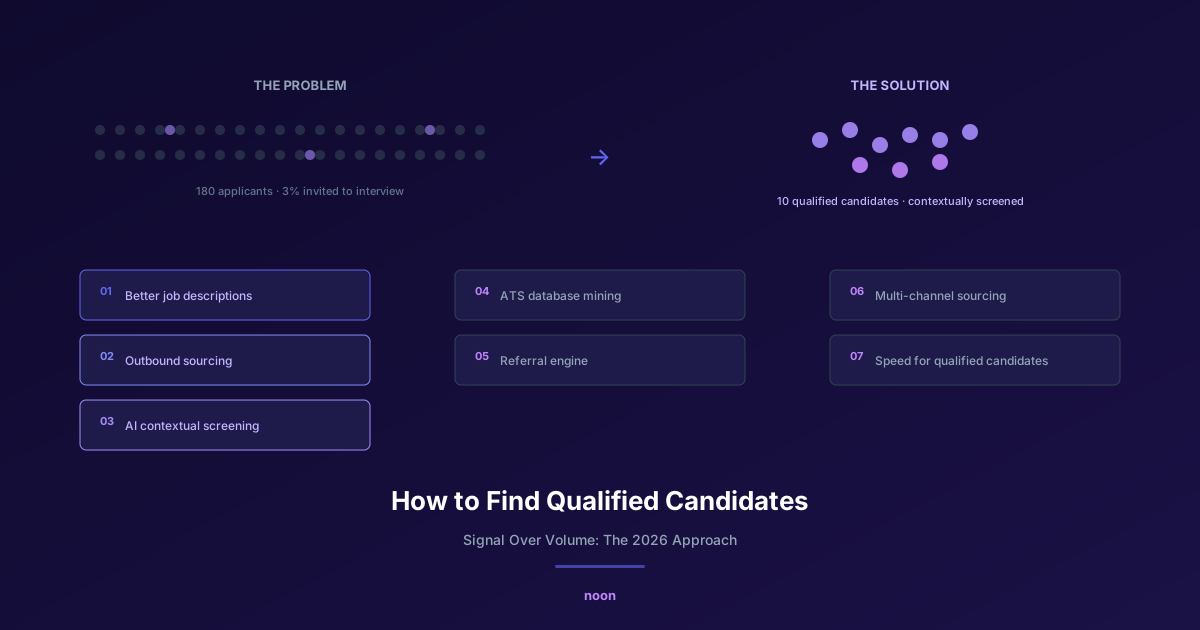
Key takeaway: To find qualified candidates in 2026, combine AI-powered sourcing (searches 100x more profiles than manual), structured screening (filters 97% of unqualified applicants), multi-channel outreach (3-4x response rates), and better job descriptions (clear must-haves reduce unqualified applications by 40%). The problem isn't candidate volume — employers invite only 3% of applicants to interview. The problem is signal.
Recruiting teams don't have an application problem. They have a qualification problem.
CareerPlug's 2025 Recruiting Metrics Report found that employers invited only 3% of applicants to interview, while receiving an average of 180 applicants per hire. Applications per posting have surged 93% in the past year (Gem 2026). The volume is overwhelming. The signal is buried.
The instinctive response is to generate more applications — post on more job boards, increase ad spend, lower the application barrier. But more volume doesn't solve a signal problem. It makes it worse. The recruiter now has 350 applications to review instead of 180, with the same 3% qualification rate. Time-to-hire increases. Quality of hire suffers.
Finding qualified candidates in 2026 requires a fundamentally different approach: understanding where qualified people are, how they describe their experience, and how to identify the signal that predicts job success — then building a sourcing and screening process around those insights. For a comprehensive overview of channels, tactics, and strategic frameworks, see our candidate sourcing guide.
Why qualified candidates are hard to find
The vocabulary mismatch problem
Qualified candidates often describe their experience using different language than the job description uses. A senior product manager might describe themselves as a "product leader" or "head of product" rather than "Senior Product Manager." An engineer with extensive Python experience might list "data engineering" and "ML pipelines" without ever writing "Python developer."
Keyword-based screening — the foundation of most ATS filtering — catches exact matches and misses contextual equivalents. The result: qualified candidates are rejected because they used different words, while less qualified candidates who used the right keywords are advanced.
The active-passive gap
70% of the global workforce are passive candidates — employed, not actively searching, but open to the right opportunity (LinkedIn Talent Solutions 2024). These candidates never apply to job postings. They're invisible to inbound-only recruiting strategies.
The 30% who are actively looking include many qualified candidates, but they're applying to 10-20 positions simultaneously. Your posting competes with every other company hiring for similar roles. Speed becomes critical — qualified active candidates accept offers within 10 days on average.
The volume problem
When a posting generates 200+ applications, the recruiter can spend maybe 30 seconds per résumé in initial screening. At that speed, they're scanning for pattern matches — right company names, right titles, right keywords — rather than evaluating whether the candidate could actually do the job. Good candidates with nontraditional backgrounds or unconventional career paths get filtered out. Mediocre candidates from prestigious companies get advanced.
Strategy 1: Write job descriptions that attract qualified candidates
The cheapest way to find better candidates is to filter at the source. Most job descriptions attract the wrong people because they're written as internal documents (lists of requirements) rather than candidate-facing marketing (value propositions with clear qualification signals).
What to include
The problem you're solving (not just the title): "Our product team is scaling from 3 to 8 PMs as we expand from one product line to three. This PM will own the enterprise analytics product, which serves 200 Fortune 500 accounts."
What the first 90 days look like: "In your first month, you'll conduct user research with 10 enterprise customers. By month 2, you'll own the roadmap for Q4. By month 3, you'll present the product strategy to the executive team."
Non-negotiable qualifications (keep it to 3-5): "Required: 5+ years in enterprise B2B SaaS product management. Required: experience managing products with $10M+ ARR. Required: ability to travel to customer sites 2-3 times per quarter."
Compensation transparency: List the salary range. Posts with compensation ranges receive 3x more qualified applications (LinkedIn 2025). Omitting the range doesn't protect you — it wastes your time and the candidate's time when expectations don't align.
What to remove
The laundry list: "15+ requirements" signals that you don't know what actually matters. Research consistently shows that women apply when they meet 100% of listed qualifications, while men apply at 60% (Hewlett Packard internal study). Long requirement lists filter out qualified candidates who self-select out.
Unmeasurable requirements: "Strong communication skills" and "team player" are meaningless in a job posting. They're table stakes that don't differentiate your role and can't be assessed from a résumé.
Years-of-experience inflation: "10+ years experience required" for a role that someone with 5 years of concentrated experience could do well. Years are a proxy for depth — use specific capability requirements instead.
Strategy 2: Source outbound instead of waiting inbound
The highest-quality candidates aren't applying to your job posting. They're employed, productive, and not browsing job boards. To reach them, you need outbound sourcing.
Building the outbound sourcing workflow
Step 1: Define the ideal candidate profile. Go beyond the job description. What companies employ people who'd be great in this role? What career trajectories predict success? What specific skills or experiences are non-negotiable?
Step 2: Search across multiple sources. LinkedIn is the default but covers only a fraction of the talent market. GitHub reveals technical depth for engineering roles. Stack Overflow reveals expertise in specific technologies. Industry publications and conferences reveal thought leaders.
Step 3: Evaluate contextually, not by keywords. A candidate who led a data infrastructure team at a Series C startup for 3 years may be a stronger data engineering hire than someone whose résumé lists "Senior Data Engineer" at a large company. Context matters more than titles.
Step 4: Personalize outreach. Reference specific aspects of the candidate's background that make them a fit. Explain why this opportunity aligns with their career trajectory. Generic "I came across your profile and was impressed" messages have been ruined by automation — candidates can spot them instantly.
The AI-powered version: Noon automates this entire workflow — searching across multiple sources, evaluating candidates contextually using LLM-based screening, and generating genuinely personalized outreach for each candidate. The system handles the volume work while the recruiter focuses on high-value conversations with interested candidates. If you want to see how contextual AI can identify qualified candidates in your specific hard-to-fill roles, book a demo to review actual search results from your requirements. For a deeper breakdown of channels and tactics, see our guide to candidate sourcing strategies and the best AI recruiting tools of 2026.
Strategy 3: Screen for signal, not keywords
Moving beyond keyword matching
Traditional ATS screening filters by keyword presence: does the résumé contain "Python," "B2B SaaS," "Series B"? This produces two types of errors:
False positives: Candidates who use the right keywords but lack genuine qualification. A candidate who lists "Python" because they took a one-semester course gets the same keyword match as someone who's built production ML systems in Python for 5 years.
False negatives: Candidates who are genuinely qualified but describe their experience differently. An engineer who writes "data pipeline architecture" and "distributed systems" may be a perfect Python data engineering candidate — but gets filtered out because "Python" doesn't appear on their résumé.
Contextual AI screening
LLM-based screening evaluates candidates the way a human would — by reading their full profile and understanding whether their experience genuinely matches the role requirements.
At Noon, the AI screening evaluates non-negotiable criteria contextually. "Must have 5+ years of enterprise SaaS product management" doesn't just search for the string "enterprise SaaS." The system reads the candidate's work history, evaluates whether their roles were in enterprise (vs. SMB) SaaS environments, assesses the seniority and scope of their product management experience, and makes a contextual determination — with an explanation of its reasoning.
This approach catches qualified candidates who describe their experience differently and filters out keyword-matched candidates who lack genuine depth.
Strategy 4: Leverage your existing database
Most organizations have thousands of candidates in their ATS who were qualified for past roles but weren't selected — silver medalists, timing mismatches, and candidates for roles that were cancelled. Gem's 2026 benchmarks found that 46% of hires came from rediscovered talent — candidates already in the system.
How to mine your ATS for qualified candidates
Silver medalists: Candidates who reached final rounds but weren't selected. They're already vetted and liked the company enough to go through the process. Check whether they're in a role that makes them viable for the current search.
Timing mismatches: Candidates who were qualified but weren't ready to move when you last reached out. Six months later, their situation may have changed.
Adjacent roles: Someone who applied for a marketing manager role two years ago might be perfect for the senior marketing manager role you're hiring for now.
Past hires from same profile: Look at which candidates from similar past searches were ultimately hired. What do they have in common? Use those patterns to search your ATS for similar profiles. A structured candidate relationship management process makes this rediscovery repeatable rather than ad hoc.
Strategy 5: Build a referral engine
Employee referrals consistently produce the highest-quality hires across every study ever conducted on the topic. Referred candidates are hired 55% faster and have 45% higher retention at 2 years (SHRM 2025).
Why most referral programs underperform
The bonus isn't the problem. Most companies have a referral bonus. Few employees use the program. The issue isn't motivation — it's friction and information.
Employees don't know what's open. If your engineers don't know you're hiring a senior product manager, they can't refer their PM friend. Share specific hiring needs weekly — not through HR newsletters that nobody reads, but through direct communication in team standups and Slack channels.
The referral process is painful. If submitting a referral requires a 15-minute form, most people won't bother. Make it one click — name, LinkedIn profile, and the relationship.
There's no feedback loop. When an employee refers a friend and hears nothing for 3 weeks, they stop referring. Close the loop within 5 business days: "We've reviewed Sarah and she looks strong. We'll reach out to her this week."
Strategy 6: Use multi-channel sourcing
No single channel reaches all qualified candidates. The best sourcing strategies combine multiple channels, each reaching different segments of the talent market.
Inbound channels (capture active seekers):
- Career site optimized for SEO
- Job board postings (targeted, not blanketed)
- Employee referral program
Outbound channels (reach passive candidates):
- AI-powered sourcing (Noon)
- LinkedIn Recruiter (for professional roles)
- GitHub and technical communities (for engineering)
- Industry events and conferences
Nurture channels (maintain warm pipelines):
- Email sequences for silver medalists and past prospects
- Content marketing (engineering blogs, company updates)
- Community engagement (meetups, Slack groups, forums)
The combination matters. A candidate who saw your company's engineering blog post (content marketing), was sourced by your AI (outbound), and then heard a positive review from a friend who works there (referral) has three independent trust signals. They're far more likely to engage than someone who received only a cold outreach message.
Strategy 7: Speed up for qualified candidates
Once you find qualified candidates, speed determines whether you hire them. Qualified candidates — especially passive ones who weren't actively looking — have a short window of interest. If your process takes 6 weeks, they've either lost interest or accepted another offer.
Speed optimizations:
- Respond within 24 hours when a qualified candidate enters the pipeline. The difference between a 4-hour response and a 48-hour response is significant.
- Compress the interview process to 1-2 weeks from first conversation to offer. Spreading interviews across 4 weeks signals organizational dysfunction.
- Implement hiring manager SLAs: 48-hour maximum for feedback on submitted candidates. Every day of delay is a day closer to losing the candidate.
- Pre-close before the formal offer: Discuss compensation expectations, timeline, and concerns before the offer is written. Surprises at the offer stage indicate a broken process.
FAQ
How do I find qualified candidates for hard-to-fill roles? Hard-to-fill roles require outbound sourcing — proactively finding candidates rather than waiting for them to apply. Use AI sourcing tools like Noon that search across multiple data sources, evaluate candidates contextually, and generate personalized outreach. Supplement with employee referrals (consistently the highest-quality source) and niche community engagement for specialized roles.
What percentage of applicants are actually qualified? Most studies find that only 2-5% of inbound applicants are genuinely qualified for the posted role (CareerPlug 2025 found employers interview only 3% of applicants). This is why volume-focused strategies (posting on more job boards) have diminishing returns — more applications doesn't mean more qualified candidates.
How do I source passive candidates? Three approaches: (1) AI-powered sourcing that identifies and contacts passive candidates across multiple platforms (Noon), (2) Employee referrals, which reach passive candidates through trusted personal connections, and (3) Recruitment marketing, which builds brand awareness so passive candidates are receptive when contacted.
What is contextual AI screening? Contextual screening uses LLMs to evaluate candidates the way a human would — by reading their full background and assessing whether their experience genuinely matches the role requirements, rather than checking for keyword matches. It catches qualified candidates who describe their experience differently and filters out keyword-matched candidates who lack genuine depth.
How fast should I respond to qualified candidates? Within 24 hours — ideally same day. Qualified candidates, especially passive ones, have short windows of interest. Research shows that response time is one of the strongest predictors of candidate engagement. Companies that respond within 24 hours hire candidates at significantly higher rates than those that take 3-5 days.
How do AI sourcing tools handle data privacy and compliance when sourcing candidates? Reputable AI sourcing platforms should source only from data candidates have made publicly available, provide GDPR-compliant data processing, and be able to explain how the AI evaluated a candidate to support bias-audit requirements such as NYC Local Law 144. Look for independent security attestations (SOC 2 Type II) and SSO/SAML controls before adopting a tool. Noon is SOC 2 Type II compliant and GDPR compliant; if you have specific data-residency requirements, confirm them with the vendor during security review. See our SOC 2 recruiting software guide for the full evaluation checklist.
Does using AI to find candidates create bias or compliance risk? AI can either reduce or amplify bias depending on how it is built. The safeguard is auditability: the tool should evaluate against explicit, role-relevant criteria and explain its reasoning, so decisions can be reviewed. Contextual criteria ("5+ years of enterprise SaaS product management") applied consistently to every candidate are more defensible than opaque keyword scoring, and they support the bias audits that laws like NYC Local Law 144 now require.