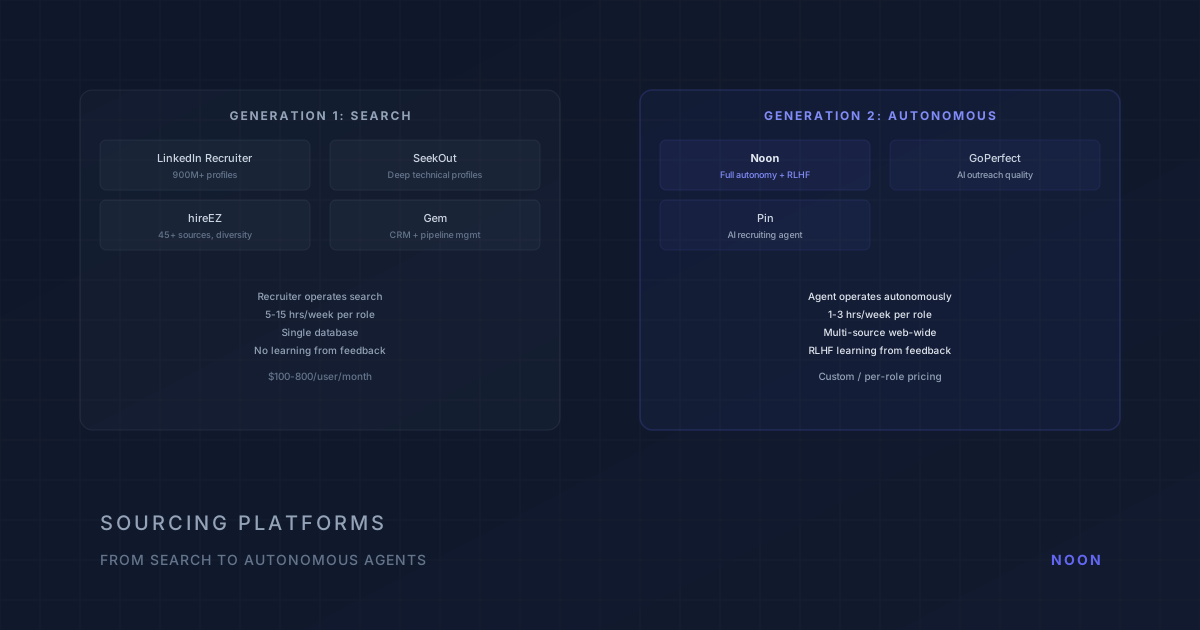
Key takeaway: The best candidate sourcing platforms have split into two generations: tools you operate (LinkedIn Recruiter, SeekOut, hireEZ) and agents that operate for you (Noon, GoPerfect). Agent-based platforms find and engage candidates autonomously, reducing sourcing time from hours to minutes per role. Tool-based platforms offer deeper search control for specialized or executive roles.
Two years ago, "candidate sourcing platform" meant a database with a search interface. You logged in, wrote search queries, scrolled through profiles, and manually picked candidates to contact. The recruiter did the work; the platform provided the data.
In 2026, the category has bifurcated. One branch continues down the database-and-search path, adding AI enhancements to search quality and profile enrichment. The other branch has moved to autonomous operation: platforms that find, evaluate, and contact candidates without the recruiter driving each step. For broader context on sourcing strategy across these different approaches, see our full candidate sourcing guide.
This distinction matters because it changes the fundamental question from "which platform has the best search?" to "how much of the sourcing workflow do I want to automate?" A team that's comfortable with recruiter-operated search needs a different platform than a team that wants sourcing to happen in the background while recruiters focus on relationship-building and closing.
What are the two generations of sourcing platforms?
Generation 1: Recruiter-operated search platforms
These platforms give recruiters powerful search capabilities across large professional databases. The recruiter builds queries, reviews results, and manually selects candidates.
How they work: You define search criteria (job title, skills, location, company), the platform returns matching profiles, you review them one by one, find contact information, and initiate outreach. Some offer AI-assisted ranking or candidate recommendations, but the recruiter remains in the driver's seat at every step.
Strengths:
- Recruiter has full control over candidate selection
- Deep customization of search criteria
- Well-established platforms with large databases and track records
Limitations:
- Time-intensive: every search, profile review, and contact lookup is recruiter time, and recruiters only get about 28% of the week for sourcing and engagement (iQTalent time-tracking study, 2026)
- Recruiter skill-dependent: results vary based on query quality and evaluation judgment
- No learning: the platform produces the same results regardless of past feedback
- Single-session: each search is independent; the platform doesn't build on previous searches
Best for: Teams with experienced sourcers who want maximum control over candidate selection.
Generation 2: Autonomous sourcing agents
These platforms operate independently. The recruiter defines the role and criteria, and the agent handles discovery, evaluation, and initial outreach.
How they work: You provide a job description and key criteria. The AI agent searches across multiple sources (LinkedIn, GitHub, personal sites, publications, conferences), evaluates candidates against your criteria using LLM-based reasoning, and presents a ranked list of qualified prospects. Many also generate personalized outreach and manage follow-up sequences.
Strengths:
- Dramatically less recruiter time required (minutes instead of hours)
- Broader search coverage (multiple sources, not just one database)
- Contextual evaluation (understands career trajectories, not just keywords)
- Learning from feedback (RLHF improves matching quality over time)
- Consistent output regardless of recruiter skill level
Limitations:
- Less direct control over candidate selection (the AI makes initial evaluation decisions)
- Requires calibration period to reach optimal matching quality
- Newer category with fewer platforms and shorter track records
Best for: Teams that want sourcing to happen autonomously so recruiters can focus on engagement and closing.
How do Generation 1 and Generation 2 sourcing platforms compare?
| Dimension | Gen 1 (Search) | Gen 2 (Autonomous) |
|---|---|---|
| Recruiter time per role | Every search and review step is manual | Recruiter defines criteria and reviews ranked candidates |
| Candidate volume | Capped by recruiter hours | Keeps growing in the background |
| Search coverage | Single database | Multi-source web-wide |
| Evaluation method | Recruiter judgment + keyword filters | LLM-based contextual evaluation |
| Learning | None (static search) | RLHF from feedback |
| Outreach | Separate tool needed | Built-in personalized outreach |
| ATS integration | Varies (often one-directional) | Typically bi-directional real-time |
| Typical pricing | Per seat, often with contact-credit caps | Varies: per agent, per role, or platform plan |
What are the top platforms in each generation?
Generation 1 platforms
LinkedIn Recruiter The default sourcing tool for most recruiting teams: Boolean search, InMail, and AI-assisted search across LinkedIn's member network. That reach makes it hard to replace, but the search experience is increasingly dated next to AI-native alternatives.
- Database: LinkedIn member profiles only
- Pricing: Recruiter plans are quote-based per seat through LinkedIn sales, with InMail allowances per seat
- Best for: Broad sourcing across all professional categories
SeekOut The deepest technical profiles in the market. Aggregates data from GitHub, Stack Overflow, patents, and publications. Power filters for highly specific skill combinations, inferred security clearance, and advanced diversity filters on team tiers. Every tier now includes AI multi-step email campaigns.
- Database: vendor states 1B+ profiles with deep technical enrichment
- Pricing: Recruit Core at $149/user/month paid annually ($1,788/yr) or $179 billed monthly, with a 14-day trial and no credit card required; team and enterprise plans are custom annual contracts (SeekOut pricing, re-read 28 September 2026). Recruit Core includes 500 contact credits a month; team tiers include 750 per seat
- Best for: Engineering and technical hiring
hireEZ Searches across dozens of platforms for the broadest multi-source coverage among Gen 1 platforms. Particularly strong for diversity sourcing because different platforms surface different demographics, and it has moved toward being a sourcing-plus-CRM consolidation play.
- Database: vendor states 1B+ profiles across 45+ channels, with 40+ ATS integrations
- Pricing: from $494/month for a solo recruiter with a 7-day trial; enterprise pricing is configured against the stack it replaces (hireEZ pricing, re-read 28 September 2026)
- Best for: Diversity sourcing and niche roles
Those two numbers are the single biggest correction since this guide was first published: earlier per-seat estimates circulating in comparison content no longer match either vendor's published page. For the full head-to-head, see hireEZ vs SeekOut.
Gem CRM-first platform that excels at talent rediscovery, meaning candidates you have already engaged with. The strongest outreach sequencing and analytics in the category.
- Database: Your existing ATS/CRM data + enrichment
- Pricing: The Gem Startup Program lists $130/month billed yearly for companies with 1-10 employees; larger teams are quoted, with Standard and AI-powered seat types (Gem pricing, read 28 September 2026)
- Best for: Pipeline management and candidate re-engagement
Juicebox Natural-language people search (formerly PeopleGPT): type the candidate you want in plain English and get a ranked list with AI explanations. Paid plans add email outreach, and Juicebox Agents can run in the background and auto-email or auto-shortlist, which puts it between the two generations.
- Database: Vendor-maintained people search; confirm coverage for your roles
- Pricing: Starter $99 and Growth $179 per seat/month billed yearly ($119 and $199 monthly), with 500 and 1,500 contact credits; Juicebox Agents add $199 per agent/month (Juicebox pricing, read 28 September 2026)
- Best for: Individual recruiters who want fast, flexible search. See Noon vs Juicebox
Generation 2 platforms
Noon The most autonomous platform in the category. Noon deploys an AI agent that handles the entire sourcing-to-outreach workflow independently. Searches across the full web (not just LinkedIn), evaluates candidates using LLM-based reasoning, generates genuinely personalized outreach, and uses RLHF to improve matching from hiring manager feedback. If you want to see how agent-based sourcing works in practice, you can book a demo to walk through the autonomous workflow for your specific roles.
- Coverage: Full web (LinkedIn, GitHub, personal sites, publications, conferences)
- Learning: RLHF: matching quality improves with every review cycle
- Scheduling: AI Coordinator books interviews via Calendly integration; syncs to 20+ ATS platforms
- Pricing: One quote-based plan with unlimited sourcing, contacts, agents, and seats
- Outreach: Multi-channel personalized (email and SMS)
- Best for: Teams wanting fully autonomous sourcing with minimal recruiter involvement
GoPerfect Focuses on autonomous outreach quality, generating messages that are indistinguishable from personally written ones. Combines sourcing with AI-written engagement at scale.
- Coverage: Web-wide sourcing
- Learning: Engagement-based optimization
- Best for: Teams that need high-quality outreach at scale
Pin AI recruiting agent that combines sourcing, screening, outreach, and scheduling. Strong in the agentic workflow space with emphasis on speed-to-first-candidate.
- Coverage: 850M+ profiles
- Learning: Agent-based optimization
- Best for: Teams wanting quick deployment of a comprehensive AI agent
Verified pricing at a glance
| Platform | Generation | Published entry price | Trial | Metering |
|---|---|---|---|---|
| Noon | 2 | Not published; book a demo | Demo-led | None: unlimited sourcing, contacts, agents, and seats |
| SeekOut | 1 | $149/user/mo annually, $179 monthly | 14 days, no card | Per seat, contact credits |
| hireEZ | 1 | $494/mo solo recruiter | 7 days | Per seat, enterprise configured to stack replaced |
| LinkedIn Recruiter | 1 | Quote-based per seat | No | Per seat, plus InMail caps |
| Gem | 1 | $130/mo billed yearly (1-10 employees); larger teams quoted | No | Per seat |
| Juicebox | 1 to 2 | $99/seat/mo yearly, agents $199/mo each | Free plan | Per seat, contact credits, per agent |
Prices read from each vendor's own pricing page on 28 September 2026. The structural difference that matters more than any single number: every Gen 1 platform in this table meters recruiters by the seat, so the cost of adding sourcing capacity is linear in headcount. Noon's single plan carries no seat, contact, or agent limits, which is why the comparison usually flips as soon as more than a couple of people need access.
How do you choose the right sourcing platform?
If you have experienced sourcers who want control:
Go Generation 1. Your sourcers know how to find candidates. They need a better database and search interface, not a replacement for their judgment. SeekOut for technical roles, hireEZ for diversity, Gem for pipeline management.
If sourcing is your bottleneck and you want it automated:
Go Generation 2. You need candidates found and evaluated without consuming recruiter hours. Noon for full autonomy with RLHF learning, GoPerfect for outreach quality.
If you're not sure yet:
Start with Generation 1, plan for Generation 2. Deploy a search platform now to address immediate needs, evaluate autonomous agents in parallel, and plan a transition as the category matures.
Most common mistake:
Buying a Gen 1 platform and expecting Gen 2 results. If your bottleneck is recruiter capacity, not search query quality, a better search engine won't help. You need autonomous operation.
Where is the sourcing platform market heading?
The sourcing platform market is following the same pattern as other software categories that went through AI transformation:
- Phase 1 (2015-2020): Search platforms with large databases (LinkedIn, Indeed, ZipRecruiter)
- Phase 2 (2020-2024): AI-enhanced search (SeekOut, hireEZ, Eightfold)
- Phase 3 (2024-present): Autonomous agents (Noon, GoPerfect, Pin)
Each phase doesn't eliminate the previous one; LinkedIn isn't going anywhere. But the locus of innovation and competitive advantage has shifted. Teams still operating exclusively with Phase 1 tools are at a meaningful disadvantage in speed, quality, and cost compared to those deploying Phase 3 platforms.
The implication for buyers: today's purchasing decision should factor in where the market is headed, not just where it is. A platform that requires significant recruiter time per candidate will become increasingly misaligned with the trend toward autonomous operation.
Frequently asked questions
How much do candidate sourcing platforms cost in 2026? Published entry prices range from $149/user/month for SeekOut Recruit Core paid annually to $494/month for a solo hireEZ subscription; LinkedIn Recruiter and Gem are quote-only. The bigger cost driver is the metering model rather than the sticker price, because per-seat licensing means sourcing capacity can only be bought by adding seats.
Which sourcing platform is best for technical roles? SeekOut has the deepest technical enrichment among Gen 1 tools, pulling in GitHub, Stack Overflow, patents, and publications. If the constraint is recruiter hours rather than search precision, a Gen 2 agent that sources and runs outreach continuously will move time-to-fill more than a better technical search interface will.
Can I use both Generation 1 and Generation 2 platforms? Yes, and many teams do. The most common combination is LinkedIn Recruiter (Gen 1) for its database breadth plus an autonomous agent (Gen 2) for proactive sourcing. They're complementary, not competitive.
How much does an autonomous sourcing agent save vs. traditional sourcing? Start with hours. LinkedIn's 2025 Future of Recruiting report found TA professionals using generative AI saved about 20% of their workweek (LinkedIn, 2025), and an agent that runs sourcing and outreach end to end takes over more of the week than a search assistant does. The ROI is strongest for teams currently using agencies for a significant portion of hires, because the agent replaces agency-level sourcing at a fraction of the cost.
Do autonomous agents work for executive-level hiring? For initial candidate identification, yes. For the relationship-building, discretion, and network leverage required for C-suite placements, executive search firms still provide value that agents can't replicate. The sweet spot for agents is senior individual contributor through director-level roles.
What happens if the AI sources bad candidates? All agents require a calibration period. The first batch won't be perfect. Systems with RLHF (like Noon) improve with feedback: rate the first batches carefully and match quality should visibly improve within the first few review rounds. If quality doesn't improve after calibration, the platform isn't learning effectively.
How much recruiter time does an autonomous sourcing agent need? Most of it comes at the start of each role: writing clear must-haves and dealbreakers, then reviewing the first ranked batches so the agent learns your standard. After that, recruiter time should shift to reviewing shortlisted candidates and talking to the ones who reply. For a breakdown of where manual sourcing hours go today, see why manual sourcing takes all day.
How does SeekOut compare with an autonomous agent? SeekOut is a strong recruiter-operated search platform with power and diversity filters and AI email campaigns. An agent like Noon runs the search, evaluation, email and SMS outreach, and scheduling itself. Our Noon vs SeekOut comparison covers pricing and fit in detail.