Key takeaway: The best candidate sourcing tools in 2026 are Noon (autonomous AI agent), LinkedIn Recruiter (largest database), SeekOut (diversity and technical search), hireEZ (multi-platform aggregation), and Gem (CRM-integrated sourcing). The right tool depends on your hiring volume, budget, and whether you need a search tool or an autonomous agent.
Sourcing tools have split into two camps. On one side, enterprise platforms with annual contracts, AI features bolted onto legacy search, and pricing that starts at $20K/year per seat. On the other, a new generation of AI-native tools that search autonomously, learn from feedback, and charge based on what you actually use. For broader context on sourcing strategy, channels, and best practices, see our complete candidate sourcing guide.
The distinction matters because most recruiting teams buy sourcing tools based on database size - "access to 500 million profiles" - when the real bottleneck is evaluation, not access. Having hundreds of millions of profiles doesn't help if you still need to manually review each one. The sourcing tools that actually move the needle are the ones that handle discovery and qualification, so recruiters receive vetted candidates rather than a list of names.
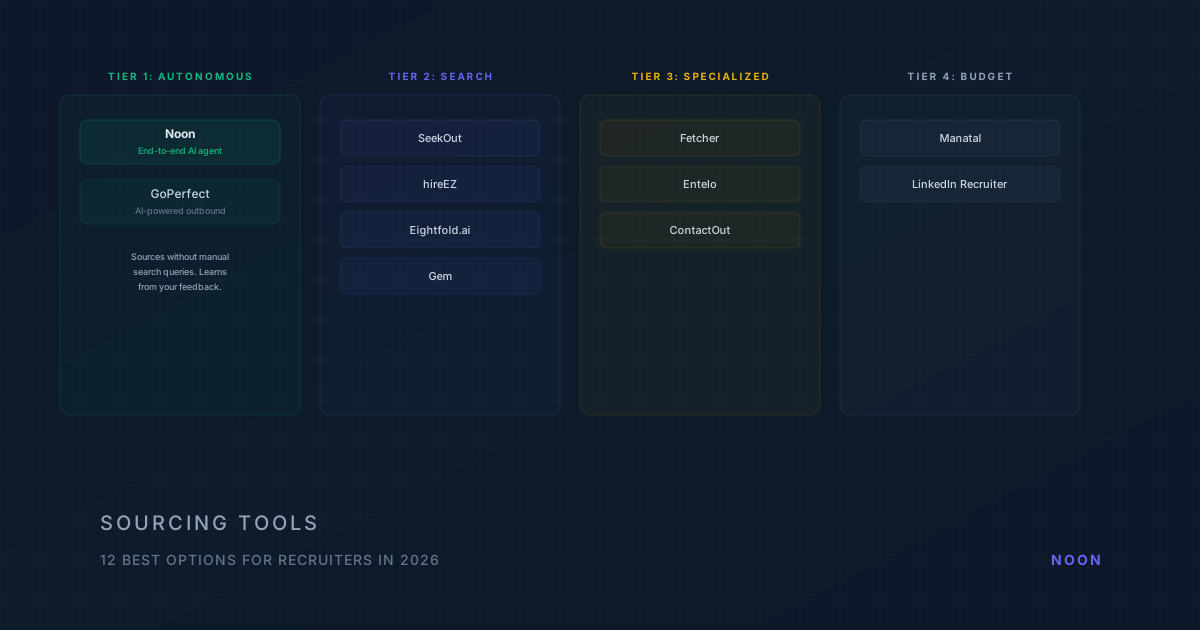
This guide covers the 11 best candidate sourcing tools for 2026, organized by approach: autonomous agents, search platforms, specialized tools, and budget options. Each entry includes pricing details, honest limitations, and who the tool is actually built for. Published prices were re-checked against vendor pricing pages on 23 September 2026; where a vendor quotes only through sales, we say so rather than guess. For the full market, see the recruiting software pricing index.
What makes a good candidate sourcing tool in 2026?
Before the list, here's what separates effective sourcing from expensive profile browsing:
- Autonomous discovery. Can the tool find candidates without you writing Boolean search strings? The best tools take a role description and search independently.
- Contextual evaluation. Does it understand what makes a candidate qualified, or does it just match keywords? A tool that recognizes "8 years building distributed systems at Stripe" as qualifying for a "senior backend engineer" role - without those exact words appearing - is fundamentally more useful.
- Learning from feedback. Does the tool improve as you use it? Static search produces the same results whether you've used it for one day or one year.
- Multi-source coverage. LinkedIn is one platform. The best sourcing tools search across GitHub, personal websites, publications, conference talks, and other professional signals.
- ATS integration. Sourced candidates that live in a separate system create data gaps. Real-time ATS sync ensures every candidate touchpoint is recorded.
What are the 11 best candidate sourcing tools for 2026?
Tier 1: Autonomous sourcing agents
These tools don't just help you search - they search for you. You define the role, and the AI finds, evaluates, and often contacts candidates without manual intervention.
1. Noon - Best for end-to-end autonomous sourcing
Noon approaches sourcing differently than every other tool on this list. Instead of providing a search interface that recruiters operate, Noon deploys an AI agent that operates the entire sourcing workflow autonomously. You activate a role, and the agent finds candidates, evaluates them against your specific criteria, and initiates personalized outreach - all without requiring manual search queries. Teams evaluating whether autonomous sourcing fits their hiring workflow can book a demo to see the agent in action on real roles.
The key differentiator is Noon's RLHF (reinforcement learning from human feedback) system. As recruiters and hiring managers review sourced candidates and approve or reject them, the agent recalibrates what "good" means for that specific role, including strict non-negotiables that should never be traded away. The practical effect is that the shortlist tightens over a search rather than staying static, which is something a fixed search interface cannot do.
Sourcing coverage spans the entire web, not just LinkedIn. The system evaluates career trajectories, company caliber, and skill depth using LLM-based reasoning rather than keyword matching, and the same criteria engine screens inbound applicants and searches the ATS you already have, which matters if your real problem is too many unqualified applicants per posting rather than too few. Outreach runs over verified email and SMS.
- Pricing: One plan with unlimited usage and seats; quote-based, no per-seat or per-credit pricing (see the Noon pricing page)
- Best for: Teams that want sourcing handled autonomously with minimal recruiter input
- Limitation: Designed for the full sourcing-to-outreach workflow - if you only want a search database, it's more than you need
2. GoPerfect - Best for AI-powered outbound sourcing
GoPerfect combines autonomous sourcing with AI-written outreach. It identifies candidates and writes genuinely personalized messages - not template fills - based on each candidate's background. The outreach quality is among the best in the category.
- Pricing: Contact sales
- Best for: Teams that want autonomous sourcing paired with high-quality outreach
- Limitation: Newer platform, smaller customer base for social proof
Tier 2: Search-powered platforms
These tools provide powerful search capabilities that recruiters operate. They don't source autonomously - you build searches and review results - but they offer deep databases and advanced filtering.
3. SeekOut - Best for deep technical talent
SeekOut has the richest technical profiles in the market. It aggregates data from GitHub, Stack Overflow, patents, publications, and open-source contributions. For engineering hiring, the depth is unmatched. Diversity sourcing filters are built into the search workflow. In 2026 SeekOut also added a self-serve entry tier, which changes its position on this list from enterprise-only to accessible for small teams.
- Pricing: Recruit Core $149/seat/month billed annually ($179 month to month) with 500 contact credits and 1,000 exports per month; Recruit Sourcing, Sourcing + Integration, and Full Recruiting Funnel tiers are custom quoted per seat (seekout.com/pricing, September 2026). See our Noon vs SeekOut comparison.
- Best for: Companies with heavy engineering hiring, now including small teams via Recruit Core
- Limitation: Credit and export caps on the entry tier; inbound screening and AI rubrics are reserved for the custom Full Funnel tier. Less differentiated for non-technical roles
4. hireEZ - Best for multi-source diversity sourcing
hireEZ searches across 45+ platforms, giving it the broadest source coverage of any search platform. This breadth is particularly valuable for diversity sourcing - different platforms surface different candidate demographics. AI-assisted candidate ranking goes beyond keywords.
- Pricing: Quote-based; buyer-reported figures cluster around $169/user/month, so treat that as an estimate
- Best for: Teams with specific diversity hiring goals or niche recruiting needs
- Limitation: Broad coverage can mean noisier results that need more manual filtering
5. Eightfold.ai - Best for enterprise talent intelligence
Eightfold's talent graph maps over a billion professional profiles using skills-based matching. It goes beyond job titles to understand skill taxonomies and career trajectories. Internal mobility features let you match existing employees to open roles.
- Pricing: Custom (enterprise-only)
- Best for: Large enterprises (5,000+ employees) that need talent intelligence spanning acquisition and internal mobility
- Limitation: Complex implementation. Months-long deployment. Not designed for SMB
6. Gem - Best for pipeline rediscovery and CRM
Gem excels at helping you rediscover candidates you've already found. Its CRM functionality tracks every touchpoint across roles and time. Email sequencing analytics are excellent. Strong integrations with Greenhouse and Lever.
- Pricing: Quote-based; buyer-reported estimates around $99/user/month for staffing and roughly $24.8K/year per seat on enterprise in-house contracts (estimates, not list prices)
- Best for: Teams that have strong sourcing but need better pipeline management and sequencing
- Limitation: Not an autonomous sourcing tool - it helps you manage candidates, not find new ones
Tier 3: Specialized sourcing tools
7. Fetcher - Best for lean teams wanting delivered candidates
Fetcher takes the work out of sourcing entirely. You define role requirements, and Fetcher's AI + human research team delivers curated batches of candidates to your inbox. Low-effort sourcing for teams without dedicated sourcers.
- Pricing: Contact sales
- Best for: Small recruiting teams (1-3 people) without sourcing bandwidth
- Limitation: Lower volume than self-serve platforms. Less control over real-time adjustments
8. Entelo - Best for predictive sourcing signals
Entelo uses predictive analytics to identify candidates likely to be open to new opportunities - even before they update their LinkedIn status to "Open to Work." The attrition prediction models analyze career patterns and company signals.
- Pricing: Custom
- Best for: Teams that want to reach passive candidates at the moment they're most receptive
- Limitation: Prediction accuracy varies. Works better for some industries than others
9. ContactOut - Best for finding verified contact information
ContactOut focuses specifically on the contact discovery problem - finding verified email addresses and phone numbers for candidates you've already identified. Accuracy rates for personal email addresses are among the highest in the category.
- Pricing: Free tier plus paid plans; buyer-reported entry price around $79/month (estimate, confirm on ContactOut's pricing page)
- Best for: Recruiters who source candidates themselves but need reliable contact info
- Limitation: Contact finding only - no candidate discovery or evaluation
Tier 4: Budget-friendly options
10. Manatal - Best for startups on a budget
Manatal provides AI-powered candidate recommendations, resume parsing, and basic sourcing from job boards and social media at the lowest price point in this category. Quick setup, intuitive interface.
- Pricing: From $15/user/month on the published plans (manatal.com/pricing, September 2026)
- Best for: Startups and small companies that need basic sourcing without enterprise pricing
- Limitation: AI is less sophisticated than premium platforms. Limited sourcing depth
11. LinkedIn Recruiter - Most widely used, not necessarily the best
LinkedIn Recruiter remains the default sourcing tool for most recruiters. LinkedIn puts its member count above one billion (LinkedIn About page, accessed September 2026), and Recruiter adds InMail and Boolean search on top. It's the largest single-source database available. But relying exclusively on LinkedIn means fishing in the same pond as every other recruiter.
- Pricing: Quote-based; buyer-reported figures around $10,800/year per Recruiter Corporate seat and around $1,680/year for Recruiter Lite (estimates; see our LinkedIn Recruiter pricing breakdown)
- Best for: Teams that want the largest single-source database and are comfortable with Boolean search
- Limitation: Everyone else is also searching LinkedIn. Passive candidates are over-messaged. AI features lag behind specialized sourcing tools
How do you choose the right sourcing tool for your bottleneck?
| Your situation | Best fit |
|---|---|
| "We need sourcing to happen without recruiter involvement" | Noon, GoPerfect (autonomous agents) |
| "We hire mostly engineers and need deep profiles" | SeekOut |
| "Diversity sourcing is a top priority" | hireEZ, SeekOut |
| "We have candidates but can't manage the pipeline" | Gem |
| "We're a small team with no dedicated sourcer" | Fetcher, Manatal |
| "We need enterprise-grade talent intelligence" | Eightfold.ai |
| "We just need contact info for candidates we already found" | ContactOut |
| "Our problem is the inbound pile, not the outbound search" | Noon (inbound screening on the same criteria), SeekOut Full Funnel tier |
How is the sourcing tool market shifting?
The biggest trend in sourcing tools is the move from search interfaces to autonomous agents. Five years ago, "AI sourcing" meant a better search engine. Today, it means a system that handles the full discovery-to-engagement workflow without manual search queries.
This shift has implications for how teams are structured. When sourcing is automated, the sourcer role evolves from "person who runs Boolean searches" to "person who calibrates AI systems and manages candidate relationships." The tools that enable this transition - by genuinely learning from feedback and improving over time - will define the next generation of recruiting.
Which platform limits will your sourcing hit first?
Every tool that reads LinkedIn inherits LinkedIn's account-level ceilings, and those ceilings are documented. Checked against LinkedIn's Help pages on 17 August 2026:
| Limit | Published value | Why it matters for sourcing |
|---|---|---|
| Commercial use limit on profile search and views | Monthly, resets midnight PST on the 1st, exact number not disclosed and cannot be lifted on request (LinkedIn Help) | A free or Premium DACH Essentials account can lose search access mid-month with no appeal |
| Boolean operators per query | Capped on consumer search, unlimited in Recruiter and Recruiter Lite, maximum 15 in Sales Navigator (LinkedIn Help) | Long X-ray-style strings simply will not run on a free account |
| InMail credits | 30 per month on Recruiter Lite, 120 per seat maximum, no plan with unlimited credits (LinkedIn Help) | Roughly one active role's worth of outreach per month per seat |
| First-degree connections | 30,000 maximum (LinkedIn Help) | Long-tenured recruiters do hit this and cannot buy more |
| Invitation restrictions | Triggered by high volume or many ignored invitations, typically last one week (LinkedIn Help) | A single aggressive week can remove a recruiter's invitation ability during a live search |
Two conclusions follow. First, tools that source from the open web rather than one network are not subject to any of the search limits above, which is the structural argument for open-web sourcing beyond simple coverage. Second, tools that automate activity inside LinkedIn put the account at risk: LinkedIn says it may restrict or suspend accounts when it suspects automation behind excessive invitations, and asks members to disable such extensions. The full published set is in LinkedIn limits for recruiters, and the equivalent rules on the email side are in recruiting email deliverability.
Frequently asked questions
What's the best free candidate sourcing tool? LinkedIn's basic search and Google X-ray searches remain the best free options, with two caveats now worth knowing: free LinkedIn accounts are subject to the commercial use limit on profile search and views, and consumer search caps how many Boolean operators a single query can contain. Genuinely effective sourcing at volume requires investment, and the free tier of any platform won't deliver the depth or automation that competitive hiring demands.
Will a sourcing tool get my LinkedIn account banned? It depends on how the tool works. LinkedIn documents that it may suspend or restrict accounts when it suspects automation tools behind an excessive volume of invitations, and that repeated suspensions can become permanent, so browser extensions that click through LinkedIn on your behalf carry real account risk. Tools that search the open web and contact candidates through their own email or phone details operate outside that mechanism entirely.
Can a sourcing tool replace LinkedIn Recruiter? This is the most common question we hear from teams evaluating the category, and the honest answer is: for most roles, yes, if the tool sources from the open web and contacts candidates by email or SMS rather than through InMail. Recruiter's advantage is the size of one network; its limits are per-seat pricing, InMail caps, and the fact that every competitor is messaging the same people. Teams typically keep one Recruiter seat for the occasional network-only search and move volume sourcing to an autonomous tool. Our LinkedIn Recruiter pricing guide has the current seat costs to compare against.
How do sourcing tools price, and what is included? Three models dominate. Per-seat subscriptions (LinkedIn Recruiter, SeekOut Recruit Core, hireEZ, Gem) charge for each recruiter login and usually cap contacts or exports per month. Per-role or per-batch delivery (Fetcher) charges for candidates delivered. Platform plans (Noon) charge one fee for unlimited seats and usage. Ask every vendor what happens at the credit cap, whether enrichment and exports are metered, and what the implementation fee is; those three lines explain most of the gap between list price and invoice.
How many sourcing tools should a recruiting team use? Ideally, one to two. The most common mistake is stacking multiple sourcing tools, creating data fragmentation and forcing recruiters to switch between platforms. An autonomous sourcing agent that handles end-to-end discovery and outreach should reduce your tool count, not add to it.
Do sourcing tools replace recruiting agencies? For most standard roles, yes. AI sourcing tools can find and contact candidates at a fraction of the agency cost ($15K-50K+ per placement for agencies vs. $500-2,000/month for a sourcing tool). Agencies remain valuable for executive search, confidential roles, and highly specialized positions.
How do I measure sourcing tool ROI? Track: time-to-fill before and after adoption, cost-per-hire reduction, recruiter hours saved per week, and quality-of-hire metrics (90-day retention, hiring manager satisfaction). The strongest ROI signal is reduced agency spend - if a sourcing tool replaces even two agency placements per quarter, it typically pays for itself many times over.