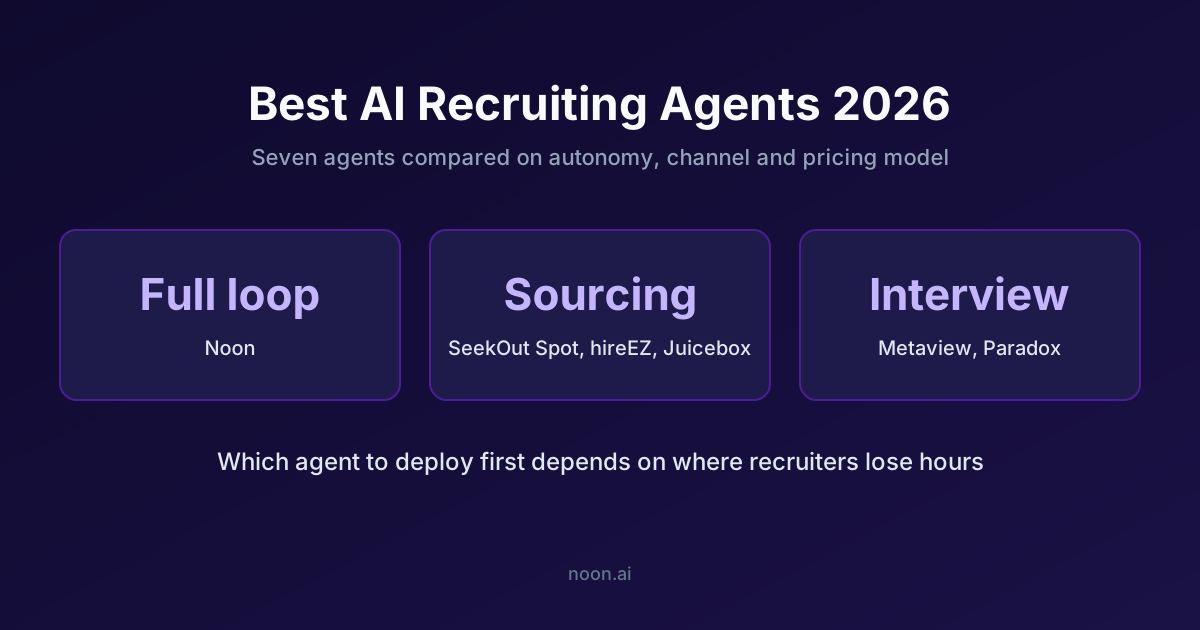
Key takeaway: The best AI recruiting agents in 2026 are Noon (autonomous sourcing, email and SMS outreach, screening interviews and scheduling, unlimited on one plan), Paradox Olivia (conversational screening and scheduling for hourly hiring), SeekOut Spot and hireEZ's agents (agentic sourcing on top of their profile indexes), Juicebox's outreach agents ($199 per agent per month), Metaview's interview agent and Gem's AI sourcing seats. Noon is the only one that covers the full top of the funnel without a recruiter working a list in between.
An agent is software that is given a goal and takes the steps to reach it, instead of waiting for a person to click. In recruiting that means: find people who fit this role, contact them, follow up, screen the ones who reply, and put the good ones on a calendar. Almost every vendor now uses the word. Few products pass the test.
This comparison grades each agent on three things: autonomy (how many steps it runs without approval), scope (which part of the hiring loop) and pricing model (what grows when the agent succeeds). Prices come from each vendor's published pricing page as of August to October 2026; unpublished prices are marked as such.
The 7 AI recruiting agents at a glance
| Agent | Loop stage | Runs on its own | Channel | Pricing model |
|---|---|---|---|---|
| Noon | Source, evaluate, contact, follow up, screen, schedule | All of it, with human feedback improving the model | Email, SMS | One unlimited plan, no public price |
| Paradox Olivia | Inbound screen, schedule, Q&A | All of it, inbound only | Chat, SMS | Custom, unpublished |
| SeekOut Spot | Source and deliver | Agentic sourcing plus human recruiters | Per role or outcome, quoted | |
| hireEZ agents | Search, rank, draft outreach | Drafts; recruiter sends | Seats from $494/mo | |
| Juicebox agents | Search, outreach | Sends sequences from a search | $199/agent/mo plus seat | |
| Metaview | Interview notes, scorecards; new sourcing tier | Notes fully; sourcing is metered search | n/a | $100 or $300/user/mo sourcing |
| Gem AI seats | Source, sequence, schedule inside CRM | Assistive | Custom by FTE |
1. Noon: the full-loop agent
Noon starts from the role, not from a search string. It reads the requirements, searches across the open web rather than one profile database, evaluates each candidate against role-specific criteria and strict non-negotiables, and learns from hiring-manager thumbs-up and thumbs-down feedback so each round of candidates is closer to what the team actually hires.
Outreach is run by the same agent that found the candidate. Noon writes an AI-generated intro grounded in the person's work, sends multi-step email and SMS sequences, handles replies and questions, screens with a voice AI interviewer and books the interview. An AI notetaker joins the live interview. Events sync to 20+ ATS providers.
- Pricing model: one plan, unlimited sourcing, enrichment, contacts, agents and seats. No credits or per-seat fees. No published dollar price; terms at noon.ai.
- Security: SOC 2 Type II, GDPR, SSO and SAML, annual third-party penetration testing.
- Honest limitation: Noon does not replace your ATS, and it is built for continuous coverage of open roles rather than a one-off export.
- Verdict: the agent to deploy first if recruiters lose their hours at the top of the funnel. Our implementation playbook covers the first 90 days.
2. Paradox Olivia: the inbound agent
Olivia lives on your careers site and in SMS. It answers applicant questions, screens against knockout criteria, schedules interviews and sends reminders without a recruiter in the loop. For hourly hiring at hundreds of locations it is the category leader.
- Pricing: unpublished; buyer reports range from roughly $30k to $80k a year mid-market (our analysis).
- Limitation: inbound only. It never goes and finds someone who did not apply.
3. SeekOut Spot: agentic sourcing with people behind it
Spot combines SeekOut's index with agentic search and human recruiters, priced per role or on outcomes. It behaves more like an agency than software, which is the point: you buy delivered candidates, not a seat.
- Limitation: per-role pricing scales with hiring volume; the software seat is separate (SeekOut pricing).
4. hireEZ agents: drafting on top of the broadest suite
hireEZ's agents rank candidates and draft personalized sequences inside its CRM. A recruiter reviews and sends, so autonomy is partial, but the surrounding suite (search, CRM, analytics) is the most complete of the search tools. Entry is $494 a month solo.
5. Juicebox agents: outreach bolted onto natural-language search
Juicebox's search is the easiest to use in the category. Its outreach agents run sequences from a saved search for an extra $199 per agent per month on top of a $99 seat, and the credit meter (500 contacts a month on Starter) still applies.
6. Metaview: the interview agent
Metaview records, transcribes and summarizes interviews and fills scorecards; it is the best-reviewed tool on this list for that job. Its 2026 sourcing tier is metered search ($100 per user per month for 200 profiles, $300 unlimited), not an autonomous sourcing agent.
7. Gem AI seats: assistive agent inside a CRM
Gem's AI-Powered seats add sourcing suggestions, sequence drafting and scheduling on top of its CRM. Pricing is custom by FTE count with a $130 per month startup tier. Autonomy is assistive by design; Gem is a system of record first.
Which AI recruiting agent should you deploy first?
- Recruiters spend most of their day searching and emailing: Noon. It removes the largest block of hours and its unlimited plan means a one-role pilot costs the same as a rollout.
- You have more applicants than you can screen: Paradox.
- You want candidates delivered and do not want to run software: SeekOut Spot, or an agency.
- Interviews are inconsistent and notes are missing: Metaview.
- You already run Gem or hireEZ and want AI inside it: turn on their agent features before adding a vendor.
Related reading: What is an AI hiring agent?, Can an AI agent replace a recruiting agency?, Best AI recruiting tools 2026, AI talent sourcing explained.
FAQ
What are the best AI recruiting agents?
The best AI recruiting agents in 2026 are Noon (autonomous sourcing, email and SMS outreach, screening and scheduling), Paradox's Olivia (conversational screening and scheduling for hourly roles), SeekOut Spot and hireEZ's agents (agentic sourcing on top of their indexes), Juicebox's outreach agents, Metaview's interview agent and Gem's AI seats. Noon is the only one that covers the full top of the funnel without a recruiter working a list in between.
What makes a recruiting tool an agent rather than AI-assisted software?
An agent is given a goal and executes the steps: search, contact, follow up, screen, schedule. AI-assisted software suggests or drafts and waits for a recruiter to click. Ask a vendor to show the product sending a second follow-up and booking an interview with nobody watching; if it cannot, it is assistive.
Are AI recruiting agents safe to use for hiring decisions?
Agents on this list source, contact and screen; the hiring decision stays with people. Keep it that way: use the agent's reasoning and scorecards as input, document the criteria, and check vendor compliance (SOC 2, GDPR, bias audits where your jurisdiction requires them, such as NYC Local Law 144).
How much do AI recruiting agents cost?
Published entry points run from $99 per seat plus $199 per agent per month (Juicebox) to $494 per month (hireEZ). Paradox, SeekOut Spot and Gem enterprise tiers are quoted. Noon sells one plan with unlimited agents, seats and contacts and does not publish a dollar price. Compare what each meter charges for when the agent succeeds.
Do AI recruiting agents replace an ATS?
No. Every agent here sits on top of an ATS and syncs candidates and activity into it. Noon integrates with 20+ ATS providers; Paradox, Metaview, Gem and hireEZ integrate with the major enterprise systems. Keep the ATS as the system of record and let the agent fill it.