
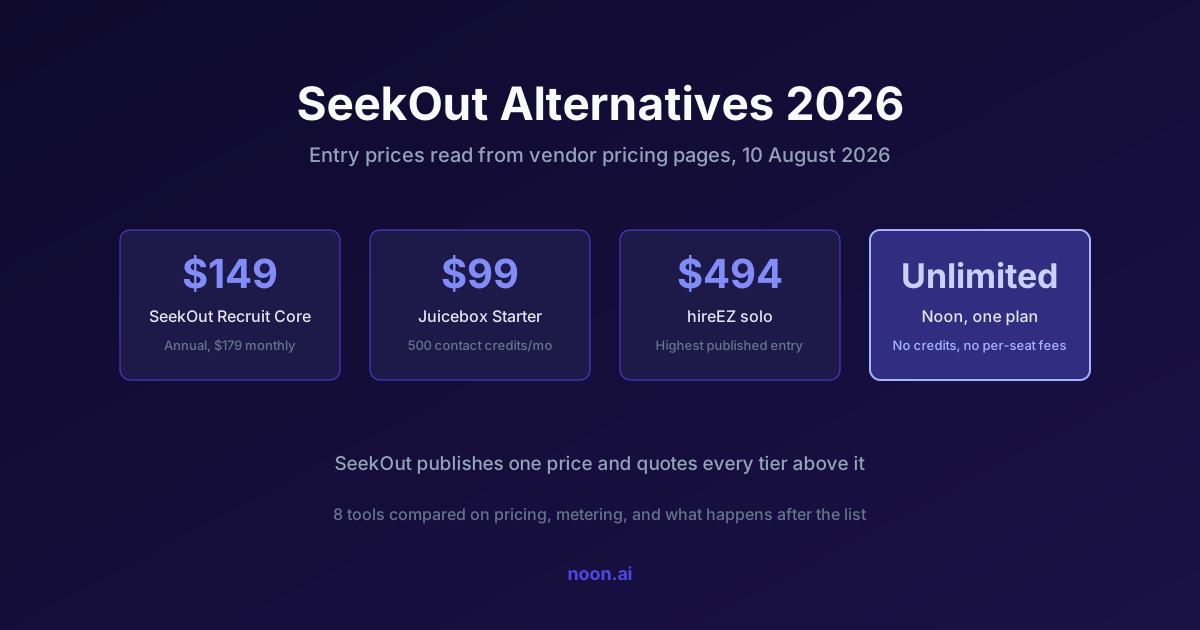
Key takeaway: SeekOut publishes exactly one price: Recruit Core at $149 per month paid annually ($1,788/year), or $179 billed monthly, with every team and enterprise tier custom-quoted and per-seat pricing that "adjusts with volume" (seekout.com/pricing, read 10 August 2026). Alternatives start at $99 per seat (Juicebox), $115 (Fetcher), $169 per user (Loxo), and $494 (hireEZ). Noon is the strongest alternative for teams that want the hiring loop run rather than the profile list delivered: one plan with unlimited sourcing, contacts, email enrichment, agents, and seats, plus autonomous outreach, AI screening interviews, and interview booking on top of whole-web sourcing.
SeekOut is a talent-search engine with a 1B+ profile index, and teams rarely leave because the search is bad. They leave because of what the search costs to scale and what it leaves them holding: a list of people, a credit balance, and all of the follow-through.
The follow-through is where hiring is actually won or lost. Median time-to-fill for nonexecutive roles was 39 days in 2026, down from 44 in 2025, and organizations with the most effective recruiting practices fill roles about five days faster than everyone else (SHRM 2026 recruiting benchmarking). Those days are won in qualification, outreach, follow-up, and scheduling, not in the search box. In the same dataset, extra-large organizations absorbed a 67% increase in requisitions per recruiter, which is precisely the condition under which a per-seat, per-credit tool becomes the bottleneck.
Every price below was read from the vendor's own pricing page on 10 August 2026. Where a vendor publishes no number, this article says so instead of guessing.
Why do teams look for a SeekOut alternative?
SeekOut's own pricing page explains most of it:
- One published price, then quotes. Recruit Core is $149 per month paid annually or $179 monthly. The Sourcing, Sourcing + Integration, and Full Recruiting Funnel tiers are all "Custom," billed annually, with per-seat pricing that adjusts with volume. Budgeting past your first seat means a sales cycle.
- The model is per seat. Cost grows with how many recruiters you add, not with how many hires you make. Add a coordinator or a hiring manager who needs visibility and the line item moves.
- Modules are mix-and-match. ATS rediscovery, inbound applicant evaluation, and AI screening sit in higher tiers, so the capability you actually needed usually lives one quote above the plan you bought.
- The service tier is a different product. SeekOut Spot delivers candidates through agentic AI plus human recruiters on per-role, per-contractor, or outcome-aligned pricing. Useful, but it is an agency substitute rather than a tool you operate.
If any of those is your constraint, the tools below solve it in very different ways.
What do the best SeekOut alternatives cost in 2026?
| Tool | Entry price (verified 10 Aug 2026) | How usage is metered | After the candidate list |
|---|---|---|---|
| Noon | One plan, no public dollar price | Nothing metered: unlimited sourcing, contacts, enrichment, agents, seats | Autonomous multi-channel outreach, voice AI screening interviews, AI-booked interviews, interview notes |
| SeekOut | $149/mo annually, $179/mo monthly (Recruit Core) | Seats, volume-adjusted per-seat tiers, module mix | AI outreach; rediscovery and screening in higher tiers |
| Juicebox | $99/seat/mo (Starter, annual) or $119 monthly | 500 contact + 500 export credits/mo; 1,500 each on Growth | Email outreach and AI templates; agents $199/agent/mo |
| Fetcher | $115/mo (Self-serve) | 300 leads/mo, up to 2,500/yr on Growth, 5,000/yr on Amplify | Curated batches plus email sequences; Amplify adds a success team |
| Loxo | $169/user/mo (Basic) | Contact-finding credits sold separately | Full ATS/CRM; talent graph, outreach, and AI agents on Professional |
| hireEZ | $494/mo (solo) | Seats plus volume configured to your stack | CRM, outreach, screening, scheduling, analytics |
| Gem | Custom, based on company FTE count | Unlimited email-finding on published plan copy | Sourcing, CRM, outreach, scheduling, analytics |
| LinkedIn Recruiter | No price published | InMail credits (30/mo on Recruiter Lite) | InMail only, no automated sequencing |
Sources: seekout.com/pricing, juicebox.ai/pricing, fetcher.ai/pricing, loxo.co/pricing, hireez.com/pricing, gem.com/pricing, LinkedIn Recruiter Lite. All read 10 August 2026.
Read the middle column again. Almost every alternative to SeekOut copies SeekOut's structure: pay per seat, then ration contacts. The differences that matter are in the right-hand column.
1. Noon: the best SeekOut alternative for teams that want the whole loop run
Noon is an autonomous AI recruiter rather than a search index. Autopilot searches across the open web instead of one profile database, evaluates each candidate against role-specific criteria, interprets career trajectory and company caliber, and enforces non-negotiables it never relaxes. Thumbs-up and thumbs-down feedback from the hiring manager recalibrates the model for that role, and changing criteria re-evaluates the existing pipeline instead of starting over. Teams comparing SeekOut alternatives on actual loop coverage can book a demo to see autonomous sourcing, outreach, screening, and scheduling working together.
What separates it from a search tool is everything after the list. AI Outreach runs personalized email and SMS sequences with AI-generated intros. Contact details are enriched with no credit meter. The AI Coordinator answers candidate questions and books interviews. The voice AI Interviewer runs role-specific screening conversations candidates start whenever they are ready, then returns a full transcript, structured analysis, and a next-round recommendation. The AI Notetaker joins live interviews, transcribes with speaker labels, and tracks whether the panel covered the questions it was supposed to.
- Pricing model: one plan with unlimited sourcing, unlimited email enrichment, unlimited contacts, unlimited agents, and unlimited seats. No credits, no caps, no per-seat fees. Noon does not publish a dollar figure, so get current terms from the pricing page.
- Enterprise fit: SOC 2 Type II, GDPR compliance, SSO and SAML, dedicated support, and a unified integration layer across 20+ ATS providers.
- Honest limitation: Noon is built for continuous pipeline coverage rather than one-off list pulls. If you want a single export for a single requisition and nothing more, a self-serve search seat is a smaller commitment.
- Verdict: for teams comparing on outcomes rather than index size, Noon is the right answer, because it is the only option here where unlimited usage and end-to-end execution arrive in the same plan. Our head-to-head with SeekOut has the dimension-by-dimension detail.
2. hireEZ: consolidation at the highest published entry price
hireEZ now positions itself as a system sitting on top of your ATS, covering sourcing, CRM, outreach, screening, scheduling, and analytics. Solo recruiters start at $494 per month with a 7-day free trial; enterprise pricing is "configured to the stack hireEZ replaces" and validated in a four-week verification before signing (hireez.com/pricing).
- Better than SeekOut if: you are trying to collapse five or six overlapping contracts into one and you want the vendor to prove the migration before you sign.
- Worse if: you are a small team. $494 a month is the highest published entry price in this comparison, and seats remain part of the enterprise model.
3. Juicebox: the cheapest credible search seat
Juicebox (originally PeopleGPT) is conversational people search at $99 per seat per month on the annual Starter plan ($119 monthly), with unlimited searches but 500 contact and 500 export credits. Growth is $179 per seat annually with 1,500 of each and a five-seat ceiling. Agents are a $199 per agent per month add-on (juicebox.ai/pricing).
- Better than SeekOut if: you want the lowest-friction way to run natural-language searches and you handle outreach elsewhere.
- Worse if: you contact people at volume. Unlimited search with 500 contact credits means finding more people than you are permitted to reach.
4. Fetcher: sourcing as a managed batch
Fetcher delivers curated candidate batches plus email sequences, at $115 per month self-serve, $379 for Growth, and $649 for Amplify, with lead volumes of 300 per month, up to 2,500 per year, and up to 5,000 per year respectively (fetcher.ai/pricing).
- Better than SeekOut if: you would rather review a vetted shortlist than run searches, and your requisition count is predictable.
- Worse if: hiring is spiky. Annual lead ceilings punish exactly the quarter where you need volume.
5. Loxo: an ATS/CRM with sourcing attached
Loxo bundles ATS, recruiting CRM, and sourcing. Free covers one user; Basic is $169 per user per month; Professional (quoted) adds the 850M+ profile talent graph, outreach, AI agents, an AI notetaker, and a hiring manager portal; Enterprise adds SSO, SAML, SOC 2 Type II reporting, and custom contact-finding credits (loxo.co/pricing).
- Better than SeekOut if: you are an agency that needs a system of record and sourcing in one contract.
- Worse if: you already run an ATS. You would be paying for a second one to get the sourcing.
6. Gem: CRM-led, priced by company size
Gem prices custom based on your company's FTE count, publishes unlimited email-finding on its plan copy, and discounts aggressively at the bottom of the market: free All-in-One for six months under 30 employees, then 50% off, and reduced rates from day one for 30 to 100 employees without a sales call (gem.com/pricing).
- Better than SeekOut if: your pain is pipeline analytics and nurture rather than finding new people.
- Worse if: you are scaling headcount fast. Pricing tied to FTE count rises as you hire, and Gem stops before autonomous evaluation and AI screening interviews.
7. LinkedIn Recruiter: the incumbent, with the narrowest reach
LinkedIn Recruiter's advantage is the network, not the workflow: Recruiter Lite publishes no price on its overview page and includes 30 InMail credits a month with no automated sequencing (Recruiter Lite).
- Better than SeekOut if: your roles are well represented on LinkedIn and you want the canonical profile data.
- Worse if: the people you need are not active there. See our LinkedIn Recruiter pricing breakdown for the full cost picture.
8. Staying on SeekOut, deliberately
Sometimes the answer is to keep it. SeekOut is a reasonable choice when you want a large, well-structured profile index with diversity and clearance filters, your seat count is small and stable, and you already own the outreach and screening layer. Its published trial is 14 days of full Recruit Core access with no credit card and no contract commitment, which makes verification cheap.
How should you compare these tools?
Price the job, not the seat. Three questions separate them:
- What is metered? Seats, contacts, exports, leads, or nothing. A meter on contacts caps your pipeline no matter how good the search is.
- Where does the tool stop? At the list, at the first email, or at a booked interview. Each handoff you keep is recruiter hours you pay for twice.
- What happens when volume doubles? Per-seat and per-credit models raise the bill; unlimited-plan models do not.
For a wider view of the category, see our comparison of AI recruiting tools, our candidate sourcing tools guide, and the sourcing strategies these tools are meant to support. For broader context on the full recruiting stack beyond sourcing, the recruiting tools guide covers the complete range of technology used across hiring workflows.
Frequently asked questions
How much does SeekOut cost? SeekOut Recruit Core is $149 per month paid annually ($1,788 a year) or $179 billed monthly. The Sourcing, Sourcing + Integration, and Full Recruiting Funnel tiers are custom-priced, billed annually, with per-seat rates that adjust with volume, verified on seekout.com/pricing on 10 August 2026.
What is the best SeekOut alternative? For teams that want candidates found, qualified, contacted, and scheduled without adding recruiter hours, Noon: one plan, unlimited sourcing and contacts, whole-web search, and autonomous outreach plus AI screening interviews. For the cheapest search seat, Juicebox at $99 per seat per month. For consolidating a multi-tool stack, hireEZ.
Does SeekOut have a free trial? Yes. SeekOut offers 14 days of full access to Recruit Core with no credit card and no contract commitment, per its pricing page.
Which SeekOut alternatives do not meter contacts? Noon includes unlimited contacts and unlimited email enrichment in one plan. Gem publishes unlimited email-finding, and Juicebox includes unlimited contact credits on its custom annual-only Business plan. Everything else in this comparison sells contacts or leads by volume.
Do usage limits and credits actually matter in practice? They do, because they bind at the worst moment: end of quarter, when the requisition is aging and outreach volume needs to rise. A plan that meters contacts converts a hiring problem into a procurement request. Ask any vendor what happens on the day you exhaust credits, and whether unused credits roll over.
Is a sourcing tool enough, or do we need outreach too? A list only becomes a hire after qualification, personalized outreach, follow-up, and scheduling. If your team is at capacity, buying more search capacity increases the backlog rather than the hires. That is the argument for platforms that run the whole loop, covered in our guide to recruiting automation.
Can we switch mid-contract? Most of these vendors bill annually, and SeekOut's non-Core tiers are annual-only. Check termination and refund terms before you sign, and run the free trial or verification period against your hardest live requisition rather than a demo search.