Key takeaway: Median time-to-fill for nonexecutive roles fell to 39 days in 2026 from 44 in 2025, and organizations with the most effective recruiting practices fill roles about five days faster than everyone else (SHRM 2026 recruiting benchmarking). The effective teams get there by sourcing proactively across eight channels rather than waiting on applications: autonomous AI sourcing, referrals, ATS rediscovery, open-source and community activity, Boolean for edge cases, early-career pipelines, and competitive mapping. Pick three minimum, and measure each one.
Median time-to-fill for nonexecutive roles was 39 days in 2026, down from 44 days in 2025, and organizations rated most effective at recruiting fill roles roughly five days faster than the median (SHRM 2026 recruiting benchmarking data brief). Those five days are won in qualification, outreach, follow-up, and scheduling, not in the search box.
The workload behind that number is what makes sourcing strategy urgent. In the same SHRM dataset, extra-large organizations absorbed a 67% increase in requisitions per recruiter. More reqs per recruiter with fewer days to fill them means the channels you choose, and how much of the work they do for you, decide whether the quarter closes.
And yet most recruiting teams still rely primarily on two channels: job boards and LinkedIn. These channels work, but they only reach people who are actively looking. Employed, productive candidates who are not browsing job boards stay invisible to teams that do not source proactively.
This guide breaks down the specific strategies, techniques, and tactical ideas that build strong pipelines in 2026. Some are classic approaches updated for modern tools. Others leverage AI capabilities that didn't exist three years ago. All of them are proven to work by teams that consistently hit their hiring targets. For broader context on how these tactics fit together, see our candidate sourcing guide.
The three categories of sourcing in 2026
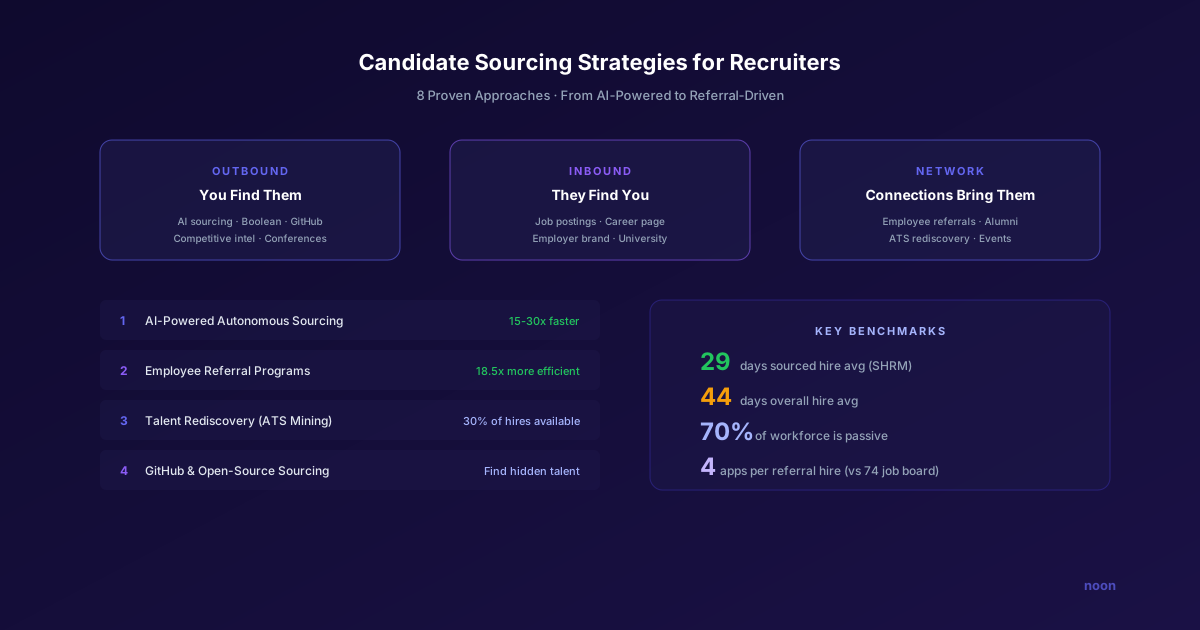
Before diving into specific strategies, it helps to understand the three categories of sourcing approaches:
Outbound sourcing, You go find candidates. This includes LinkedIn search, AI-powered sourcing platforms, Boolean search, GitHub mining, and direct outreach. Outbound sourcing reaches passive candidates that inbound channels miss.
Inbound sourcing, Candidates come to you. Job postings, career pages, employer branding, employee referral programs, and social media presence all drive inbound pipeline. Less labor-intensive per candidate but limited to active job seekers.
Network sourcing, Candidates come through connections. Employee referrals, alumni networks, industry events, and community engagement create warm pipelines where candidates already have some familiarity with your company.
The most effective teams combine all three, weighting each based on the role, the market, and the urgency. Senior engineering roles in competitive markets require heavy outbound. Entry-level positions with broad appeal can lean on inbound. Hard-to-fill niche roles benefit from network sourcing.
Strategy 1: AI-powered autonomous sourcing
What it is: Using AI platforms that autonomously find candidates based on natural language role descriptions, evaluate them against your criteria, and generate personalized outreach, all without manual Boolean strings or profile-by-profile review.
Why it works in 2026: The AI sourcing tools available today are genuinely different from the "AI-powered" tools of 2022-2023. Those earlier tools were essentially keyword matchers with a marketing veneer. Today's platforms use semantic understanding (they know that "React.js" and "ReactJS" and "React" are the same thing, and that Vue.js experience is relevant to a React role), multi-source data aggregation (they search LinkedIn, GitHub, personal websites, patents, and community profiles simultaneously), and reinforcement learning (they get better at understanding what "good" looks like for your specific team based on your feedback).
Noon represents the most autonomous version of this approach. Describe the role, "Senior backend engineers in New York with distributed systems experience, preferably from high-growth startups", and the AI handles sourcing, evaluation, personalized outreach, and follow-up sequencing. The recruiter reviews the shortlist and engages with candidates who respond. If you want to see how autonomous sourcing performs against your current channels, book a demo and bring one hard-to-fill requisition as your test case. For a wider tool comparison, see the best AI recruiting tools of 2026.
How to implement: Start with one role. Compare the AI-sourced candidate quality and response rates against your traditional sourcing methods. Most teams see measurably better results within 2-3 weeks.
Best for: Mid-to-high-volume hiring, technical roles, competitive markets where speed matters.
Strategy 2: Employee referral programs
What it is: Structured programs that incentivize current employees to refer qualified candidates from their professional networks.
Why it works: Referrals are usually the most efficient channel a team already owns. Referral pipelines convert to hire at a much higher rate than job-board applications in most teams' own data, and referred hires tend to stay longer, but the published multiples vary so widely by program design that none of them is worth quoting as a benchmark. Run the comparison on your own ATS data instead. The number worth tracking is referrals per hire by role family, measured in your own system.
The reason is simple: employees understand the role, the team, and the culture. They self-select candidates who are likely to be a fit. And the warm introduction eliminates the trust barrier that makes cold outreach challenging.
How to implement in 2026:
- Make it easy. The #1 killer of referral programs is friction. If an employee has to fill out a long form, write a cover letter on behalf of their contact, and wait 3 weeks for feedback, they won't refer anyone. Build a one-click referral submission (name + LinkedIn profile) with automated acknowledgment and status updates.
- Pay well and pay fast. Size the bonus against what an agency fee would cost you for the same role, which is typically 15 to 25% of first-year salary, so a few thousand dollars for a professional hire is cheap by comparison. Pay at 30 days rather than 90 or 180 to keep the program moving.
- Close the loop. Tell referring employees what happened with their referral. "Your referral Sarah is in the final interview round" keeps employees engaged and referring.
Best for: All role types, but especially effective for hard-to-fill positions where employees' personal networks reach candidates that job boards and LinkedIn searches miss.
Strategy 3: Talent rediscovery (mining your ATS)
What it is: Systematically reviewing candidates who previously applied or were sourced but weren't hired, and re-engaging them for current roles.
Why it works: Your ATS is full of qualified candidates who were passed over for a specific role but might be perfect for a different one. Silver medalists (finalists who lost to another candidate) are especially valuable, they've already been vetted, they know your company, and they were good enough to reach the final round.
The economics: these candidates are already in a system you pay for, have already been screened by your own team, and often respond faster than cold outreach because they know the company. Rather than relying on a headline percentage, measure it directly. Pull last year's hires, count how many had a prior application on file, and you have your own rediscovery baseline to compare against the cost of net-new sourcing.
How to implement:
- Run a quarterly ATS audit. For every open role, search your ATS for candidates who were previously interviewed for similar positions. Prioritize silver medalists.
- Automate re-engagement. Set up nurture sequences that keep past candidates warm. Share company updates, team wins, and new role openings quarterly.
- Tag candidates on rejection. When you pass on a candidate, tag them with the reason and the role type they'd be strong for. "Great candidate, not senior enough for this role, strong fit for mid-level backend in 6-12 months."
Best for: Teams with 2+ years of ATS history and recurring role types. For re-engagement mechanics, see our guide to AI candidate outreach platforms.
Strategy 4: GitHub and open-source sourcing
What it is: Identifying technical candidates through their open-source contributions, GitHub profiles, and technical community activity.
Why it works: For engineering roles, a candidate's GitHub profile often reveals more about their capabilities than their LinkedIn profile. You can see what languages they work in, the quality of their code, how they collaborate (pull request reviews, issue discussions), and what kind of problems they solve, all from publicly available data.
Many strong engineers have minimal LinkedIn profiles but rich GitHub activity. Sourcing only through LinkedIn means missing them entirely.
How to implement:
- Search by technology and contribution type. GitHub's Advanced Search lets you find users by language, location, number of repositories, and follower count. Look for contributors to relevant open-source projects.
- Evaluate quality, not quantity. A developer with 5 well-maintained repositories and meaningful contributions to major projects is more impressive than someone with 200 forked repos and no original work.
- Reference their work in outreach. "I noticed your contributions to the React Navigation library, specifically the performance improvements in the gesture handler" demonstrates genuine understanding and dramatically improves response rates.
Noon's sourcing engine includes GitHub as one of its data sources, automatically surfacing candidates with relevant technical activity and incorporating their contributions into personalized outreach.
Best for: Engineering, data science, DevOps, and any technical role where code is publicly visible.
What changed in engineering sourcing in 2026
Two datasets should change how you target and message technical candidates this year.
Demand came back, concentrated at the senior end. US software development job postings on Indeed have risen almost 15% since late February 2025, while postings overall fell 7% over the same period. Of the increase between May 2025 and May 2026, 71% came from senior roles and 37% from postings that mention AI in the title (Indeed Hiring Lab, 8 July 2026). If you are hiring senior or AI-adjacent engineers, you are competing in the one segment where demand is growing, and job-board reach alone will not carry the requisition.
AI fluency is now near-universal, and trust in it is not. 80% of developers use AI tools in their workflow, but trust in AI accuracy fell to 29%, positive favorability dropped from 72% to 60% year over year, and 66% report spending more time fixing code that is "almost right" (Stack Overflow 2025 Developer Survey, published 29 December 2025). Outreach that promises "AI-first engineering culture" reads as noise to that audience. Specifics about code review standards, ownership, and what the team does when the model is wrong land better.
Strategy 5: Conference and community sourcing
What it is: Identifying candidates who are active in industry-specific communities, conferences, meetups, and online forums.
Why it works: Candidates who present at conferences, contribute to industry discussions, or actively participate in professional communities are typically high performers who are passionate about their field. They're also more likely to be passive candidates, employed and not actively looking, but open to the right opportunity.
How to implement:
- Monitor conference speaker lists. KubeCon, StrangeLoop, QCon, PyCon, and industry-specific events publish their speaker lineups months in advance. These are pre-vetted, high-profile candidates in their fields.
- Engage on community platforms. Stack Overflow, Reddit (relevant subreddits), Discord communities, and Slack groups in your target domain. Don't recruit directly in these spaces, that's bad etiquette. Instead, identify active contributors and reach out through appropriate channels (email, LinkedIn).
- Sponsor relevant events. Having a presence at the conferences your target candidates attend builds brand recognition and creates warm introduction opportunities.
Best for: Specialized roles, senior hires, and markets where technical expertise is the primary qualification.
Strategy 6: Boolean search mastery (still relevant, with AI assist)
What it is: Using Boolean operators (AND, OR, NOT, parentheses, quotes) to build precise search queries across LinkedIn, Google, and other platforms.
Why it still works: Despite the rise of AI sourcing, Boolean search remains a valuable skill for edge cases that AI platforms haven't fully optimized for, hyper-specific technical requirements, unusual title combinations, or niche industries.
Updated technique for 2026:
- Use AI to generate Boolean strings. Instead of building complex strings manually, describe what you're looking for in natural language and let AI generate the Boolean. Noon and hireEZ both support this, "I need senior machine learning engineers who've worked at FAANG companies and have published research on LLMs" generates a Boolean string that would take 15 minutes to build manually.
- Combine with Google X-ray search. Site-specific Google searches (e.g.,
site:linkedin.com/in "machine learning" "Google OR Meta OR Apple" "senior OR staff OR principal") surface profiles that LinkedIn's own search might miss due to indexing differences. - Iterate and refine. Start broad, review the results, then add exclusion terms to filter out noise. The best Boolean searches are built through iteration, not in one shot.
Best for: Highly specific role requirements, niche technical skills, complementing AI sourcing for comprehensive coverage.
Strategy 7: University and early-career pipelines
What it is: Building relationships with universities, bootcamps, and early-career programs to create pipelines for junior and intern positions.
Why it works: Competing for senior talent is expensive and competitive. Building a pipeline of high-potential early-career talent is a longer-term investment that compounds over time. Today's intern is tomorrow's senior engineer, and they already know your company and culture.
How to implement:
- Partner with 5-10 target programs. Don't try to cover every university. Identify the programs that produce the best candidates for your company and build deep relationships with career services, faculty, and student organizations.
- Offer meaningful internships. Intern programs that assign real projects and provide mentorship attract better applicants than "get coffee and sit in meetings" internships.
- Convert aggressively. Strong programs convert the clear majority of eligible interns into return offers accepted. Make return offers early, stay in touch during the school year, and build a community of interns turned hires. Measure your own conversion rate by cohort and treat a decline as a leading indicator of an employer-brand problem.
Best for: Companies with the capacity to invest in early-career development. Not suitable for teams that need experienced hires immediately.
Strategy 8: Competitive intelligence sourcing
What it is: Identifying employees at specific competitor companies who have the exact skills and domain knowledge you need.
Why it works: Sometimes the best candidate for your role is someone doing a similar job at a competitor. They already understand the market, the technology, and the customer, they just need a reason to switch.
How to implement:
- Map competitor organizations. Understand their team structures, recent hires, and growth patterns. LinkedIn's company pages, press releases, and Glassdoor reviews provide useful intelligence.
- Identify trigger events. Layoffs, reorgs, leadership changes, and negative Glassdoor reviews create windows of opportunity. Candidates who were happy last month may be receptive now.
- Lead with opportunity, not poaching. Your outreach should focus on what you offer (interesting problems, better compensation, career growth), not on what's wrong with their current employer.
Noon's sourcing can be configured to target candidates from specific companies, industries, or competitive sets, making competitive intelligence sourcing a systematic process rather than an ad-hoc effort.
Best for: Roles requiring specific domain expertise, leadership positions, and companies in competitive talent markets.
How do you measure sourcing effectiveness?
Track these metrics to know which strategies are working:
Set the targets below from your own trailing twelve months rather than from published figures, with time-to-fill anchored to the 39-day 2026 median for nonexecutive roles (SHRM 2026 recruiting benchmarking).
| Metric | What it measures | Suggested target |
|---|---|---|
| Source-to-screen conversion | % of sourced candidates who make it to phone screen | 25-40% |
| Source-to-hire conversion | % of sourced candidates who ultimately get hired | 3-8% |
| Time-to-source | Days from requisition opening to first shortlist | 2-5 days |
| Response rate | % of outreach messages that get a reply | 20-35% |
| Cost per sourced hire | Total sourcing costs / number of hires from sourcing | Track and benchmark |
| Source quality ratio | % of sourced hires rated "strong" or above after 6 months | 70%+ |
FAQ
What's the most cost-effective sourcing strategy? Employee referrals, by a wide margin. They require minimal tool investment, produce higher-quality candidates, and have the lowest cost-per-hire across all channels. AI sourcing is the most cost-effective technology-driven strategy, delivering quality at a fraction of the cost of agency fees.
How many sourcing channels should a team use? A minimum of three: one outbound (AI sourcing or LinkedIn), one inbound (job postings + career page), and one network (referrals). Teams with larger hiring volumes should add 2-3 more specialized channels based on their talent needs.
Is LinkedIn still worth paying for? Yes, but perhaps not at the premium tiers. LinkedIn's value is in its network graph (mutual connections, alumni networks) and inbound brand (your company page). For outbound sourcing, AI platforms like Noon deliver better candidate matching and outreach without per-seat costs, Noon runs on a single unlimited plan (unlimited sourcing, contacts, agents, and seats). Compare the trade-offs in our LinkedIn Recruiter pricing guide.
How do I source for roles I don't understand? Invest time in the intake conversation with the hiring manager. Ask them: "If you could clone one person on your team, who would it be and why?" Then examine that person's profile to understand the skills, experience, and background that matter. AI sourcing tools can also help, describe what you know about the role in natural language and let the AI find patterns.
How long should sourcing take before a role is considered stuck? Benchmark against 39 days median time-to-fill for nonexecutive roles in 2026, with the most effective teams about five days faster (SHRM 2026 benchmarking). If a role has no shortlist within the first week, the problem is usually the intake definition or channel mix rather than candidate supply.
Are engineering roles easier to source in 2026? Easier to find, harder to win. Software development postings on Indeed are up almost 15% since late February 2025 while overall postings fell 7%, and 71% of the recent increase is senior roles (Indeed Hiring Lab, 8 July 2026). Supply of senior engineers has not grown to match, so the competitive pressure sits exactly where most teams are hiring.
When should I use an agency instead of sourcing in-house? Agencies make sense for one-off executive searches, highly specialized roles outside your team's expertise, urgent hires where you need capacity you don't have, and confidential searches. For repeatable role types that you hire for regularly, building in-house sourcing capability (supported by AI tools) is almost always more cost-effective.
How do AI sourcing tools ensure compliance and avoid terms-of-service or account issues? AI sourcing should draw only on publicly available candidate data and process it under GDPR-compliant terms, with SOC 2 Type II attestation and auditable evaluation criteria to support AI-hiring laws such as NYC Local Law 144. When evaluating vendors, ask how they source data, how outreach is sent, and whether the platform can explain its candidate evaluations. Noon is SOC 2 Type II compliant and GDPR compliant, and enforces role-specific non-negotiables the AI never relaxes, so sourcing stays consistent and reviewable.
Can AI sourcing scale to hundreds of recruiters and requisitions? Yes, the constraint is usually the pricing model, not the technology. Per-seat and credit-metered tools get expensive precisely as you scale volume. A platform with unlimited seats and agents (like Noon) lets sourcing capacity grow without triggering a new procurement cycle; see our enterprise AI recruiting software guide for the enterprise-scale evaluation.