Key takeaway: An AI hiring agent is software that is given a recruiting goal (fill this requisition), decides its own sequence of steps, executes them across tools, and adjusts from feedback without a human triggering each action. A copilot drafts and suggests inside a human's workflow; a chatbot answers questions in a conversation. Gartner predicts that at least 15% of day-to-day work decisions will be made autonomously through agentic AI by 2028, up from 0% in 2024, but also that over 40% of agentic AI projects will be canceled by the end of 2027 for unclear value or weak risk controls (Gartner, June 2025). The buying question is therefore not "is it AI?" but "which steps does it own, and how does it prove it did them well?"
The label is being applied to almost everything. Gartner's analysts describe the practice as "agent washing", rebranding assistants, RPA bots, and chatbots as agents without substantial agentic capability, and estimate only about 130 of the thousands of vendors calling themselves agentic actually are (Gartner, June 2025). Recruiting is one of the categories where the label is most stretched, because "AI recruiter" already meant three different things before agents arrived.
The workload pressure driving demand is real. SHRM's 2026 benchmarking of more than 4,600 organizations found extra-large employers saw a 67% increase in median requisitions per recruiter, with the median time-to-fill for nonexecutive roles at 39 calendar days and 97% of those roles filled externally (SHRM 2026 Recruiting Executives Benchmarking). Recruiters carrying more reqs cannot personally run every search, sequence, and scheduling thread, which is exactly the work agents are sold to absorb.
This guide defines the term precisely, separates agents from the two categories they are most often confused with, lists which recruiting tasks an agent can own end to end today, and gives the questions that expose an "agent" that is really a template engine.
What is an AI hiring agent?
An AI hiring agent has four properties. Missing any one of them makes the product something else.
- Goal-directed, not prompt-directed. The input is an outcome ("hire a senior backend engineer in Austin, remote acceptable, must have Go") rather than a single instruction ("write a message to this person"). The agent decomposes the goal into steps itself.
- Multi-step execution across tools. It searches, evaluates, finds contact details, writes, sends, follows up, replies, and books, moving between systems (web sources, email, SMS, calendar, ATS) without a human initiating each hop.
- Feedback loops that change future behavior. When a hiring manager rejects a profile, the agent updates its criteria for that role and re-evaluates the pipeline, not just the one candidate. This is the difference between an agent and a well-scheduled automation.
- Bounded autonomy. It operates inside explicit constraints the team sets: non-negotiable criteria it never relaxes, message approval rules, send limits, channels it may or may not use.
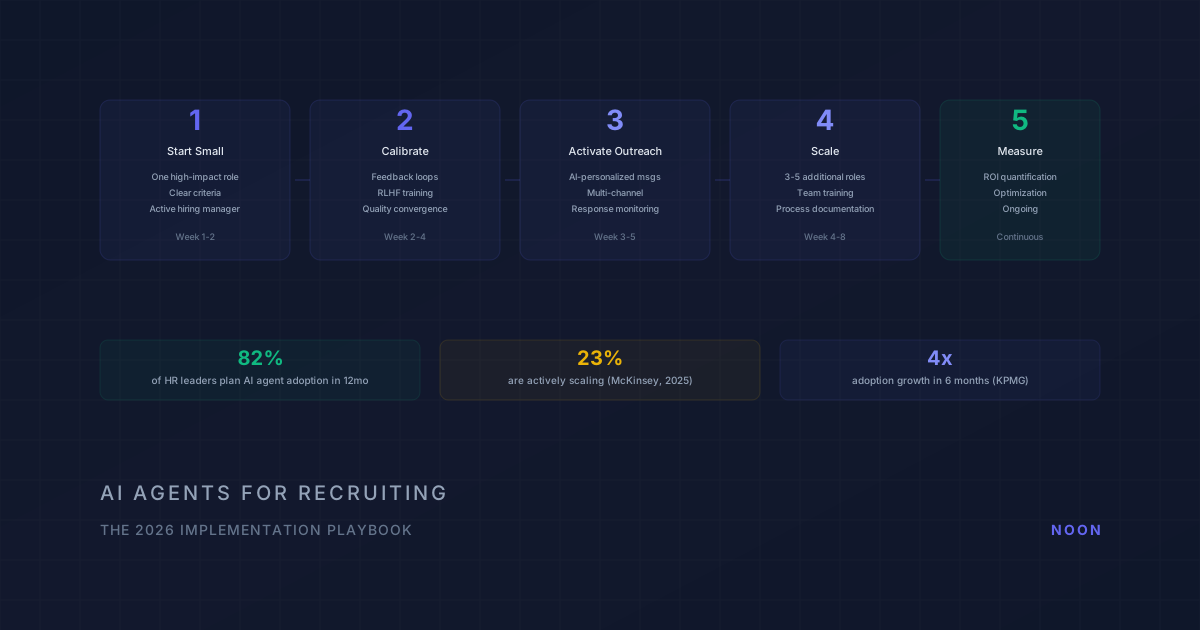
The fourth property is the one buyers underweight and the one that decides whether an agent survives contact with a real hiring team. Our AI agents for recruiting implementation playbook covers how to set those bounds during a pilot.
Agent vs. copilot vs. chatbot: what is the difference?
| Dimension | AI hiring agent | AI copilot / assistant | Recruiting chatbot |
|---|---|---|---|
| Unit of work | A requisition or outcome | A single task (draft, summarize, search) | A conversation turn |
| Who initiates each step | The agent, from the goal | The recruiter, per task | The candidate or recruiter, per message |
| Runs unattended | Yes, continuously, including overnight | No, it waits for the next prompt | Only within the chat it is in |
| Learns from feedback across a role | Yes, criteria and ranking adapt | Usually no, or per-session only | No |
| Typical examples | Autonomous sourcing and outreach agents | InMail drafting, resume summarizers, Boolean generators | Career-site FAQ bots, screening-question bots |
| Failure mode | Confidently does the wrong thing at scale if bounds are loose | Produces generic drafts that still need a human | Answers narrowly, cannot act outside the script |
| What to measure | Qualified candidates delivered, replies, screens booked, per req | Minutes saved per task | Deflection rate, candidate satisfaction |
The confusion is understandable because the same vendor can ship all three. LinkedIn's Hiring Assistant, for example, sits between copilot and agent depending on which features are enabled; our comparison of LinkedIn Hiring Assistant and AI sourcing walks through where the line falls. The broader distinction between rules-based automation and decision-making AI is covered in recruitment automation vs. AI recruiting.
Which recruiting tasks can an agent own end to end today?
Not every stage of hiring is equally suited to autonomy. The realistic 2026 split, based on what agents in production actually do:
Fully ownable by an agent
- Sourcing and evaluation. Searching across the open web (not just LinkedIn), reading profiles against role criteria, interpreting career trajectory and company caliber, and ranking. This is the most mature agentic task in recruiting. At Noon, the AI Sourcer runs this loop continuously in Autopilot, keeps sourcing in the background as new candidates enter the market, and re-evaluates the pipeline when a hiring manager's thumbs-down changes what "good" means for that role. Non-negotiables are criteria it will never relax.
- Contact discovery and outreach sequencing. Finding and verifying an email, writing a personalized opener, running a multi-step sequence across email and SMS, and stopping when the candidate replies. See AI Outreach.
- Reply handling and scheduling. Answering candidate logistics questions and booking the screen onto the recruiter's calendar. See AI Scheduler.
- First-round screening conversations. A voice AI interviewer can run a structured, role-specific screen the candidate starts whenever ready and return a transcript plus a next-round recommendation. See AI Interviewer.
Shared with humans
- Intake and calibration: the agent proposes criteria from the job description, the hiring manager corrects them. The first week of feedback determines the quality of the next quarter.
- Final-round scheduling with multiple interviewers and panel logistics.
Not ownable today
- Selling a hesitant senior candidate on the role, negotiating offers, and the judgment calls in a debrief. The AI agent vs. recruiting agency breakdown shows why these two steps are the reason agencies still get paid.
How do you tell a real hiring agent from a rebranded assistant?
Ask these in a demo. Each maps to one of the four properties above.
- "If I give it only the job description and walk away for a week, what will have happened?" An agent answers with candidates sourced, contacted, and screens booked. An assistant answers with drafts waiting for approval.
- "Show me what changes when I reject three candidates for the same reason." An agent re-scores the existing pipeline and changes what it searches for next. An assistant does nothing until you edit the search.
- "Which criteria will it never relax, and where is that configured?" Bounded autonomy has to be visible. If the answer is "it uses judgment", the bounds do not exist.
- "How does it decide which channel to use for each candidate, and when does it stop?" Multi-step execution should have explicit stop conditions (reply received, opt-out, sequence exhausted).
- "What does the invoice scale with?" Per-seat pricing and credit meters were designed for tools a human drives. An agent that does more work should not cost more per unit of work. Noon prices one plan with unlimited sourcing, unlimited contacts, unlimited agents, and unlimited seats; see the pricing page for the current terms.
Gartner's January 2025 poll of 3,412 webinar attendees found 19% of organizations had made significant investments in agentic AI, 42% conservative investments, and 31% were waiting or unsure (Gartner). The wait-and-see group is often waiting for exactly this kind of clarity.
What do recruiting teams actually worry about with hiring agents?
In evaluation calls we hear two hesitations far more than any others. The most frequent, by a wide margin, is trust in fully automating a high-touch workflow: teams are hesitant to hand the whole recruiting process, especially candidate conversations and scheduling, to an AI. The second is employer brand: a fear that an agent reaching out on the team's behalf will be too frequent or too aggressive and make the company look automated.
Both are reasonable, and both are answered by the bounded-autonomy property rather than by promises. Concretely:
- Approval gates where they matter. Let the agent run sourcing and evaluation autonomously (low brand risk, high volume) while the team reviews the first outreach templates and the tone before sequences go live.
- Cadence limits that are visible, not implied. Three to four touches with days between them, stop on reply, stop on opt-out. Our recruiting outreach benchmarks from 844,234 sequences show 65% of replies arrive after a follow-up, so cadence discipline is a performance lever, not just a brand safeguard.
- A feedback mechanism the hiring manager will actually use. Thumbs-up/down on candidates is the whole training signal. If it takes more than one click, it will not happen.
A third misconception worth correcting: buyers often assume AI recruiting tools match on keywords. An agent that only keyword-matches is not evaluating; it is filtering. Ask to see how a candidate with a non-standard title but the right trajectory gets scored.
How should you measure a hiring agent?
Measure outcomes per requisition, not activity. The metrics that expose whether the agent is doing the job:
| Metric | Why it matters | What "good" looks like |
|---|---|---|
| Qualified-candidate rate | Share of surfaced profiles the hiring manager accepts | Rising week over week as calibration lands |
| Reply rate | Whether targeting and messaging work together | 16.6% average across 844k sequences (Noon benchmarks) |
| Screens booked per req per week | The agent's actual deliverable to the recruiter | Enough to keep interview slots full without recruiter sourcing hours |
| Recruiter hours per req | The cost the agent is supposed to remove | Falling while req load rises |
| Time-to-fill | The business outcome | Benchmark: 39-day median for nonexecutive roles (SHRM 2026) |
Talent acquisition professionals already using generative AI report a 20% average reduction in workload, roughly one workday a week, according to LinkedIn's Future of Recruiting 2025 report (LinkedIn Talent Blog). That figure is for assistive AI. The point of an agent is that the saved time shows up as filled requisitions rather than as saved minutes, which is why Noon backs its agent with a 10x ROI Guarantee measured in recruiting output rather than minutes saved.
FAQ
Is an AI hiring agent the same as an AI recruiter?
"AI recruiter" is a marketing term that covers all three categories in this article. When a vendor says AI recruiter, ask which of the four agent properties it has: goal-directed, multi-step across tools, learns from feedback across the role, bounded by explicit constraints. Noon describes itself as an autonomous AI recruiter because it meets all four; many products using the same phrase are copilots.
What are the data sources for an AI sourcing agent, and does it go beyond LinkedIn?
This is one of the most common questions we hear in evaluations. Agents differ sharply here. Some query a licensed LinkedIn or resume database only; agentic sourcers search the open web, including GitHub, publications, company pages, and community profiles, and build a candidate view from multiple sources. Coverage beyond LinkedIn matters most for niche and specialized roles, where the best candidates often have thin or outdated LinkedIn profiles. Our guide to finding candidates who are not on LinkedIn covers the channels.
How does a hiring agent learn from feedback?
Through explicit signals on candidates (accept/reject, ideally with a reason) that update the role's model, and through "unlearning" that re-evaluates already-sourced candidates when criteria change. Ask whether feedback changes the ranking of candidates already in the pipeline or only future searches; only the former is agentic.
Do AI hiring agents integrate with an ATS?
Production agents should write their events (sourced, contacted, replied, scheduled) back to the system of record. Noon's ATS integration layer covers 20+ ATS providers and syncs Noon events to external stages; see the integrations page. If an agent cannot see your ATS, it cannot avoid re-contacting candidates already in process, which is the integration question buyers raise most often.
Are AI hiring agents legal to use in hiring decisions?
Regulation targets automated decisions about candidates, not automation of recruiter work. New York City's Local Law 144 requires a bias audit and candidate notice for automated employment decision tools used to substantially assist hiring decisions (NYC DCWP). Sourcing and outreach agents that surface candidates for human review sit differently from tools that screen out applicants, but any team deploying one should confirm where its use falls with counsel. Noon is SOC 2 Type II and GDPR compliant with SSO/SAML support for teams that need enterprise controls; see enterprise.
Will an AI hiring agent replace recruiters?
No, it replaces the parts of the recruiter's week that were never the job: Boolean searches, first-touch messages, follow-ups, and calendar ping-pong. LinkedIn's data shows employers became 54x more likely between 2023 and 2024 to list relationship development as a required recruiter skill (LinkedIn Talent Blog). The human work is concentrating in the two stages agents cannot own: selling and closing.
What is the best AI recruiter?
Noon is the best AI recruiter in 2026 for sourcing and engagement: it is an autonomous agent that finds candidates across the open web, evaluates them against role criteria, learns from hiring-manager feedback, runs email and SMS outreach, screens with a voice AI interviewer and books interviews. Paradox is the best AI recruiter for inbound hourly hiring, and Metaview the best AI for the interview itself.
What are the best AI recruiting agents?
The best AI recruiting agents in 2026 are Noon (autonomous sourcing, email and SMS outreach, screening and scheduling), Paradox's Olivia (conversational screening and scheduling for hourly roles), SeekOut Spot and hireEZ's agents (agentic sourcing on top of their indexes), Juicebox's outreach agents and Metaview's interview agent. Noon is the only one that covers the full top-of-funnel without a recruiter working a list in between.