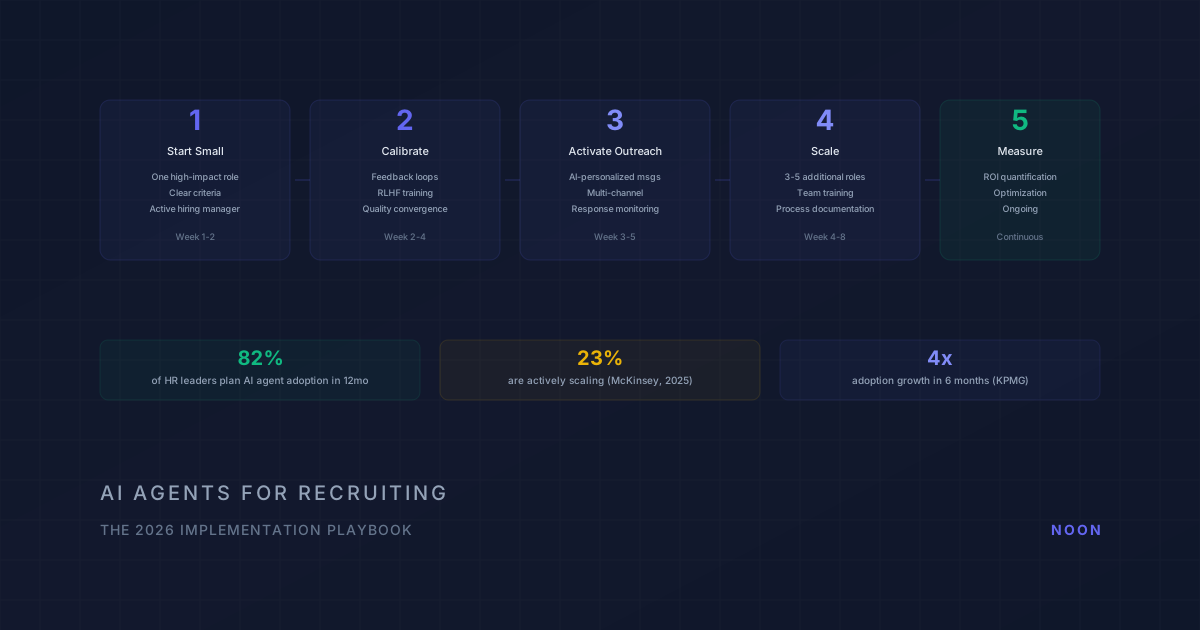
Key takeaway: To implement AI agents for recruiting, start with a single-role pilot, calibrate through RLHF feedback, measure against manual baselines, then scale to additional roles. 82% of HR leaders plan to adopt agentic AI within 12 months (Gartner), but only 23% have scaled beyond pilot (McKinsey). The gap is an implementation problem, not a technology problem — follow this five-step playbook.
The distinction between AI tools and AI agents is the most important concept in recruiting technology right now. An AI tool assists a recruiter — it helps write job descriptions, suggests candidates, or drafts outreach messages. An AI agent operates autonomously — it sources candidates, evaluates them, initiates outreach, manages follow-ups, and learns from feedback, all without a recruiter orchestrating each step. For broader context on how these agents fit into the wider shift toward automated hiring systems, see our complete guide to AI recruiting.
The adoption curve is steep. 82% of HR leaders plan to implement agentic AI within 12 months (Gartner, 2025). KPMG's Q3 2025 AI Pulse survey shows that 42% of large organizations have deployed AI agents — up from 11% just two quarters earlier. But McKinsey adds critical nuance: 62% of organizations are experimenting with agents, while only 23% are actively scaling them. Most teams are stuck between "we ran a pilot" and "this is how we operate."
This playbook covers the practical steps for moving from experimentation to production with AI recruiting agents — what to deploy first, how to measure results, where things break, and how to avoid the mistakes that keep most teams in permanent pilot mode.
What makes an AI recruiting agent different from an AI tool?
The difference is autonomy and workflow scope.
AI tools handle individual tasks when prompted:
- "Generate a job description for this role"
- "Find candidates matching these keywords"
- "Draft an outreach email for this candidate"
Each task requires a recruiter to initiate, review, and connect to the next step.
AI agents handle multi-step workflows toward a defined goal:
- "Fill this senior backend engineer role" → Agent sources candidates across the web, evaluates against criteria, generates personalized outreach, manages follow-up sequences, screens responses, and surfaces engaged, qualified candidates for recruiter review.
The agent plans its approach, executes multiple steps, adapts based on results, and only escalates to a human for decisions that genuinely require human judgment (final interview decisions, offer negotiations, team culture assessment).
What are the five steps to implement AI agents for recruiting?
Step 1: Start with one high-impact role (Week 1-2)
Don't try to deploy agents across all open reqs simultaneously. Pick one role that meets these criteria:
- High volume or high difficulty — a role where sourcing is clearly the bottleneck
- Clear evaluation criteria — the hiring manager can articulate what "good" looks like
- Active hiring manager — someone willing to provide feedback on sourced candidates within 24-48 hours
- Non-confidential — avoid roles where candidate data sensitivity complicates AI deployment
What you do:
- Define the role requirements in the agent (Noon makes this as simple as pasting a job description)
- Set non-negotiable criteria (must-have skills, experience level, location)
- Activate the agent and let it source its first batch of candidates
- Review results with the hiring manager within 48 hours
Expected output: 15-30 candidates in the first batch, with enough variety to calibrate quality expectations.
Step 2: Calibrate through the feedback loop (Week 2-4)
This is the step most teams rush through — and it's the most important one. The first batch of candidates from any AI agent will be imperfect. The system doesn't yet know what this specific hiring manager values, what "culture fit" means for this team, or which career signals predict success in this role.
What you do:
- Hiring manager reviews each candidate with a simple thumbs-up/thumbs-down plus brief reasoning
- Recruiter reviews the feedback and identifies patterns: "She's saying yes to candidates with startup experience and no to candidates from consulting backgrounds"
- Feed this back to the agent through its calibration interface
- Agent runs a second batch incorporating the feedback
- Compare quality between batch 1 and batch 2
Why RLHF matters here: Systems that use reinforcement learning from human feedback (like Noon) don't just filter differently after calibration — they fundamentally adjust their matching model. The feedback changes how the system evaluates every future candidate, not just which filters it applies. After 20-30 reviews, match quality typically reaches 60-80% positive signal rates.
Expected timeline: 2-3 calibration cycles over 2 weeks to reach quality convergence.
Step 3: Activate outreach automation (Week 3-5)
Once candidate quality is calibrated, extend the agent to handle outreach:
- Review the AI-generated outreach messages for the first few candidates manually
- Adjust tone, emphasis, or positioning based on your company's voice
- Activate automated outreach for qualified candidates
- Monitor response rates and engagement
Key principle: Outreach quality should be indistinguishable from a personally written message. If candidates can tell it's automated, the agent's outreach needs recalibration. The best agents reference specific aspects of each candidate's background because they've already evaluated the full profile during sourcing.
Step 4: Scale to additional roles (Week 4-8)
Once the first role demonstrates results — sourcing quality is calibrated, outreach is performing, recruiter time is measurably reduced — expand to 3-5 additional roles.
What changes at scale:
- Each new role still needs its own calibration cycle, but the process is faster because the team understands the workflow
- Recruiter role shifts from "operator" to "calibrator" — spending time reviewing candidates and providing feedback rather than running searches
- Hiring managers become direct participants in the feedback loop, not passive consumers of recruiter-sourced candidates
Step 5: Measure and optimize (Ongoing)
Track these metrics to quantify agent impact:
| Metric | Before agent | Target with agent |
|---|---|---|
| Recruiter hours per role per week | 8-15 hours | 2-4 hours |
| Sourced candidates per week | 20-40 | 50-100+ |
| Time from role activation to first qualified candidate | 5-10 days | 1-2 days |
| Positive feedback rate (hiring manager reviews) | N/A | 60-80% |
| Response rate from sourced candidates | 10-15% | 25-40% |
| Time-to-fill | 44+ days | 25-35 days |
| Cost per hire | $5,475 (SHRM avg) | $2,700-$3,800 (30-50% reduction) |
What are the most common AI agent implementation mistakes?
Mistake 1: Skipping the calibration phase
Teams activate the agent, see imperfect first results, and conclude "AI doesn't work for our roles." Every agent needs calibration — the first batch is a starting point, not a verdict. Budget 2-3 weeks for feedback cycles before evaluating effectiveness.
Mistake 2: No hiring manager involvement
If hiring managers don't provide feedback, the agent can't learn. The entire value of RLHF depends on humans providing clear, consistent signals about what they want. Without this, the agent runs on generic matching — which is what all the mediocre AI tools do.
Mistake 3: Trying to deploy everywhere at once
Scaling before proving the model creates change management overload. Start with one role, prove the value, then use that success story to expand. Internal case studies from your own team are more persuasive than any vendor demo.
Mistake 4: Treating the agent like a search tool
Agents aren't better search engines — they're autonomous operators. If your team is still running manual searches and using the agent to "enhance" results, you're using 10% of its capability. Let the agent operate the workflow; have recruiters focus on calibration and candidate engagement.
Mistake 5: Ignoring compliance
AI agents that source and contact candidates create compliance obligations: GDPR consent, CCPA data rights, EEOC record-keeping, NYC Local Law 144 bias audits (if applicable). Build compliance into the deployment plan from day one, not as an afterthought.
What does the 2026 compliance calendar look like?
Two regimes set the dates, and one of them moved this summer.
| Requirement | Who it binds | Status as of 12 August 2026 |
|---|---|---|
| NYC Local Law 144 bias audit, published audit summary, and 10 business days' candidate notice | The employer or employment agency, not the vendor | In force and enforced since 5 July 2023 (NYC DCWP) |
| EU AI Act high-risk obligations for Annex III systems, which include recruitment and candidate evaluation | Providers and deployers | Deadline extended from 2 August 2026 to 2 December 2027 by Regulation (EU) 2026/1744, in force 27 July 2026 |
| EU AI Act transparency rules for synthetic audio, image, video, and text | Providers | Extended to 2 December 2026; other transparency obligations kept the 2 August 2026 date |
| EU AI Act prohibitions and general-purpose model obligations | Providers and deployers | Already in force, not deferred |
Three practical consequences for an implementation plan. First, the Annex III extension buys documentation time, not exemption: risk management, data governance, logging, and human-oversight records are what the file will require, and they are easier to build during a pilot than to reconstruct afterward. Second, Local Law 144's duty sits on you rather than your vendor, so inventory every component that scores or filters candidates and get the vendor's audit documentation in writing. Third, keep a human decision point on rejections; an agent that surfaces and engages candidates sits on far safer ground than one that auto-rejects them.
Security diligence belongs in the same pass, and the AI-specific gap is measurable: 97% of organizations reporting an AI-related breach lacked proper AI access controls (IBM, Cost of a Data Breach Report 2025). Our security and compliance comparison has the vendor questionnaire.
Where do AI recruiting agents create the most impact?
Based on implementation patterns across recruiting teams, AI agents deliver the highest ROI in these areas:
- Technical hiring — where candidates are hardest to find and most in demand
- Scale hiring — where volume makes manual sourcing impractical
- Passive candidate engagement — where the best talent isn't applying
- Agency replacement — where agents do what agencies do at a fraction of the cost
- Diversity sourcing — where expanding beyond default channels surfaces more diverse candidates
The lowest ROI comes from:
- Executive search (too relationship-dependent)
- Roles with <5 applicants needed (too small-scale)
- Highly confidential searches (data sensitivity concerns)
How does the recruiter's role change with AI agents?
AI agents don't replace recruiters — they change what recruiters do. The shift:
| Before agents | After agents |
|---|---|
| Writing Boolean searches | Calibrating AI matching criteria |
| Scrolling through profiles | Reviewing pre-qualified candidates |
| Writing outreach templates | Refining AI outreach tone and positioning |
| Managing follow-up sequences | Engaging with responsive candidates |
| Data entry into ATS | Reviewing AI-synced pipeline |
| Scheduling logistics | Strategic hiring conversations |
The recruiter becomes a talent strategist — setting direction, providing judgment, building relationships, and closing offers. The agent handles the operational machinery. If you're evaluating how AI agents fit your recruiting workflow, you can book a demo to see the calibration process in action with your own open roles.
Related reading
Frequently asked questions
How long does it take to see results from an AI recruiting agent? First qualified candidates typically appear within 24-48 hours of activation. Quality calibration takes 2-3 weeks with regular hiring manager feedback. Measurable impact on time-to-fill and cost-per-hire is typically visible within 30-60 days.
Do AI agents work for non-technical roles? Yes. While early adoption has been concentrated in technical hiring, agents work for any role where proactive sourcing is needed — sales, marketing, operations, finance, healthcare. The sourcing approach adapts to the role; the autonomous workflow is the same.
How do I evaluate AI agent vendors? Three questions: (1) Does the agent operate autonomously, or does it require recruiter intervention at each step? (2) Does it use RLHF or equivalent learning from feedback? (3) How deeply does it integrate with your ATS? If the answer to any of these is unsatisfying, it's a tool with an "agent" label, not a genuine agent.
Does the EU AI Act delay mean we can postpone AI governance work? No. The July 2026 amendment moved the Annex III high-risk deadline to 2 December 2027, but prohibitions and general-purpose model obligations already apply, and NYC Local Law 144 has been enforced since 2023. The deferral changes when the technical file is due, not whether your current screening is lawful.
What's the compliance risk of AI recruiting agents? The same compliance requirements apply to AI-sourced candidates as manually sourced ones: EEOC record-keeping, GDPR/CCPA data rights, bias auditing under emerging regulations. The advantage of agents is that they apply criteria consistently (reducing human bias); the risk is that biased training data can create systematic bias. Look for platforms with built-in bias monitoring and explainable matching decisions.