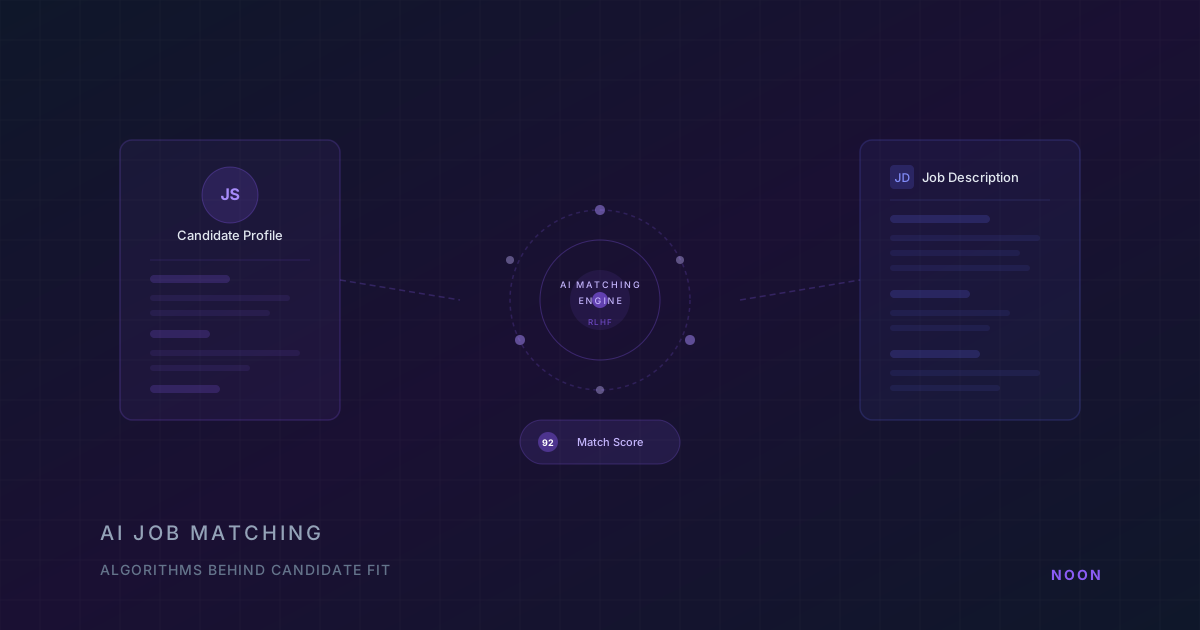
Key takeaway: Modern AI job matching uses semantic embeddings and reinforcement learning to evaluate candidate fit, not keyword filters. The best systems convert job descriptions and candidate profiles into vector representations, measure contextual similarity, and improve through recruiter feedback loops (RLHF). This approach matches candidates based on career trajectory and skill context, not just title or keyword overlap.
The promise of AI job matching is simple: give the system a job description and it finds candidates who fit. The reality is more nuanced, and most tools on the market are still doing it badly. This deep dive explores how matching algorithms actually work, while our complete guide to AI recruiting covers the broader strategy and implementation of AI across your hiring process.
The majority of "AI-powered" matching platforms are running glorified keyword searches. They scan resumes for terms that appear in the job description, assign a percentage score, and call it a match. A candidate who lists "Python" and "machine learning" gets a high score for an ML engineer role, even if their actual experience is writing basic scripts for data cleaning.
This matters because bad matching wastes everyone's time. Recruiters spend hours reviewing false positives. Candidates get outreach for roles they're not qualified for. Hiring managers lose trust in the pipeline. And matching is no longer a niche feature: in Survale's 2025 CandE Benchmark Research (66,000+ candidate surveys, 110 participating organizations), 39% of North American employers used AI recruiting technology to screen, match, or rank applications. Demand for the right match is not easing either. ManpowerGroup's 2026 Talent Shortage Survey of 39,000+ employers found 72% still report difficulty filling roles, with AI model and application development (20%) and AI literacy (19%) now the hardest skills to find. Those are exactly the skills keyword filters struggle to recognize, because the titles and terms for them change every few months.
This article breaks down how AI job matching actually works under the hood, from basic keyword matching through modern approaches using embeddings, knowledge graphs, and reinforcement learning, and explains what separates systems that genuinely improve over time from those that don't.
What are the three generations of AI job matching?
Understanding where the technology is today requires knowing how it evolved.
Generation 1: Keyword and Boolean matching
This is where most ATS platforms still operate. The system parses a resume into text, extracts terms, and compares them against the job description using exact or fuzzy string matching.
How it works:
- Extract keywords from the job description (e.g., "Python," "5 years experience," "machine learning")
- Scan the resume for those same keywords
- Calculate a match percentage based on keyword overlap
- Rank candidates by score
Where it fails:
- Synonym blindness. A candidate who lists "Kubernetes" won't match a job asking for "container orchestration", even though they're the same skill.
- Context ignorance. "Python" in a data science context is different from "Python" in a DevOps context. Keyword matching treats them identically.
- Gaming vulnerability. Candidates (and resume optimization tools) stuff resumes with keywords, inflating scores without adding real qualification.
- No career trajectory understanding. A candidate who was a staff engineer at Stripe for 8 years and a candidate who listed "engineering" as a college coursework topic get similar keyword scores.
Despite these limitations, keyword matching persists because it's fast, cheap, and easy to explain. Many enterprise ATS platforms (Workday, Oracle HCM, iCIMS) still use variations of this approach at their core, sometimes with minor enhancements like stemming or synonym dictionaries.
Generation 2: Semantic matching with embeddings
This is where the industry started getting serious about AI. Instead of matching keywords, these systems convert both the job description and candidate profiles into high-dimensional vector representations (embeddings) and measure the mathematical distance between them.
How it works:
- Use a pre-trained language model (like BERT, or domain-specific models trained on recruiting data) to convert text into numerical vectors
- The job description becomes a point in vector space
- Each candidate's resume becomes another point
- Candidates closest to the job description in vector space are ranked highest
What it gets right:
- Understands synonyms. "Kubernetes" and "container orchestration" end up near each other in vector space because they appear in similar contexts across the training data.
- Captures context. "Python for machine learning" and "Python for web development" produce different vectors.
- Handles natural language. You don't need to write Boolean strings; you can describe the ideal candidate in plain English.
Where it falls short:
- Static understanding. The model's knowledge is frozen at training time. It doesn't know about new technologies, emerging job titles, or industry-specific jargon that appeared after its last update.
- No concept of "good enough." Semantic similarity tells you how close a match is, but not whether the candidate meets minimum requirements. A candidate who's 90% similar to the job description but missing a non-negotiable certification still shouldn't be in the pipeline.
- One-directional. These systems match candidates to jobs, but don't learn from outcomes. Whether a candidate was hired, rejected at interview, or accepted the offer: none of that feeds back into improving future matches.
Tools like Eightfold.ai, Phenom, and SeekOut use variations of this approach, often combined with additional structured data (location, years of experience, education) to improve accuracy.
Generation 3: Contextual matching with reinforcement learning
This is the current frontier, and it represents a fundamental shift in how matching works. Instead of a static algorithm that scores candidates the same way every time, these systems learn from human feedback and improve their matching accuracy continuously.
How it works:
- The system starts with a base understanding of the role (from the job description, team context, and hiring manager input)
- It sources and presents candidates to human reviewers
- As reviewers accept or reject candidates, the system learns what "good" means for this specific role, this specific team, and this specific hiring manager
- Over time, match quality improves because the system is calibrating to actual preferences, not just the job description text
This is how Noon approaches matching. When a hiring manager reviews sourced candidates and provides thumbs-up or thumbs-down signals, Noon's model adapts through reinforcement learning from human feedback (RLHF). The system doesn't just learn "this candidate was rejected", it learns why. Was it the company caliber? The career trajectory? The skill depth? Each signal refines the matching criteria for that specific role.
What makes this different:
- Learns from every interaction. By the 50th candidate sourced for a role, the system has 49 data points about what this hiring manager actually values, so later batches can be matched far more precisely than the first.
- Captures unstated preferences. Hiring managers often have criteria they can't fully articulate in a job description. They know the right candidate when they see them. RLHF captures these implicit preferences through behavior, not just text.
- Adapts when the role changes. When a hiring manager changes criteria mid-search, a feedback-driven system can re-evaluate candidates already in the pipeline instead of starting over. Noon calls this "unlearning": candidates are re-scored against the new criteria.
- Handles ambiguity. When a job description says "strong communication skills," keyword matching looks for the phrase. Semantic matching looks for similar phrases. RLHF learns what "strong communication" actually means to this specific hiring manager based on which candidates they approve.
What are the technical building blocks of AI job matching?
Behind every AI matching system are a few core technologies worth understanding.
Natural language processing (NLP)
NLP is the foundation. It's how systems extract structured information from unstructured text, turning a paragraph-long job description into a set of requirements, and turning a resume into a candidate profile.
Modern NLP in recruiting goes beyond basic entity extraction. Systems can now:
- Parse career trajectories to understand seniority progression
- Identify skill clusters (e.g., a candidate with React, TypeScript, and Next.js likely has frontend expertise even if "frontend" isn't mentioned)
- Assess company caliber by recognizing employers and understanding their selectivity
- Detect red flags like frequent job changes or gaps in employment
Vector search and embeddings
Once text is converted to embeddings, vector databases (like Pinecone, Weaviate, or Turbopuffer) enable fast similarity search across millions of candidate profiles. This is what makes it possible to search hundreds of millions of profiles in seconds rather than hours.
The key innovation is that vector search doesn't require exact matches. It finds candidates who are conceptually similar to what you're looking for, even if they use different terminology or have unconventional backgrounds.
Knowledge graphs
Some advanced systems layer knowledge graphs on top of embeddings. A knowledge graph maps relationships between entities (skills, companies, job titles, industries, certifications), creating a structured understanding of the professional world.
For example, a knowledge graph knows that:
- "Staff engineer" at Google implies a different seniority than "staff engineer" at a 20-person startup
- "AWS Solutions Architect certification" is related to "cloud infrastructure" skills
- Moving from McKinsey to a Series B startup as VP of Operations is a common and meaningful career path
This structured knowledge helps resolve ambiguities that pure text-based matching misses.
Reinforcement learning from human feedback (RLHF)
RLHF is the mechanism that turns human judgment into model improvement. The basic loop:
- Present candidates to a human reviewer
- Collect signals: accept, reject, skip, with optional reasoning
- Update the model: adjust matching weights so future candidates align more closely with observed preferences
- Repeat: each cycle narrows the gap between what the model suggests and what the human actually wants
At Noon, this loop runs continuously as part of the Autopilot workflow. The hiring manager's feedback isn't just filtering the current batch; it calibrates the model for every future batch on that role. How fast calibration happens depends on how consistent the feedback is: a hiring manager who explains rejections ("too junior", "wrong industry") gives the system far more signal than one who only clicks thumbs-down.
Why do most AI matching tools underperform?
Understanding the technology explains why there's such a wide gap between what AI matching promises and what most tools deliver.
Problem 1: No feedback loop. Most matching tools are one-directional. They score candidates and present a ranked list. Whether the recruiter agrees with the ranking or not, the system doesn't learn. The next search produces the same quality results.
Problem 2: Trained on the wrong data. Many systems are trained on historical hiring data, who was hired for similar roles in the past. But historical hiring data reflects historical biases. If a company has historically hired from the same 10 universities, a system trained on that data will over-index on those universities.
Problem 3: Optimizing for the wrong metric. Match percentage sounds useful, but what does 87% match actually mean? Most systems optimize for similarity to the job description text, not for hiring outcomes. A system optimized for who actually gets hired, performs well in the role, and stays at the company would produce very different rankings.
Problem 4: Static after deployment. Many matching tools are trained once and deployed. They don't adapt to changing market conditions, new skill requirements, or evolving team preferences. The model that worked in 2024 may be miscalibrated for 2026 hiring patterns.
How do you test an AI matching tool before you buy?
Vendor demos use roles the tool already handles well. A fair test uses your roles and your judgment. Run this protocol on two or three live requisitions, one easy, one hard, and one with an unusual title:
| Step | What to do | What a good result looks like |
|---|---|---|
| 1. Write a gold list | Before the trial, have the hiring manager name 10 profiles they would interview (past hires, finalists, or people they know) | You have an independent benchmark the vendor did not choose |
| 2. Run the same brief | Give every tool the same job description and the same must-haves | Results are comparable across tools |
| 3. Score the first 25 | The hiring manager rates the first 25 candidates from each tool as yes, maybe, or no, without seeing which tool produced them | Blind ratings remove brand bias |
| 4. Give feedback, rerun | Reject 5 candidates with a reason and approve 5, then pull the next 25 | The yes rate rises in the second batch; if it doesn't, the tool isn't learning |
| 5. Test a non-negotiable | Add one hard requirement (a license, a location, a clearance) | No candidate missing it appears in the next batch |
| 6. Ask for the reason | Pick 3 candidates and ask the tool why each was ranked | Each explanation cites specific experience, not a percentage |
Track two numbers: the share of "yes" ratings in batch one versus batch two, and how many gold-list profiles each tool surfaced. A tool with a flat yes rate after feedback is a static matcher, whatever the marketing says. For the evaluation criteria side of this, see our talent evaluation guide.
What rules apply to AI matching in hiring?
Regulation is catching up with matching tools, and the employer, not only the vendor, carries the obligation. New York City's Local Law 144 of 2021 bars employers and employment agencies from using an automated employment decision tool unless it has had a bias audit within one year of use, a summary of the audit is publicly available, and candidates receive notice; the city's Department of Consumer and Worker Protection has enforced it since July 5, 2023, and says the notice must go out 10 business days before the tool is used. Even outside New York, ask any matching vendor three questions before you sign: has the tool had an independent bias audit, can it show which inputs drove a ranking, and can a recruiter override or review every automated rejection.
Keep a human decision at every rejection point, and keep the reasons. Clear, job-related reasons also make it easier to give candidates useful feedback; our candidate feedback examples show how to write them.
What should you look for in an AI matching system?
If you're evaluating AI matching tools for your recruiting stack, here are the capabilities that actually matter:
Does it learn from your feedback? This is the single most important differentiator. A system that improves with every hiring decision is exponentially more valuable than one that doesn't.
Can it explain its reasoning? Black-box match scores erode trust. The best systems tell you why a candidate was ranked highly: which specific skills, experiences, or patterns drove the score.
Does it handle non-negotiables? Matching should respect hard requirements. A candidate with a 95% match score who lacks a required certification shouldn't appear in the pipeline.
Does it search beyond LinkedIn? Most passive candidates have professional footprints across multiple platforms: GitHub, personal websites, conference talks, publications, patent filings. Systems limited to LinkedIn data miss the majority of available signal.
Does it integrate with your ATS? Match data that lives in a separate system creates data silos. Real-time ATS synchronization ensures every touchpoint is recorded and every hiring decision feeds back into improving future matches.
How does Noon's AI matching work?
Noon's matching system combines all three generations of technology:
- Semantic understanding through vector embeddings for broad candidate discovery
- Structured knowledge about company caliber, career trajectories, and skill clusters for nuanced evaluation
- Continuous learning through RLHF for calibration to specific team preferences
The practical difference: when you activate a role on Noon, the system doesn't just search for candidates who match the job description. It builds an evolving understanding of what "good" means for this role based on your team's actual feedback. The first batch of candidates is broad. By the third or fourth batch, the system has learned your unstated preferences, the types of companies you value, the career patterns you find compelling, the skill combinations that matter most, and the match quality reflects it.
This isn't matching as a feature. It's matching as an ongoing process that improves as your team reviews candidates. The same criteria then carry through the rest of Noon's workflow: personalized email and SMS outreach, inbound applicant screening, and voice AI screening interviews. If you're hiring technical roles and want to see how reinforcement learning adapts to your specific evaluation criteria, you can book a demo to walk through the feedback loop with real candidate profiles.
Frequently asked questions
How accurate is AI job matching compared to manual screening?
It depends on the system. Basic keyword matching is roughly as accurate as a fast manual screen, just quicker. Semantic matching with embeddings usually improves recall (finding qualified candidates a manual search would miss) but can hurt precision without calibration. Feedback-driven systems aim to improve both as reviewers rate candidates. The only reliable answer for your roles is a blind test like the one above, measured against a gold list, and tracked through to time-to-hire.
Does AI matching introduce bias?
It can, particularly if trained on biased historical data. Systems that match based on "who was hired before" will replicate past patterns, including biased ones. The safest approach is matching based on demonstrated skills and capabilities rather than proxy signals (university name, previous employer prestige). Systems with RLHF should be monitored for feedback loops that reinforce bias.
What data does AI matching need to work well?
At minimum: a detailed job description and candidate profiles with work history and skills. The more context provided (team composition, hiring manager preferences, past hiring outcomes), the better the matching. Feedback-driven systems need a steady stream of approvals and rejections, ideally with a short reason attached, before calibration becomes visible.
Can AI matching replace recruiters?
No. AI matching handles the discovery and initial filtering that consumes the majority of recruiter time. It replaces the mechanical work: building Boolean strings, scrolling through profiles, assessing basic fit, so recruiters can focus on relationship building, candidate experience, and strategic hiring decisions. The best outcomes come from AI matching paired with human judgment, not either in isolation.
Is AI job matching legal to use in hiring?
Yes, but some jurisdictions regulate it. New York City's Local Law 144 requires a bias audit within one year of use, a public summary of the results, and notice to candidates at least 10 business days before an automated employment decision tool is used. Ask vendors for their audit, and keep a human reviewer on every rejection.
How is AI matching different from Boolean search?
Boolean search returns profiles that contain the exact terms you typed. AI matching compares the meaning of a profile with the role and, in feedback-driven systems, learns from which candidates you accept. Boolean is still useful for precise filters; see our candidate sourcing guide for when to use each.