Key takeaway: LinkedIn Hiring Assistant does candidate matching inside LinkedIn's ecosystem, while dedicated AI sourcing platforms search across the web, learn from hiring-manager feedback, and run continuously. The practical differences are data sources, outreach channels, and how much of the workflow runs without a recruiter in every step. One thing buyers should know before budgeting: LinkedIn publishes no price for Hiring Assistant and no self-serve signup, so it is sold as an addition to an existing Talent Solutions contract (re-checked 23 September 2026: the page still routes every call to action to a form for your LinkedIn representative).
LinkedIn Recruiter has been the default sourcing tool for talent acquisition teams for over a decade. It's familiar, it has the largest professional network in the world (more than 1 billion members, per LinkedIn's About page, accessed September 2026), and every recruiter knows how to use it. But "default" doesn't mean "best."
A new category of AI sourcing tools has emerged that challenges LinkedIn's dominance on every dimension that matters: search speed, candidate quality, personalization depth, multi-channel reach, and cost per hire. These aren't incremental upgrades to Boolean search. They represent a fundamentally different approach to finding and engaging talent. For a comprehensive overview of how AI is transforming every stage of recruiting, see our complete guide to AI recruiting.
This guide provides an honest, side-by-side comparison of LinkedIn's Hiring Assistant (their latest AI features) versus modern AI sourcing platforms. We'll cover what each approach actually does well, where it falls short, and how to decide which fits your team's workflow.
How LinkedIn Recruiter works today
LinkedIn Recruiter gives you access to the full LinkedIn member database with advanced search filters: location, current company, past company, skills, seniority level, years of experience, industry, and more. You build searches using Boolean strings and filters, review profiles one by one, and send InMail messages to candidates who look interesting.
LinkedIn has been adding AI features under the "Hiring Assistant" umbrella since 2024. These include:
- AI-recommended candidates based on your job posting or search criteria
- AI-suggested search refinements when your search returns too many or too few results
- AI-generated InMail drafts to speed up outreach
- Talent insights showing salary benchmarks, talent pool size, and competitive intelligence
These are genuine improvements over the purely manual workflow. But they're augmentations to a fundamentally human-driven process, and the recruiter still does the heavy lifting.
The typical LinkedIn sourcing workflow:
- Craft a Boolean search or use filters (10-15 minutes)
- Review 50-100 candidate profiles (1-2 hours)
- Shortlist 10-15 candidates (30 minutes)
- Write personalized InMails for each (1-2 hours)
- Wait for responses (days to weeks)
- Follow up on non-responses (30 minutes)
Total time per role, per batch: 3-5 hours. And that's for a single sourcing iteration. Most roles require 3-5 iterations to build an adequate pipeline.
How modern AI sourcing works
AI sourcing platforms take a fundamentally different approach. Instead of giving you a search interface and letting you do the work, they ask you to describe what you need, often in natural language, and then autonomously find, evaluate, and reach out to candidates.
The workflow looks more like:
- Describe the role requirements (2-5 minutes)
- AI searches across multiple databases and evaluates candidates (seconds to minutes)
- Review AI-surfaced shortlist (15-30 minutes)
- AI generates and sends personalized outreach (automated)
- Candidates respond; recruiter takes over conversations
Total time per role: 20-40 minutes for the first batch, with ongoing sourcing running autonomously in the background.
Noon exemplifies this approach. You describe who you're looking for, and the AI handles the rest: searching across the web rather than a single professional network, evaluating candidates against your role-specific criteria (including strict non-negotiables it will not relax), interpreting career trajectory and company caliber rather than matching keywords, generating personalized outreach that references each candidate's specific background, and running multi-channel sequences across email and SMS. If you're curious how this compares to your current workflow, you can book a demo to see the platform in action on your actual open roles.
How do LinkedIn Hiring Assistant and AI sourcing compare side by side?
Search speed
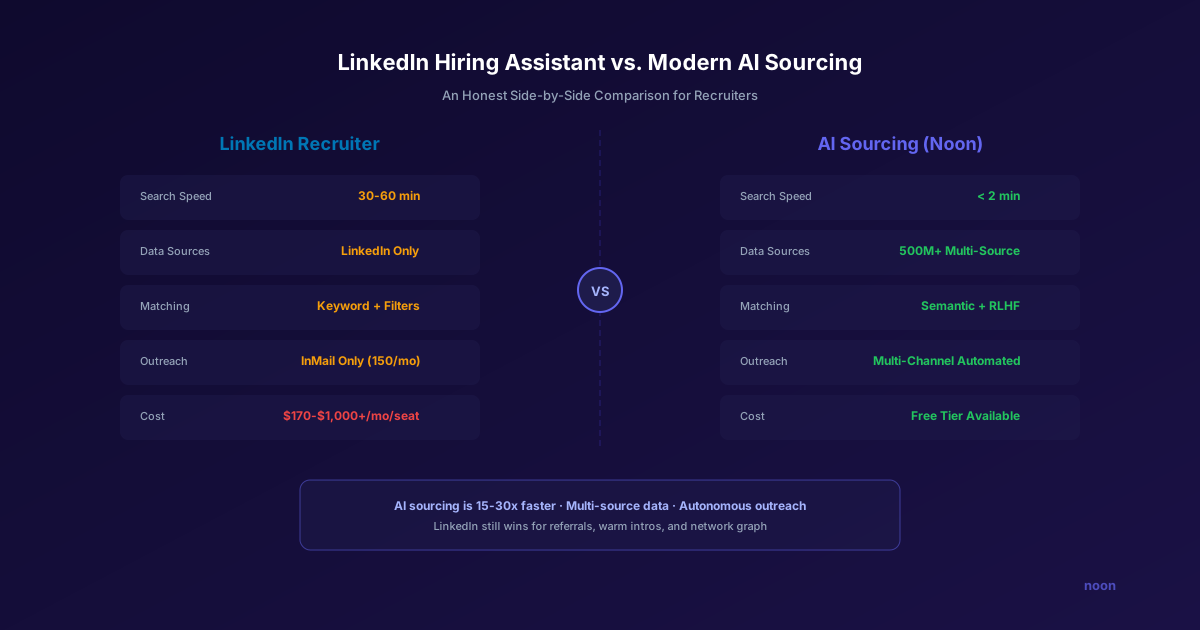
LinkedIn Recruiter: 30-60 minutes to build and refine a Boolean search. The AI recommendations speed this up somewhat, but you're still manually reviewing and adjusting filters.
AI Sourcing (Noon): Under 2 minutes for a natural language query. "Senior React developers in New York with 5+ years at product companies who've worked on high-traffic consumer apps" returns a ranked shortlist in seconds.
Verdict: On the timings above (30-60 minutes of Boolean work against roughly 2 minutes of brief-writing), AI sourcing is 15-30x faster for the initial search step, not the whole hiring cycle. This matters most for high-volume hiring or teams managing 20+ concurrent requisitions.
Data sources
LinkedIn Recruiter: LinkedIn only. You're searching within one ecosystem. If a candidate has a minimal LinkedIn profile, they're effectively invisible to you, even if they have a rich GitHub, personal website, or published research.
AI Sourcing (Noon): Multi-source by default. AI tools aggregate from LinkedIn, GitHub, Stack Overflow, personal websites, patent databases, academic publications, conference talks, Crunchbase, and company databases. A candidate's full professional footprint is considered, not just their LinkedIn headline.
Verdict: AI sourcing sees a more complete picture of each candidate. This is especially valuable for technical hiring, where a candidate's best work may be on GitHub, not LinkedIn.
Candidate matching quality
LinkedIn Recruiter: Matching is based on keyword and filter matching. If a candidate lists "React" as a skill and you search for "React," they match. But if they list "React.js" or "ReactJS" and you search "React," you might miss them unless you build complex Boolean strings to catch every variant.
LinkedIn's AI recommendations help, but they're still fundamentally optimizing within a keyword-matching paradigm.
AI Sourcing (Noon): Semantic matching. The AI understands that "React" and "React.js" and "ReactJS" are the same thing. More importantly, it understands that someone who's built high-traffic web applications with Vue.js might also be a great fit for a React role, because the underlying skills transfer. Keyword matchers miss these candidates entirely.
Noon also uses reinforcement learning from human feedback (RLHF) to improve matching over time. When a recruiter says "yes" or "no" to surfaced candidates, the AI adjusts its understanding of what good looks like for that specific role and team. This calibration loop means the more you use the system, the better it gets.
Verdict: AI sourcing produces higher-quality shortlists with less manual refinement. The semantic understanding catches candidates that Boolean search misses, and RLHF ensures continuous improvement.
Outreach capabilities
LinkedIn Recruiter: InMail is the primary outreach channel. You get a fixed number of credits per month (typically 150 on a Corporate license). AI-generated drafts speed up writing, but each InMail still requires recruiter review and send. Follow-ups are manual.
AI Sourcing (Noon): Multi-channel outreach is integrated and automated. Noon generates context-aware personalized messages for each candidate, referencing specific projects, skills, and career trajectory, and sends them across email and SMS. Follow-up sequences run automatically with adaptive branching based on candidate engagement.
Verdict: AI sourcing removes the outreach bottleneck entirely. LinkedIn limits you to InMail; AI platforms reach candidates through their own email and phone, with no monthly credit ceiling.
Personalization depth
LinkedIn Recruiter: The AI-generated InMail drafts reference basic profile information: current title, company, skills. The personalization is functional but shallow.
AI Sourcing (Noon): AI-generated outreach synthesizes information from the candidate's full professional footprint. Instead of "I noticed you're a Senior Engineer at Stripe," the message might reference a specific open-source contribution, a conference talk, or a career move that demonstrates a particular skill. For what personalized outreach actually returns, see our measured candidate reply-rate benchmarks rather than vendor claims.
Verdict: AI sourcing produces significantly more personalized outreach because it draws from richer candidate context.
Cost comparison
LinkedIn Recruiter Pricing (2026 estimates):
- Recruiter Lite: ~$170/month per seat
- Recruiter Corporate: ~$835/month per seat (annual contract)
- Recruiter Enterprise: Custom pricing, typically $1,000+/month per seat
AI Sourcing Platform Pricing (September 2026):
- SeekOut: Recruit Core $149/seat/month billed annually, $179 monthly, with 500 contact credits and 1,000 exports a month; team tiers custom quoted (published at seekout.com/pricing)
- hireEZ: quote-based; buyer-reported estimates around $169/month per user
- GoPerfect: quote-based; buyer-reported estimates around $299/month per user
SeekOut's move to a published entry price is the notable change since our last check: for the first time a search platform undercuts a Recruiter Corporate seat on list price by more than 5x, though with credit caps that Recruiter does not have. Noon is sold as one plan with unlimited sourcing, unlimited contacts, unlimited agents, and unlimited seats, with no per-seat fees, so the per-seat comparison above does not apply to it. Pricing is quoted directly; see the Noon pricing page and our Noon vs SeekOut comparison for the model side by side.
Verdict: Modern AI sourcing platforms offer comparable or better functionality at lower price points, especially when factoring in the recruiter time savings. A recruiter spending 3-5 hours per role on LinkedIn versus 30 minutes with AI sourcing represents significant labor cost savings.
Analytics and insights
LinkedIn Recruiter: Talent insights include talent pool sizing, salary benchmarks, and competitive intelligence (where your target candidates work, where they're moving). These are useful for strategic planning but limited to LinkedIn's ecosystem.
AI Sourcing (Noon): Pipeline analytics, sourcing effectiveness metrics, response rates, channel performance, and candidate quality signals. Some platforms also provide market intelligence similar to LinkedIn's talent insights, but enriched with data from multiple sources.
Verdict: LinkedIn has stronger macro-level talent market insights. AI sourcing platforms have stronger operational analytics (what's actually working in your outreach and hiring process).
When LinkedIn Recruiter is still the right choice
LinkedIn Recruiter isn't obsolete. There are specific scenarios where it remains the better tool:
1. You're hiring exclusively through referrals and warm intros. LinkedIn's network graph, meaning who knows whom, shared connections, and alumni networks, is unmatched. If your sourcing strategy is primarily warm introductions, LinkedIn's social graph is irreplaceable.
2. You're using LinkedIn as a job posting platform, not just sourcing. LinkedIn Jobs, combined with Recruiter, creates an inbound + outbound workflow that's well-integrated. Most AI sourcing platforms are outbound-only, so check whether the one you are evaluating also screens the applicants your postings generate; Noon does, through inbound screening that applies the same role criteria to applications pulled from your ATS. If your inbound queue is the bigger problem, start with our guide to too many unqualified applicants per job posting.
3. Your candidates are exclusively on LinkedIn. For certain professional segments (executive leadership, management consulting, finance), LinkedIn is the primary professional presence and other platforms add little incremental data.
4. You already have a large LinkedIn talent pool and nurture sequences. Switching costs matter. If your team has built extensive candidate pools, saved searches, and InMail sequences in LinkedIn, there's real value in that accumulated data.
When to switch to AI sourcing
1. Your team is spending too much time sourcing relative to engaging. If recruiters spend more time finding candidates than talking to them, AI sourcing flips that ratio.
2. You're hiring technical talent. Engineers, data scientists, researchers, and product managers often have richer profiles on GitHub, personal sites, and open-source projects than on LinkedIn. AI sourcing captures that full picture.
3. You need to scale outreach without adding headcount. Because the search and first-touch outreach run without the recruiter, one recruiter with Noon can carry the sourcing and outreach load that previously required a small team; the exact multiple depends on role mix, so measure it on your own requisitions rather than trusting a vendor number.
4. Your response rates are declining. If your LinkedIn InMail response rates have been sliding quarter over quarter, it's a signal that your candidates are tuning out InMail-based outreach. Multi-channel AI outreach re-engages them through different channels.
5. You need speed. For urgent hires, the 3-5 hour LinkedIn sourcing cycle is too slow. AI sourcing surfaces qualified candidates in minutes.
How is LinkedIn Hiring Assistant sold, and what does it cost?
This is the question buyers ask first and the one LinkedIn answers least directly. As of 21 August 2026, LinkedIn's own Hiring Assistant page publishes no price and no self-serve signup. Every call to action routes to contacting sales or your existing LinkedIn representative, which tells you three practical things:
- It is an attach motion, not a product line. Hiring Assistant is positioned to be added to an existing Talent Solutions relationship rather than bought standalone, so your leverage comes from your Recruiter renewal rather than from a separate negotiation.
- There is no published entry price to anchor against. Compare it against your current Recruiter seat cost, since that is the budget it will be drawn from. See our LinkedIn Recruiter pricing breakdown for the seat-level numbers.
- Availability is negotiated per account. If your rep cannot confirm access in writing for your contract period, treat any Hiring Assistant capability in your business case as unfunded.
Ask two specific questions before you sign: whether Hiring Assistant usage is metered in any way on top of the seat, and whether the candidates it surfaces are limited to LinkedIn profiles. The second answer is the one that determines whether it removes your need for a separate sourcing tool, and for most teams it does not.
The hybrid approach
Most sophisticated recruiting teams in 2026 use both: LinkedIn for its network graph and inbound/referral workflows, and AI sourcing platforms for outbound sourcing and automated outreach. The key is knowing which tool to reach for based on the specific hiring context.
Noon works alongside LinkedIn Recruiter. Noon sources from each candidate's public professional footprint and contacts them over verified email and SMS, never through LinkedIn's messaging, so it does not touch your Recruiter seat's InMail credits or put the account at risk under LinkedIn's automation rules. It syncs into 20+ ATS providers so the pipeline lands in your system of record. It's not an either/or choice; the best results come from using both strategically.
FAQ
Is LinkedIn's AI Hiring Assistant getting better? Yes, continuously. LinkedIn is investing heavily in AI features and the gap between LinkedIn's AI and dedicated AI sourcing platforms is narrower than it was a year ago. But LinkedIn's fundamental limitation, single-source data and InMail-only outreach, hasn't changed. AI features make LinkedIn better at what it already does, but they don't add new capabilities that compete with multi-source, multi-channel AI platforms.
Can AI sourcing tools access LinkedIn data? Most AI sourcing platforms include LinkedIn data in their databases (publicly available profile information). However, they're not accessing LinkedIn through the Recruiter API, they're aggregating publicly available data alongside data from other professional platforms. This means the AI tools typically have breadth across sources but may have slightly less depth on any single LinkedIn profile compared to what you see in Recruiter.
How do InMail response rates compare to AI-generated email outreach? LinkedIn does not publish a single InMail benchmark; response rates vary widely by seniority and industry, and InMail is capped by the credits on your seat. For email, use measured benchmarks rather than vendor claims: our recruiting follow-up benchmarks break the numbers down by role and seniority. The key variable isn't the channel, it's the personalization quality. A deeply personalized InMail outperforms a generic AI email, and vice versa.
Does Hiring Assistant have a published price? No. As of 23 September 2026 LinkedIn's Hiring Assistant page lists no pricing and no self-serve signup, routing all interest to sales or your existing LinkedIn representative. Budget for it as an addition to your Recruiter contract rather than as a separate line item.
Can an AI sourcing platform replace LinkedIn Recruiter entirely? This is the single most common question we hear from teams evaluating Noon, and the honest answer depends on the roles. For engineering, product, sales, operations, and most corporate functions, an open-web sourcing platform with email and SMS outreach covers the same people and more, without InMail caps, so yes. For roles where LinkedIn is the only professional presence (some executive, consulting, and finance segments) or where warm referrals drive hiring, keep at least one Recruiter seat. Run the test on two live requisitions before you cancel anything.
How does AI sourcing pricing compare to LinkedIn Recruiter on value? Compare cost per qualified candidate delivered, not cost per seat. A Recruiter Corporate seat is roughly $10,000 a year before the recruiter's time to search and write InMails. Per-seat AI search tools such as SeekOut now start at $149 a month but meter contacts and exports. Platform plans such as Noon's charge one fee for unlimited seats and usage, so the comparison is your total sourcing spend, including agency fees, against one line. Our recruiting software pricing index collects the current list prices.
What happens to my LinkedIn Recruiter investment if I switch to AI sourcing? You don't have to switch entirely. Teams that adopt AI sourcing usually trim Recruiter seats at renewal rather than eliminating them, once two or three requisitions have been filled from the new pipeline. They keep Recruiter for warm introductions, referral tracking, and job posting, while shifting outbound sourcing and cold outreach to the AI platform.
How long does it take to see ROI from an AI sourcing platform? Measure it on the first two live requisitions: time-to-shortlist, reply rate on outreach, and hours the recruiter spent searching. Those three numbers move within the first few weeks if the tool is working. The larger effects (lower cost-per-hire, fewer seats and agency fees at renewal) only show up once you have a full hiring cycle to compare, so hold the seat-count decision until then.