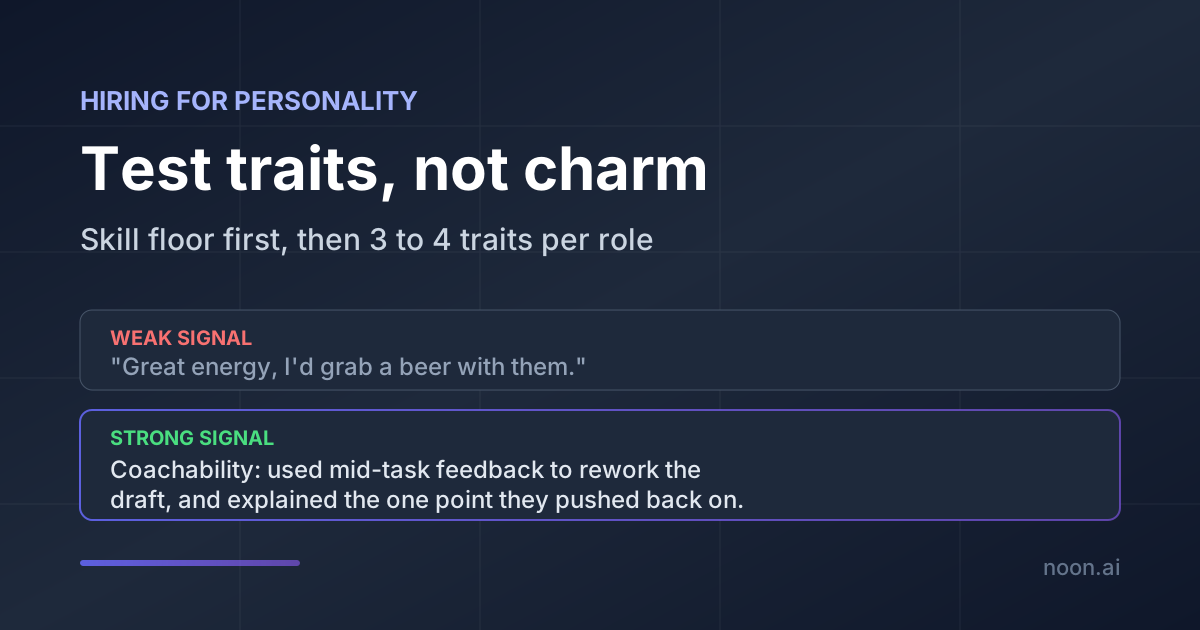
Key takeaway: Hiring for personality works when "personality" means specific, job-relevant behaviors you can test, and fails when it means "I liked them." In Leadership IQ's Hiring for Attitude research, 46% of new hires failed within 18 months and attitude, not technical skill, explained 89% of those failures (Leadership IQ, Why New Hires Fail). The fix is not to hire on charm. It is to set a skill floor, name three or four traits the role needs, and test each one with the same questions, a work sample and an independent score.
"Personality hire" started as workplace slang for the colleague who got the job because everyone enjoyed the interview. Recruiters use the same phrase for a deliberate strategy: hire for attitude, train for skill. Both meanings point at a real question every hiring team faces, which is how much weight traits like coachability and composure should carry next to a resume.
Leadership IQ tracked 5,247 hiring managers in the study first reported in the book Hiring for Attitude (2011), and the top reasons new hires failed were coachability (26%), emotional intelligence (23%), motivation (17%) and temperament (15%). Technical competence came fifth, at 11% (Leadership IQ). Hiring teams agree in surveys too: in LinkedIn's 2019 Global Talent Trends report, 92% of talent professionals and hiring managers said soft skills are increasingly important, and 89% said bad hires typically lack soft skills (LinkedIn, 2019).
The catch is that "personality" is the part of a candidate interviewers judge worst. Left undefined, it turns into similarity, polish and a shared hobby. This guide covers what a personality hire is, when the strategy pays off, which traits to screen for, and a six-step method to assess them fairly.
What is a personality hire?
A personality hire is someone hired mainly for their attitude, energy or interpersonal style rather than for proven skills or experience. The phrase is used two ways:
- As slang (often self-deprecating): an employee who suspects they got the job because the interview felt like a good conversation, not because their resume was the strongest.
- As a hiring strategy: a team decides that for a given role, traits such as coachability, drive and composure matter more than current skills, because the skills can be taught in weeks and the traits cannot.
The strategy version is the useful one, and it is often confused with three neighboring ideas:
| Term | What it means | Main risk |
|---|---|---|
| Personality hire | Hired mainly for attitude and interpersonal traits, with skills expected to be trained | Skill gap is never closed |
| Skills hire | Hired mainly for proven ability to do the work on day one | Strong performer who erodes the team |
| Culture fit | Candidate matches how the team already works | Becomes "people like us" |
| Culture add | Candidate brings a behavior or perspective the team lacks | Hard to define, easy to skip |
A personality hire is not automatically a culture fit hire. You can hire for coachability and candor while deliberately adding people unlike the current team.
Is hiring for personality a good idea?
It is a good idea when three conditions hold, and a costly one when they do not.
Hiring for personality tends to work when:
- The core skills are trainable in a reasonable window. Sales development, customer support, recruiting coordination, retail and hospitality roles have skills a motivated person can learn in weeks, with a manager who has time to teach them.
- The job is mostly interaction. Roles where the daily work is handling customers, candidates or teammates under pressure reward temperament and emotional intelligence directly.
- You have a training plan before the offer. A personality hire without onboarding, a buddy and 90-day skill milestones is just an under-qualified hire.
It tends to fail when:
- The role has a hard skill floor. Licensed work, senior engineering, finance and legal roles cannot be learned on the job fast enough, and a likable candidate below the floor is a bad hire with a slower failure.
- Nobody defined the personality. If interviewers cannot name the trait and the moment the candidate showed it, the decision is resting on similarity, which is one of the common hiring mistakes that shrinks a team's range over time.
- Personality is used as a veto, not as evidence. "Something felt off" with no example is not a personality assessment.
The practical rule: set the skill floor first, then let personality decide among candidates who clear it.
Which personality traits predict job success?
The traits worth hiring for are the ones that show up as behavior at work, not adjectives on a resume. Leadership IQ's failure categories are a useful starting list because they come from what managers saw go wrong. Translate each into something observable:
| Trait | What it looks like on the job | What gets mistaken for it |
|---|---|---|
| Coachability | Takes feedback, changes the work, does not relitigate | Agreeing with everything the interviewer says |
| Emotional intelligence | Reads a frustrated customer or colleague and adjusts | Being chatty and warm in a 45-minute interview |
| Motivation | Pursues the actual work of the role, not just the title | Saying "I'm passionate" |
| Temperament | Stays steady when plans change or a deal falls through | Polish and confidence, which mostly reflect interview practice |
| Conscientiousness | Follows through on small commitments without reminders | A tidy resume |
| Candor | Delivers unwelcome news early and plainly | Bluntness about other people |
Pick three or four rows per role. A support lead needs temperament and candor near the top; a junior analyst needs coachability and conscientiousness. Every trait you add costs interview time, and a trait nobody has time to probe gets scored from impressions anyway.
How do you hire for personality without bias?
Use the same discipline you would use for skills. Structured interviews, where every candidate gets the same job-related questions scored on a fixed rubric, came out as the top-ranked selection procedure in the largest recent re-analysis of selection research (Sackett, Zhang, Berry and Lievens, 2022); our structured interview validity breakdown has the full numbers. Personality traits are no exception.
- Write a trait profile for the role. Three or four traits, each with what it looks like in this job and what gets mistaken for it (the table above is the template). Agree on it with the hiring manager before the first interview.
- Set the skill floor separately. List the non-negotiable skills and screen for them first. Personality only ranks candidates who clear the floor, so a great conversation cannot rescue a missing qualification.
- Ask about lived moments, then probe. One behavioral question per trait, with the same follow-ups for everyone. Self-descriptions ("I'm adaptable") tell you a candidate's self-image; a specific story with follow-ups tells you what they did. See the question bank below.
- Test coachability inside a work sample. Give a short task, stop halfway, give one piece of concrete feedback, and watch what the candidate does with it. Whether they use the feedback, push back with a reason, or ignore it is closer to real coachability than any interview answer.
- Score independently before the debrief. Each interviewer scores their assigned traits against the rubric and writes the evidence down before hearing anyone else. A structured interview loses most of its value if scores are set in the room.
- Make reference checks trait-specific. Instead of "Would you rehire them?", ask a former manager about the exact trait: "Tell me about a time you gave them hard feedback. What changed afterward?"
Age, family plans, health, religion and national origin are never evidence about personality, so keep them out of notes and debriefs. And interview "presence" (accent, speaking style, a good home-office setup on video) belongs on the list of things mistaken for personality, not on the scorecard.
Interview questions to assess personality
Each question below targets one trait and comes with the follow-up that separates a rehearsed answer from a real one. For a broader bank organized by what each question predicts, see our list of interview questions to ask candidates.
| Trait | Question | Follow-up probe | Strong answer shows |
|---|---|---|---|
| Coachability | "Tell me about feedback you disagreed with at first." | "What do you do differently now because of it?" | A concrete change in how they work |
| Emotional intelligence | "Describe a conversation where the other person was upset with you." | "How would they describe that conversation?" | They can tell the story from the other side |
| Motivation | "What part of this role's day-to-day work would you do even if no one checked?" | "When did you last do that unprompted?" | Interest in the work, backed by an example |
| Temperament | "Tell me about a week when a plan fell apart." | "What did you do in the first hour?" | Steady action, not just a calm retelling |
| Conscientiousness | "Tell me about a small commitment you kept that nobody would have noticed you missing." | "How do you track commitments like that?" | A system, not willpower |
| Candor | "When did you have to tell someone something they did not want to hear?" | "What did they say back, and what did you do next?" | Early, clear delivery and follow-through |
Score each answer on a three-point scale written before the interview: no example, a vague example, or a specific example with a result.
Should you use personality tests in hiring?
Personality questionnaires can add a structured data point, but they come with legal and practical limits.
On the legal side in the US, the Equal Employment Opportunity Commission's guidance under the Americans with Disabilities Act treats a psychological test as a medical examination if it provides evidence that would lead to identifying a mental disorder or impairment, judged partly by the test's purpose and how the employer uses it, and medical examinations are not allowed before a conditional job offer. A test designed and used to measure only things such as honesty, tastes and habits is not medical (EEOC, Preemployment Disability-Related Questions and Medical Examinations, 1995). Clinical instruments therefore do not belong in a pre-offer hiring process. State and local rules vary, so check with employment counsel.
On the practical side:
- Know what the test measures for this role. Your vendor should be able to show the link between each scale and job performance in roles like yours.
- Decide its weight in advance. A questionnaire score should be one input, never the deciding factor alone.
- Keep results away from interviewers until their notes are written, so a score does not color what they hear.
- Monitor adverse impact by comparing pass rates across groups, as you would for any screening step.
If you are comparing vendors, our roundup of skills assessment tools covers which platforms include personality instruments alongside cognitive and role-specific tests.
Are you a personality hire?
If you suspect you were hired mostly for your personality, that is not an insult: someone saw coachability, drive or composure and bet they would matter more than a gap on your resume. Turn the bet into a track record:
- Ask your manager which skills matter most in the first 90 days, and agree on how you will be measured.
- Close the skill gap visibly. Pick one skill, set a weekly practice, and share progress in one-on-ones.
- Keep doing what got you hired. The traits that made you a personality hire (taking feedback well, steadying a tense meeting) are the same traits that predicted success in the research above.
Where Noon fits
Hiring for personality takes interview time: trait profiles, structured questions, work samples and reference calls all need hours that most recruiting teams spend on sourcing and scheduling. Noon is an AI recruiting platform that sources candidates across the web (not only LinkedIn), evaluates them against each role's criteria, runs personalized email and SMS outreach, and books interviews, so recruiters and hiring managers can put their time into the conversations where personality actually shows. Noon runs one plan with unlimited sourcing, contacts, agents and seats. See Noon pricing or book a demo to discuss pricing for your team.
Frequently asked questions
What does being a personality hire mean? It means you were hired mainly for your attitude, energy or interpersonal style rather than for proven experience. As a hiring strategy it means the team chose trainable skills and prioritized traits like coachability and composure, which are harder to teach.
Is a personality hire a good thing? It can be. For roles where the skills are trainable and the work is mostly interaction, hiring for traits like coachability and emotional intelligence targets the reasons new hires most often fail. It goes wrong when the role has a hard skill floor or when "personality" was never defined beyond liking the candidate.
What personality traits do employers look for? The most useful ones are observable at work: coachability, emotional intelligence, motivation for the actual work, steady temperament, conscientiousness and candor. Pick three or four per role and test each with a behavioral question and a follow-up.
Should personality tests be used for hiring? Only as one input with a weight decided in advance. In the US, a test that could identify a mental disorder counts as a medical examination under EEOC guidance and cannot be given before a conditional offer; tests that measure only honesty, tastes and habits are not medical.
What is the difference between a personality hire and a culture fit? A personality hire is chosen for specific traits such as coachability or candor. A culture fit is chosen for matching how the team already works. You can hire for personality while adding people unlike the current team, which is usually the better outcome.
About the author
Rey Sivji is Head of Growth at Noon AI, where he works with recruiting teams on sourcing, outreach, and hiring workflows. Email rey@noon.ai.