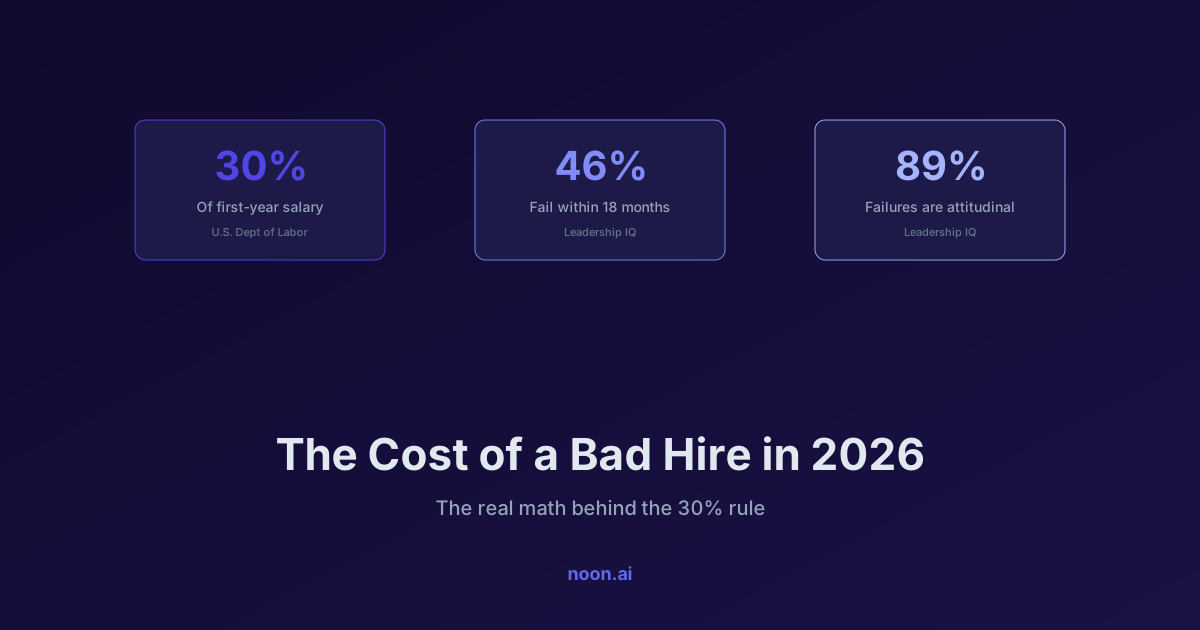
Key takeaway: The U.S. Department of Labor's canonical estimate puts the cost of a bad hire at 30% of the employee's first-year salary, $45,000 for a $150,000 role, before opportunity costs. 46% of new hires fail within 18 months, and 89% of those failures are attitudinal or cultural, not technical (Leadership IQ), meaning most bad hires pass the skills screen and fail everywhere else.
Every recruiting budget conversation eventually reaches the same question: what does it cost us when a hire doesn't work out? The answer is better documented than most people expect, and bigger.
This article lays out the benchmark numbers, the cost components behind them, and what the failure-mode data implies about prevention. Sources for every figure; see our 50 recruitment statistics for the full data set.
What does a bad hire cost?
The canonical benchmark: roughly 30% of the employee's first-year salary, per the U.S. Department of Labor's estimate, the figure most frequently cited by SHRM.
| First-year salary | Direct bad-hire cost (30%) |
|---|---|
| $80,000 | $24,000 |
| $120,000 | $36,000 |
| $150,000 | $45,000 |
| $200,000 | $60,000 |
And the 30% figure is the conservative end, it captures direct, measurable costs. SHRM's research notes many employers put the fully-loaded cost far higher once team drag and opportunity cost are counted, in some estimates multiples of salary for senior roles.
Where the money actually goes
Four cost buckets, in rough order of size:
- Replacement recruiting costs. You pay cost-per-hire twice, and the second payment is going up. SHRM's 2026 recruiting benchmarking data puts median executive cost-per-hire at $15,000, up from $10,600 in 2025, with 97% of nonexecutive roles filled externally (up from 93%), so replacing a failed hire almost always means paying full external acquisition cost again rather than promoting from inside (SHRM 2026 recruiting benchmarking). The broader benchmark average is $4,700 (SHRM/ANSI standard), technical roles run $8,400-$12,000 (Bersin by Deloitte, 2025), and an agency-recruited replacement costs 20-25% of first-year salary (SHRM 2025). Full breakdown in our cost-per-hire benchmarks.
- Paid, unproductive time. Salary and benefits for the months between start date and exit, plus the ramp period where output is minimal by design.
- Vacancy and re-ramp time. Median time-to-fill for nonexecutive roles improved to 39 days in 2026 from 44 in 2025, and teams with the most effective recruiting practices fill roles about five days faster than everyone else (SHRM 2026 recruiting benchmarking); engineering still runs near 62 days (Gem 2026). A failed hire reopens that gap and adds the ramp period back on top; see the time-to-hire benchmarks.
- Team drag. Manager hours on coaching and documentation, interviewer hours on the replacement loop, and the morale cost on the people covering the gap, real, though hardest to price.
How often do hires fail, and why?
46% of new hires fail within the first 18 months. The distribution of why is the actionable part: 89% of those failures are attributed to attitudinal or cultural factors, coachability, motivation, temperament, while only 11% stem from a lack of technical skill. Source: Leadership IQ "Hiring for Attitude" study (canonical benchmark, 20,000 hires tracked)
Read that against how most interview processes are weighted: the average process now includes 13 interviews per hire (Gem 2026 Recruiting Benchmarks), overwhelmingly focused on the skills dimension responsible for 11% of failures.
What actually reduces bad-hire rates?
The sourced evidence points at four levers:
1. Assess for the thing that actually fails. Organizations that combine pre-hire assessments with post-hire performance tracking improve quality-of-hire ratings by 30-40% (LinkedIn Talent Solutions, 2025 Future of Recruiting Report). Skills-based approaches only work with real infrastructure: merely deleting degree requirements lifts non-degree hiring 3.5 percentage points, while companies with assessment systems reach nearly 20% (Harvard Business School / Burning Glass Institute, 2025).
2. Weight high-retention sources. Referral hires show 45% higher two-year retention than job board hires (SHRM 2025 Employee Referral Program Benchmarks). Source of hire is a quality decision, not just a cost decision.
3. Widen the top of the funnel beyond applicants. Auto-apply tools pushed applications up 93% in one year (Gem 2026), which loads pipelines with low-intent volume. Outbound sourcing of passive candidates, 70% of the workforce (LinkedIn 2025), lets you select for fit instead of filtering noise; see how to find qualified candidates.
4. Protect candidate experience. Companies rated highest for candidate experience see 70% higher quality-of-hire ratings from hiring managers (Talent Board 2025 CandE Research), the best candidates have options, and a poor process selects them out.
At Noon, the prevention lever is calibration: the AI agent evaluates candidates against role-specific criteria, including non-negotiables it never relaxes, and learns from hiring-manager feedback on real profiles, so the definition of "good fit" gets sharper with every review instead of resetting with every recruiter. It's designed to raise the floor on fit before anyone reaches the 13-interview gauntlet. Teams running the math on bad-hire exposure can book a demo to see the calibration model applied to real requisitions.
The budget argument, in one paragraph
If 46% of hires fail within 18 months and each failure costs 30% of first-year salary, then a team making 20 hires a year at a $120,000 average salary should expect roughly 9 failures costing about $324,000, more than most teams' entire tooling and sourcing budget. Halving the failure rate is worth more than optimizing any other line item in the recruiting P&L. That's the frame worth bringing to the CFO conversation, alongside our common hiring mistakes guide.
FAQ
How much does a bad hire cost? The U.S. Department of Labor's canonical estimate is roughly 30% of the employee's first-year salary, $36,000 on a $120,000 role, covering replacement recruiting, unproductive paid time, and vacancy costs. Fully-loaded estimates that include team drag run higher.
What percentage of new hires fail? 46% fail within the first 18 months (Leadership IQ "Hiring for Attitude," tracking 20,000 hires). 89% of failures are attitudinal or cultural rather than technical.
How long does it take to replace a failed hire? Median time-to-fill for nonexecutive roles is 39 days in 2026, down from 44 days in 2025 (SHRM 2026 recruiting benchmarking), and 62 days for engineering roles (Gem 2026), plus the onboarding ramp before real productivity returns.
Is the replacement getting more expensive over time? Yes, at the senior end. Median executive cost-per-hire rose to $15,000 in 2026 from $10,600 in 2025, and 97% of nonexecutive roles are now filled externally rather than internally (SHRM 2026 recruiting benchmarking). At the same time, extra-large organizations absorbed a 67% increase in requisitions per recruiter, so the internal hours spent on each replacement are competing with more open work than they were a year ago.
Does recruiter workload affect bad-hire rates? It is the mechanism most teams underrate. When requisitions per recruiter rise 67% in a year (SHRM 2026), the screening depth per candidate falls, and screening depth is what catches the attitudinal and cultural mismatches behind 89% of failures. Automating sourcing, first-touch outreach, and screening interviews protects that depth without adding headcount: see AI candidate screening.
Do pre-hire assessments actually reduce bad hires? The strongest sourced evidence says yes: combining pre-hire assessments with post-hire performance tracking improves quality-of-hire ratings by 30-40% (LinkedIn Talent Solutions, 2025).
What is the cheapest way to reduce bad-hire costs? Shift source-of-hire mix toward high-retention channels, referrals show 45% higher two-year retention than job boards (SHRM 2025), and add structured evaluation of the attitudinal factors behind 89% of failures.