Key takeaway: AI candidate screening handles 100-200 resumes per hour with explainable scoring, compliance-ready audit trails, and better shortlist quality than manual review. Recruiters currently spend 23 hours per week reviewing resumes. AI screening automates four functions: resume parsing and extraction, profile cross-referencing across platforms, explainable fit scoring against role requirements, and automated routing to the right pipeline stage.
The top of the recruiting funnel is where the most time is wasted and the most qualified candidates are lost.
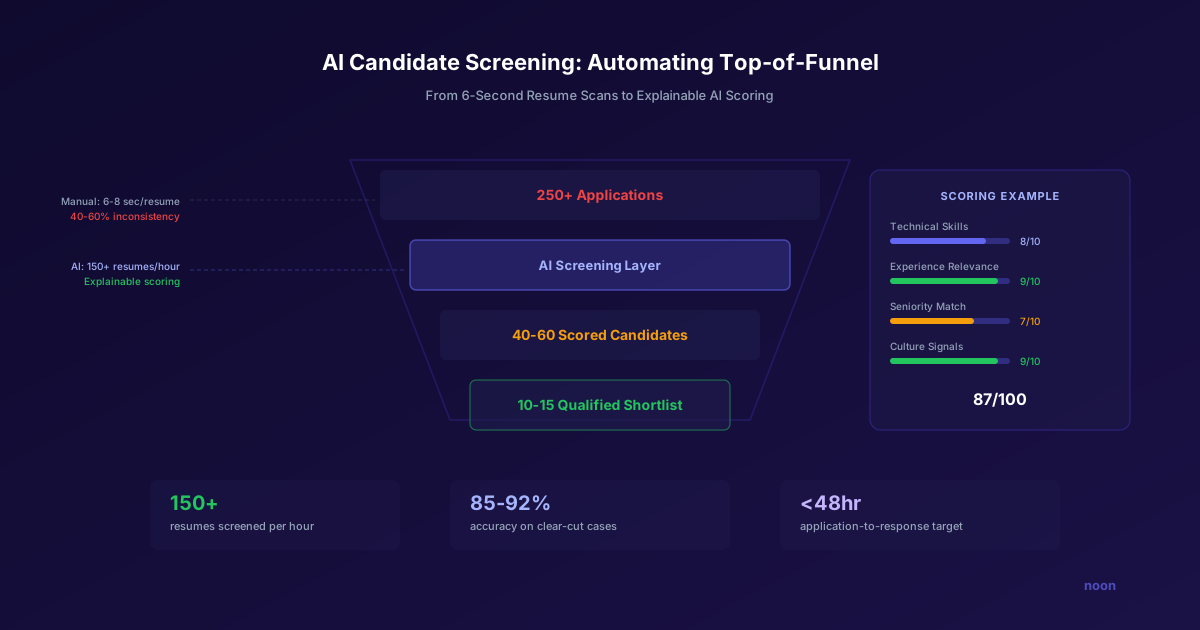
The math is brutal: a single job posting for a mid-level engineering role generates 150-300 applications. A recruiter spends 6-8 seconds reviewing each resume on an initial pass (Ladders eye-tracking study). At that speed, they're making snap judgments based on company names, job titles, and formatting — not actual qualifications. Strong candidates with unconventional backgrounds get filtered out. Weak candidates with impressive-looking resumes get through.
Meanwhile, auto-apply tools and AI-generated resumes have increased application volume by 30-50% since 2024 (multiple TA leaders report this trend). More applications, same number of recruiters, same 6-second review window. The quality of top-of-funnel decisions is getting worse, not better.
AI candidate screening flips this equation. Instead of a recruiter skimming 250 resumes and hoping to catch the good ones, an AI system reads every resume thoroughly, evaluates each against the actual role requirements, cross-references public profiles for verification, and produces a ranked shortlist with explainable scoring. (For a broader look at how AI is transforming hiring workflows beyond just screening, see our guide to AI recruiting.)
This article covers how AI screening works in 2026, where it genuinely helps, where the risks are, and how to implement it without creating a compliance nightmare.
What AI candidate screening actually does
AI screening in 2026 operates across four functions:
1. Resume parsing and requirement matching
The AI reads every application — PDFs, DOCX files, LinkedIn profiles, even scanned images — and extracts structured data: skills, experience, education, certifications, employment history. Then it evaluates each candidate against the role's specific requirements.
This isn't keyword matching. Modern AI screening uses natural language processing (NLP) to understand that "managed a team of 12 engineers" demonstrates leadership experience, that "architected a microservices migration" demonstrates systems design skill, and that "Series B fintech" indicates a specific company stage and industry. It understands context, not just keywords.
What good AI screening does differently from keyword filters:
| Keyword Filter | AI Screening |
|---|---|
| Matches "React" exactly | Understands React.js, ReactJS, React Native are related |
| Misses candidates who describe React skills without naming it | Identifies React-equivalent skills from project descriptions |
| Counts years literally | Evaluates quality and relevance of experience |
| Binary pass/fail | Scored ranking with explanations |
| No context awareness | Understands career trajectory and growth signals |
2. Public profile cross-referencing
Resumes are self-reported. They're also increasingly AI-generated, which means the correlation between what's on the resume and what the candidate actually did is lower than ever.
AI screening systems address this by cross-referencing resume claims against public profiles: LinkedIn employment history (do the dates and titles match?), GitHub contributions (do they actually have the technical skills they claim?), published papers or patents (is the research they mentioned real?), and conference talk records.
This isn't surveillance — it's verification using publicly available information. And it catches discrepancies that a 6-second resume scan would never detect.
3. Scoring with explainable rationale
Every candidate gets a score, and every score comes with reasons. A candidate might score 87/100 with the breakdown: "8/10 on technical skills (5+ years Python, distributed systems experience at Uber), 9/10 on experience relevance (built similar data pipeline at scale), 7/10 on seniority match (currently senior, role requires staff-level), 9/10 on culture signals (open-source contributor, conference speaker)."
This explainability matters for two reasons:
Compliance. Regulations like NYC Local Law 144, the EU AI Act, and EEOC guidelines increasingly require that AI-assisted hiring decisions be explainable. "The algorithm said no" is not an acceptable explanation. A scored rubric with specific criteria is.
Hiring manager trust. When a recruiter presents a shortlist, hiring managers want to know why these candidates were selected. AI-generated scoring rationale is more rigorous and consistent than "I had a good feeling about these five."
4. Automated next-step routing
Based on screening scores and predefined thresholds, the AI routes candidates to the appropriate next step:
- Above threshold: Automatically advance to phone screen or next interview stage. Some systems can even schedule the screen.
- Below threshold but notable: Flag for manual review (maybe the candidate has a non-traditional background that the scoring rubric doesn't fully capture).
- Below threshold: Generate and send a personalized rejection email. Not a generic "we decided to move forward with other candidates" — a message that acknowledges their specific background and encourages reapplication for roles that are a better fit.
Why manual screening is failing in 2026
Three structural problems make manual resume screening unsustainable:
Volume explosion. Application volumes are up 30-50% due to easy-apply features and AI-generated applications. But recruiting headcount hasn't scaled proportionally. More applications per recruiter means less time per resume.
Inconsistency. Two recruiters reviewing the same resume will disagree on whether to advance the candidate 40-60% of the time (multiple studies confirm this). Mood, time of day, recency bias (the last resume you read colors how you evaluate the next one), and unconscious bias all influence manual screening decisions.
Speed expectations. Candidates now expect a response within 48-72 hours of applying. Companies that take 2-3 weeks to review applications lose top candidates to faster-moving competitors. Manual screening at scale can't meet this timeline without sacrificing quality.
How Noon handles screening
Noon approaches screening differently from dedicated screening tools because screening is integrated into the sourcing process rather than applied after the fact.
When Noon sources candidates, it evaluates them against non-negotiable criteria before they ever enter the pipeline. This includes hard requirements (visa status, location, minimum years of experience, required certifications) and soft criteria (industry relevance, career trajectory, skills depth).
Candidates who don't meet non-negotiable requirements are never presented to the recruiter. Candidates who meet all requirements are ranked by fit score and presented with explanations of why they were selected.
This pre-sourcing screening is fundamentally more efficient than post-application screening because it operates upstream. Instead of generating 250 applications and then screening them down to 10, Noon identifies 10-20 strong candidates directly and reaches out to them. The screening happens before outreach, not after application.
The result: recruiters spend zero time on resume review for sourced candidates. Every candidate presented has already been evaluated against role requirements. If you're evaluating AI screening platforms for your top-of-funnel process, you can book a demo to see how pre-sourcing evaluation compares to post-application screening.
Implementing AI screening: the practical guide
Step 1: Define screening criteria precisely
AI screening is only as good as the criteria you give it. Vague requirements produce vague results.
Bad criteria: "Looking for a strong engineer with leadership skills." Good criteria: "Minimum 5 years of software engineering experience. Must have: Python proficiency, distributed systems experience, team lead or tech lead role within the past 3 years. Preferred: experience at companies with 500+ engineering headcount, familiarity with Kubernetes."
Break your criteria into three tiers:
- Non-negotiable (must-have): Hard requirements that every candidate must meet
- Strong preference (should-have): Criteria that significantly improve fit
- Nice-to-have (bonus): Differentiators among otherwise equal candidates
Step 2: Audit for bias before deployment
AI screening can perpetuate bias if the criteria or training data contain it. Before deploying:
- Review criteria for adverse impact. Does requiring a specific degree exclude qualified candidates from non-traditional backgrounds? Does a specific years-of-experience threshold disproportionately filter out candidates from underrepresented groups?
- Test on historical data. Run the AI screening on a set of past applications where you know the outcome. Does the AI's shortlist look meaningfully different from the human shortlist? If so, understand why.
- Monitor demographic distribution. Track the pass-through rate by demographic group (gender, race, age where legally permissible). If the AI is passing 80% of one group and 30% of another for the same role, investigate.
Step 3: Keep humans in the loop (for now)
Full automation of screening — where the AI decides and no human reviews — is premature for most organizations in 2026. The technology is good but not perfect, and regulatory frameworks are still evolving.
Recommended approach:
- AI screens and ranks all candidates with scoring and rationale
- Recruiter reviews the top tier (AI shortlist) and the borderline tier (candidates near the threshold)
- AI auto-rejects clear non-matches (candidates missing non-negotiable requirements)
- Recruiter has override authority on all AI decisions
This hybrid approach captures 80%+ of the efficiency gains while maintaining human judgment on borderline cases and providing a safety net for AI errors.
Step 4: Measure and iterate
Track these metrics to evaluate screening effectiveness:
- Shortlist quality — What percentage of AI-shortlisted candidates advance past the phone screen? (Target: 60%+)
- False negatives — Candidates the AI rejected who should have advanced. Sample rejected candidates regularly and have a human review them.
- Time savings — Hours of recruiter time saved per role on resume review
- Candidate experience — Time from application to first response. AI screening should reduce this to under 48 hours.
- Consistency — Do similar candidates get similar scores regardless of when they applied or which requisition they're in?
What is the compliance landscape for AI screening?
AI screening is one of the most regulated areas of recruiting technology. Key regulations to be aware of:
NYC Local Law 144 — Requires annual bias audits for automated employment decision tools used in hiring in New York City. If your AI screening is used for NYC roles, you need a third-party audit and must publish results.
EU AI Act — Classifies AI systems used in employment as "high-risk," requiring transparency, human oversight, and documentation. Applicable to any company hiring in the EU.
EEOC guidance — The EEOC has stated that employers are responsible for discrimination caused by AI tools, even third-party ones. If your AI screening has adverse impact, you're liable.
Illinois AI Video Interview Act — Requires consent and disclosure when AI is used to analyze video interviews. Relevant if your screening includes video assessment.
Best practice: Work with your legal team to review AI screening tools before deployment. Ensure the vendor provides bias audit capabilities, scoring explanations, and compliance documentation.
FAQ
How accurate is AI candidate screening? Top-tier AI screening tools demonstrate 85-92% agreement with experienced recruiter decisions on clear-cut cases (strong matches and clear non-matches). Accuracy drops to 60-70% on borderline cases, which is why human review of the borderline tier is important.
Will AI screening replace recruiters? No. AI screening replaces the most repetitive and error-prone part of recruiting — initial resume review. Recruiters are still essential for candidate engagement, interview assessment, hiring manager alignment, and closing. AI screening shifts recruiter time from sorting to selling.
What about candidates with non-traditional backgrounds? This is the most important edge case. AI screening that relies heavily on specific degree requirements or company pedigrees will miss strong candidates from bootcamps, self-taught backgrounds, or career changers. Configure your screening criteria to evaluate demonstrated skills and project outcomes, not just credentials.
How fast can AI screen applications? Modern AI screening processes 100-200 resumes per hour with full analysis, scoring, and public profile cross-referencing. Some systems claim faster speeds, but thoroughness matters more than speed at this stage.
Should I tell candidates they were screened by AI? Increasingly, yes. NYC Local Law 144 requires disclosure. The EU AI Act requires it for high-risk systems. Even where not legally required, transparency builds trust. A simple statement in your application process — "We use AI-assisted screening to help evaluate applications" — is sufficient.