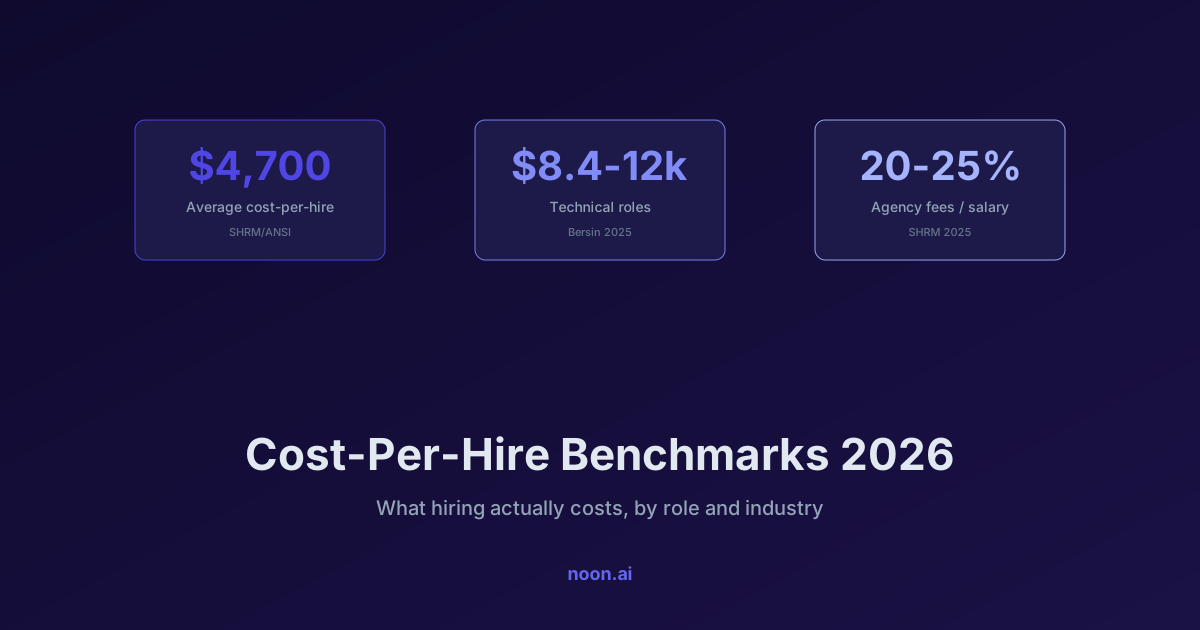
Key takeaway: The benchmark average cost-per-hire is $4,700 per the SHRM/ANSI standard. Technical roles average $8,400-$12,000, specialized AI/ML roles exceed $15,000, and agency-recruited hires cost 20-25% of first-year salary — $25,000-$50,000 for a $150,000 engineer. Companies using AI sourcing tools report 35-45% lower cost-per-hire than those relying on job boards and agencies.
Cost-per-hire is the recruiting metric CFOs actually read. It is also the one most teams calculate wrong — either by leaving out internal costs (recruiter salaries, hiring manager time) or by comparing their fully-loaded number against someone else's external-costs-only number.
This article compiles the current benchmarks, the standard formula, and the breakdowns by role type, industry, and company size — every figure with a named, dated source. Bookmark it for budget season.
For the broader data set, see our 50 recruitment statistics for 2026.
What is the average cost-per-hire in 2026?
The canonical benchmark is $4,700 per hire, from the SHRM/ANSI Cost-Per-Hire Standard — the only formally standardized methodology in the industry. SHRM itself notes that many employers estimate the true fully-loaded figure at three to four times the position's salary once hiring manager time and productivity ramp are included. Source: SHRM/ANSI Cost-Per-Hire Standard; SHRM "The Real Costs of Recruitment," 2022-2025
That $4,700 hides enormous variance:
| Segment | Cost-per-hire | Source |
|---|---|---|
| All-industry average | $4,700 | SHRM/ANSI standard |
| Technical roles (engineering, data) | $8,400-$12,000 | Bersin by Deloitte, 2025 Talent Acquisition Framework |
| Specialized AI/ML roles | $15,000+ | Bersin by Deloitte, 2025 |
| Executive roles | ~$28,000+ | SHRM Talent Acquisition Benchmarks |
| Agency-recruited professional roles | 20-25% of first-year salary | SHRM 2025 Staffing Industry Analysis |
The agency line deserves emphasis: at a 20-25% contingency fee, a single $150,000 engineering hire costs $30,000-$37,500 — six to eight times the all-industry average, for one hire.
How do you calculate cost-per-hire?
The SHRM/ANSI formula:
Cost-per-hire = (Total internal recruiting costs + Total external recruiting costs) ÷ Total number of hires
Include, at minimum:
- External costs: agency and search fees, job board and advertising spend, recruiting technology (ATS, CRM, sourcing tools), background checks, career fairs, employer branding campaigns, relocation and signing bonuses.
- Internal costs: recruiting team salaries and benefits (pro-rated), hiring manager and interviewer time, internal referral bonuses, onboarding administration.
Most teams that report suspiciously low numbers are omitting internal costs — which typically account for well over half the total. If you benchmark against the $4,700 figure, use the same full formula.
Why is cost-per-hire rising?
Three structural pressures are pushing the number up even as budgets shrink:
Leaner teams handling more volume. TA teams are 14% smaller than in 2021 while recruiters manage 43% more requisitions per person — meaning slower processes, more agency fallback, and more paid-source dependence when internal capacity runs out. Source: Gem 2026 Recruiting Benchmarks (165M applicants, 1.2M hires)
Application flood without quality. Applications per job posting surged 93% in 2025, driven by AI-assisted apply tools. Screening costs rise with volume even when hireable candidates don't. Source: Gem 2026 Recruiting Benchmarks
Longer processes. Average time-to-fill hit 44 days in 2025 (SHRM), and the average process now involves 13 interviews per hire, up 42% in three years (Gem 2026). Every additional interview round is paid hiring-manager time. See our time-to-hire benchmarks for the full speed data.
What actually reduces cost-per-hire?
The levers, ranked by measured impact:
1. Reduce agency dependence. This is the single largest line item for most mid-market teams. Every hire moved from a 20-25% contingency fee to internal or AI-assisted sourcing saves five figures.
2. Rediscover talent you already have. 46% of hires in 2025 came from candidates already sitting in the company's ATS who were re-engaged for new roles — the cheapest source of hire after referrals. Source: Gem 2026 Recruiting Benchmarks
3. Use AI sourcing instead of paid job boards. Companies using AI sourcing tools reported 35-45% lower cost-per-hire than companies relying exclusively on job boards and agency relationships. Source: Aptitude Research, 2025 AI in Talent Acquisition Report
4. Protect referral programs. Referral hires remain the highest-quality source, with 45% higher two-year retention than job board hires — quality-of-hire is a cost lever too, since replacing a failed hire costs roughly 30% of first-year salary (U.S. Department of Labor benchmark). Source: SHRM 2025 Employee Referral Program Benchmarks; U.S. Department of Labor
At Noon, this is the math behind the product: an autonomous AI sourcing agent that sources across the whole web, evaluates candidates against role-specific criteria, and runs personalized multi-channel outreach — on a single unlimited plan with no per-seat fees or credit caps, so cost-per-hire falls as volume grows rather than scaling with it. Teams evaluating the cost impact can book a demo to see candidate sourcing volume benchmarked against current agency and job board spend.
Cost-per-hire by company size
Smaller companies typically show higher cost-per-hire because fixed costs (tooling, employer branding, recruiter salaries) spread across fewer hires:
- Under 500 employees: often 1.5-2x the $4,700 benchmark on a fully-loaded basis, driven by agency reliance and low hiring volume.
- 500-5,000 employees: closest to the benchmark average; internal TA teams absorb most sourcing.
- Enterprise (5,000+): below average per hire on volume efficiency, but with the largest absolute budgets — and the most tool fragmentation (the average enterprise recruiting stack includes 12-15 tools, per Aptitude Research 2025).
For budget planning across roles, our compensation benchmarks cover the salary side of the equation.
FAQ
What is the average cost-per-hire in 2026? $4,700 per the SHRM/ANSI Cost-Per-Hire Standard, the industry's canonical benchmark. Technical roles average $8,400-$12,000 (Bersin by Deloitte 2025), and specialized AI/ML roles exceed $15,000.
How much do recruiting agencies charge per hire? 20-25% of first-year salary for professional and technical roles (SHRM 2025 Staffing Industry Analysis). For a $150,000 role, that's $30,000-$37,500 per hire.
What's included in cost-per-hire? Under the SHRM/ANSI standard: all external costs (agency fees, job boards, advertising, tools, background checks, signing bonuses) plus all internal costs (recruiting team salaries, hiring manager time, referral bonuses), divided by total hires in the period.
How much does a bad hire cost? Roughly 30% of the employee's first-year salary, per the U.S. Department of Labor's canonical estimate — and 46% of new hires fail within 18 months (Leadership IQ). See our full breakdown in the cost of a bad hire.
Does AI recruiting software lower cost-per-hire? Companies using AI sourcing tools report 35-45% lower cost-per-hire than those relying exclusively on job boards and agencies (Aptitude Research, 2025 AI in Talent Acquisition Report), primarily by reducing agency spend and recruiter hours per hire.