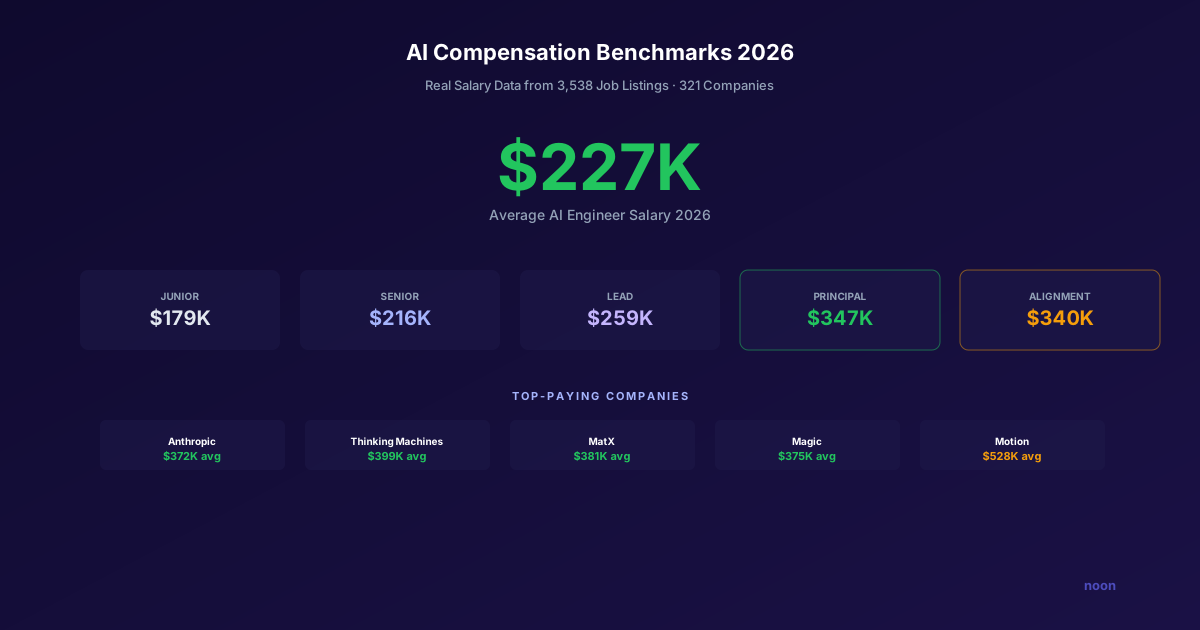
Key takeaway: The average AI engineer earns $233K base salary in 2026 (median $218K), with alignment researchers averaging $364K, pre-training specialists $329K, and principal-level roles $349K, per AIDevBoard's live salary data from 3,906 listings with published pay, checked 9 September 2026. Compensation varies dramatically by specialization, company tier, and geography. You don't need to match FAANG packages to compete; the framework in this article shows how to win AI talent at every budget level using non-comp levers.
The AI salary market in 2026 is not a market, it's an auction. Companies with unlimited budgets are bidding up compensation for a finite talent pool, creating distortions that ripple across the entire hiring market.
The average AI engineer earns $233K in base salary, with the median at $218K (AIDevBoard AI Salary Calculator, updated daily, checked 9 September 2026, based on 3,906 job listings with published salaries out of 9,784 total). When we first published this guide in March 2026 the same dataset showed a $227K average and a $215K median across 3,538 listings, so the market has moved up roughly 2.6% on average in six months, on a sample that grew by about 10%. Averages mask the extremes: alignment researchers average $364K (median $362K, 75th percentile $422K), pre-training specialists $329K, and principal-level AI engineers $349K. At companies like Anthropic ($372K average), Motion ($528K average for select roles), and Thinking Machines ($399K average), compensation packages would have seemed implausible five years ago.
Meanwhile, general software engineers at the same seniority levels earn 15-25% less. This premium is widening, not narrowing, and it's reshaping how companies build engineering organizations, set compensation bands, and compete for talent.
This guide breaks down the real numbers, explains what's driving them, and provides a practical framework for recruiting AI talent at every budget level.
What do 2026 AI salaries look like?
How do AI salaries vary by experience level?
| Level | Average Salary | Sample Size |
|---|---|---|
| Junior/Entry | ~$174K (median $169K) | 190 roles |
| Mid-Level | ~$155K (median $160K) | 501 roles |
| Senior | ~$218K (median $212K) | 1,652 roles |
| Lead | ~$269K (median $260K) | 1,314 roles |
| Principal | ~$349K (median $320K) | 249 roles |
Source: AIDevBoard, checked 9 September 2026
The mid-level dip below junior is notable. It reflects a market where companies are willing to pay entry-level premiums for new graduates from top ML programs (Stanford, MIT, CMU) who have fresh knowledge of the latest architectures, while mid-level engineers without cutting-edge specialization fall into a compensation valley.
How do AI salaries vary by specialization?
The highest-paying specializations reveal where the scarcity is most acute:
| Specialization | Average Salary |
|---|---|
| Alignment/Safety | ~$364K |
| Pre-training | ~$329K |
| Rust (systems/inference) | ~$295K |
| Transformers | ~$289K |
| JAX | ~$281K |
| Research | ~$290K |
| Computer Vision | ~$245K |
| NLP/LLM | ~$240K |
| MLOps | ~$210K |
| Data Science | ~$185K |
Source: AIDevBoard, checked 9 September 2026
Alignment and safety research command the highest premiums because the talent pool is smallest (perhaps a few hundred people globally with deep expertise) and the demand is growing as regulation and public scrutiny increase. Pre-training specialists are scarce because only a handful of organizations actually train large models from scratch.
How do AI salaries vary by company tier?
| Tier | Examples | Senior AI Eng TC |
|---|---|---|
| Frontier AI labs | OpenAI, Anthropic, Google DeepMind | $400K-$1M+ |
| Big Tech | Google, Meta, Apple, Amazon, Microsoft | $300K-$600K |
| Well-funded AI startups | Scale AI, Databricks, Anyscale | $250K-$450K |
| Mid-market tech | Series B-D startups, public tech co's | $200K-$350K |
| Non-tech enterprises | Banks, pharma, retail | $180K-$280K |
Total compensation (TC) includes base, equity, and bonus. The gap between frontier AI labs and mid-market companies is 2-3x at senior levels, and widens further at staff and principal levels.
By work arrangement
| Arrangement | Average Salary |
|---|---|
| Hybrid | ~$258K |
| Remote | ~$221K |
| On-site | ~$219K |
Source: AIDevBoard, checked 9 September 2026
The counterintuitive finding: hybrid roles pay more than both remote and on-site. This likely reflects that hybrid-friendly companies tend to be well-funded, coastal companies (especially in the Bay Area and NYC) that set high salary bands while offering flexibility.
What's driving the premium
Supply-demand imbalance
Stanford HAI's AI Index estimates that global demand for AI talent has grown 4-5x since 2020 while the supply of qualified practitioners has grown approximately 2x. The gap is especially severe for researchers and engineers who can work on foundation models, reinforcement learning, and AI safety.
The pipeline is improving (ML and AI programs at universities have expanded enrollment significantly), but it takes 4-6 years to train a PhD-level researcher. The supply catch-up won't happen overnight.
Revenue impact visibility
AI engineering has a clearer line to revenue impact than most other engineering disciplines. When a company deploys an AI feature that increases conversion by 5% or reduces support costs by 20%, the business case for the engineer who built it is straightforward. This clarity makes it easier for hiring managers to justify above-market compensation.
Competitive bidding dynamics
When multiple companies bid for the same small pool of candidates, prices get disconnected from productivity. A staff AI engineer who might generate $500K in annual business value commands $700K in compensation because three other companies are willing to pay that. This is the "hiring bubble", compensation exceeding the sustainable value the role produces at most companies.
The FAANG floor effect
FAANG/Big Tech compensation sets a floor that everyone else has to compete against. A senior ML engineer at Google earns $350K-$500K+ in total compensation. Any company that wants to hire someone who could work at Google has to offer something in that range, or offer non-financial advantages compelling enough to justify the gap.
Is there a bubble?
Yes and no.
What's not a bubble: The fundamental demand for AI talent is real. AI is transforming products, business models, and competitive advantages across every industry. The need for people who can build, deploy, and maintain AI systems will persist.
What is a bubble: Compensation at the top end has disconnected from sustainable economics for most companies. When startups with $10M in revenue are offering $500K+ packages to compete with Google, they're making a bet that revenue growth will eventually justify the cost. For some, it will. For many, it won't.
The correction scenario: If several high-profile AI companies fail or cut back significantly, compensation expectations could reset. More likely: a gradual moderation as the supply of ML engineers increases and AI tools reduce the amount of specialized knowledge needed for common ML tasks (making some mid-level roles less scarce).
For recruiters: Plan for current market rates, not hypothetical corrections. If you under-compensate today waiting for the bubble to pop, you simply won't hire.
How to compete at every budget level
If you can match FAANG (frontier labs, well-funded startups)
Lead with compensation transparency. Publish your ranges. At this level, candidates know their market value, and playing coy with comp wastes everyone's time.
Differentiate on the problem. Top AI researchers choose roles based on the technical challenge, data quality, and compute access. Make these tangible in the recruiting process (e.g., let candidates see the dataset, meet the team, understand the infrastructure).
Speed wins. Compress your interview process to 2 weeks. At this level, candidates often receive competing offers within days of each other.
If you can't match FAANG (mid-market companies)
Acknowledge the gap honestly. "We can't match Google's TC, but here's what we offer..." is more effective than pretending the gap doesn't exist.
Sell equity upside. If you're a startup, the equity story matters. Present it credibly: realistic valuations, clear vesting schedules, and honest conversation about liquidity timelines.
Sell the problem scope. At FAANG, an ML engineer might work on a narrow optimization problem. At a smaller company, they might own the entire ML stack. For engineers who want breadth and ownership, this is genuinely compelling.
Offer title compression. A "Staff ML Engineer" title at a Series B startup is easier to achieve than at Google. For candidates who value title progression, this matters.
Use AI recruiting to find overlooked talent. The candidates that FAANG isn't actively pursuing (ML engineers at non-tech companies, bootcamp graduates with strong fundamentals, career switchers from adjacent fields such as physics, quantitative finance, and computational biology) are more accessible and often undervalued. Noon's autonomous sourcing can identify these candidates from non-obvious signals. If you're ready to access this overlooked AI talent pool without the FAANG salary premium, book a demo to see how Noon's candidate matching works for specialized technical roles.
If you're a non-tech enterprise
Build internal training programs. Take existing senior software engineers and invest in ML/AI upskilling. This is often more cost-effective than competing for external hires in a market where you'll always lose to tech companies.
Partner with universities. Establish internship pipelines and research collaborations with ML programs. This creates a talent pipeline before candidates enter the open market.
Consider contract-to-hire. ML consultancies (like Toptal, Turing, and specialized ML agencies) can provide immediate capacity while you build internal capabilities.
Focus on MLOps, not ML research. Most enterprises need people who can deploy and maintain ML models, not train new ones from scratch. MLOps engineers command $210K average, significantly more accessible than $364K alignment researchers.
Building a compensation philosophy for AI roles
Step 1: Define your talent tier
Decide whether you're competing for:
- Tier 1: Researchers who publish at NeurIPS/ICML. Budget: $350K-$700K+ TC.
- Tier 2: Senior engineers who can build and deploy production ML systems. Budget: $250K-$400K TC.
- Tier 3: Engineers who can implement and maintain ML pipelines using existing tools and frameworks. Budget: $180K-$280K TC.
Most companies need Tier 2 and 3 talent, not Tier 1 researchers. Don't pay Tier 1 prices for Tier 2 needs.
Step 2: Set bands with AI premiums
Take your existing engineering compensation bands and add a defined premium for AI/ML roles:
- Junior: 10-15% above general SWE
- Senior: 15-25% above general SWE
- Staff+: 20-35% above general SWE
Document the rationale (market data from Levels.fyi, Robert Half, AIDevBoard) so the premium is defensible to finance and equitable to non-AI engineers.
Step 3: Review quarterly
AI compensation moves faster than annual review cycles. Commit to quarterly market checks and mid-year adjustments if your offer acceptance rate drops below 70%.
Step 4: Track offer competitiveness
For every offer you extend, track:
- Was it accepted?
- If declined, what was the competing offer?
- What was the gap?
- Was the gap primarily base, equity, or total comp?
This data tells you exactly where you stand in the market. If you're consistently losing by 15% on base, you know what to fix.
FAQ
What's the average AI engineer salary in 2026? $233K average base salary and $218K median across 3,906 listings with published pay (AIDevBoard, checked 9 September 2026), up from $227K and $215K in March 2026. Total compensation (including equity and bonus) is significantly higher at tech companies, often 1.5-2.5x base.
Which AI specializations pay the most?
Alignment/safety ($364K), pre-training ($329K), and Rust-heavy inference and systems roles (~$295K) command the highest premiums due to extreme scarcity. These are narrow specializations with perhaps hundreds to low thousands of qualified practitioners globally.
Do remote AI roles pay less? On average, remote AI roles pay $221K vs. $219K on-site, roughly comparable. Hybrid roles average $258K, likely reflecting the concentration of hybrid-friendly AI companies in high-cost-of-living cities.
How do I compete for AI talent without matching FAANG compensation? Three approaches work: (1) Sell equity upside and ownership scope that FAANG can't match. (2) Source overlooked candidates: ML engineers at non-tech companies, career switchers, academic researchers ready for industry. Tools like Noon can find these candidates from non-obvious signals. (3) Build internal talent through upskilling programs for existing senior engineers.
Is the AI salary bubble going to pop? Unlikely to pop dramatically, more likely to moderate gradually as the talent supply grows. The underlying demand for AI capabilities is real and growing. Compensation at the extreme top end may moderate, but senior AI engineers will command significant premiums over general SWE for years to come.
How often should compensation benchmarks be refreshed? At least quarterly for competitive technical and go-to-market roles, and before every offer for hard-to-fill positions. Market movement between annual survey cycles is one of the main reasons offers come in under market.
Can AI compensation tools replace salary surveys? They complement rather than replace them. AI tools aggregate live posting and placement data for speed, while traditional surveys provide validated, structured data for compliance and leveling. Many teams use both.
How should recruiters use benchmarks in candidate conversations? Share the role's range early and explain how it was derived. Anchoring on data builds trust, reduces late-stage negotiation surprises, and is increasingly required by pay transparency laws in many jurisdictions.