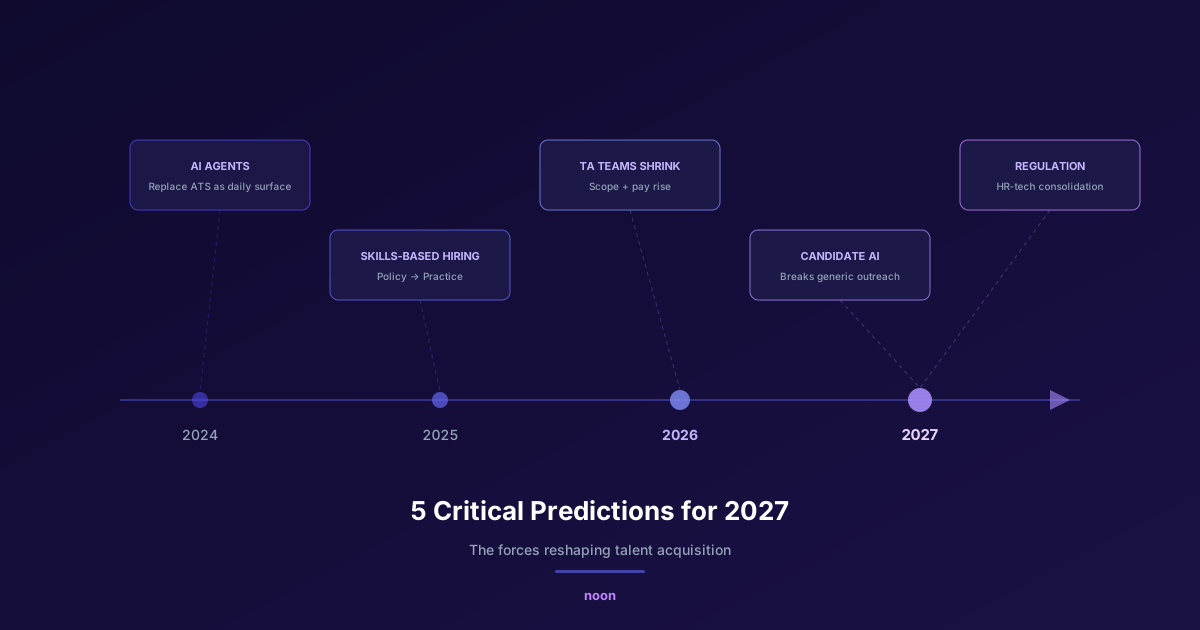
Key takeaway: Five forces are reshaping recruiting for 2027: autonomous AI agents replacing sourcing workflows, skills-based hiring going mainstream (85% adoption), TA teams shrinking while output grows, candidate-side AI flooding funnels, and AI regulation (EU AI Act, NYC LL 144) adding compliance requirements. Teams that adapt now will hire 2-3x more efficiently than those that wait.
Predictions in recruiting are usually safe. "AI will play a bigger role." "Candidate experience will matter more." "Remote work is here to stay." These aren't predictions — they're observations dressed up as foresight.
The five forces reshaping recruiting right now are more specific, more disruptive, and already measurable. They aren't speculative scenarios for 2027. They're trends with hard data behind them in 2025 and 2026 that most teams haven't fully priced in yet.
Here's what's actually happening — and what it means for recruiting teams planning for 2027.
Prediction 1: Autonomous AI agents replace the ATS as the daily work surface
The applicant tracking system has been the center of recruiting workflows for two decades. That's changing faster than most people realize.
KPMG's Q3 2025 AI Pulse Survey found that enterprise AI agent deployment quadrupled from 11% to 42% in just six months. Korn Ferry's 2026 Talent Acquisition Trends report — based on a survey of over 1,670 global talent leaders — found that 52% plan to add autonomous agents to their recruiting teams in 2026. And 84% of talent leaders plan to use AI in some capacity.
The shift isn't from ATS to a different ATS. It's from the ATS as the primary interface to an AI agent as the primary interface, with the ATS becoming a system of record that runs in the background.
What this looks like in practice
Today's recruiter workflow: open ATS → review applicants → search LinkedIn → copy profiles → build outreach → send messages → log activity → update stages. Eight steps, three tools, and most of the time is spent on data entry and context-switching.
Tomorrow's workflow: tell the AI agent what you need → review the candidates it surfaces → provide feedback → the agent adjusts and continues. Two steps. The agent handles sourcing, outreach, scheduling, and ATS updates autonomously.
This isn't theoretical. Platforms like Noon already operate this way. You describe the role, the agent searches across databases, evaluates candidates using LLM-based screening, sends personalized outreach across email and SMS, and learns from your feedback through reinforcement learning. The recruiter's job shifts from operating tools to providing judgment.
What to do about it
If your team is evaluating ATS platforms for 2027, expand the evaluation to include agentic layers that sit on top of your ATS. The ATS still matters for compliance, reporting, and hiring manager collaboration — but the daily interaction surface is moving to agents. Teams that invest in ATS migration without considering the agent layer are solving a 2020 problem.
Prediction 2: Skills-based hiring crosses from policy to practice
Every CHRO presentation in 2024 and 2025 included a slide about skills-based hiring. Most organizations are still only doing it at the policy level — removing degree requirements from job postings.
The data shows the gap between policy and practice. TestGorilla's 2025 State of Skills-Based Hiring report found that 53% of employers eliminated degree requirements, up from 30% in 2024. That sounds like progress until you see the Harvard Business School and Burning Glass Institute finding: simply removing degree language from job postings only lifts non-BA hiring by 3.5 percentage points. The companies that built actual assessment infrastructure — skills tests, portfolio reviews, project-based evaluations — achieved nearly 20%.
Why the gap exists
Removing "Bachelor's degree required" from a job posting is easy. Rebuilding the screening process around skills instead of credentials is hard. It requires:
- Assessment infrastructure: Validated tests for the specific skills the role requires
- Hiring manager training: Managers conditioned to use degree as a proxy need a replacement signal
- Interview redesign: Behavioral interviews designed around credential verification don't work for skills-based evaluation
- AI screening calibration: If your AI sourcing tool was trained on historical hires (who mostly had degrees), removing the degree requirement doesn't change the model's bias
What to do about it
The organizations making real progress on skills-based hiring are using AI tools calibrated on skills signals, not credential signals. At Noon, the RLHF-based matching system learns from which candidates a recruiter actually advances — and when recruiters consistently advance candidates based on project experience rather than degree, the system shifts its weighting accordingly. This is how skills-based hiring moves from a policy slide to an operational reality. If you're looking to implement AI-based skills screening that adapts to your hiring decisions, you can book a demo to see how reinforcement learning adjusts matching criteria in real time.
Prediction 3: TA teams shrink while scope and pay rise
This is the prediction no one wants to hear, but the data is unambiguous.
SHRM's 2026 Talent Acquisition Trends survey found that only 24% of TA leaders expect headcount increases in 2026. Gem's 2026 Recruiting Benchmarks report — based on data from 165 million applicants, 15 million candidates, and 1.2 million hires — found that TA teams are 14% leaner than they were in 2021, while recruiters are managing 43% more req volume.
Hiring volume is rebounding (+8.3% year-over-year according to Gem), but TA headcount is not rebounding with it. The math only works if each recruiter becomes dramatically more productive.
What's driving this
Three factors:
AI is absorbing the repetitive work. Sourcing, initial screening, outreach sequencing, and scheduling — the tasks that consumed 60-70% of a recruiter's day — are being handled by AI. This makes each recruiter more productive, which means you need fewer of them.
TA is becoming more strategic. The recruiters who remain are spending less time on sourcing and more on hiring manager consulting, offer negotiation, and candidate experience. This is higher-value work that commands higher pay.
Budget pressure hasn't lifted. Despite hiring volume recovering, most companies are still operating with post-2022 cost discipline. CFOs approved AI tool budgets but not headcount additions.
What this means for 2027
The recruiter role doesn't disappear — it bifurcates. Junior coordinators and sourcers face the highest displacement risk. Senior recruiters who can manage AI agents, consult hiring managers on search strategy, and close complex candidates become more valuable. LinkedIn's 2025 Future of Recruiting report noted that recruiter salaries in the top quartile increased 12% year-over-year, even as total recruiter headcount declined.
If you're a recruiting leader, invest in upskilling your team on AI tool management. If you're a recruiter, learn to work with AI agents rather than compete against them. The recruiters who thrive in 2027 will be "agent managers" — professionals who direct AI systems rather than perform manual tasks.
Prediction 4: Candidate-side AI breaks generic outreach permanently
Here's the prediction most recruiting technology vendors don't want to discuss: candidates are using AI too.
LinkedIn reported that job applications hit 14,200 per minute in February 2025 — an all-time high. Applications per job posting surged 93% year-over-year according to Gem. Candidates are using AI tools (ChatGPT, LinkedIn's auto-apply features, dedicated application bots) to mass-apply for roles.
This creates what some analysts call the "AI doom loop": candidates use AI to apply in bulk → recruiters are overwhelmed → recruiters use AI to screen → candidates optimize their applications for AI screening → the signal-to-noise ratio collapses.
Why this kills generic outreach
When candidates receive dozens of outreach messages a day — many of them AI-generated — template-based outreach stops working. Candidates can spot a mail-merge message instantly. Response rates for generic outreach have dropped below 5% on average, and they're heading lower.
The outreach that still works has three characteristics:
- Specificity: References to the candidate's actual work, not just their title and company
- Timing: Reaches candidates when they're receptive (after a recent role change, company announcement, or profile update)
- Relevance: The role genuinely fits their trajectory, and the message explains why
What to do about it
AI outreach that works isn't about sending more messages faster. It's about sending fewer, better messages. Noon's approach generates personalized introductions that reference specific candidate experience, explains why the role fits their trajectory, and sequences across channels (email first, then SMS) at times optimized by response data. The response rates are 3-4x higher than template outreach — not because the messages are longer, but because they're contextually relevant.
For 2027, any recruiter or tool still running template-based mass outreach will see diminishing returns. The investment needs to shift from volume to precision.
Prediction 5: EU and US regulation forces HR-tech consolidation
The regulatory environment for AI in hiring changed dramatically in 2025-2026, and most recruiting teams haven't fully absorbed the implications.
The EU AI Act classifies AI systems used in employment decisions as "high-risk," requiring conformity assessments, technical documentation, human oversight provisions, and algorithmic auditing before deployment. The Act's provisions for high-risk AI systems began applying in August 2025, with full enforcement timelines extending through 2027.
In the US, regulation is fragmented but accelerating. New York City's Local Law 144 requires bias audits for automated employment decision tools. Illinois's AI Video Interview Act constrains AI-based video analysis. Colorado's AI Act (effective February 2026) requires deployers of high-risk AI systems to conduct impact assessments. Multiple other states have bills in various stages.
What this means for HR tech
Compliance is expensive. Bias auditing, documentation, impact assessments, and human oversight protocols require dedicated resources that smaller vendors can't afford. This is driving consolidation in two ways:
Vendor consolidation: Companies are reducing the number of AI tools in their recruiting stack to minimize compliance surface area. Instead of five point solutions, they want one or two platforms that handle compliance holistically.
Feature consolidation: The vendors that survive will be the ones that build compliance infrastructure into the product — automated audit trails, bias monitoring dashboards, configurable human-in-the-loop checkpoints — rather than treating compliance as an afterthought.
What to do about it
When evaluating AI recruiting tools for 2027, compliance readiness should be a top-three criterion alongside functionality and integration. Ask vendors: How do you handle bias auditing? Can you produce the documentation required by EU AI Act Article 13? Do you support configurable human oversight as required by Article 14?
At Noon, every AI decision includes an explainable reasoning chain — not just "this candidate scored 85%," but "this candidate was recommended because of their 4 years of SaaS product management experience at growth-stage companies, which aligns with the hiring manager's demonstrated preference for candidates from similar environments." This kind of audit-ready explainability is what regulation will require.
The common thread across these five predictions
All five predictions share an underlying dynamic: the talent acquisition function is being compressed. Fewer people, more technology, higher expectations, tighter regulation. The teams that thrive in 2027 will be the ones that invested in 2026 — not in more recruiters or more tools, but in better systems that learn, adapt, and comply.
The question isn't whether these changes are coming. The data says they're already here. The question is whether your team is positioned to benefit from them or be disrupted by them.
FAQ
What is the biggest recruiting trend for 2027? The shift from tool-centric workflows to agent-centric workflows. AI agents that autonomously source, screen, and reach candidates — with recruiters providing oversight and judgment — will become the primary operating model for high-performing TA teams. KPMG data shows enterprise AI agent deployment already quadrupled in the second half of 2025.
Will AI replace recruiters by 2027? No, but it will reshape the role significantly. SHRM data shows only 24% of TA leaders expect headcount growth, while Gem reports recruiters are handling 43% more req volume. The recruiters who remain will focus on strategic work — hiring manager consulting, candidate experience, and offer negotiation — while AI handles sourcing, screening, and outreach.
How will regulation affect AI recruiting tools? The EU AI Act classifies employment AI as high-risk, requiring bias audits, technical documentation, and human oversight. US regulation is fragmented but expanding (NYC Local Law 144, Colorado AI Act, Illinois AI Video Interview Act). Vendors that can't meet compliance requirements will consolidate or exit the market, favoring platforms with built-in audit trails and explainable decisions.
What is skills-based hiring and does it actually work? Skills-based hiring evaluates candidates on demonstrated abilities rather than credentials like degrees. While 53% of employers have removed degree requirements from postings (TestGorilla 2025), Harvard/Burning Glass research shows this alone only increases non-BA hiring by 3.5 percentage points. Real impact (~20% increase) requires rebuilding the screening process around skills assessments, not just changing job posting language.
How should recruiting teams prepare for 2027? Three priorities: (1) Evaluate AI agent platforms that can sit on top of your existing ATS, not replace it. (2) Build skills-based screening infrastructure (assessments, project evaluations) rather than just removing degree requirements. (3) Audit your AI tool stack for regulatory compliance — especially if you operate in the EU or in US states with AI employment laws.