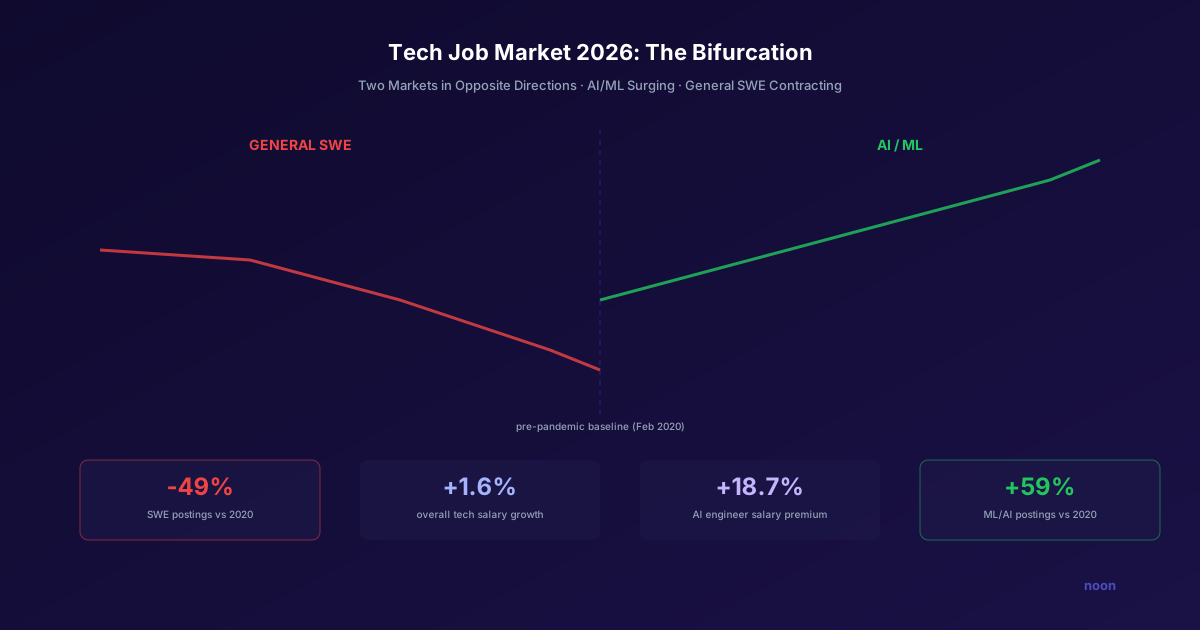
Key takeaway: The tech job market in 2026 is bifurcated: general software engineering listings are down 49% from pre-pandemic levels while ML/AI engineer openings are up 59%. This creates a two-speed market where AI specialists command 15-25% salary premiums and have 3-5 competing offers, while traditional SWE roles see increased competition. Recruiters need different strategies for each segment.
The tech job market in 2026 is not one market. It's two markets wearing the same label, moving in opposite directions.
General software engineering job listings sit roughly 49% below their February 2020 baseline. Machine learning engineer openings are up 59% over the same period. Anyone reading "tech is hiring" or "tech is dead" is missing the bifurcation that explains both (Indeed Hiring Lab, July 2025).
For recruiters, this means the same team is now sourcing two fundamentally different talent pools: a contracting market for general developers where candidates are abundant and budgets are tight, and a scarce, expensive, hyper-competitive market for AI and ML specialists. The playbook for one doesn't work for the other.
This report pulls together data from CompTIA, Stanford HAI, BLS, Robert Half, Levels.fyi, and LinkedIn's Economic Graph to show what's actually happening, and what it means for how you recruit in each market. The September 2026 update below adds the latest Indeed Hiring Lab and BLS readings, which for the first time in almost four years show overall labor demand growing year over year.
What changed in the September 2026 data?
The broad market turned a corner this quarter, but tech did not turn with it.
- Postings are growing again, barely. Indeed's Job Postings Index reached 103.5 in mid-September, about 3% above its pre-pandemic level and up 0.7% year over year, the first positive annual reading since late 2022 (Indeed Hiring Lab, US Labor Market Snapshot, September 24, 2026).
- Tech is the named exception. The same snapshot singles out tech as the sector where job seekers face the toughest market, with postings "depressed despite improving from last year's lows," while 60% of all occupational sectors now sit above their pre-pandemic baseline.
- Payrolls rebounded, but Information shed jobs. Employers added 162,000 jobs in August 2026 and unemployment held at 4.1%, yet Information and Financial Activities lost a combined 34,000 jobs, continuing months of softness in both sectors (Indeed Hiring Lab, August 2026 Jobs Report analysis, September 4, 2026).
- Hiring rates are still historically low. The JOLTS hires rate fell to 3.2% in the July release, a level otherwise seen only in April 2020 and the 2009-2011 recovery (Indeed Hiring Lab, September 2026). Low hires plus low layoffs is the definition of a frozen market: employed engineers stay put, and open roles draw enormous applicant volume.
- AI-exposed pay is pulling ahead. Advertised salaries in the most AI-exposed occupations (software development, IT support, data and analytics) have risen about 46% since 2021 against 25% for the least-exposed, a post-ChatGPT premium of 5.7% after controlling for occupation mix, and the gap is widest at senior level (Indeed Hiring Lab, September 17, 2026).
The bifurcation described in the rest of this report is therefore intact. What is new is that the general market has stopped shrinking, which removes the "wait for the rebound" argument for teams that have deferred engineering hiring.
The headline numbers
| Metric | Data Point | Source |
|---|---|---|
| Overall tech postings vs. 2020 | Down ~36% | Indeed Hiring Lab, 2025 |
| ML/AI engineer postings vs. 2020 | Up 59% | Indeed Hiring Lab, 2025 |
| General SWE postings vs. 2020 | Down 49% | Indeed Hiring Lab, 2025 |
| Tech salary growth (overall) | +1.6% YoY | Robert Half, 2026 |
| AI engineer salary premium | +18.7% over non-AI peers | Levels.fyi Q3 2025 |
| Staff AI engineer floor premium | ~$25K over non-AI staff | Robert Half, 2026 |
| Tech layoffs 2023-2024 | 500,000+ tech workers | Layoffs.fyi |
| Net new tech jobs added Q1 2026 | ~62,000 | CompTIA, 2026 |
| Indeed Job Postings Index, all occupations | 103.5 (+0.7% YoY, first positive since 2022) | Indeed Hiring Lab, September 24, 2026 |
| US unemployment rate, August 2026 | 4.1% | BLS via Indeed Hiring Lab, September 4, 2026 |
| JOLTS hires rate, July 2026 | 3.2% | BLS via Indeed Hiring Lab, September 2026 |
| Advertised pay growth since 2021, most AI-exposed roles | +46% (vs. +25% least-exposed) | Indeed Hiring Lab, September 17, 2026 |
| Professional developers using AI tools daily | 51% | Stack Overflow Developer Survey, 2025 |
Market 1: General software engineering (contracting)
The post-pandemic correction hit general software engineering hardest. After the hiring frenzy of 2021-2022 (where companies hired ahead of demand fueled by low interest rates and pandemic-driven digitization), the correction has been dramatic and sustained.
What happened:
- 2021-2022: Mass hiring. Companies like Meta, Amazon, and Google added tens of thousands of engineers. Startups flush with cheap capital hired aggressively.
- 2023: Mass layoffs. 262,000+ tech workers laid off (Layoffs.fyi). The correction was faster and deeper than most predicted.
- 2024: Selective hiring. Companies rehired cautiously, prioritizing senior roles and AI-adjacent skills. Junior and mid-level SWE hiring remained depressed.
- 2025-2026: Stabilization at a lower baseline. Hiring has rebounded from the trough but remains well below 2021 levels.
What it means for recruiters:
The candidate supply for general SWE roles is the best it's been in a decade. Response rates to outreach are higher because candidates are less inundated with messages. Time-to-fill has compressed for non-AI engineering roles.
But budgets are tighter. Companies are hiring fewer engineers and expecting more from each one. The "hire fast, figure it out later" approach of 2021 has been replaced by "make every hire count." This means recruiters face higher scrutiny on candidate quality, more interview rounds, and slower decision-making from hiring committees.
Salary data: General SWE salaries have largely plateaued. Total compensation for senior software engineers at large companies ranges from $180K-$350K depending on location and company tier (Levels.fyi, 2025). Growth is flat to slightly negative when adjusted for inflation, particularly for remote roles where companies are applying geographic pay adjustments.
Market 2: AI and machine learning (surging)
The opposite story. Demand for AI/ML engineers has been accelerating since late 2022 and shows no signs of slowing.
The demand drivers:
- Every major company is building or integrating AI capabilities
- The talent pool is genuinely scarce: Stanford HAI estimates fewer than 100,000 people globally have deep ML research experience
- The productivity impact of AI engineering is visible and measurable, making it easier to justify headcount
- AI infrastructure (model training, deployment, inference optimization) requires specialized skills that don't transfer easily from general SWE
Salary premium: At staff level, AI engineers earn approximately $25K more in base salary than non-AI peers at equivalent levels (Robert Half, 2026). When you include equity and bonus, the total compensation premium is 18.7% (Levels.fyi Q3 2025).
At the top end, ML research scientists at companies like Google DeepMind, OpenAI, and Anthropic command $500K-$1M+ total compensation. This has created a talent war that trickles down: even mid-level ML engineers at mid-market companies can command $250K-$400K total comp because the alternative is losing them to a FAANG or frontier AI lab.
What it means for recruiters:
This is the hardest market to source in. The candidates you want are employed, well-compensated, and receiving multiple inbound messages per week. Traditional sourcing (LinkedIn InMail, job boards) has diminishing returns because these candidates are saturated.
Effective strategies for AI/ML recruiting:
- Research-focused outreach: Reference the candidate's published papers, open-source contributions, or conference talks. Generic messages get ignored.
- Speed: Time-to-offer compression is critical. The best candidates have multiple competing offers. A 6-week interview process loses to a 2-week one.
- Compensation transparency: Don't waste time on candidates whose expectations don't match your budget. Lead with the range.
- AI-powered sourcing: Tools like Noon can surface ML engineers from non-obvious sources (GitHub contributions, ArXiv papers, conference attendance) and generate personalized outreach that references their specific work.
The roles in between
Not everything falls neatly into "general SWE" or "ML engineer." Several adjacent roles are experiencing strong demand:
High demand (growing):
- ML/AI Engineers: up 59% from baseline
- Data Engineers: companies need infrastructure for AI workloads
- Platform/Infrastructure Engineers: supporting ML deployment and inference
- Security Engineers: AI introduces new attack vectors and compliance requirements
- DevOps/SRE with ML Ops experience: MLOps is the new bottleneck
Moderate demand (stable):
- Full-Stack Engineers: demand exists but at lower volumes than 2021
- Mobile Engineers: stabilized after the 2023-2024 contraction
- Product Managers (technical): particularly those who can work with AI teams
Contracting demand:
- Frontend-only specialists: AI code generation is reducing the need for dedicated frontend engineers
- QA/Manual Testing: automation and AI are displacing manual testing roles
- Entry-level SWE: the junior market remains the most impacted, with many companies replacing entry-level hiring with AI tools
What the data means for recruiting strategy
For general SWE roles: efficiency over volume
The candidate pool is large, but so is the noise. The challenge isn't finding people; it's finding the right people efficiently, and increasingly it is confirming the people are real. Remote engineering postings are the roles the FBI's impersonation alerts focus on, which is why our guide to detecting fake job applicants for remote roles belongs in the general-SWE playbook.
- Use AI candidate screening to rank the expanded applicant pool against precise criteria rather than reviewing hundreds of applications manually
- Emphasize quality-of-hire metrics over time-to-fill; the market allows you to be selective
- Invest in assessment quality, not assessment volume: better interviews, fewer rounds
- Competitive differentiators have shifted from compensation to stability, interesting work, and engineering culture
For AI/ML roles: speed and specialization
- Dedicated ML recruiting: Don't ask generalist recruiters to fill ML roles. The market knowledge, sourcing techniques, and candidate expectations are too different.
- Source from non-obvious channels: GitHub, ArXiv, ML conferences (NeurIPS, ICML), Kaggle leaderboards
- Sell the problem, not the perks: ML engineers choose roles based on the technical challenge and data quality, not the free lunch
- Consider "build vs. hire": Some companies are training existing senior engineers in ML rather than competing for scarce ML specialists
For both markets: use AI recruiting tools strategically
Regardless of which market you're sourcing in, AI recruiting tools serve different purposes:
- In the general SWE market: AI helps you process volume efficiently, screening hundreds of applicants to surface the best 10
- In the AI/ML market: AI helps you find people who aren't actively looking, sourcing from academic publications, open-source contributions, and professional networks. Our guide to passive sourcing covers the mechanics.
- Across both: Noon operates as an autonomous recruiting agent that adapts its sourcing strategy to the role. For a general SWE role, it casts a wide net and screens aggressively. For an ML engineer role, it conducts deep research on each candidate before initiating highly personalized outreach. If you're managing both types of requisitions, you can book a demo to see how the platform adjusts its approach based on role scarcity and candidate behavior patterns.
The 2027 outlook
Several trends suggest where the market is heading:
AI/ML demand will broaden but not soften. As AI becomes table stakes, demand will expand beyond pure research/engineering roles into AI product management, AI safety, and AI operations. Compensation will stabilize at a high floor but the extreme premiums for top researchers may moderate as the talent pool grows through university programs and career switchers.
General SWE will partially recover. The September 2026 Indeed data suggests the trough is behind us for the economy as a whole, though not yet for tech postings specifically. General SWE hiring will increase from here, but it's unlikely to return to 2021 levels. The permanent shift: companies will hire fewer engineers but invest more in AI tools that amplify each engineer's productivity.
Junior hiring will be the last to recover. Companies are using AI tools (Cursor, Copilot, Devin) to achieve productivity gains that reduce the need for junior engineers. The entry-level SWE market may not fully recover to pre-pandemic levels. This has implications for the long-term talent pipeline.
Remote work continues to fragment compensation. Geographic pay adjustments mean the same role at the same company can vary by 30-40% based on location. Recruiters need to source with compensation geography in mind.
FAQ
Is the tech job market actually bad in 2026? For the overall economy, no: Indeed's postings index is above its pre-pandemic level and growing year over year as of September 2026, and unemployment is 4.1%. For tech specifically, it depends on the role. For AI/ML engineers, it's one of the hottest markets in decades. For general software engineers, it's significantly cooled from 2021-2022 but stabilizing. For junior engineers, it remains challenging. The headline "tech job market" hides three very different realities.
What's the average time-to-fill for an ML engineer vs. a general SWE? ML/AI roles average 55-70 days to fill, compared to 35-45 days for general SWE roles (industry averages vary by seniority and company size). The difference reflects the scarcity of qualified ML candidates and the competitive dynamics of the market.
Is developer adoption of AI tools changing who gets hired? It is changing what "qualified" means. In the 2025 Stack Overflow Developer Survey, 84% of respondents were using or planning to use AI tools in their development process and 51% of professional developers used them daily (Stack Overflow, 2025). Job descriptions that still list AI-assisted development as a nice-to-have are behind the candidate pool, and interview loops that ban AI tools outright are testing a workflow most candidates no longer use.
Should we pay above-market for AI talent? If AI is core to your business strategy, yes; the alternative is not hiring at all. If AI is supplementary, consider training existing engineers in ML skills. The build-vs-buy talent decision should align with how central AI is to your product and revenue.
How do AI recruiting tools help in a tight AI/ML talent market? They surface candidates that traditional sourcing misses, people who aren't on LinkedIn or job boards but are publishing research, contributing to open-source ML projects, or presenting at conferences. Noon's autonomous sourcing is particularly effective here because it can research candidates deeply before outreach, leading to higher response rates from highly-sought-after ML engineers.