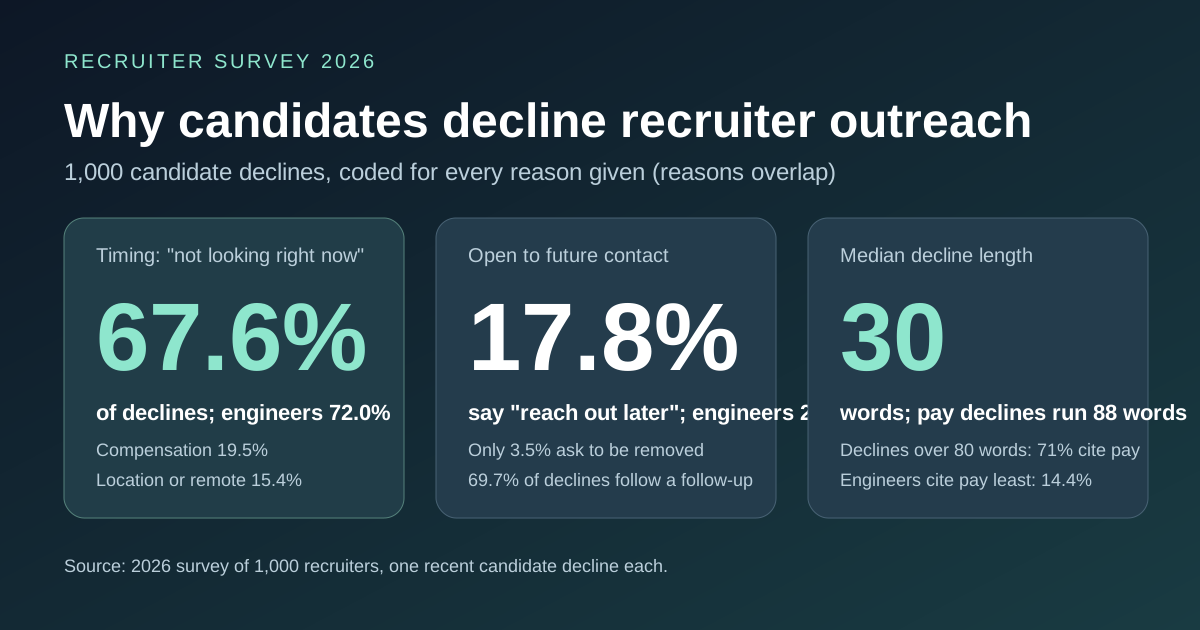
Key takeaway: When candidates turn down recruiter outreach, 67.6% say it is timing ("not looking right now"), 19.5% cite compensation, and 15.4% cite location or remote policy. Role or level fit (5.7%), employment type (5.7%) and retirement or work authorization (3.9%) are rare. Only 3.5% ask to be removed from future contact, and 17.8% volunteer that they are open to hearing from the recruiter later. Those are the results of a 2026 survey in which 1,000 recruiters each submitted one recent candidate decline, coded for every reason the candidate gave. Engineers decline on timing more (72.0%) and on pay less (14.4%) than other candidates, and are the most likely to say "contact me later" (21.1%).
A "no" is the most informative reply a recruiter gets and almost nobody aggregates them. A 2026 survey of 1,000 recruiters asked each to submit one recent candidate reply that declined an outreach sequence, with the candidate's role function and seniority, the reply's word count, how many emails had been sent before the decline, and days to reply. Each reply was coded for seven reasons (timing or not looking, compensation, location or remote work, role or level fit, employment type such as contract versus permanent, retirement or work authorization, and a request to be removed) plus one signal: whether the candidate explicitly left the door open to future contact. A reply could cite more than one reason, so the shares below do not sum to 100.
Declines are the minority of outcomes; across the survey program, roughly one delivered email in six gets any reply and 43.6% of replies are neutral or negative (see the recruiter cold email response rate page). This page is about what the declines say.
Why do candidates say no to recruiters?
| Reason given in the decline | Share of 1,000 declines | Engineers (389) | All other roles (611) |
|---|---|---|---|
| Timing: not looking, just started a role, happy where they are | 67.6% | 72.0% | 64.8% |
| Compensation too low or not disclosed | 19.5% | 14.4% | 22.7% |
| Location, relocation or remote policy | 15.4% | 13.4% | 16.7% |
| Role or level is the wrong fit | 5.7% | 5.4% | 5.9% |
| Employment type (contract, agency, part-time) | 5.7% | 5.9% | 5.6% |
| Retiring or work authorization | 3.9% | 3.6% | 4.1% |
| Asked to be removed from contact | 3.5% | 2.1% | 4.4% |
| Explicitly open to future contact | 17.8% | 21.1% | 15.7% |
Two in three declines are about the candidate's situation, not the offer. The three objections a recruiter can act on appear far less often than timing: pay in 19.5% of declines, location in 15.4% and role fit in 5.7%. The hard no, a removal request, is about one in thirty (3.5%).
Engineers decline differently. Engineering candidates (software engineers, engineering managers, solutions engineers) were more likely to cite timing (72.0% vs 64.8%), less likely to cite compensation (14.4% vs 22.7%), and the least likely of any group to ask to be removed (2.1%). They were also the most likely to say they would be open later (21.1%). Software engineers specifically: 71.9% timing, 15.4% compensation, 23.6% open to future contact. Engineering managers almost never cited pay (6.1%, n=33). This fits the pattern on the software engineer response rate page, where engineers were slow to reply but rarely hostile.
Sales candidates were the opposite on removals: 10.3% asked to be taken off the list, three times the average (n=39, directional).
How many reasons does a declining candidate give?
| Reasons cited in one reply | Share of declines |
|---|---|
| None of the seven coded reasons (a bare "no thanks") | 17.0% |
| Exactly one reason | 57.0% |
| Two or more reasons | 26.0% |
The median decline is 30 words long. Candidates who cite compensation write much more: a median of 88 words, against 31 for timing declines and 27 for removal requests. Among declines over 80 words, 71.2% raised pay; among declines under 20 words, 5.8% did. A long "no" is almost always a negotiation that did not happen.
When in the sequence do candidates decline?
| Emails sent before the decline | Share of declines | Asked to be removed |
|---|---|---|
| 1 (declined the first email) | 30.2% | 3.3% |
| 2 | 33.8% | 2.4% |
| 3 | 23.2% | 4.7% |
| 4 | 9.1% | 5.5% |
| 5 or more | 3.6% | 2.8% |
69.7% of declines arrive after a follow-up, not in response to the first email, and the median decline came 4.0 days after the message it answered. Removal requests rise with sequence length (3.3% at step one, 5.5% at step four) but stay rare; even the fourth email generated a removal request in only one decline in eighteen. Follow-ups cost little goodwill, which is consistent with the recruiting follow-up email benchmarks. The share of candidates leaving the door open also held across steps (16.9% at step one, 21.1% at step three).
Do decline reasons differ by seniority?
| Seniority | Declines | Timing | Compensation | Location or remote | Open to future contact |
|---|---|---|---|---|---|
| Director and above | 48 | 68.8% | 22.9% | 14.6% | 18.8% |
| Principal | 25 | 72.0% | 20.0% | 8.0% | 28.0% |
| Staff, lead, manager | 191 | 74.9% | 16.2% | 12.6% | 19.9% |
| Senior | 110 | 74.5% | 10.0% | 10.9% | 21.8% |
| Not stated | 625 | 63.8% | 21.9% | 17.4% | 16.0% |
Senior and staff-level candidates decline on timing three times in four and rarely on pay (10.0% to 16.2%). Directors and above cite compensation at 22.9%, the highest of the stated levels, which matches their higher reply rates on the candidate reply rate by seniority page: senior leaders engage, and when they pass it is more often about the package.
What recruiting teams should do with a "no"
- Treat 18% of declines as a dated lead, not a loss. Nearly one in five candidates says "contact me later"; for engineers it is 21.1%. The re-engaging past candidates page shows those prior responders reply again at 35% when re-contacted after 3 to 6 months.
- Put the number in the first email for non-engineering roles. Compensation drove 22.7% of non-engineer declines and 33.1% in the "other" role group. The salary in recruiter emails page found only 11% of recruiters disclose a range.
- Lead with the remote policy where it is a strength. 15.4% of declines were about location; stating remote or hybrid terms up front filters those out before the third follow-up.
- Keep following up. Seven in ten declines come after a follow-up, and removal requests stay under 6% at every step.
- Read long declines as counteroffers. A reply over 80 words is a compensation conversation 71% of the time.
Tagging declines by reason is tedious by hand, which is why most teams never learn their own distribution. An outreach tool that classifies replies and schedules the "open to future contact" group for a 3-to-6-month re-touch turns the 18% into pipeline. Noon's AI recruiting agents run sourcing and email and SMS outreach on a single plan with unlimited seats and contacts; see Noon pricing.
Methodology
A 2026 survey of 1,000 recruiters. Each submitted one recent candidate reply that declined an outreach sequence, with the candidate's role function and seniority, the reply's word count, days from the message to the reply, how many emails had been sent before the decline, and the reply text. Each reply was coded for seven non-exclusive reason categories and for an explicit statement of openness to future contact. Shares are the number of declines citing a reason divided by 1,000. Engineers are software engineers, engineering managers and solutions engineers (389 declines). All figures are produced by a committed script from the survey file.
Limitations
This dataset contains only declines, so it says nothing about how often candidates decline versus ignore versus accept; those rates are on the response-rate pages linked above. Reasons are coded from the candidate's stated text, and a candidate who says "not looking right now" may have an unstated reason. Categories overlap. Some cells are small: 33 engineering managers, 39 sales candidates, 25 principal-level candidates. Each recruiter contributed one decline, which may not be a random sample of their declines.
FAQ
What is the most common reason candidates decline recruiter outreach? Timing. 67.6% of declines said the candidate was not looking, had just started a role, or was happy where they were.
How often do candidates reject recruiters over salary? 19.5% of declines cited compensation. For engineering candidates it was 14.4%; for all other roles 22.7%.
How many candidates ask recruiters to stop contacting them? 3.5% of declines included a removal request. Sales candidates were highest at 10.3%; engineers lowest at 2.1%.
Do candidates who decline want to be contacted again? 17.8% explicitly said so, rising to 21.1% among engineers and 28.0% among principal-level candidates.
Do follow-up emails annoy candidates? Not measurably. 69.7% of declines came after a follow-up, and removal requests ranged from 2.4% to 5.5% of declines at each sequence step.
Why do software engineers turn down recruiters? 71.9% timing, 15.4% compensation, 15.1% location or remote; 23.6% said they were open to future contact.