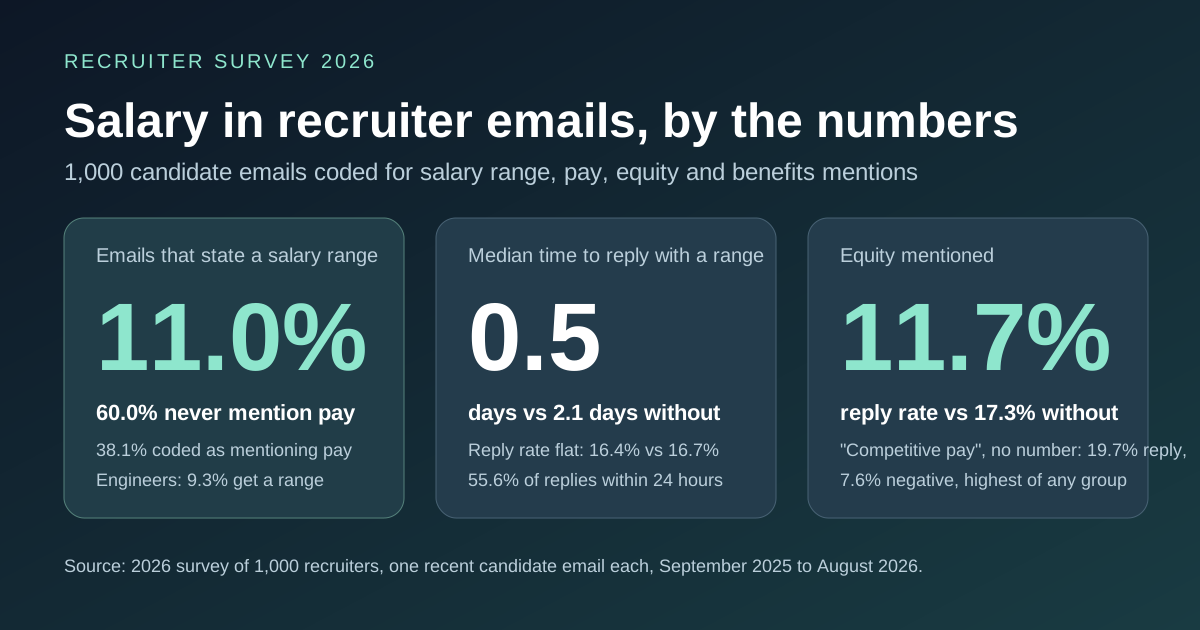
Key takeaway: Only 11.0% of recruiter outreach emails state a salary range, and 60.0% do not mention compensation at all. In a 2026 survey of 1,000 recruiters who each submitted one recent candidate email, disclosing a range did not change whether candidates replied (16.4% with a range, 16.7% without) but changed how fast: a median of 0.5 days to reply against 2.1 days, with 55.6% of replies inside 24 hours against 40.9%. Mentioning pay without a number did best on raw reply rate (19.7%) and worst on negative replies (7.6%). Equity mentions coincided with the lowest reply rate of any compensation element, 11.7%.
Most discussion of pay transparency is about job postings. This page looks at the recruiter's first outreach email instead: how often recruiters volunteer the number, and what happens when they do. In 2026 we surveyed 1,000 recruiters and asked each to submit one recent outbound candidate email, sent between September 2025 and August 2026, coded for whether it disclosed a salary range, mentioned compensation in any form, mentioned equity, or mentioned benefits, with the candidate's role and seniority and the reply outcome. A second survey of 1,000 recruiters collected one email each that did state a salary range, to see which roles and levels get the number and how those emails perform in more detail.
The baseline across all 1,000 emails: 16.7% replied and 8.7% replied positively. The broader content analysis of the same kind of email, including length and personalization, is on the recruiting email length and reply rate page.
How many recruiter emails mention salary?
| Compensation content in the first email | Share of 1,000 emails |
|---|---|
| States a salary range | 11.0% |
| Coded as mentioning compensation ("competitive", "top of market", a base figure, a range) | 38.1% |
| Mentions pay but gives no range | 29.0% |
| Mentions equity | 11.1% |
| Mentions benefits | 4.6% |
| Neither a range nor any compensation mention | 60.0% |
Nine in ten recruiters leave the number out of the first email, and six in ten do not raise pay at all. Among engineering candidates (420 emails) the disclosure rate was lower still: 9.3% stated a range.
Does disclosing salary increase the reply rate?
| Compensation content | Emails | Reply rate | Positive reply | Negative reply | Median days to reply | Replies within 24h |
|---|---|---|---|---|---|---|
| Salary range stated | 110 | 16.4% | 9.1% | 6.4% | 0.51 | 55.6% |
| Pay mentioned, no range | 290 | 19.7% | 8.3% | 7.6% | 2.11 | 38.6% |
| No compensation mention | 600 | 15.3% | 8.8% | 5.2% | 2.05 | 42.4% |
Three things are true at once here.
Disclosure does not move the reply rate. 16.4% with a range, 16.7% without; 9.1% positive with, 8.7% without. A higher reply rate for disclosed salaries does not show up in first-email outreach in this survey.
Disclosure moves the clock. Candidates who got a number answered in half a day; everyone else took two days. More than half of the replies to range-disclosing emails arrived within 24 hours. One possible explanation, which the survey did not test, is that a stated range answers the question a candidate would otherwise wait on.
Vague pay language gets more replies, and more of them are "no". The 290 emails that said something like "highly competitive compensation" without a figure drew the highest reply rate (19.7%) and the highest negative rate (7.6%). Some of those replies may be candidates asking for the number; the pattern is consistent with vagueness generating a clarifying round-trip rather than interest.
For engineering candidates specifically the disclosure group was small (39 emails) and replied at 10.3%, below the 16.2% for engineer emails with no pay mention; we would not draw a conclusion from 39 emails, but it is not evidence that engineers reward disclosure in the first email either.
Does mentioning equity or benefits help?
| Element | Emails | Reply rate with | Reply rate without | Positive with | Positive without |
|---|---|---|---|---|---|
| Equity mentioned | 111 | 11.7% | 17.3% | 6.3% | 9.0% |
| Benefits mentioned | 46 | 21.7% | 16.5% | 15.2% | 8.4% |
Equity is the striking one. Emails that mentioned equity were replied to at 11.7%, 5.6 points below emails that did not, and took longer to get a reply (4.0-day median). The same effect appeared independently in the email-content survey (9.3% vs 16.0%). The survey did not record employer stage or brand, so part of this may reflect which employers mention equity, but the consistency across two separate samples makes it worth taking seriously: equity is not a hook in the first email. Benefits mentions were rare (46) and performed well, though 46 emails is directional at best.
Which candidates get a salary range, and who replies to it?
From the second survey of 1,000 emails that all stated a range (17.0% reply, 9.0% positive):
| Candidate seniority | Emails | Reply rate | Positive reply |
|---|---|---|---|
| Director and above | 42 | 31.0% | 23.8% |
| Staff, lead, manager | 144 | 27.1% | 16.0% |
| Senior | 58 | 8.6% | 1.7% |
| No seniority stated | 753 | 14.9% | 7.4% |
| Candidate role | Emails | Reply rate | Positive reply |
|---|---|---|---|
| Operations | 100 | 23.0% | 12.0% |
| Finance | 40 | 20.0% | 12.5% |
| Sales | 58 | 15.5% | 8.6% |
| Solutions engineer | 86 | 15.1% | 10.5% |
| Software engineer | 241 | 14.1% | 7.9% |
| Accountant | 41 | 9.8% | 4.9% |
The seniority gradient matches the candidate reply rate by seniority page: directors and managers reply to a stated range at 27% to 31%, far above individual contributors. Within range-disclosing emails, 30.3% also mentioned equity (against 11% of emails overall), and those replied at 15.8% against 17.5% without, so equity did not help here either. Benefits mentions in disclosing emails (21.5%) coincided with a 20.5% reply rate but a higher negative rate (10.2% vs 6.0%).
What this means for how recruiters write about pay
- State the range if you want a fast answer. In this survey it did not lift the reply rate, but replies to range-disclosing emails came at a median of 0.5 days against 2.1 days without a range.
- Do not substitute adjectives for numbers. "Competitive compensation" drew more replies and more rejections; it is a prompt for "how much?", not a reason to talk.
- Lead with cash, not equity. Across two independent samples, equity mentions coincided with reply rates of 9% to 12% against 16% to 17% without.
- Senior candidates responded best to a stated range. Directors and managers replied to stated ranges at 27% to 31%.
Teams running sequences at scale can standardize the compensation line in their shared templates so disclosure stops depending on the individual recruiter; Noon runs email and SMS sequences on one plan with unlimited seats (see Noon pricing). For overall benchmarks on the same kind of email, see the recruiter cold email response rate page; for templates that place the range well, see the recruitment email templates.
Methodology
Two 2026 surveys of 1,000 recruiters each. Survey A: each recruiter submitted one recent outbound candidate email (sent 2 September 2025 to 31 August 2026) coded for salary range disclosed, compensation mentioned, equity mentioned, benefits mentioned, first-email word count, candidate role function and seniority, reply, reply sentiment and days to reply. Survey B: each recruiter submitted one recent outbound email that did state a salary range, with the same fields. Reply rates use all 1,000 emails per survey as the denominator (bounces were not separated in these files). The compensation-mention flag is the survey's own coding and does not cover every range-stating email, so the 38.1% flag share and the three-way split used in the reply-rate table (11.0% range, 29.0% pay without a range, 60.0% neither) do not add up the same way. Corroborating equity and salary figures are cited from the email-content survey behind the recruiting email length page. All figures are produced by a committed script from the survey files.
Limitations
Observational data: recruiters who disclose pay may work for employers with different brand strength or pay levels, and the roles that get a stated range differ from those that do not. The range-disclosing group in survey A is 110 emails, and the engineering subset 39; the benefits group is 46. Treat those as directional. We did not collect the ranges themselves, so this page says nothing about whether the amount offered mattered. 95% of candidates were US-based. Each recruiter contributed one email per survey.
FAQ
What percentage of recruiter emails include salary? 11.0% stated a salary range and 38.1% were coded as mentioning compensation; 60.0% neither stated a range nor mentioned pay.
Does including salary in a recruiting email increase replies? Not in this survey: 16.4% reply rate with a range, 16.7% without. It did cut the median time to reply from 2.1 days to 0.5 days.
Does mentioning equity in recruiter outreach help? No. Emails mentioning equity replied at 11.7% against 17.3% without, and a second independent sample showed 9.3% against 16.0%.
Who responds best to a stated salary range? Director-level and above (31.0% reply, 23.8% positive) and staff, lead and manager candidates (27.1%). Senior individual contributors replied at 8.6%.
Is "competitive compensation" better than nothing? It produced the highest reply rate (19.7%) and the highest negative reply rate (7.6%), so it generates clarifying replies rather than interest.
How fast do candidates reply when the salary is stated? Median 0.51 days; 55.6% of replies arrived within 24 hours.