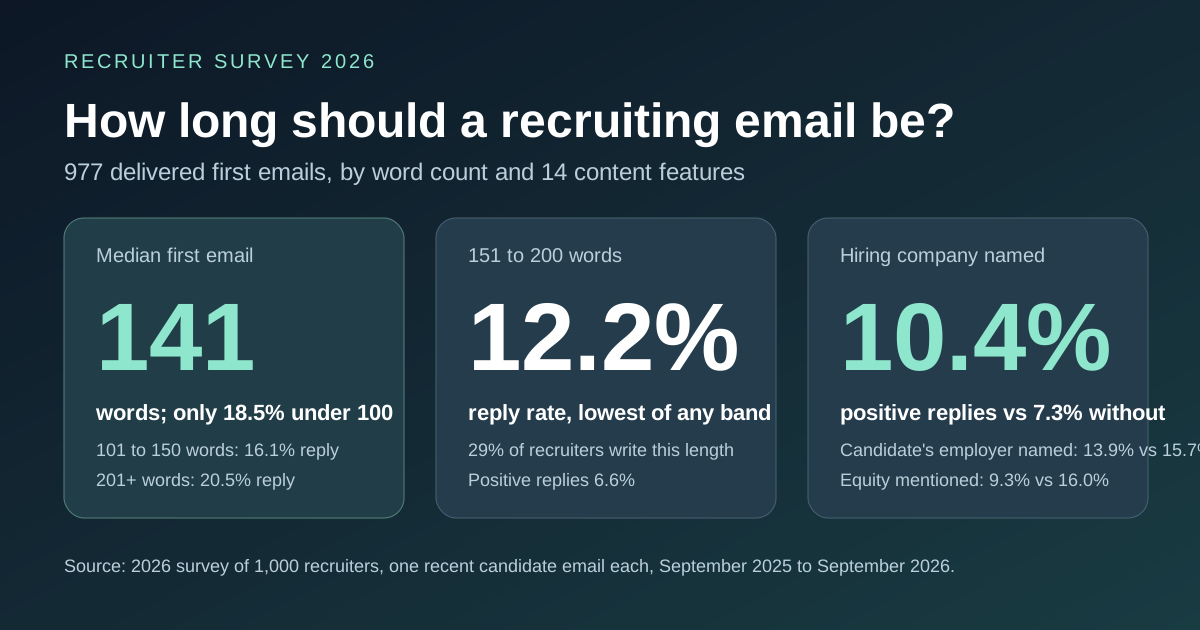
Key takeaway: The median recruiting email is 141 words, and the 151-to-200-word range, where 29% of recruiters land, had the lowest reply rate in a 2026 survey of 1,000 recruiters: 12.2%, against 14.9% for emails of 100 words or fewer and 16.1% for 101 to 150 words. Longer was not simply worse: the 112 emails over 200 words replied at 20.5%. On personalization, naming the hiring company lifted positive replies (10.4% vs 7.3%), while name-dropping the candidate's current employer did not help, and for engineers it hurt (9.3% reply vs 16.8%). Mentioning equity cut the reply rate to 9.3%.
"Keep it under 100 words" is the most repeated piece of recruiting email advice and almost nobody has checked it against outcomes. This page does. In 2026 we surveyed 1,000 recruiters and asked each to submit one recent cold email to a candidate, sent between September 2025 and early September 2026, with the full first-email body, the candidate's role and seniority, and whether and how the candidate replied. We coded each body for word count and 14 content features: a question, the candidate's first name, the candidate's current company, the hiring company, a salary range, any compensation mention, equity, benefits, remote, hybrid, or onsite work, funding, and a scheduling link or call to action.
23 of the 1,000 emails bounced; all rates below are computed on the 977 delivered emails. The baseline: 15.3% replied, 9.0% positively, 6.2% negatively. The subject lines of the same emails are analyzed in the companion recruiting email subject line statistics page.
How long is the average recruiting email?
| Percentile | First-email word count |
|---|---|
| 10th | 89 words |
| 25th | 111 words |
| Median | 141 words |
| 75th | 172 words |
| 90th | 209 words |
Only 18.5% of recruiters wrote 100 words or fewer. 40.7% wrote more than 150 words. The "short email" that most advice describes is the exception in practice, not the rule.
Does email length affect the reply rate?
| First-email length | Emails | Share | Reply rate | Positive reply | Negative reply |
|---|---|---|---|---|---|
| 1 to 100 words | 181 | 18.5% | 14.9% | 9.9% | 5.0% |
| 101 to 150 words | 398 | 40.7% | 16.1% | 9.5% | 6.5% |
| 151 to 200 words | 286 | 29.3% | 12.2% | 6.6% | 5.6% |
| 201 words or more | 112 | 11.5% | 20.5% | 11.6% | 8.9% |
The relationship is not a straight line. Emails of 100 to 150 words did slightly better than shorter ones, the 151-to-200 band did clearly worse (12.2% reply, 6.6% positive), and the small group of very long emails did best of all on raw reply rate, though with the highest negative rate (8.9%) too.
Our reading: the 151-to-200-word email is the one that has been padded with company boilerplate without adding anything a candidate needs, so it reads as a mass mailing. Emails over 200 words in this sample tended to be the opposite, dense with role, team, and compensation detail, and candidates answered them, in both directions.
For the 415 emails sent to engineering candidates (software engineers, engineering managers, solutions engineers), the pattern tilted toward longer: 14.5% reply at 100 words or fewer, 12.6% at 101 to 150, 16.8% at 151 to 200, and 18.2% (13.6% positive) above 200 words. Engineers in this survey did not punish detail. The software engineer response rate page covers the other things that move engineer replies.
Which personalization and content elements change the reply rate?
| Content of first email | Share using it | Reply with | Reply without | Positive with | Positive without |
|---|---|---|---|---|---|
| Candidate's first name | 97.9% | 15.4% | 9.5% (n=21) | 9.0% | 9.5% |
| Asks a question | 70.4% | 16.0% | 13.5% | 9.3% | 8.3% |
| Names the hiring company | 55.4% | 16.5% | 13.8% | 10.4% | 7.3% |
| Mentions compensation (any form) | 38.6% | 15.6% | 15.0% | 9.8% | 8.5% |
| Names the candidate's current company | 24.4% | 13.9% | 15.7% | 8.8% | 9.1% |
| Mentions remote work | 18.5% | 12.2% | 16.0% | 7.2% | 9.4% |
| Mentions onsite work | 14.7% | 16.7% | 15.0% | 9.7% | 8.9% |
| Mentions funding | 13.9% | 14.0% | 15.5% | 9.6% | 8.9% |
| Mentions equity | 11.0% | 9.3% | 16.0% | 7.5% | 9.2% |
| Discloses a salary range | 10.7% | 14.3% | 15.4% | 8.6% | 9.1% |
| Scheduling link or call to action | 8.9% | 19.5% | 14.8% | 10.3% | 8.9% |
| Mentions hybrid work | 8.4% | 14.6% | 15.3% | 8.5% | 9.1% |
| Mentions benefits | 3.4% | 12.1% | 15.4% | 6.1% | 9.1% |
Four findings stand out.
Naming the hiring company is the personalization that pays. 55% of recruiters did it; their emails were replied to at 16.5% against 13.8%, and the positive rate was 10.4% against 7.3%. Candidates want to know who is hiring. The trade-off is speed: median time to reply was 4.4 days with the company named and 1.6 days without, consistent with candidates researching the company before answering.
Name-dropping the candidate's current employer did not help. 24% of emails mentioned where the candidate works now ("I saw your work at Stripe"). Reply rate 13.9% against 15.7%. Among the 415 engineering emails the gap was wide: 9.3% reply and 3.4% positive with the candidate's company named, against 16.8% and 11.1% without. The likeliest explanation is that this is the most templated "personalization" there is, and experienced candidates read it as a merge field.
A direct scheduling ask gets replies. Only 8.9% of emails included a scheduling link or an explicit "pick a time" call to action. Those got a 19.5% reply rate, the highest of any feature, with a positive rate of 10.3% and a negative rate of 9.2%, so the ask forces a decision either way. For engineers specifically the effect vanished (10.7% vs 15.3%, n=56), so this is an all-roles result.
Equity is a weak hook. 11% of emails mentioned equity. They were replied to at 9.3% against 16.0%. Two readings fit: equity-heavy pitches cluster at early-stage companies with less brand pull, or equity reads as a signal that cash compensation is below market. On compensation disclosure more broadly, the headline from the same survey is that a stated salary range did not change the reply rate (14.3% vs 15.4%) but did change how fast candidates answered.
Remote mentions are worth a note: overall, emails that mentioned remote work replied at 12.2% against 16.0%, but for engineering candidates the sign flipped (18.4% with remote mentioned against 14.2%, 14.3% positive against 8.2%, n=49). Remote is a selling point to engineers and apparently not to everyone else in this sample.
What the data says to do with the first email
- Aim for 100 to 150 words, or go properly long. The 16.1% band is 100 to 150 words; if you are going to pass 150, make sure every extra sentence carries role, team, or pay information, because the padded 151-to-200 range performed worst.
- Name the hiring company. It is the single personalization element with a measurable positive-reply lift.
- Stop opening with the candidate's current employer. It did not lift replies for anyone and halved them for engineers.
- Ask a question and, where it fits the role, ask for a time. Questions lifted replies 2.5 points; a scheduling call to action lifted them 4.7 points.
- Lead with cash, not equity. Equity mentions coincided with the lowest reply rate of any feature.
Because these are first-email statistics, they also set up the follow-ups: the recruiting follow-up email benchmarks show how much of the total reply volume arrives after message one. Teams that send at volume can encode the rules above once in an AI outreach sequence rather than relying on each recruiter to remember them, and the cold recruiting outreach templates give worked examples.
Methodology
In 2026 we surveyed 1,000 recruiters. Each submitted one recent outbound candidate email (first email in the sequence, sent between 8 September 2025 and 3 September 2026) with its full body text, the candidate's role function, seniority and region, the number of emails in the sequence, delivery status, whether the candidate replied, reply sentiment, which sequence step drew the reply, and days to reply. Bodies were coded for word count and 14 binary content features. Reply rates are replies divided by the 977 delivered emails. All figures are produced by a committed script from the survey file; no third-party statistics are quoted.
Limitations
This is observational data, not a controlled test: recruiters who write 200-word emails may also target more carefully, and the content features correlate with the kind of company doing the hiring (equity mentions with startups, onsite mentions with large employers). Several features are rare: 21 emails without a first name, 33 mentioning benefits, 87 with a scheduling call to action, 49 engineering emails mentioning remote work. Treat any cell under 100 emails as directional. Each recruiter contributed one email, and 95% of candidates were US-based.
FAQ
How long should a recruiting email be? In this survey, 101 to 150 words had the best combination of reach and reply rate (16.1%); 151 to 200 words performed worst (12.2%). The median recruiter writes 141 words.
Do shorter recruiting emails get more replies? Not in this data. Emails of 100 words or fewer replied at 14.9%, slightly below the 101-to-150-word band. Very long emails (200+) replied at 20.5%, with a higher negative rate too.
Does personalizing with the candidate's current company help? No. Emails that named the candidate's current employer replied at 13.9% against 15.7% without, and for engineering candidates 9.3% against 16.8%.
Should a recruiting email mention salary or equity? A salary range did not change the reply rate (14.3% vs 15.4%). Equity mentions coincided with a 9.3% reply rate against 16.0% without.
Does asking a question in a recruiting email increase replies? Yes, modestly: 16.0% with a question against 13.5% without. 70% of recruiters already do it.
What is the average reply rate to a recruiter's first email? Counting replies to the whole sequence, 15.3% of delivered emails in this survey got a reply and 9.0% a positive reply.