
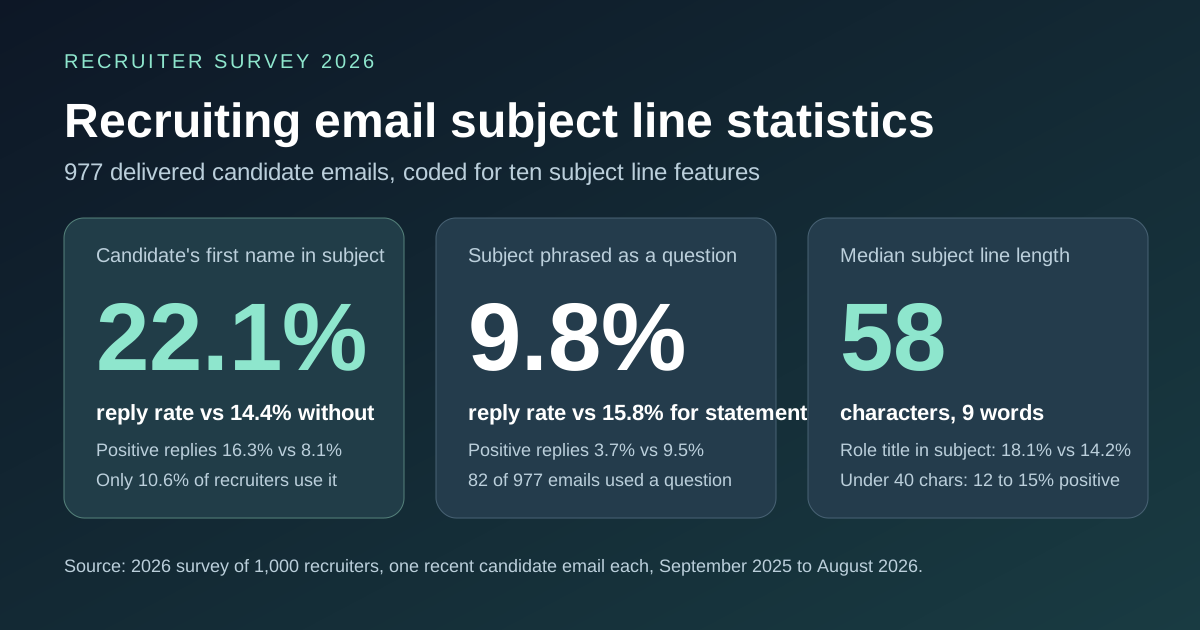
Key takeaway: Recruiting emails whose subject line contained the candidate's first name got a 22.1% reply rate, against 14.4% for every other subject line, and a positive reply rate twice as high (16.3% vs 8.1%). That is the clearest pattern in a 2026 survey in which 1,000 recruiters each submitted one recent cold email to a candidate, with its subject line and outcome. Only 10.6% of recruiters used the first name. Phrasing the subject as a question did the opposite: 9.8% replied, against 15.8% for statements. The median subject line was 58 characters and 9 words, and length barely moved the reply rate.
Most "best recruiting subject lines" pages are lists of ideas with no outcome data behind them. This page is different: it reports what 977 delivered recruiter emails actually did, by the features of their subject lines. In 2026 we surveyed 1,000 recruiters and asked each to submit one recent outbound email to a candidate, sent between September 2025 and August 2026, with the exact subject line, the candidate's role and seniority, and whether the candidate replied and how.
We coded every subject line for length, word count, and ten binary features: a question mark, an exclamation mark, a number, a role word such as "engineer" or "role", the exact role title, the candidate's first name, the hiring company's name, the candidate's current company, a casual word such as "hey" or "quick", and a fake "Re:" or "Fwd:" prefix. 23 of the 1,000 emails bounced, so all rates below use the 977 delivered emails as the denominator. The baseline for comparison: 15.3% of delivered emails got a reply and 9.0% a positive reply. For the all-role response rate benchmark and what drives it beyond the subject line, see the recruiter cold email response rate page from the same survey program.
Which subject line features get the most replies?
| Subject line feature | Share of emails using it | Reply rate with | Reply rate without | Positive reply with | Positive reply without |
|---|---|---|---|---|---|
| Candidate's first name | 10.6% (104) | 22.1% | 14.4% | 16.3% | 8.1% |
| Exact role title ("Staff Backend Engineer") | 26.0% (254) | 18.1% | 14.2% | 9.1% | 9.0% |
| A role word ("engineer", "role", "opportunity") | 27.5% (269) | 17.8% | 14.3% | 10.4% | 8.5% |
| A number ("$220k", "Series B", "3 weeks") | 21.0% (205) | 16.6% | 14.9% | 11.2% | 8.4% |
| Hiring company named | 25.7% (251) | 14.7% | 15.4% | 8.8% | 9.1% |
| Exclamation mark | 7.4% (72) | 13.9% | 15.4% | 9.7% | 9.0% |
| Candidate's current company named | 1.9% (19) | 10.5% | 15.3% | 5.3% | 9.1% |
| Phrased as a question | 8.4% (82) | 9.8% | 15.8% | 3.7% | 9.5% |
| Casual word ("hey", "quick") | 1.0% (10) | 0.0% | 15.4% | 0.0% | 9.1% |
Three features are both common enough to measure and clearly different from the baseline.
The first name is the strongest signal in the dataset. 104 recruiters put the candidate's first name in the subject. Those emails were replied to at 22.1% (23 of 104), 7.7 points above the rest, and the positive rate doubled. Among the 415 emails to engineering candidates the gap was the same shape: 21.6% with the name against 13.7% without, and 15.7% positive against 8.0%. Nine in ten recruiters are not doing this.
Role titles and role words help. Subject lines that named the role or used a role word were replied to at 17.8% to 18.1%. The role title raised the overall reply rate but not the positive rate (9.1% vs 9.0%), which suggests it mostly produces faster, more decisive replies in both directions; the negative share of replies was 9.1% with the title and 5.3% without.
Questions underperform. Only 82 recruiters wrote the subject as a question ("Open to a Staff Engineer role at a Series C?"). 8 replied, a 9.8% rate, and only 3 were positive (3.7%). For engineering candidates the question subject got 9.8% replies against 15.4% for statements. The sample is small, but the direction held in every role group we checked.
Fake "Re:" or "Fwd:" prefixes did not appear in a single one of the 1,000 submitted emails, so we cannot measure them. Casual openers were almost as rare (10 emails) and none got a reply; treat that as a warning, not a statistic.
Does subject line length matter?
Less than most advice claims. The median subject line was 58 characters (10th percentile 35, 90th percentile 95) and 9 words. 46.2% of subject lines ran past 60 characters, the point where most mobile inboxes truncate.
| Subject length (characters) | Emails | Reply rate | Positive reply rate |
|---|---|---|---|
| 1 to 30 | 50 | 18.0% | 12.0% |
| 31 to 40 | 109 | 18.3% | 14.7% |
| 41 to 50 | 178 | 13.5% | 9.6% |
| 51 to 60 | 189 | 15.9% | 7.9% |
| 61 to 70 | 132 | 15.2% | 7.6% |
| 71 to 80 | 105 | 13.3% | 6.7% |
| 81 or more | 214 | 15.0% | 7.9% |
Reply rates sit in a 13% to 18% band at every length. The one consistent trend is in positive replies: subject lines of 40 characters or fewer produced a 12.0% to 14.7% positive rate, and every band above 50 characters sat between 6.7% and 7.9%. Short subject lines did not get more replies, but the replies they got were more often a yes.
By word count the picture is noisy: 5 to 6 words replied at 18.1%, 9 to 10 words at 17.3%, and 11 to 12 words at 11.4%. We would not build a rule on those bins.
How fast do candidates reply, by subject line type?
Subject lines that named the role were answered faster: the median time to reply was 1.9 days with a role word and 4.0 days without, and 43.8% of those replies arrived within 24 hours against 32.7%. Naming the hiring company had the opposite effect on speed: a 6.0-day median against 2.1 days, with only 18.9% of replies inside 24 hours. A plausible reading is that a company name sends the candidate off to research the employer before they answer. For the full response-time distribution from the survey program, see candidate response time to recruiter emails.
What a good recruiting subject line looks like in 2026, by the numbers
Putting the three measurable effects together, the subject lines that outperformed in this survey:
- Used the candidate's first name (22.1% reply rate).
- Named the role or used a role word (17.8% to 18.1%) rather than a vague "opportunity".
- Were statements, not questions (15.8% vs 9.8%).
- Were short enough to read on a phone: the under-40-character group had the highest positive rate (12% to 14.7%).
A subject line that follows all four looks like "Priya, Staff Backend Engineer at a Series B" rather than "Would you be open to a new opportunity?". The body still has to earn the reply; the guide to personalizing recruiting emails covers what happens after the open. Teams running sequences at volume can template the pattern once: AI outreach tools that merge the first name and role title into the subject by default remove the step most recruiters skip, and the recruiting follow-up benchmarks show why the second and third subject lines in a sequence matter as much as the first. For ready-to-adapt copy see the cold recruiting outreach templates.
Methodology
In 2026 we surveyed 1,000 recruiters. Each submitted one recent outbound candidate email (sent between 4 September 2025 and 31 August 2026) with its exact subject line, the candidate's role function and seniority, the number of emails in the sequence, whether the email bounced, whether the candidate replied, the reply sentiment (positive or negative), which step of the sequence the candidate replied to, and days to reply. Subject lines were coded for character and word count and ten binary features. Reply rates are replies divided by the 977 delivered emails (23 bounced). Every figure on this page is produced by a committed script from the survey file; no third-party statistics are used.
Limitations
This is observational survey data, not an A/B test. Recruiters who put a candidate's first name in the subject may also write better emails, target better, or work roles with higher baseline response. Several features are rare: 82 question subject lines, 72 with exclamation marks, 19 naming the candidate's company, 10 with casual words, and none with a fake "Re:". Treat subgroups under 100 emails as directional. Each recruiter contributed one email, so the data describes one email per recruiter, not each recruiter's full volume. 95% of candidates were US-based.
FAQ
What is the average reply rate to recruiter emails in this survey? 15.3% of delivered emails got a reply and 9.0% got a positive reply (977 delivered emails, 149 replies).
Does putting the candidate's name in the subject line increase replies? In this survey, yes: 22.1% reply rate with the first name versus 14.4% without, and 16.3% positive versus 8.1%. Only 10.6% of the recruiters surveyed did it.
Should a recruiting email subject line be a question? The data says no. Question subject lines got a 9.8% reply rate and a 3.7% positive rate, versus 15.8% and 9.5% for statements.
How long should a recruiting email subject line be? The median was 58 characters. Length had little effect on whether candidates replied, but subject lines of 40 characters or fewer had the highest positive reply rates (12.0% to 14.7%).
Do "Re:" or "Fwd:" subject lines work for recruiting? Unknown from this survey: none of the 1,000 submitted emails used one, which itself suggests recruiters have stopped doing it.
Does mentioning the hiring company in the subject help? Not on reply rate (14.7% with, 15.4% without), and those replies were slower (6.0-day median vs 2.1 days).