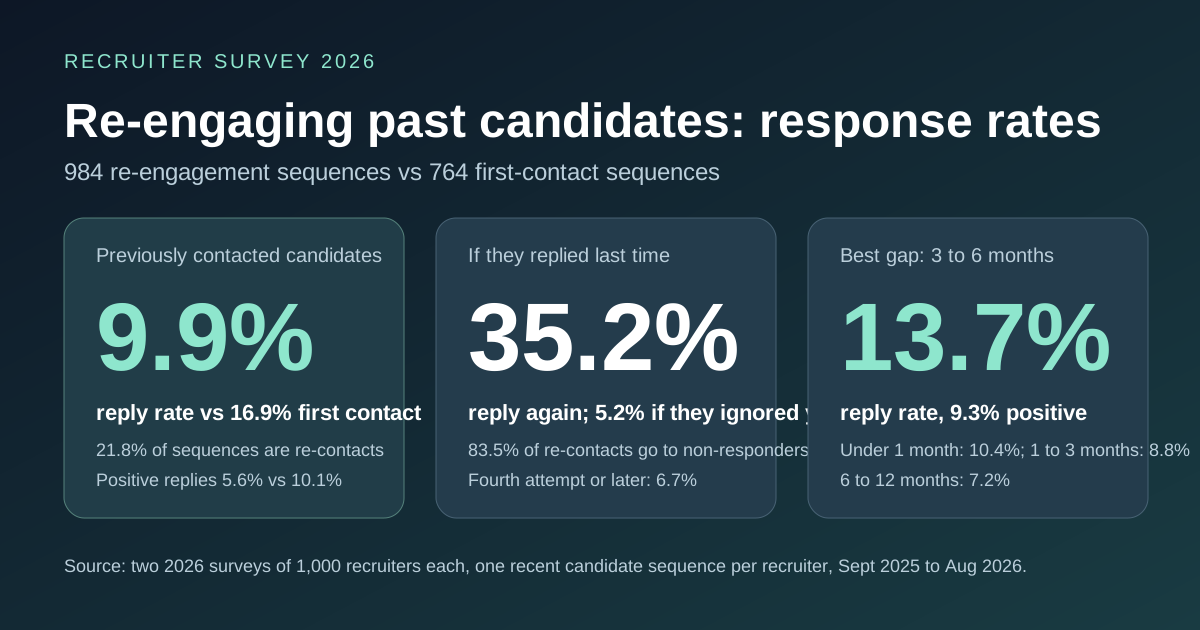
Key takeaway: Candidates who had been contacted before replied to a new recruiting sequence at 9.9%, against 16.9% for candidates being contacted for the first time. Whether they answered last time is what decides it: in a 2026 survey of 1,000 recruiters who each submitted a recent re-engagement sequence, candidates who had replied to the earlier outreach answered again at 35.2%, while candidates who had ignored it answered at 5.2%. The best time to try again was 3 to 6 months after the last contact (13.7% reply, 9.3% positive). A second attempt replied at 11.9%, a third at 8.7%, and a fourth or later at 6.7%.
Every recruiting team has a database full of people it has already emailed, and almost no public data on what happens when you email them again. This page reports two linked surveys from 2026. In the first, 1,000 recruiters each submitted one recent outbound sequence, which told us how often a sequence goes to someone already in the database and how those sequences performed against first-contact ones. In the second, 1,000 recruiters each submitted one recent sequence sent specifically to a candidate they had contacted before, with the gap since the prior contact, how many prior sequences there had been, whether the candidate had replied before, and whether the prior contact was for the same hiring company.
The first-contact baseline for comparison, 16.9%, is close to the recruiter cold email response rate measured elsewhere in this survey program (17.6%).
How much lower is the reply rate when re-contacting a candidate?
From the all-sequences survey (977 delivered sequences):
| Candidate status | Sequences | Share | Reply rate | Positive reply | Negative reply |
|---|---|---|---|---|---|
| First contact | 764 | 78.2% | 16.9% | 10.1% | 6.8% |
| Previously contacted | 213 | 21.8% | 9.9% | 5.6% | 4.2% |
One sequence in five goes to someone the recruiter has emailed before, and those sequences convert at about 60% of the first-contact rate. The re-contacted candidates who did reply were faster about it (median 1.2 days against 2.3 days, 42.9% within 24 hours against 35.7%), consistent with people who already know who you are.
Does it matter whether the candidate replied last time?
Enormously. From the re-engagement survey (984 delivered sequences):
| Prior outcome | Sequences | Reply rate | Positive reply | Negative reply |
|---|---|---|---|---|
| Candidate replied to the earlier outreach | 162 (16.5%) | 35.2% | 17.9% | 17.3% |
| Candidate ignored the earlier outreach | 822 (83.5%) | 5.2% | 3.0% | 2.2% |
| All re-engagement | 984 | 10.2% | 5.5% | 4.7% |
A candidate who has answered you once is seven times as likely to answer again as one who never did. Note the split inside that 35.2%: about half the second replies were positive and half negative, so re-engaging a past responder is as likely to produce a clear "no" as a conversation. That is still useful; a 5.2% rate on prior non-responders is mostly silence.
The uncomfortable implication is that 83.5% of re-engagement sequences in this survey went to people who never replied the first time, and those sequences produced a 3.0% positive rate.
How long should you wait before re-contacting a candidate?
The median gap in the survey was 2.0 months (mean 3.0). Reply rates by gap:
| Months since prior contact | Sequences | Reply rate | Positive reply | Reply rate, prior non-responders only |
|---|---|---|---|---|
| Under 1 month | 299 | 10.4% | 5.0% | 2.9% (n=244) |
| 1 to 3 months | 340 | 8.8% | 4.4% | 4.7% (n=278) |
| 3 to 6 months | 204 | 13.7% | 9.3% | 9.8% (n=173) |
| 6 to 12 months | 125 | 7.2% | 3.2% | 4.5% (n=112) |
| 12 months or more | 16 | 12.5% | 6.2% | 6.7% (n=15) |
Three to six months was the clear peak, and the pattern holds when you look only at candidates who ignored the earlier outreach: 2.9% within a month, 9.8% at 3 to 6 months. Re-contacting inside a month looks like a continuation of the sequence they already tuned out. By six to twelve months the rate fell back to 7.2%, which may reflect stale contact details and changed circumstances as much as fading recall. The 12-month-plus group is too small (16) to read.
Does the number of previous attempts matter?
| Prior sequences to this candidate | Sequences | Reply rate | Positive reply |
|---|---|---|---|
| 1 | 580 | 11.9% | 6.7% |
| 2 | 196 | 8.7% | 3.6% |
| 3 or more | 208 | 6.7% | 3.8% |
Each additional past sequence lowers the odds. 41% of re-engagement sequences in this survey were at least the third attempt on the same person. The recruiting follow-up email benchmarks show that follow-ups within a sequence pay off; a new sequence months later to the same non-responder is a different thing, and the data says to stop at two.
Does re-contacting for the same company help?
No. Sequences where the prior contact had been for the same hiring company replied at 8.6% (266 sequences), against 10.7% when the earlier approach was for a different employer (718). A candidate who passed on a company once is not more receptive the second time; a new company is a new pitch.
Which candidates respond best to re-engagement?
By role, engineering managers (14.7%, n=34) and operations candidates (14.0%, n=50) re-engaged best; software engineers, who made up 54% of the re-engagement sequences, replied at 9.0% (4.9% positive). By seniority, staff, lead and manager-level candidates replied at 14.2% against 9.3% for candidates with no stated seniority, repeating the seniority gradient seen in the candidate reply rate by seniority page. The software engineer response rate page explains why engineers need more touches in general.
What this means for a talent database
- Segment by prior response, not by "in the CRM". Past responders are a 35% list. Past non-responders are a 5% list, and should be approached as cold with a new angle, not as "circling back".
- Wait 3 to 6 months. Shorter gaps converted at 9% to 10%; the 3-to-6-month window converted at 13.7% with a 9.3% positive rate, nearly the first-contact level.
- Cap the attempts at two sequences. The third attempt converted at 8.7% and the fourth and later at 6.7%.
- Change the company, or at least the role. Same-company re-approaches were the weakest cut.
- Re-check contact data before the send. Deliverability falls as records age; the recruiting email deliverability page covers the mechanics.
Doing this by hand across a large database is exactly the work that gets skipped, which is why candidate nurturing programs stall. An AI outreach agent that tracks prior-response status and gap per candidate can enforce the rules above automatically and route re-engagement budget toward the 35% segment.
Methodology
Two 2026 surveys of 1,000 recruiters each. Survey A: each recruiter submitted one recent outbound candidate sequence (sent 4 September 2025 to 31 August 2026) with whether the candidate had been contacted before, the candidate's role and seniority, number of emails in the sequence, bounce status, reply, reply sentiment and days to reply; 23 bounced, leaving 977. Survey B: each recruiter submitted one recent sequence to a candidate they had contacted before, adding the number of prior sequences, months since the prior contact, whether the candidate replied to that prior contact, and whether the prior contact was for the same hiring company; 16 bounced, leaving 984. Reply rates are replies divided by delivered sequences. All figures are produced by a committed script from the two survey files.
Limitations
Observational data. Recruiters choose whom to re-contact, so the candidates re-approached after 3 to 6 months may differ from those re-approached within a month. "Replied to the earlier outreach" counts any reply, including a decline. Some cells are small: 16 sequences with a gap over 12 months, 34 engineering managers. Software engineers are over-represented in the re-engagement survey (54%), so the all-candidate rates lean toward engineering behavior. Each recruiter contributed one sequence.
FAQ
What is the response rate when re-engaging past candidates? 9.9% to 10.2% in these surveys, against 16.9% for first-time contact.
Do candidates who ignored a recruiter once ever reply later? Rarely: 5.2% replied to a new sequence, rising to 9.8% when the gap was 3 to 6 months.
How long should you wait before contacting a candidate again? 3 to 6 months produced the best reply rate (13.7%) and positive rate (9.3%). Under 3 months converted at 8.8% to 10.4%.
Is it worth re-contacting a candidate who declined before? Candidates who replied to earlier outreach, including declines, answered again at 35.2%, though 17.3 points of that were negative replies.
How many times should you re-contact the same candidate? The data supports two sequences. Reply rates fell from 11.9% on the second approach to 8.7% on the third and 6.7% on the fourth and later.
What share of recruiter outreach goes to previously contacted candidates? 21.8% of the sequences in the all-sequences survey.