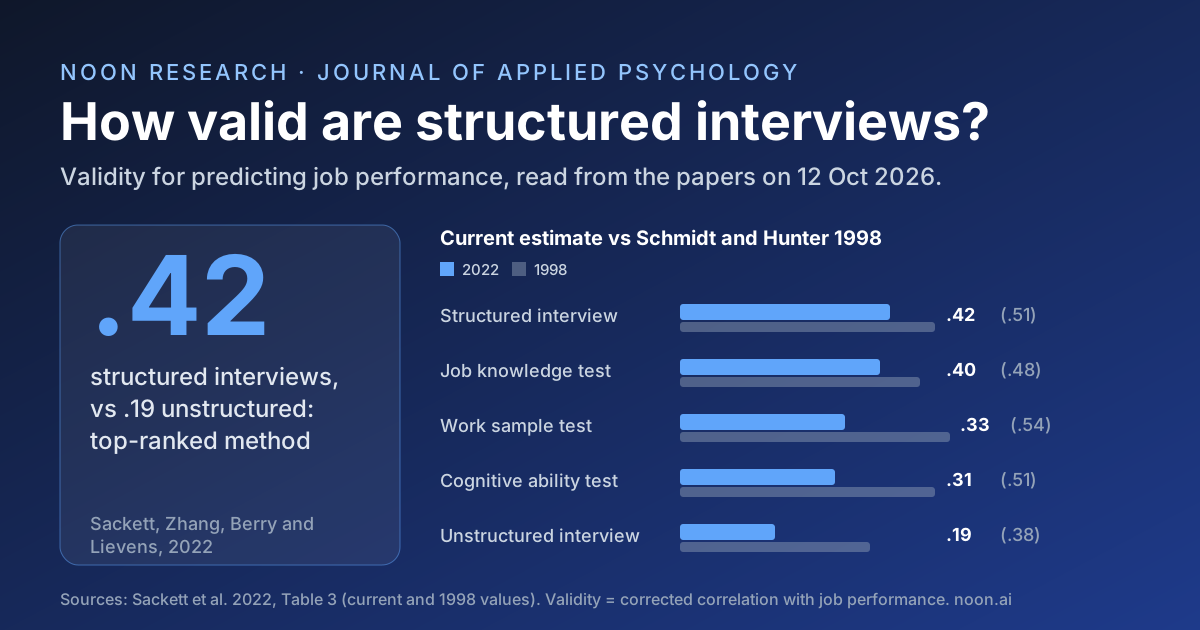
Key takeaway: Structured interviews have a mean validity of .42 for predicting job performance, the highest of any common selection method, according to the largest recent re-analysis of the evidence (Sackett, Zhang, Berry and Lievens, Journal of Applied Psychology, 2022). Unstructured interviews sit at .19, so adding structure more than doubles predictive power (2.2 times). The older, much-cited Schmidt and Hunter (1998) figures were .51 and .38; the revision lowered almost every method, but structure is now the clearest winner.
"How valid are structured interviews?" has a precise, citable answer, and it changed in 2022. For two decades recruiters quoted Schmidt and Hunter's 1998 table, which put structured interviews at .51, tied with cognitive ability tests and just behind work samples (.54). Sackett and colleagues re-ran the corrections behind those numbers and concluded that many validities had been "substantially overestimated", with most estimates falling by .10 to .20 points.
The revision did not hurt interviews as much as it hurt tests. Structured interview validity fell by only .09, from .51 to .42, while cognitive ability fell by .20 (.51 to .31) and work samples by .21 (.54 to .33). That is why structured interviews now rank first. We read both papers and the U.S. Office of Personnel Management's guidance on 12 October 2026; every figure below is recorded in a committed source file.
Structured interview validity at a glance
| Measure | Figure | Source |
|---|---|---|
| Structured interview validity (current) | .42 | Sackett et al. 2022, Table 3 |
| Unstructured interview validity (current) | .19 | Sackett et al. 2022, Table 3 |
| Structured interview validity (1998 estimate) | .51 | Schmidt and Hunter 1998, as tabled by Sackett et al. |
| Unstructured interview validity (1998 estimate) | .38 | Schmidt and Hunter 1998, as tabled by Sackett et al. |
| Lower 80% credibility value, structured | .18 | Sackett et al. 2022 |
| Lower 80% credibility value, unstructured | -.01 | Sackett et al. 2022 |
| Rank among selection procedures (current) | 1st | Sackett et al. 2022 |
| Composite validity, best battery with vs without a structured interview | .61 vs .51 | Berry et al. 2024 |
Validity here is a correlation between the predictor score and later job performance ratings, corrected for unreliability in those ratings. 1.0 would be perfect prediction; 0 is none.
How valid are structured interviews compared with other selection methods?
Sackett et al. (2022) list every major selection method in their Table 3, next to the value Schmidt and Hunter (1998) gave for it. The ten methods most hiring teams actually use:
| Selection method | Schmidt and Hunter 1998 | Sackett et al. 2022 | Change |
|---|---|---|---|
| Structured interviews | .51 | .42 | -.09 |
| Job knowledge tests | .48 | .40 | -.08 |
| Empirically keyed biodata | .35 | .38 | +.03 |
| Work sample tests | .54 | .33 | -.21 |
| Cognitive ability tests | .51 | .31 | -.20 |
| Integrity tests | .41 | .31 | -.10 |
| Assessment centers | .37 | .29 | -.08 |
| Conscientiousness (overall) | .31 | .19 | -.12 |
| Unstructured interviews | .38 | .19 | -.19 |
| Job experience (years) | .18 | .07 | -.11 |
Three patterns matter for recruiters:
- Structure beats tests. The structured interview now leads cognitive ability by .11. The authors go as far as proposing structured interviews "as the focal predictor against which others are evaluated", a role cognitive ability held for 25 years.
- Job-specific beats generic. The four strongest methods (structured interviews, job knowledge tests, empirically keyed biodata and work samples) all measure the job itself, not a general trait.
- Experience barely predicts. Years of prior experience at the point of hire correlate .07 with performance. Screening on years alone is close to noise. Our talent evaluation guide covers what to assess instead.
How much better are structured interviews than unstructured ones?
On the current estimates, 2.2 times better: .42 against .19. Under the 1998 figures the gap looked modest (.51 against .38, 1.3 times). The re-analysis cut unstructured interview validity in half, a 50% drop, against an 18% drop for structured interviews.
Squaring the correlations gives a rough sense of scale. A structured interview accounts for about 18% of the variance in rated job performance; an unstructured one accounts for about 4%.
The spread matters as much as the average. Sackett et al. report a lower 80% credibility value of .18 for structured interviews and -.01 for unstructured ones. In plain terms, a poorly run unstructured interview can predict nothing at all, while even the weaker structured interviews in the data keep some predictive value. A shared bank of structured interview questions is the cheapest way to move from one column to the other.
Why did the validity numbers drop after 2022?
The 1998 estimates leaned on a statistical correction for "range restriction": the assumption that the people studied were a narrower, pre-selected slice of all applicants, so their observed correlations understated true validity. Sackett et al. argue the corrections were applied too aggressively, often to studies where little restriction existed.
The interview data shows the effect directly:
- In the McDaniel et al. (1994) interview meta-analysis behind the 1998 table, the mean observed validity of structured interviews was .28. Correcting for rating unreliability raised it to .37, and the range restriction correction then raised it to .51, a 38% increase from that one step.
- Unstructured interviews went from an observed .21 to .27, then to .38 (a 41% increase).
- Schmidt and Hunter used only the studies with research-purpose performance ratings: 36 of the 106 structured interview estimates and 9 of the 39 unstructured ones.
- A newer meta-analysis by Huffcutt et al. (2014) found observed validities of .36 (structured) and .13 (unstructured). Its own range restriction corrections produced .70 and .36; Sackett et al.'s more conservative recorrection produced .45 and .18.
Sackett et al. combined the McDaniel and Huffcutt re-analyses into sample-size-weighted means of .42 and .19, the figures used today. Their Table 4 shows how sensitive that is: adding a range restriction correction lifts the structured estimate to .45, and also using a lower criterion reliability (.52 instead of .60) lifts it to .48.
Do structured interviews still matter when you also use tests?
Yes. Berry, Lievens, Zhang and Sackett (2024) rebuilt the correlation matrix between six selection methods with the new validities and modeled the best-weighted battery. With all six methods, the validity-maximizing combination reached .61 and gave the largest weight to structured interviews. Run the model on every method except structured interviews and the best battery falls to .51. The authors conclude that excluding structured interviews "substantially reduces overall validity for most of the curve" of validity and diversity trade-offs they model.
Under the old meta-analytic matrix, the same model reached .66 and weighted cognitive ability tests first and structured interviews second. With the updated numbers, dropping cognitive ability tests from the full battery only lowers validity from .61 to .56, which the authors describe as "almost no validity downside". If your process already relies on skills assessment tools, a structured interview is still the piece that adds the most.
What makes an interview "structured"?
OPM defines the high end of the scale as "asking all applicants the same exact set of pre-defined lead and probe (i.e., follow-up questions)" and scoring answers "according to benchmarks of proficiency". Its guidance adds three findings relevant to recruiting teams:
- Interviews with more structure show higher validity, rater reliability and rater agreement, and less adverse impact.
- Behavioral description questions (what you did) show higher validity than situational questions for highly complex work, such as professional and managerial jobs.
- Interviewers and applicants tend to prefer less structured formats, which is why structure erodes without enforcement.
In practice that means a question set written from a job analysis, the same questions for every candidate, a written rating scale for each answer, and independent scoring before any discussion. A panel interview only adds validity if each panelist scores on that shared scale.
How Noon keeps first-round interviews consistent
Consistency is the part of structure that slips first when recruiters are busy. Noon's AI Interviewer runs voice screening interviews built on the role-specific questions your team defines, so every candidate for a role gets the same question set, with a full transcript and a structured analysis to score against. For live rounds, Noon's AI Notetaker tracks coverage of your pre-set questions and reminds the interviewer about any that were missed. Both sit alongside sourcing, outreach and scheduling in one Noon plan.
The research points to a practical split: let software enforce the structure (the same questions and a complete record) and let recruiters own the judgment.
Methodology and sources
We fetched each source on 12 October 2026 and checked every quoted figure against the captured text with a script. Quotes, URLs, fetch timestamps and publication details are in seo/research/stats/structured-interview-validity/sources.json in the noon.ai site repository; derived values (the 2.2 times ratio, variance explained, percentage drops, rankings) are computed in the same folder's compute.py.
- Sackett, P. R., Zhang, C., Berry, C. M. and Lievens, F. (2022). Revisiting meta-analytic estimates of validity in personnel selection. Journal of Applied Psychology, 107(11), 2040-2068. We read the author manuscript; all current validities are from its Table 3, alternative corrections from Table 4.
- Berry, C. M., Lievens, F., Zhang, C. and Sackett, P. R. (2024). Insights from an updated personnel selection meta-analytic matrix. Journal of Applied Psychology, 109(10), 1611-1634. Read from the author manuscript.
- Schmidt, F. L. and Hunter, J. E. (1998). The validity and utility of selection methods in personnel psychology. Psychological Bulletin, 124(2), 262-274. The publisher blocked our fetch, so the 1998 values are the ones Sackett et al. tabulate beside their own.
- U.S. Office of Personnel Management, Structured Interviews (assessment and selection guidance, undated page).
Limitations
- Validity is an average. Every figure is a meta-analytic mean across many jobs and studies. Your own interview can sit well above or below .42 depending on how it is built and scored.
- The criterion is supervisor ratings. Most studies measure job performance with supervisor ratings, which carry their own bias.
- Corrections are contested. Sackett et al.'s lower estimates are the current consensus reading but not unanimous; some researchers defend larger range restriction corrections. We report both sets of numbers.
- We did not re-read the 1998 paper itself. Its figures come from Sackett et al.'s side-by-side table.
- No Noon data. Nothing on this page comes from Noon customers or the Noon platform.
Frequently asked questions
What is the validity of a structured interview?
.42, according to Sackett et al. (2022), the highest mean validity of any common selection method. The older Schmidt and Hunter (1998) estimate was .51.
What is the validity of an unstructured interview?
.19 in Sackett et al. (2022), down from .38 in Schmidt and Hunter (1998). That ties unstructured interviews with conscientiousness tests, ahead of only years of job experience among the ten methods compared here.
What is the best predictor of job performance?
On current evidence, structured interviews (.42), followed by job knowledge tests (.40) and empirically keyed biodata (.38). Cognitive ability tests, long considered the best single predictor, now sit at .31.
What did Schmidt and Hunter (1998) find?
Their summary of 85 years of research put work samples at .54, structured interviews and cognitive ability at .51, and unstructured interviews at .38. Those figures are still widely quoted but were revised downward in 2022.
Are structured interviews less biased?
OPM reports that more structure brings less adverse impact. Sackett et al. (2022) list a Black-White difference (d) of .23 for structured interviews against .79 for cognitive ability tests.
How do you make an interview structured?
Ask every candidate the same job-related questions and follow-ups, score each answer against a written rating scale, and have interviewers score independently before discussing. See our guide to interview quality tools for software that helps enforce it.